20 years.
4 continents.
9-figure portfolios.
I made Partner in my 30s leading teams of 100+ in multi-million $$$ projects most people only read about in case studies.
After 2 decades in the consulting trenches, I can tell you that most white-collar professionals are in the business of managing executive anxiety (regardless of what they think).
Your "brilliant" strategies will get incinerated if you give your stakeholders homework instead of certainty.
Every proposal is a gamble with their political capital.
When you walk into a meeting and start rattling off technical specifications, integrations, headcounts, and whatnot, you are asking the decision-maker to do the mental heavy lifting.
You are forcing them to translate your "features" into their "survival."
If they have to do that math themselves, the answer is almost always "No"...
High-level leaders care more about the stability of the flight than how the engines work.
For example, if you talk about "99.8% uptime," you are talking about a server, but if you talk about "eliminating the risk of a black-out during the busiest trading day of the year," you are talking about their reputation.
Can you feel the difference?
Every executive listens to you through a relatively simple lens... 2 brutal questions:
1) "Will this blow up in my face?" (Risk Mitigation)
2) "Will the Board think I have lost my grip on the wheel if I back this?" (Status Protection)
If your pitch doesn't provide an immediate, visceral "Yes" to both, get ready for a loooong sales cycle my friend.
Try to minimize presenting data points, and instead present narrative closures.
In the slide below, I have given a few examples you can use to take inspiration from (I'm working on a broader presentation about expertise sales...).
Have a look: I bet some of those ideas will be useful to you immediately, regardless if you are a founder, a consultant, a PM, or an engineer.
Truth is: we all have to sell!
A propósito del impecable discurso de Ana Corina Sosa Machado @anacorinasosa en Oslo. Estamos tan acostumbrados a la vulgaridad, a los gritos, a los insultos, a las malas palabras, a la gente sin preparación, sin cultura, soez, que cuando encontramos lo contrario, personas formadas, que se expresan con el tono correcto, con las palabras precisas, sin agredir ni ofender, con respeto, nos sorprende. Olvidamos que eso en realidad es lo normal. Lo verdaderamente anormal es haber vivido durante casi tres décadas en medio del desorden, la grosería y la falta de valores.
Ojalá que nuestro país logre recuperar lo que alguna vez fue, los valores, el respeto, el amor por la educación y los modales. Que podamos no solo volver a lo que éramos, sino mejorar aquello que habíamos descuidado y construir una sociedad donde la cortesía, la preparación y la cultura sean nuevamente la norma y no la excepción que nos sorprende.
Porque eso es lo que soñamos para nuestra Venezuela tierra de gracia, un país donde la cortesía, la cultura y el respeto sean la norma y donde podamos vivir con orgullo, dignidad y esperanza en cada palabra y cada gesto. Amén 🙏🏼
Alexa Gómez 💛💙♥️
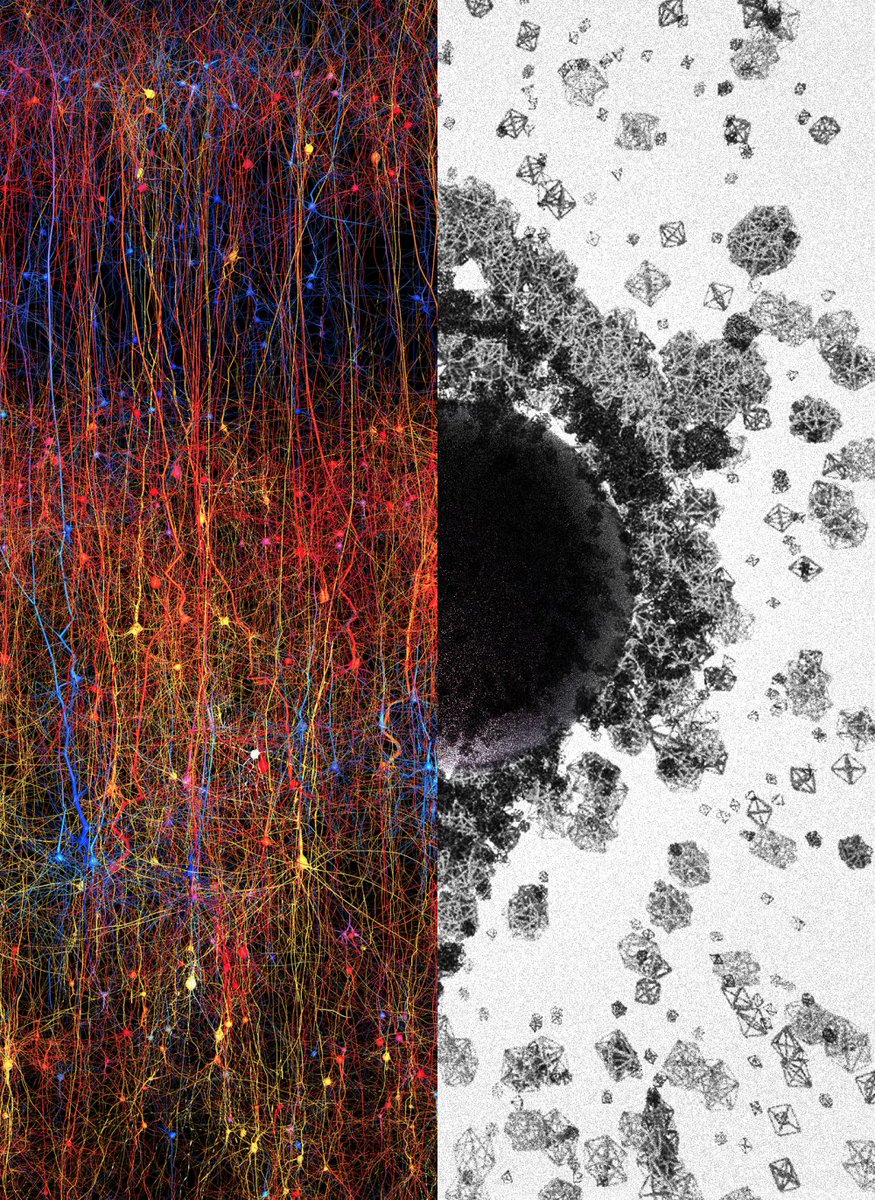
🚨: The Human Brain Builds Structures in 11 Dimensions, Discover Scientists
Your brain might be doing something far more complex than anyone imagined. Scientists from the Blue Brain Project in Switzerland have discovered that the human brain builds intricate structures capable of operating in as many as eleven dimensions. Not in the physical sense, but in the way neurons connect, interact, and process information.
Using advanced mathematical models, researchers found that neurons form tightly connected groups known as “cliques.” When these cliques link together, they create geometric shapes, not just lines or squares, but complex multi-dimensional structures. The more neurons involved, the higher the dimensionality. In some cases, networks formed up to 11-dimensional frameworks, all within the brain’s microscopic architecture.
When the brain receives information, these high-dimensional networks appear and vanish in fractions of a second, like intricate 3D sculptures that form, communicate, and dissolve almost instantly. This process may explain how we think, remember, and make decisions so efficiently. It’s a living symphony of patterns that go beyond the limits of traditional neuroscience.
The discovery could revolutionize how scientists understand consciousness and perception. It suggests that our thoughts, emotions, and awareness are not confined to simple pathways but exist across vast, unseen networks of complexity. The mind, it seems, might be using dimensions beyond anything we can visually comprehend.
In short, your brain isn’t just a biological organ; it’s a multi-dimensional universe in motion, creating and collapsing worlds of thought every single second.
Abundancia es comprar los libros que te interesan sin dudarlo.
Tener el tiempo para leerlos.
Las personas para discutirlos
Y un hogar donde guardarlos.
En una servilleta manchada de café se dibujó una idea que cambiaría la medicina para siempre.
El científico que la garabateó fue ignorado, rechazado y ridiculizado...
Pero...🧵⤵️
He aquí una madre que educa correctamente a su hijo. No abundan esas familias. Enhorabuena. Porque (recuerdo, parece una perogrullada) esa es la labor de las familias.
La rebelión de los oncólogos (l): Oncólogos denuncian presiones para no recetar fármacos caros contra el cáncer y ahorrar costes https://t.co/yuQmgUoQBA a través de @ABC_Sociedad
Cansado de perder el tiempo buscando la IA adecuada para "esta tarea" específica.
Tras más de 2 meses de investigación, he creado un documento que agrupa las 100 mejores herramientas de IA por categorías
Y durante 24 horas, es 100% GRATIS!
1.RT
2.Comenta "100"
(Debes seguirme)
Hoy cumple 93 años un monstruo del 7º arte.
Este perfil de twitter, fan abnegado de la música de cine, solo le puede rendir pleitesía a su música dedicándole un hilo de sus 10 favoritas. Gracias John Williams, GRACIAS❤️.
Espero que les guste👇🏼🧵:
1/10 - La marcha imperial - Star Wars
Simplemente HISTORIA del cine🙌


![navarrotradmed's tweet photo. Sonrían, por favor, que estamos en el fin de semana. 😉
[Viñeta de José María Nieto 🇪🇸 @HUMORJMNIETO en @elmundoes (2012)]
cc @mlalanda https://t.co/0dpVrlkxa4](https://pbs.twimg.com/media/HCRghhVWUAA18pk.jpg)