The Karate Cat has completed its first full day—AND WE’RE JUST GETTING STARTED! 🚀🔥
Huge respect to the strongest dojo in crypto! 🏆💎 In just 24 hours, we’ve built a community of warriors ready to kick FUD and fight for greatness. The legend grows from here.
#TheKarateCat
CbvWbWgK34Qna5jQdpkiZ2jnUwrXT46bu9tnMSE4moon
We live in a future where you can generate a character from text and a few minutes later have it standing on your keyboard
Workflow: MidJourney -> TripoSR -> MeshLab -> Mixamo -> Reality Converter
Playing with an early Tailwind CSS v4 alpha in a @vite_js project —
🚫 No `postcss.config.js file
🚫 No `tailwind.config.js` file
🚫 No configuring `content` globs
🚫 No `@tailwind` directives in your CSS
The future is clean ✨
Hoping to open-source this week for the bold 🤙🏻
Open AI introducing Sora
text-to-video model
Sora can create videos of up to 60 seconds featuring highly detailed scenes, complex camera motion, and multiple characters with vibrant emotions.
https://t.co/fl5Potp87l
We’ve been so busy in 2023 that we forgot to post! Here is some work bringing to life the Art of Italian Dressing for Mazetti and our friends Boundless.
#redshift#c4d
Diffusion World Model
paper page: https://t.co/0Wp7QbrOgR
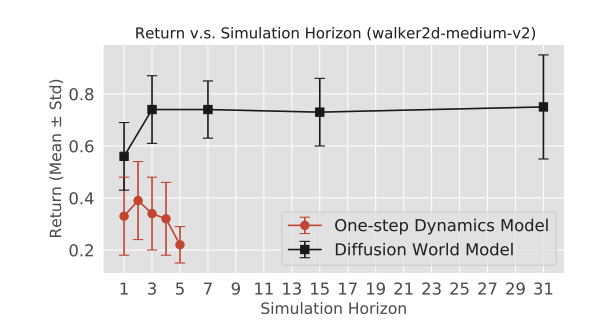
introduce Diffusion World Model (DWM), a conditional diffusion model capable of predicting multistep future states and rewards concurrently. As opposed to traditional one-step dynamics models, DWM offers long-horizon predictions in a single forward pass, eliminating the need for recursive quires. We integrate DWM into model-based value estimation, where the short-term return is simulated by future trajectories sampled from DWM. In the context of offline reinforcement learning, DWM can be viewed as a conservative value regularization through generative modeling. Alternatively, it can be seen as a data source that enables offline Q-learning with synthetic data. Our experiments on the D4RL dataset confirm the robustness of DWM to long-horizon simulation. In terms of absolute performance, DWM significantly surpasses one-step dynamics models with a 44% performance gain, and achieves state-of-the-art performance.