Why Indian Hockey is Stuck in a Power Play
This power play is so old that even the word ancient falls a bit flat, like watching an old relic in a museum. But now politicians are in the fray. Power sticks to power. Corruption sticks to corruption. The corrupt stick to their own.
There have been very interesting reactions online to the ongoing Hockey India internal battle; some absolutely hilarious. But this is not a fight for saffron or blue; there was a deliberate reason for the jersey colour change that had little to do with what the team needed. In saffron we should have won the World Cup. No?
This is a battle for survival. Each party wants to remain in power. It’s very human. And we journalists should understand that better than most. Players are smart enough to understand which side of their bread is buttered. And the parties in power lather them well with promises of longer innings in the national team, captainship and guaranteed spots in the World Cup or Asian Games team.
A forensic in audit of HI personnel spend or puzzling contracts (in crores) with a particular hockey stick manufacturer. And you don’t need to go far: it’s in the very city where the Asian Champions Trophy will be played.
To say the game is being harmed because of suspensions and dissidence is being wilfully ignorant. When certain people in HI were openly corrupt, wasn’t the sport harmed then? When the jersey shit hit the roof, wasn’t the sport taking a hit?
There is no one innocent here. Everybody is crowded into the Board Room trying to win seats, retain power, ensure that when the elections happen, they win. They have learnt from the best powerbroker of all - Narinder Dhruv Batra who learnt the real meaning of the word power from Punjab’s former DGP KPS Gill, also IHF President.
Meanwhile the Sports Ministry watches from the sidelines, like true fans, loving the wrestling match. Speaking of wrestling, one of the HI office bearers, also learnt the craft from his erstwhile boss and former WFI President, Brij Bhushan.
In the end, every battle, and almost all NSFs tug-of-wars, shuts out the players. These honorary posts are a farce.
The World Cup wasn’t in Amstelveen. It’s now being played across different state associations with promises of foreign travel if they vote for either party. And, then we wonder why we don’t end up in the semifinals of the Hockey World Cup. You want the answer - walk into the office of HI and it will stare at you in the face.
It’s not about taking sides. There is hardly anything to side with. Like with the team, these office bearers will change shirts (stripes) if it helps them stay in power (business class travel, five-star stay, huge per diems). It’s a good life.
Many are worried what if we don’t qualify for LA28. India has lost more than 30 domestic tournaments. Every year we lose more than 150 players at the sub-junior and junior level who walk away from the sport because there is no future as a domestic player; everybody cannot play the Olympic Games, the World Cup or the Asian Games. For God’s sake, there are bigger things at stake than the Olympic Qualifying. Belgium came out of nothing to become a World Power. They were not busy selling Olympic Qualifying. They were busy putting the foundations in place. We have destroyed the foundation and think playing the OG is the answer.
The sport caters to a few. From lakhs playing it, we are into the hundreds. It's a sport that stagnated. There is zero coverage. Come the WC, OG, AG and drums are dusted, beaten and if we win an AG gold, the Bhangra.
This HI battle is not for the sport’s survival. It is for the office bearer’s survival - Each one of them.
Tune into the Asian Games from September 18th.
#hockey #hockeyindia #diliptirkey #hockeymess #meninblue
#asiangameshockey
India just qualified for the quarter-finals of the AVC Asian Men's Volleyball Championship in Fukuoka Japan, keeping them in the Top 8 in Asian rankings and in the mid 40s in World Rankings, a far cry from the depths of around 130 they had hit a few years ago.
Encouraging performances from the team, ably coached by Dragan Mihailovic.
Dragan came in 2019, but lasted only six months before he was moved on by the VFI after wanting to have a larger say in the players picked for him, and returned only in 2024 thanks to the international federation, FIVB and IOA.
He was again sidelined early this year, only to be brought back just a month before the AVC Cup after players complained that the coaches who had taken over from him were using training and athlete performance and recovery techniques from the 1980s. That team took a bronze in the AVC Cup in Ahmedabad.
Its fabulous to see Dragan and the boys doing well, but I just can't help thinking how good we could have been had we had Dragan at the helm building this team for the 5 years he was out.
That, in short, is the heartbreak of Indian sport.
Two of India’s greatest coaches—Balkrishan Singh and Baldev Singh—understood this intimately. Balkrishan achieved the rare distinction of Olympic gold as both player (Melbourne, 1956) and coach (Moscow, 1980). On the other hand, Dronacharya awardee Baldev single-handedly produced over 150 players out of his stable in Shahbad.
#womenhockey #womeninblue #hockey
So much to learn from Dhyan Chand on his birthday and National Sports Day. It starts with his name. He was born Dhyan Singh, but once he joined his regiment, he had very little time in the day to practice, so he practiced at night, by moonlight and was given the name Dhyan Chand.
He could innovate. In the 1935 tour of New Zealand, the Kiwis left the grass long in all areas except the penalty area, to stop the Indian passing and dribbling. Dhyan and his brother Roop countered by keeping the ball in the air on their sticks and still scored five goals.
He did not allow his hockey or service with the Indian army to take away from what he felt was moral and correct. According to his son, Ashok Kumar, he sheltered Chandrashekhar Azad at his house in Jhansi when the police was in hot pursuit.
He was totally focussed on the game. After India suffered a shock defeat against Germany in an exhibition game before Berlin '36, he immediately asked for Ali Dara, who had been controversially dropped, to be flown in from India. Dara came and was a vital part of the Indian Olympic victory, and later captained Pakistan.
Great reading of his sport. In the finals of the Berlin Olympics, he realized the rain had made the pitch difficult. Dhyan Chand discarded his spikes at half time, played with rubber soles and totally transformed the game. India scored goals right at the start of that half.
He had a sense of humour. When Jawaharlal Nehru met Dhyan Chand in 1952 when he had come for the Padma Bhushan award, he jokingly asked him for one of his medals as he had so many on his chest. And Dhyan Chand quipped, "On you Nehruji, only the rose looks good."
Will finish with a story about him & the actor & singer KL Saigal. Saigal in 1937 was the biggest Indian star. Prithviraj Kapoor took Saigal to watch Dhyan Chand in a match in Mumbai. But till half time, neither Dhyan Chand nor his brother Roop could score.
When Saigal met them at half time, he expressed his disappointment. The brothers asked him if he would sing a song for them for every goal they scored in the second half. He agreed. They scored 12 goals in the second half, Dhyan Chand getting 8 & Roop Singh 4
India’s Glorious 5th Place and A Shaky Domestic House
India beat Germany 3-1 to finish 5th at the 2026 FIH World Cup - marking their best finish in 52 years since the high of 4th place in 1974.
Now what?
The women’s team and Indian hockey seem caught in the theatre of the absurd. On Amstelveen’s blue pitch, India’s supple wrists, that last-second swish, control, and calmness belie the storm that has overtaken the sport back home. In between, Navneet Kaur directed a powerful hit off India’s second penalty corner into the goal. Leading 3-0 till almost the end of the fourth quarter, before Germany pulled back a consolation goal (1-3), anyone watching would think the sport is thriving in India.
The story may well be the opposite.
Back home, a former Olympic captain and present Hockey India President, Dilip Tirkey, fights for the women’s league’s survival. In Amstelveen, a posse of HI officials enjoys the hospitality of their own federation: Secretary General Bholanath, who loves being clicked; Director General, Commander RK Srivastava, always present for a selfie; and Chairman Selection Committee Ram Prakash Singh, perpetually hiding behind dark shades.
While the sport, or rather the women’s league, fights for survival, these gentlemen are reportedly on a $900 per diem! How much do these players get? Let’s not even go there. That’s tricky territory. Are the sponsors, the Odisha Government, perturbed by all the negative publicity when the team has probably played its best hockey in decades and was within handshaking distance of a semi-final slot? Not really.
So, what happens now? There is not much time to reflect on either the 5th position or even the harsh reality of the sport. The Indian women have to shake off the tiredness, sore limbs, and a couple of knocks, get the World Cup out of their system and recalibrate for the Asian Games next month. Winning the gold would be a direct ticket to the LA 28 Olympics.
It’s an evening for them to celebrate. They controlled the game against Germany, held the fort, and over the next few days will replay Ishika’s wrists, where she waited for the German goalkeeper to commit before flicking the ball into the goal. Navneet, in a similar situation, surrounded by Germans, also held her nerve till the last second before flicking the ball high into the net.
Maybe someone with a heart will look at this performance. Someone might just say, let’s bet on the girls. At this moment, beyond the smiles, the online interviews, and those who will or might interview Bholanath—do ask about the allegations and how he has been elected Jharkhand Hockey President for the 4th consecutive time. Maybe they tweaked the constitution. Did they?
In the meantime, the women’s league is caught in no-man’s-land.
Sorry, no-women’s-land.
#hockey #teamindia #FIHWorldCup #womeninblue #hockeyindia
Indian U-20 Women's Team finished 2nd at the U-20 World Wrestling Championships 2026, Slovakia! 🇮🇳🔥
Japan secured 1st position with 167 points while China finished 3rd with 132 points.🤼🏻♀️
#U20Worlds#TeamIndia#Wrestling
In 1987 America refused to sell India a supercomputer.
It then offered a weaker model instead, with conditions. Civilian use only. No technology transfer. No re-export. And an American official would be posted in India to monitor how the machine was used.
India said no, and handed the job to a man who had never seen a supercomputer in his life.
His name is Vijay Bhatkar.
He was born on 11th October 1946 in Muramba, a village in Akola district in Maharashtra. He started school directly in class 4. He took his engineering degree at Nagpur, a master's at Baroda and a doctorate at IIT Delhi.
India had wanted the machine for a very ordinary reason. Weather forecasting, which for a country of farmers is not a luxury. The Indian Institute of Science wanted one for research.
The Americans classed supercomputers as dual use technology, meaning it could also help a nuclear or missile programme. So the export was blocked.
In March 1988 the government set up the Centre for Development of Advanced Computing in Pune, and made Bhatkar its founder and executive director.
Before that, the Prime Minister asked him 3 questions.
Can we do it. Bhatkar said he had never seen a supercomputer, only a photograph of the Cray, and that yes, they could.
How long will it take. He said less time than it would take to keep trying to import one.
How much will it cost. He said the entire effort, including building the institution, would cost less than buying the Cray.
He was given about 30 crore rupees and 3 years.
The start was not glamorous. He has said that for the first 6 months he could not recruit a single person, including his own secretary, because of bureaucratic delays.
His team took a different route from the Americans. Instead of building 1 enormous processor, they linked many ordinary processors together to work in parallel, using parts that could be bought off the shelf.
The prototype was ready in 1990. They called it Param, which in Sanskrit means supreme.
Then came the part he did not expect. Nobody believed it was a supercomputer. It did not look like a Cray. He has said even his own computer science professors doubted it.
So he took it abroad, to a major international supercomputing conference, and had it demonstrated and benchmarked in public. It was formally recognised there as a supercomputer.
In 1991 they completed PARAM 8000.
An American newspaper carried the story under a headline that has stayed famous in India. Denied supercomputer, angry India does it.
Versions of the machine were later exported to Germany, the United Kingdom and Russia. India went from being refused the technology to selling it.
He has one line he repeats.
Great nations are not built on borrowed technology.
10yrs ago yesterday. Sometimes I ask myself ‘did that actually happen?’ Because it feels surreal, like waking up from a dream that you thought was real but aren’t quite sure.
It’s crazy how watching this moment as a little boy in my grandma‘s living room, influenced the trajectory of my life. At the time I was growing up in a tiny town of 1000 people in the woods of Oregon. In places like that it’s easy for things to feel intangible. But for some reason, this performance felt accessible. I went right outside and started running around the gravel driveway in the dust, role-playing, and dreaming that maybe one day…
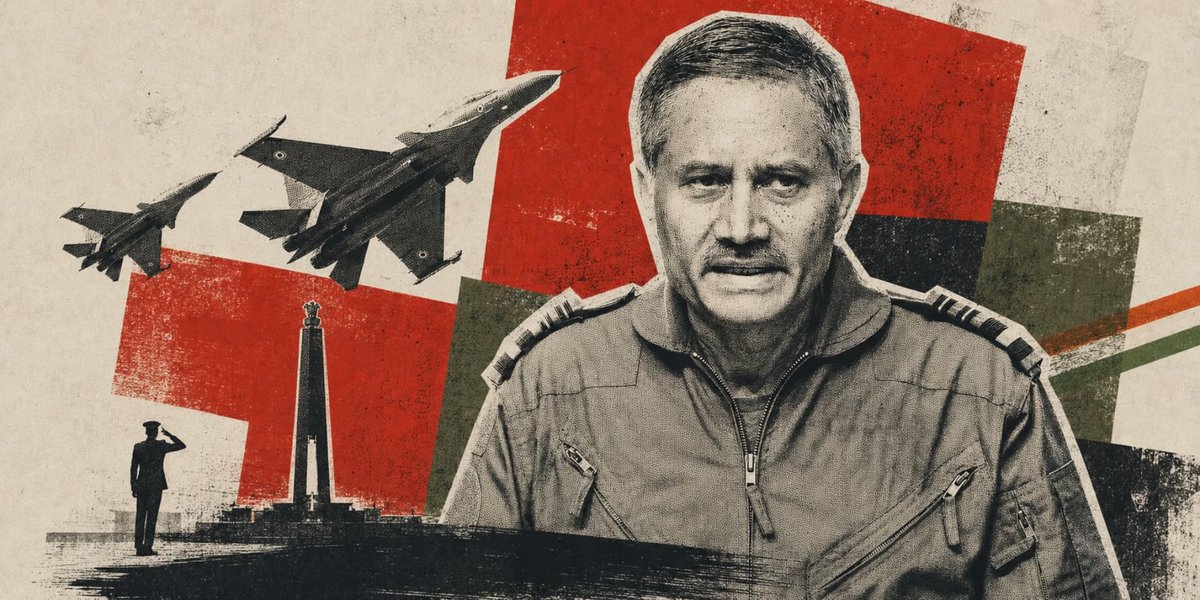
A boy from Jhunni Kala village in Purnea, Bihar took a 12-hour bus ride to Sainik School Tilaiya in 1977.
What followed was four thousand hours in a fighter cockpit, a Sukhoi squadron of his own, and finally the desk where India's air operations are planned.
He was at that desk through the four days of Operation Sindoor, 7 to 10 May 2025.
When he briefed the nation, it was not with bravado, but with facts, restraint, and a verse from the Ramcharitmanas recited from memory:
"भय बिनु होइ न प्रीति"
Without fear, there is no love.
He answered in short sentences, refused to guess at numbers he could not confirm, and made a point of saying that every Indian pilot was home. No chest-thumping. No exaggerated claims.
As he retires after 39 years, India salutes not just a distinguished Air Marshal, but the journey of a village boy from Bihar who rose to serve the nation at the highest level.
This is the Bihar India should celebrate.
Air Marshal A.K. Bharti
Salute to you, Sir.
Story - https://t.co/lfZNQRODy3
I saw a girl on the Latent Show who hated the entire male species.
She used to say that all men look the same to me… every single one of them feels disgusting and worthless. I even hate my own father simply because he’s a man.
The girl in this picture is Asmita De. She’s from Tripura.
In her village the usual mindset was that once a girl grows up, her greatest achievement in life should be getting married. But Asmita’s father was completely against that outdated thinking. He poured every bit of his energy and every last rupee into his daughter “If you want to do judo, do it. I’m right behind you.”
Asmita says that when she came to Delhi for training, even if she got the smallest injury, her father would drop everything and rush to take care of her. Relatives and the rest of the family kept discouraging them “What’s the point of all this?” but her father never listened.
In 2023 she got a job in the UP Police through the sports quota. Things became a little easier. With the remaining time she started training even harder.
Then in December 2025 her father passed away after a brain stroke. In that moment Asmita felt everything was over.
But just ten days later her mother sent her back to training with these words: “If I stop you today, your father will be furious. He’ll say that after I’m gone, no one is left to look after my daughter.”
Asmita turned that pain into strength. Two months later she topped the Asian Trials and began preparing for the Glasgow Commonwealth Games.
Today this girl has won India’s first-ever gold medal in judo. First gold… that’s no small thing. Asmita has dedicated this medal to her coach and to her father.
I don’t remember the name of that girl from the Latent Show, and I don’t want to. I want Asmita’s name on every post, every newspaper, every Indian tweet and Instagram story.
These are the real heroes of our country the ones who carry the tricolour on their shoulders and light up India’s name on the world stage. Instead of some bitter, frustrated girl, Asmita’s story is the one that deserves to go viral.
Proud of you, girl.
@joybhattacharj@chetrisunil11 Had this Goal been scored by LM10 or CR7- there would have been a seismic coverage and Uproar.
A similar(or better) goal scored by Park Ji Sung in PL by running from his own Half..was subdued by Media world Over.
The Rain, The Dice, The Glory
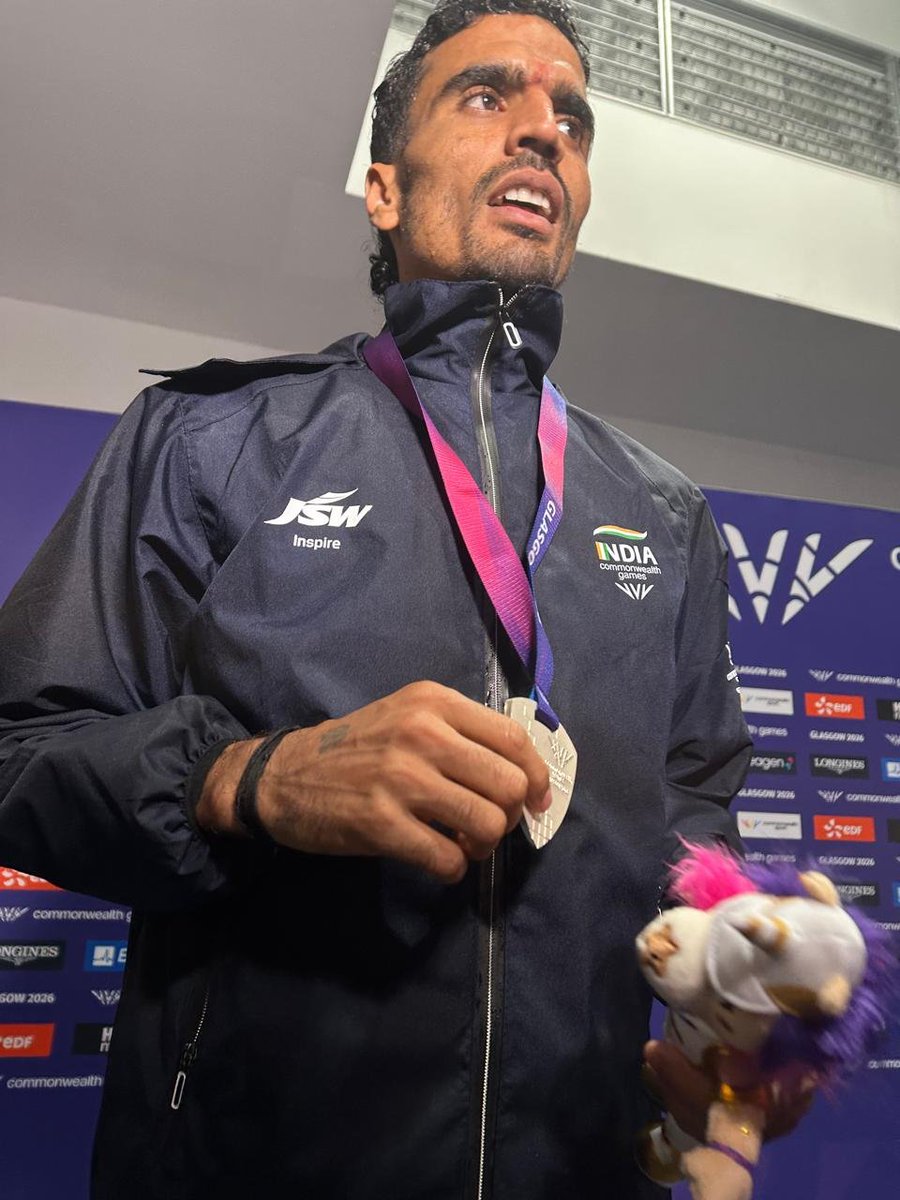
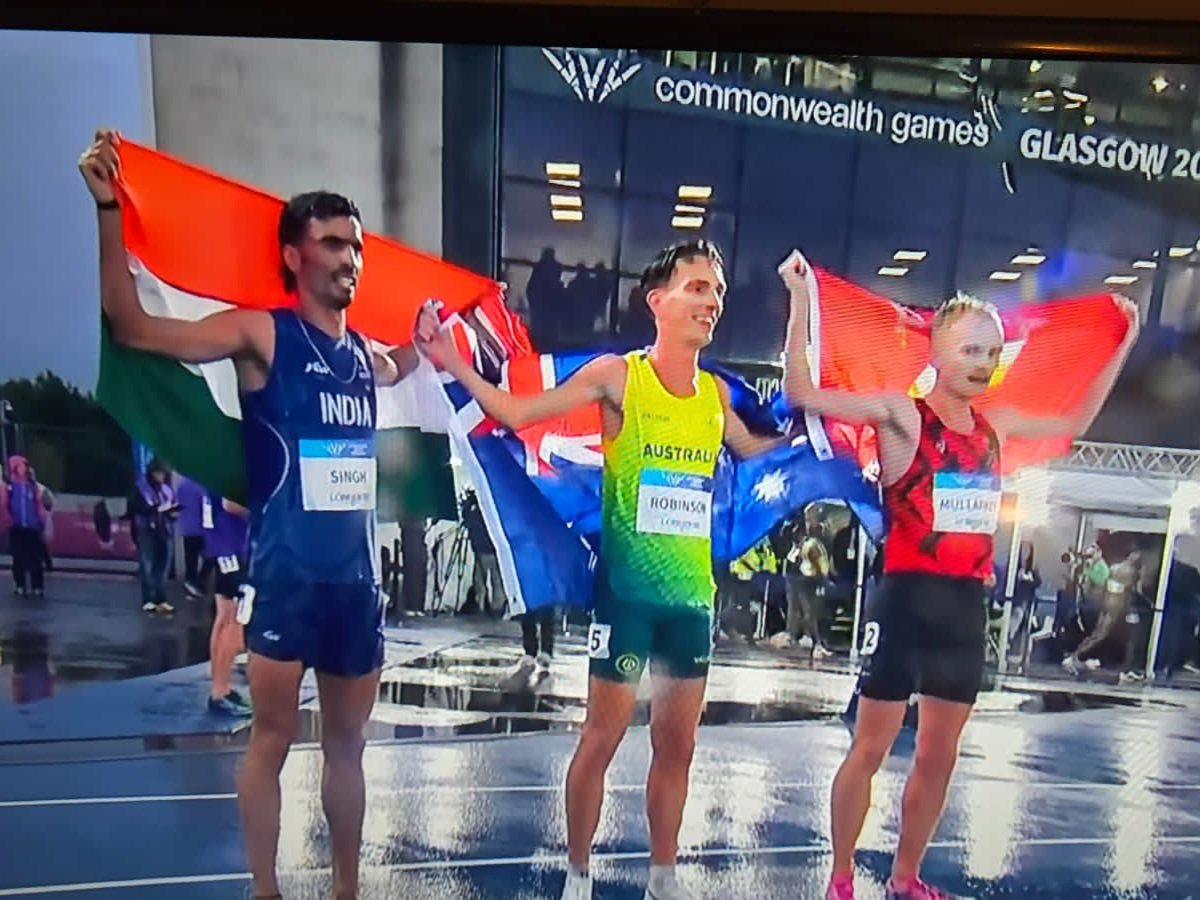
It was a night like no other. Ky Robinson became the first Australian to win the Commonwealth Games 10,000m. Gulveer Singh gave India ITS FIRST EVER CWG 10,000M SILVER. And Mullarkey captured the Isle of Man’s first-ever bronze in the event. On a storm-soaked track, three men ran past an entire continent and stepped into uncharted territory.
Streaking through the puddles, track awash in Glasgow rain, the reign of the Kenyans and the Ugandans was shattered by a motley bunch: an Australian, an Indian, and an Isle of Man athlete. Ky Robinson clinched gold with a dizzying sprint in 27:48.93. Gulveer Singh, boxed in a bit down the stretch, made room on the right, saw air, and sprinted for it. He crossed the line as if in a stupor, half-expecting to see the Africans up front, his time matching the clock at a breathtaking 27:48.93. In a similarly joyous run, David Mullarkey took bronze for the Isle of Man in 27:50.28.
For decades, the Africans had conquered the long distances. They lived in the relentless monotony of the laps. They intimidated the rest, suffocating them kilometre by kilometre until the opposition had nothing left. By the final lap, the final 200 meters, their ferocious kick squeezed out whatever air was left in the field.
Not on this night. Under dark skies, the driving rain brought a new dawn -especially for Indian long-distance running.
Gulveer hunted. He remained nestled in the pack, oscillating between second and sixth, mostly hanging tough in fourth. Ky swung between fourth and seventh, biding his time until the 7k mark hit, where he boldly seized the lead. Gulveer slipped back to ninth for a moment, and it seemed the dice weren’t rolling his way. But he woke up, snatched the dice back, and as they passed the 9k mark, carved his way into third.
On the final turn, the track became a battlefield. Legs heavy, lungs burning, they threw everything into the wet track. Gulveer, seeing Ky sprinting away, saw history, legend status, and national glory all staring back at him, coated in brilliant silver, and made his definitive surge. Behind him, Mullarkey, who had once languished in tenth, quietly clawed his way up the field. With a hundred meters to go, realizing he was sitting in third, his eyes shone bright with the shock of what was about to happen. He unleashed a desperate, glorious sprint to lock down his place in history.
#Gulveer #GulveerSingh
#CWG2026
#Glasgow2026
#Indianathletics
#Historymade #glasgowmeintiranga
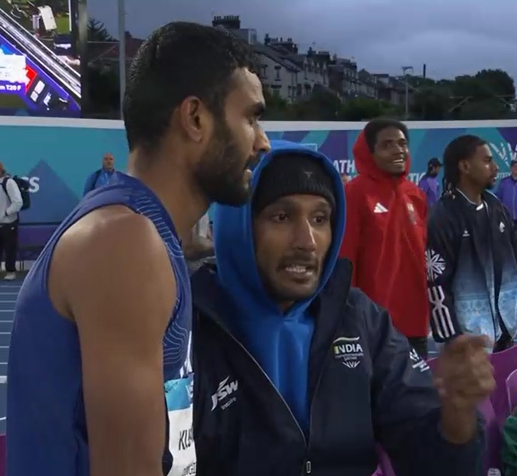
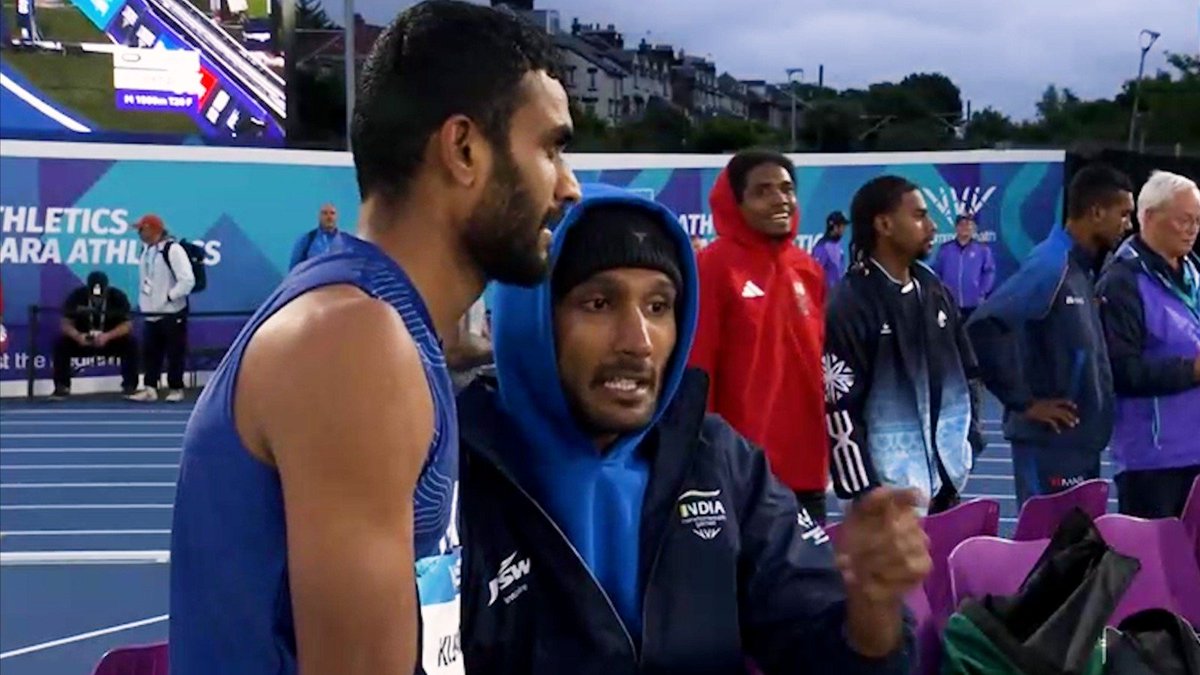
🚨 India fielded THREE high jumpers in the Commonwealth Games final. It apparently couldn't field ONE dedicated high jump coach.
🥈 Sarvesh Kushare won silver without his coach (at AFI's Poland camp). Aadarsh Ram's coach was with the Indian U20 team in Eugene.
Sarvesh's coach, Jithin Thomas, is currently in Spała, Poland, attending the AFI-arranged preparatory camp.
Aadarsh Ram's coach, Sahana Kumari, has travelled with the Indian U20 team to the World Athletics U20 Championships in Eugene.
According to SAI's final participation list, the Indian athletics contingent includes Chief Coach Radhakrishnan Nair and four foreign coaches, with no other Indian event coaches listed.
NNIS Sports has also learned that several personal coaches who travelled to Glasgow at their own expense have not been granted accreditation, preventing them from accessing the field of play.
Meanwhile, Sandeep Sharma, President of the Uttarakhand Athletics Association, was seen seated alongside Chief Coach Radhakrishnan Nair in the accredited area.
In contrast, gold medallist Romaine Beckford and bronze medallist Kimani Jack both had their coaches by their side throughout the competition, analysing every attempt and discussing technical adjustments.
Thankfully, Tejaswin Shankar—after his own heartbreaking withdrawal—stayed back to guide and support Sarvesh.
Indian athletes deserve better.
#CWG2026 #Athletics #IndianAthletics @afiindia #AthleticsIndia @Adille1@Media_SAI #Glasgow #CommonWealthGameds2026
At 2.25 metres, two jumps binned, it seemed curtains for Sarvesh Kushare. Up to that point, every mark had been cleared in a single, fluid rush of air. Then came the third attempt. Kushare sailed, the bar trembled on its pegs, and the few diehard Indian fans suffocated on their own breath. Then, a collective exhale - the bar held.
The bar moved to 2.28m. Three men remained: a Brit, a Jamaican, and an Indian. Decades ago, long before the Commonwealth found its modern sporting identity, the podium hierarchy would have been pre-written. Not this time. England’s Kimani Jack faded after two misses, settling for bronze. Jamaica’s Romaine Beckford and Kushare both hit a wall at 2.28m, failing to clear. Sarvesh had the final jump of the competition, but the gold slipped through his fingers. It came down to the painful arithmetic of countback: Beckford had cleared 2.25m on his first try, Sarvesh on his third. That single aberration, call it an error, cost him the top step.
Silver, though, was a triumph and the story behind it ran deeper than the result sheet.
Earlier in the evening, Tejaswin Shankar (TJ) had withdrawn from the event leaving open the tantalizing question of what a fully fit TJ might have achieved alongside him.
But instead of retreating to the warm-up track or the quiet of the athlete’s lounge, TJ stayed. He sat on the athlete’s bench at the edge of the apron, refusing to leave Kushare’s side.
Between every run-up, as the stadium light flickered and the cold evening breeze swirled across the pit, the two exchanged tips. TJ wasn’t just offering empty encouragement; the former national record holder was watching and dissecting the jumps. Stride adjustments, angle of Sarvesh’s plant foot would have been scanned and corrections made. High jump is a solitary discipline; one athlete, a crossbar, and the sky. TJ and Sarvesh made it a team event. Silver was secured not just on pure adrenaline but on a shared brotherhood forged under the floodlights.
#sarveshkushare #TJ #Glasgow2026 #cheer4bharat
No worries at all Gurinder Paaji...1 story sunaata hun...
1956, a young Indian sprinter arrived at the Melbourne Olympics with big hopes. He lined up for the 200m & 400m heats, ran poorly & was eliminated in the very 1st round, finishing near the bottom.
Crushed, humiliated & feeling completely outclassed on the world stage, he did not pack his bags & hide. Instead, he walked into the Olympic village & approached Charles Jenkins, the American sprinter who had just won the 400m Gold.
Despite speaking almost no English, he managed to convey 1 desperate request: "How do you train?"
Jenkins pulled out a piece of paper & wrote down his exact daily routine, split times & workout regimen.
The young Indian folded that scrap of paper, put it in his pocket & flew back to India. For the next 2 yrs, he trained with that exact paper as his blueprint, running along railway tracks & up hills until he literally collapsed & bled from his nose & mouth.
2 yrs later, in 1958, that same sprinter won Gold at the Asian Games & became India's 1st ever Commonwealth Games Gold Medalist.
His name was Milkha Singh.