Photo finish! 🏁📸
On June 14, Perseverance completed a Martian “marathon” by surpassing 26.2 miles (42.195 kilometers) of travel. The day before, NASA’s Mars Reconnaissance Orbiter snapped this view of the rover and its tracks from space.
@EdithaTogo@aniobrien Eh? DSD's affect 1 in 5000 people, and whilst they deserve empathy, they are not social constructs. Neither is gamete production.
@SimonMagus Total SF/UF escapism - the Laundry Files by Charles Stross or, if you fancy a more political slant, the Fall Revolution tetralogy by Ken McLeod. Start with the Atrocity Archives and The Star Fraction, respectively
I’m a chemist. I need to say this - because it’s getting dangerous out there. The biggest health myth in the world isn’t about vaccines.
Or GMOs. Or fluoride.
It’s the root of all of them.
It’s called chemophobia - and it’s killing science.
Fear of “chemicals” now drives vaccine rejection, GMO bans, food hysteria, and entire political movements.
From tampons to tap water, people have been taught to fear chemistry - the very thing that keeps us alive.
Chemophobia tells us:
“Natural is good.”
“Synthetic is bad.”
That’s a lie.
Botulinum toxin is 100% natural and one of the deadliest molecules known. Aspirin is synthetic and life-saving.
We’ve gone from banning harmful substances for good reason…to banning safe, well-tested molecules for emotional reasons.
You’ve seen the slogans: “If you can’t pronounce it, don’t eat it.” “Paraben-free.” “Clean beauty.”
They sound empowering. But they’re not science - they’re marketing. And they’re making the world dumber, poorer, and sicker.
Your body doesn’t care if a molecule comes from a plant or a lab. Vitamin C is vitamin C.
Formaldehyde is formaldehyde and your body makes more of it every day than any vaccine ever could.
Dose matters. Source doesn’t.
This fear isn’t harmless.
It shapes public policy.
It blocks innovation.
It raises food prices.
It slows down cancer treatments.
Chemophobia is now mainstream and it’s costing lives. Scientists aren’t losing because we’re wrong.
We’re losing because fear spreads faster than facts. Because influencers sell fear for clicks.
Because lawyers monetize doubt. And because scientists are too tired to fight back.
So here’s my message, as a chemist and as a citizen: Learn how toxicology works.
Call out chemical fear-mongering. Support policies based on evidence, not emotion.
Chemistry isn’t the enemy. It’s the reason you have clean water, safe food, and modern medicine.
If we let fear win, we lose all of it.
Really? CAFOD doesn't care about poverty now? Because make no mistake this is a recipe for entrenching greater energy poverty
Before ONS stopped publishing the data a few years ago, on average 6000-8000 people in the UK died prematurely every winter as a result of fuel poverty
What did CAFOD have to say about that?
Students who never study Stalin, Mao, and the gulags have no framework to recognize totalitarianism. A curriculum built on shame is not history. It is indoctrination. The left just tried to strip her damehood for saying so. My conversation with the newly appointed Dame Elizabeth Rata, in collaboration with @NZFreeSpeech
You’re sheltered in the Army. Most people you work with are decent. It’s a shock how many twats there are civvy street.
But I’ve never come across a more sanctimonious, mendacious and hypocritical bunch than the pro-Palestinians. Nothing they won’t lie about. Disgusting people.
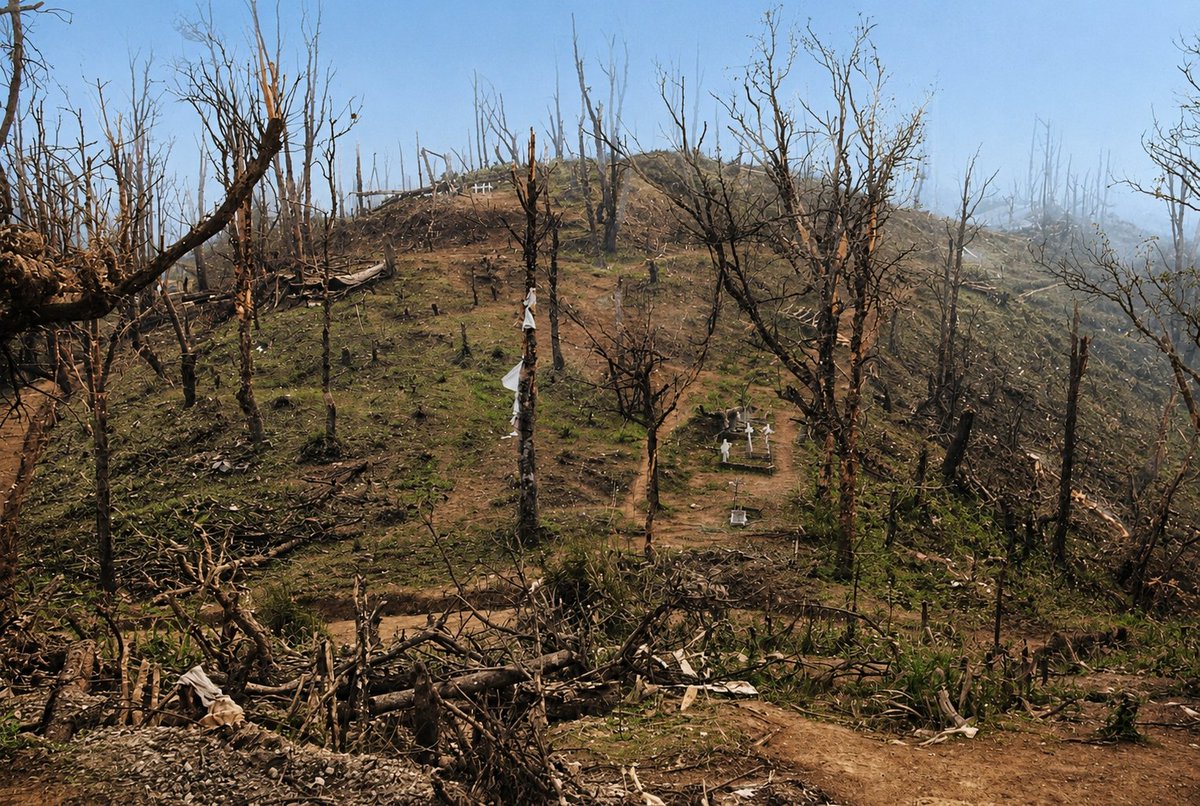
On this day in 1944, the Japanese Imperial Army's greatest defeat in history was reaching its peak in a forgotten corner of India.
By nightfall on May 26, 1944, the battle that ended Japan's last offensive of the Second World War was effectively won.
Almost nobody outside the Burma campaign knows the story.
The Japanese 15th Army, 85,000 men under Lieutenant General Renya Mutaguchi, had launched Operation U-Go in March. The plan was ambitious to the point of fantasy. Three Japanese divisions would cross the Chindwin river out of Burma, climb 7,000 feet through monsoon-soaked jungle into India, capture the British supply bases at Imphal and Kohima, and trigger the collapse of British rule in South Asia.
Mutaguchi told his officers they would feast on captured British rations within weeks. He ordered them to bring only three weeks of food. After that, they would live off the enemy.
The British, under Lieutenant General William Slim, fell back into prepared positions on the Imphal plain and at a hill station 80 miles to the north called Kohima. They dug in. They waited.
What followed was 81 days of fighting in conditions that veterans on every other front of the war refused to compare to their own.
At Kohima, the centre of gravity of the entire battle compressed onto a single tennis court behind the District Commissioner's bungalow. British and Indian troops, mostly the 4th Battalion Royal West Kents and the 1st Assam Regiment, held one side of the tennis court. Japanese soldiers held the other. They fought across it for 16 days with rifles, grenades, and bayonets, at distances of less than 30 yards. Officers threw grenades back and forth like cricket balls. The clay court was churned into a graveyard.
The monsoon arrived in mid-May. Trenches flooded waist-deep. Wounded men drowned in their own foxholes. The dead were left where they fell because no one could reach them under Japanese fire. Bodies bloated in the heat. Disease killed almost as many men as bullets did. Typhus. Dysentery. Cerebral malaria.
By mid-May, the 2nd British Division had broken through to Kohima and begun counter-attacking south down the road toward Imphal.
By May 26, 1944, the Japanese 31st Division, which had attacked Kohima, was disintegrating. Out of food. Out of ammunition. Out of medical supplies. The men were eating roots, bamboo shoots, leaves, and in some documented cases, their own dead. Soldiers too weak to walk were left behind in the jungle with a single grenade and instructions to use it on themselves before the British arrived.
By that date, virtually every Japanese position in and around Kohima had been overrun. The road south to Imphal was open.
Mutaguchi refused to authorize a retreat. To withdraw was to admit failure, and Japanese military culture treated admitting failure as worse than annihilation. His subordinate divisional commanders, watching their men starve to death, began retreating anyway, in direct defiance of explicit written orders. Major General Kotuku Sato of the 31st Division simply marched his survivors back toward Burma without authorization and dared Mutaguchi to court-martial him. Mutaguchi did not.
When the Japanese 15th Army finally fell back across the Chindwin in July, of the 85,000 men who had started Operation U-Go in March, 53,000 were dead, missing, or so broken by starvation and disease that they were no longer combatants.
Most of those casualties were not from combat. They were from hunger, dysentery, malaria, exhaustion, and despair. The trail back to Burma was lined with skeletons in tattered uniforms. Indian villagers along the route remembered finding them for years afterward.
Mutaguchi was relieved of command, recalled to Tokyo, and forced into retirement. No Japanese ground offensive of comparable size was ever launched again in the Second World War. The defeat at Kohima and Imphal broke the offensive capacity of the Imperial Japanese Army in mainland Asia.
The British and Indian troops who held the tennis court are commemorated today by a small stone memorial at Kohima War Cemetery. The inscription on it has become one of the most famous epitaphs of the Second World War:
"When you go home, tell them of us and say,
For your tomorrow, we gave our today."
In 2013, British veterans and military historians voted Imphal-Kohima the greatest battle in British military history. Greater than Agincourt. Greater than Waterloo. Greater than D-Day.
Most people in Britain have never heard of it.