임장 갈 때 핸드폰에 있어야 하는 것 총정리
• 카카오맵 / 네이버지도
└ 로드뷰 과거 날짜로 바꿔봐
└ 몇 년 전이랑 비교하면 동네 흐름이 보여
• 호갱노노 (https://t.co/hF4XywoHPa)
└ 실거주자 후기, 단지 분위기
• 디스코 (https://t.co/Wp1FknBnTS)
└ 지도 위에서 주변 실거래 바로 확인
• 밸류맵 (https://t.co/AnS3OnNFER)
└ 토지, 상가 실거래까지 보임
• 스마트국토정보 (앱)
└ 현장에서 건축물대장, 토지대장 바로 조회
• 국토부 실거래가 (https://t.co/0KeMDhKMOJ)
└ 부동산에서 들은 가격 검증용
폰으로 그 자리에서 대조하면 굿!
"Qwen이 Claude보다 5배 싸다"는 반만 맞는 말임. 실제 청구서로는 3배 차이가 안 남
토큰 단가표만 보면 Alibaba의 Qwen3.8 Max가 Claude Fable 5보다 5배에서 8배 싸 보임. 근데 Artificial Analysis가 같은 지능 과제를 실제로 풀리고 청구서를 재보면, 과제당 Qwen이 1.13달러, Fable 5가 3.14달러로 2.8배 차이임. 싼 모델일수록 같은 문제에 토큰을 더 태워서 단가 격차가 절반 이하로 좁혀지는 것
지능 지수는 Fable 5가 60 근처, Qwen3.8 Max가 58 근처로 한 계단 차이. 중국 모델이 프런티어 턱밑까지 온 건 맞는데, 단가표의 5배가 청구서에선 3배가 안 되는 것처럼 이 판 숫자는 실측으로 봐야 함. 모델 고를 때는 토큰 단가 말고 과제당 비용을 보는 게 맞음
매우 중요!
부동산 서류 떼는 정부 사이트 총정리
• 인터넷등기소 (https://t.co/4PuXzuIuDv)
└ 등기부등본 (열람 700원)
• 정부24 (https://t.co/bqULQ6uhnZ)
└ 건축물대장, 토지대장 무료
• 토지이음 (https://t.co/hkgNlbkt3K)
└ 용도지역, 토지이용계획 무료
• 씨리얼 (https://t.co/HedGeMl6fd)
└ 부동산 종합정보 무료
• 국토부 실거래가 (https://t.co/0KeMDhKMOJ)
└ 실거래 내역 무료
즐겨찾기 해두고
물건 볼 때마다 세트로 돌려 보시면 끝
인간은 사건을 인과관계로 엮어 에피소드 기억으로 저장하려는 본능이 있다. 스토리텔링은 이 본능을 활용해 사실을 직관적으로 전달하지만, 동시에 Narrative Fallacy를 유발한다. 카너먼이 지적했듯 뇌는 정보의 '완전성'보다 정보의 '일관성'에 더 쉽게 설득된다. 따라서 스토리가 매끄러울수록
가족법인 핵심 7가지 ㅡ 운영하면서 그리고 세무사들 도움 받은 내용
1. 부동산 보유시 필수
ㅡ 가치 상승 부동산은 법인에 출자
ㅡ 자녀에게 법인 주식 단계적 증여로 상속세 부담 감소
2. 자녀 승계는 시간 활용
ㅡ 10~20년에 걸친 단계적 승계로 효율적 자산 이전
3. 사업 수익도 법인으로
ㅡ 안정적 현금흐름 사업.수익 부동산 법인 이전 + 자녀 주주참여 > 재산승계 + 세금 절감
4. 상속세 미리 대비
ㅡ 부동산과 주식 분산 증여
5. 증여세 부담 해소
ㅡ 미성년 자녀도 효율적인 재산 이전
6. 법인 내부 자산 활용
7. 빠를수록 유리
this is important to understand
very simple explanation from bezos on why EPS and EBITDA are bullshit + FCF and ROIC are what matter.
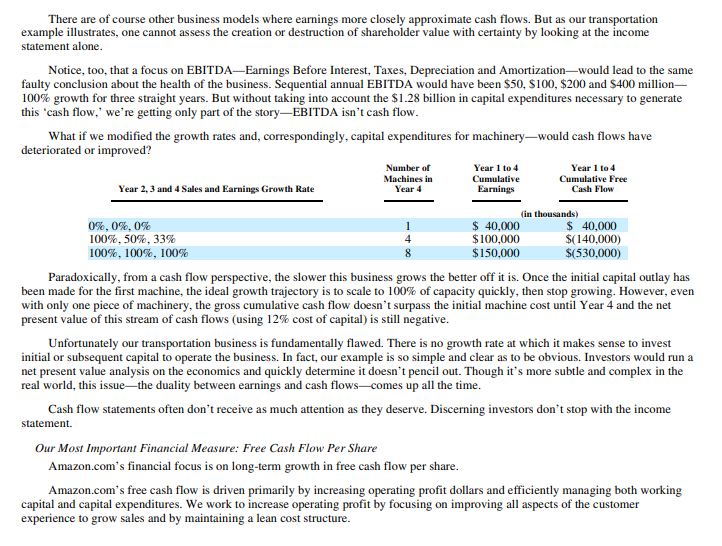
EPS and EBITDA ignore capital intensity. hypothetically, you could spend $10B on capex, at a negative ROIC, and have EPS/EBITDA quadruple.
the stock will go down in this circumstance 100% of the time fwiw, the market understands value creation
this is why you see M&A that is "EPS accretive" and the stock goes down 25%, because the mkt sees value destruction
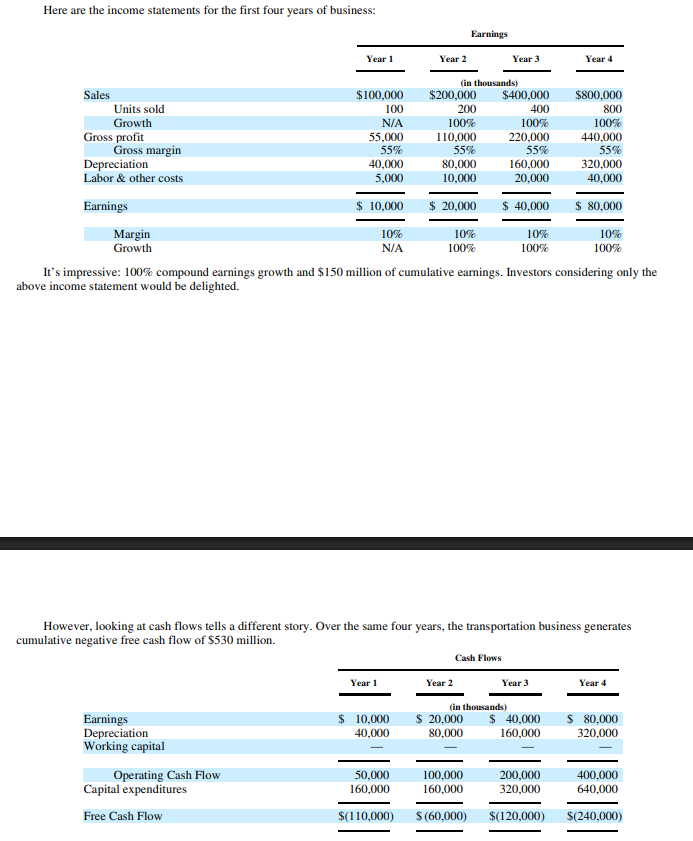
Bezos: "There are of course other business models where earnings more closely approximate cash flows. But as our transportation example illustrates, one cannot assess the creation or destruction of shareholder value with certainty by looking at the income statement alone.
Notice, too, that a focus on EBITDA—Earnings Before Interest, Taxes, Depreciation and Amortization—would lead to the same faulty conclusion about the health of the business. Sequential annual EBITDA would have been $50, $100, $200 and $400 million— 100% growth for three straight years. But without taking into account the $1.28 billion in capital expenditures necessary to generate this ‘cash flow,’ we’re getting only part of the story—EBITDA isn’t cash flow."
the letter is here, its short, 3-4 pages
https://t.co/IaAtp6sS0q
but again, pull up a bunch of LLMs, and sit there asking questions until everything written there is crystal clear
this is very very basic shit that 99.9% of twtr doesn't understand, but where u will get dinged from any intvw immediately
basically, what do P/E and EV/EBITDA get wrong, what are their flaws, what is the IS' tie to the CF statement, why is FCF what matters, what is ROIC, how is equity value created, why is every stock a DCF
this is like, bare bones fundamental equity analysis, where u simply dont understand what drives stock prices if u dont have this mastered.
so get it nailed down 🔨
싱클레어가 노화를 되돌릴 수 있다고 말하는 근거는 한 문장임. 유전자는 낡지 않음
DNA는 정보만 담고 있고, 그 정보는 90세가 돼도 20세 때와 거의 그대로 남아 있음. 문제는 이 영상에 나오는 과정, 그러니까 정보를 읽고 전달하는 쪽에서 생김. 어떤 유전자를 켜고 끌지 정하는 관리 층이 세월에 흐트러지면서 멀쩡한 정보를 빼먹고 읽기 시작하는 것, 그게 노화라는 거임
그래서 결론이 뒤집힘. 원본이 멀쩡하니 읽는 장치만 고치면 노화는 되돌릴 수 있음. 긁힌 DVD도 데이터는 남아 있어서 표면만 닦으면 다시 재생되는 원리임. 어제 올린 실험에서 92세 세포가 20대로 돌아간 게 정확히 이 리셋임
영상은 yourgenome의 DNA에서 단백질까지 3D 애니메이션임
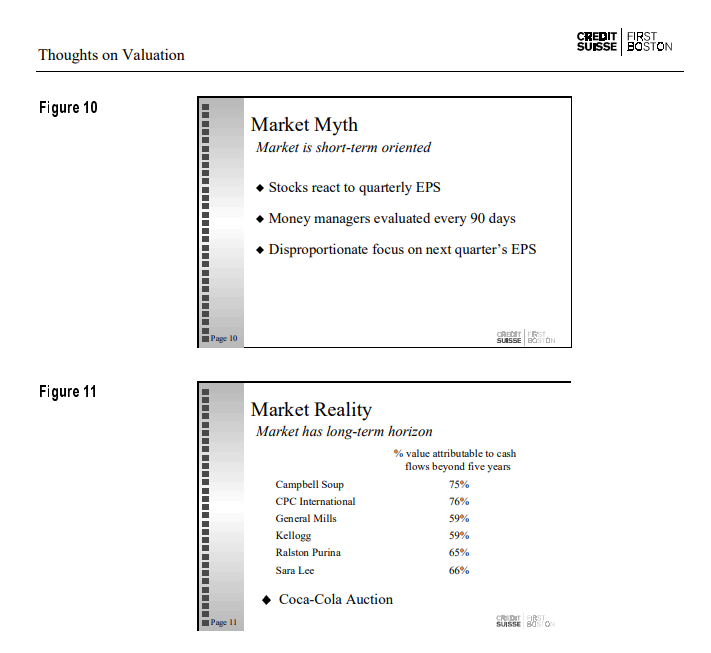
"Thoughts on Valuation" (1997, Mauboussin)
this one is straight to the point, and busts several market myths...stuff u see people get wrong every day
1. the market is short-term oriented, or "unsophisticated" or "irrational"...this is a myth.
2. EPS and EPS growth are what drive stock prices...also a myth.
theres other topics in here, he goes into CAP which is a good term/framework u can use forever...I will pull a few highlights
https://t.co/NJGD1BMVcX
1. how you can grow EPS and destroy growth (like Bezos' example)
"Let’s pretend I am an unlimited source of capital. Everyone in this room can come to me and I will give you all the money you want. There is just one catch: the expected return on the capital I give you, not the explicit return, but the implicit return, is 10%. Now, let’s say you can go out and reinvest the money I give you at 8%. I give you capital with a 10% “cost” and you reinvest it at an 8% return. Now here is the question. What is your earnings per share growth going to be for this venture? The answer is, It is going to be anything you want it to be! All you have to do is keep coming back to me for more money, reinvest it, and you will generate earnings growth at whatever rate you choose. Clearly, the more rapidly you grow earnings the worse off you are, because you are investing below the required rate of return.
That may make sense, but how does it apply to the real world? The answer is that the primary source of capital for most companies is retained earnings. (Roughly 75% of investments are funded internally.) Retained earnings have an implied opportunity cost—that is what shareholders could earn on that capital if they invested it in other ventures of similar risk—but most managers think of retained earnings as “free” money. Hence, managers who take cash generated by the business and reinvest it at below appropriate rates of return in order to drive earnings per share are doing their shareholders injustice. Mind you, investing in projects that do not earn the costs of capital may drive earnings per share growth, but will clearly destroy value. This type of investing goes on every day in corporations around the world."
2. the market sells off "EPS accretive" M&A
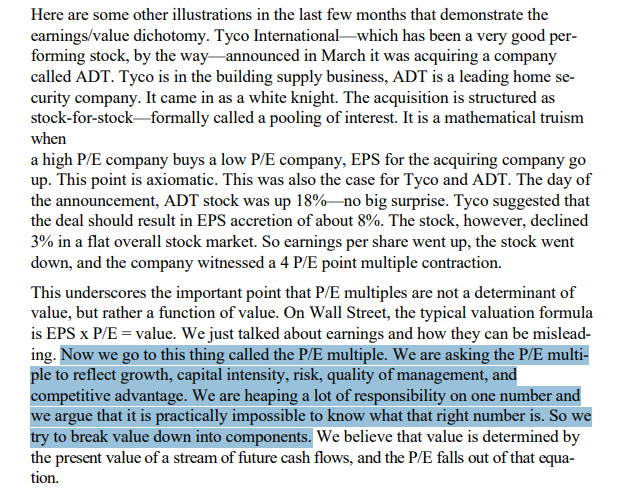
Here are some other illustrations in the last few months that demonstrate the earnings/value dichotomy. Tyco International—which has been a very good performing stock, by the way—announced in March it was acquiring a company called ADT. Tyco is in the building supply business, ADT is a leading home security company. It came in as a white knight. The acquisition is structured as stock-for-stock—formally called a pooling of interest. It is a mathematical truism when a high P/E company buys a low P/E company, EPS for the acquiring company go up. This point is axiomatic. This was also the case for Tyco and ADT. The day of the announcement, ADT stock was up 18%—no big surprise. Tyco suggested that the deal should result in EPS accretion of about 8%. The stock, however, declined 3% in a flat overall stock market. So earnings per share went up, the stock went down, and the company witnessed a 4 P/E point multiple contraction.
This underscores the important point that P/E multiples are not a determinant of value, but rather a function of value.
3. what's in a multiple? a lot
On Wall Street, the typical valuation formula is EPS x P/E = value. We just talked about earnings and how they can be misleading. Now we go to this thing called the P/E multiple. We are asking the P/E multiple to reflect growth, capital intensity, risk, quality of management, and competitive advantage. We are heaping a lot of responsibility on one number and we argue that it is practically impossible to know what that right number is.
--that bolded sentence is very important...very common question/pushback from new investors "why can't I just do a 2027 multiple, or 2030 multiple" etc
because u are obscuring all that shit, plus terminal value assumptions, into one number.
like you may as well just throw a dart. u arent doing real valuation work, ur just pretending these assumptions don't exit.
in a DCF, all those assumptions are made explicit - capex, roic, fcf, everything that moves stock prices...u model those and add confidence intervals/scenarios/probabilities where ur uncertain.
as opposed to just saying, "15x 2027 EPS." like closing ur eyes and saying, poof, doesn't exist
the only shortcut (which everyone uses) is thinking directionally...a stock price = cash flows and multiple.
so if u say a stock at $100, is worth $50, u have to explain...are cash flows going down 50%? or is the multiple going down 50%? or some combo? and why? (keeping in mind that the multiple captures all those variables laid out above)
ask LLMs if any of this isnt clear (multiple vs DCF) -- I'm not going to argue with you on how you think the sky is orange instead of blue, and LLMs will get this right.
4. short-termism myth
"The next myth is that the market is very short-term orientated. This one is a favorite of the business press, and is a theory in which many CEOs indulge. What is the evidence for “short-termism?” First, stocks react to quarterly earnings per share. Next, money mangers are evaluated every 90 days so they have to run fast to make sure their portfolio is well positioned for the short term. Finally, there is a disproportionate focus on next quarter’s earnings per share. This is particularly endemic to the sell side."
--someone is going to push back and say, "the market can be irrational"
yes, it can, its not perfect - "the market has predicted 9 of the last 5 recessions"
its still far more right than it is wrong. and the degree to which u understand this, tends to be linear to ur years of experience
mauboussin goes into examples of how the market is long term focused, but u can see that regardless - why is spacex worth a trillion dollars despite that theres no FCF for 5+ years?
because the market plays the long game. maybe its worth $2T, or $1T, or $500B, we'll see...but there's clearly a lot of value in there.
and on the flip side, u can see how AI/Claude has lopped off the terminal value of software stocks - those are long-term considerations, its not about next qtr being at risk, its 5-10 years out.
again, I'm not gonna argue with u here, go hit LLMs with ur opinions and views.
buffett 101: a stock is worth all the cash flow it will produce from now until kingdom come, discounted back at some rate appropriate to the business, risk, opportunity cost, 10-yr (he has many answers re: disc rate...but the point stands)
go argue w buffett, dont argue w me
5. cont - time horizon
"The next canard is that the market is “unsophisticated” or in some instances “irrational.” Allen Greenspan and Warren Buffett have recently contributed to this myth. Sumner Redstone, the CEO of Viacom, recently said that his stock price is depressed because the stock market is irrational; people don’t get it. All these portfolio managers, who are out to make money in a competitive setting, are collectively irrational. That is a difficult one to buy.
What does happen is a company makes an acquisition, tells the world it’s a great strategic deal, and is shocked when the stock is down 2% or 3%. Now in some cases the market doesn’t get it because the market doesn’t have the appropriate information. In that case, it is incumbent on the company to provide the relevant information so as to allow investors to make the right decision. Collectively, the market gets it a lot more times than it doesn’t get it."
6. CAP 🧢
"Now we come to the last component of the value-based model and it is a critical one. This idea is what takes the DCF from the classroom into the real world. It takes it from theory to practice. Most MBAs have not been subjected to anything like this before, yet it is really the key to securities analysis. It’s something we call competitive advantage period (CAP). CAP is defined as the period of time a company can generate excess returns on its incremental investments. It is based on the idea that competitive forces ultimately drive your excess returns down to zero, meaning the business earns the cost of capital. The ability to extend excess returns for as long as possible is the basic concept of competitive advantage. This is how competitive advantage is tied into this framework.
Generally, when companies or investors run a cash flow model they go out five or ten years. Why is that? Because that’s how many fingers you have. Literally, we live in a decimal world because that is how many fingers we have! What you really want to do is link the competitive position of your business and/or industry to an economically sound competitive advantage period.
CAP can be defined by three major variables. The first is the current return on capital—the higher the better. The second is the rate of industry change—if you are in a fairly dynamic industry where things are changing quickly, investors tend to shorten the competitive advantage period. And third, which is related to the first two, is the barriers to entry; the higher the barriers to entry, the longer the competitive advantage period tends to be."
--
Summary
there's more in there, but u will notice that like everyone u know, everyone u follow, is doing all this shit wrong.
mauboussin and buffett have it right, u do not have to question anything they've written, nor argue with someone who says "buffett has it wrong"
ok pal
here is the best path though. independently consult LLMs, make sure you understand all of this front to back, get all ur q's answered...develop your own understanding of this
and then after that, u can either tune the crowd out entirely (since u have confirmation ur logic is sound), or u can try and correct people when u see them doing it wrong.
the latter will have u laughing, people will spend hours arguing in defense of some point of view which they literally just made up
and where an LLM within 2 seconds wouldve said "dude lol. no."
so idk, arguing with strangers on the internet is like Caligula declaring war on the ocean....u are never gonna win, its a neverending battle.
do your own homework and trust in LLMs, they are laser-sharp on topics like this -- fundamental equity analysis and basic market theory -- and will have u operating with some semblance of confidence.
"don't follow the crowd, they're lost."
buena suerte 🫡
생물학이 AI로 유독 빨리 뚫리는 이유는 간단함. 생명 자체가 언어로 쓰여 있기 때문임
DNA는 A, G, C, T 네 글자로 쓴 시퀀스고 단백질은 아미노산 20글자로 쓴 문장임. LLM이 하는 일이 정확히 문자 배열에서 문법과 문맥을 배워 다음 글자를 맞추는 것인데, 유전체에는 진화가 수십억 년 쌓아둔 말뭉치가 통째로 있음. 그래서 트랜스포머를 거의 그대로 옮겨 심으면 됨. AlphaFold가 서열을 구조로 번역해냈고, 단백질 언어모델들은 문장 빈칸 채우듯 새 효소를 쓰는 중임
물리나 화학의 연속적인 세계는 토큰으로 잘게 못 썰어서 LLM이 아직 버거워하는데, 생물학은 처음부터 이산적인 글자였음. 싱클레어 랩이 160년치 스크리닝을 두 달에 끝낸 것도, 제프 딘이 과학 자동화 회사를 차린 것도 이 지점을 본 거임. AI가 처음으로 모국어를 만난 과학이 생물학임
영상은 Nucleus Medical Media의 DNA 복제 애니메이션임. 헬리케이스가 지퍼를 열고 중합효소가 글자를 받아 적는, 딱 그 언어 기계들임
《151 Trading Strategies》에서 건진 것 3/15
이 책에는 우리가 가장 익숙하게 보는 이동평균 전략도 나온다.
그런데 막상 규칙을 보면 놀랄 정도로 단순하다.
Single Moving Average 전략은 대략 이렇다.
현재 가격이 장기 이동평균보다 높으면 Long.
현재 가격이 이동평균 아래로 내려가면 포지션을 정리하거나 Short.
끝이다.
Two Moving Averages는 조금 다르다.
단기 이동평균이 장기 이동평균보다 위에 있으면 Long.
단기 이동평균이 장기 이동평균 아래로 내려가면 Short 또는 청산.
우리가 흔히 말하는 Golden Cross, Dead Cross와 거의 같다.
Three Moving Averages까지 가면
단기선 > 중기선 > 장기선
일 때 상승추세가 가장 강하다고 판단한다.
예를 들어
20일선 > 60일선 > 200일선
이라면
최근 가격,
중기 가격,
장기 가격
순서대로 모두 위에 있다는 뜻이다.
차트로 보면 자연스럽게 강한 상승추세가 만들어진다.
여기까지는 누구나 안다.
그런데 책에서 더 흥미로웠던 건 그다음이다.
저자들도 질문한다.
“왜 이동평균선이 교차했다고 미래 가격이 올라야 하지?”
20일이라는 숫자에 경제적 의미가 있는 것도 아니다.
60일선을 넘었다고 기업의 매출이 갑자기 증가하는 것도 아니다.
이동평균선 자체가 주가를 움직이는 게 아니다.
그럼에도 이런 전략이 오랫동안 사용되는 이유는 무엇일까?
가능한 설명은 Momentum이다.
시장에 새로운 정보가 들어왔다고 하자.
그 정보가 모든 사람에게 즉시, 완벽하게 반영되지 않는다면 가격은 한 번에 움직이지 않고 일정 기간 같은 방향으로 이동할 수 있다.
좋은 실적이 나온 기업을
첫날 일부 투자자가 사고,
다음에는 기관이 사고,
애널리스트 목표가가 올라가고,
추가 자금이 들어오면서
가격 추세가 이어질 수 있다.
이동평균은 그 원인을 분석하는 지표가 아니다.
이미 나타난 추세를 확인하는 도구다.
그래서 Moving Average의 장점과 약점은 동시에 나온다.
장점은 큰 추세가 한번 만들어지면 끝까지 따라가기 쉽다는 것이다.
하지만 횡보장에서는 계속 속는다.
100 → 102 → 99 → 103 → 100
처럼 가격이 방향 없이 움직이면
매수 → 매도 → 매수 → 매도
가 반복되면서 작은 손실이 계속 쌓일 수 있다.
이걸 Whipsaw라고 한다.
그래서 이동평균 전략의 본질은
“미래를 예측한다”
라기보다
“추세가 실제로 발생했을 때 그 추세의 일부를 먹는다”
에 더 가깝다.
그리고 여기서 투자자가 가져갈 중요한 포인트가 하나 있다.
지표를 사용할 때
“이 지표가 몇 % 맞냐?”
보다 먼저 물어야 할 질문은
“이 지표는 시장의 어떤 현상을 잡으려고 만든 것인가?”
다.
이동평균선의 핵심은 선이 아니다.
그 뒤에 존재한다고 가정하는 Trend Persistence다.
《151 Trading Strategies》라는 자료를 하나 발견해서 전체를 보고 있다.
저자는 Zura Kakushadze와 Juan Andrés Serur.
제목 그대로 주식, ETF, 옵션, 선물, 채권, 외환, 원자재, 변동성, 암호화폐까지 150개가 넘는 매매전략을 한 번에 정리해놓은 자료다.
550개가 넘는 수식, 약 2,000개의 참고문헌, 백테스트 코드까지 들어 있다.
처음에는 “151개 전략 중 실제로 뭐가 제일 잘 벌까?”가 궁금해서 보기 시작했다.
그런데 읽다 보니 오히려 더 중요한 내용이 보였다.
좋은 전략을 찾는 방법보다
가짜 전략에 속지 않는 방법,
백테스트를 어떻게 봐야 하는지,
리스크를 어떻게 줄이는지,
왜 단순한 전략이 복잡한 전략보다 나을 수 있는지
이런 내용이 훨씬 재미있다.
그래서 투자자 입장에서 실제로 도움 될 만한 부분만 쉽게 풀어서 하나씩 정리해보려고 한다.
중요한 점 하나.
이 책에 150개가 넘는 전략이 실려 있다고 해서 150개 모두 돈을 번다는 뜻은 아니다.
저자들도 이 자료의 목적을 전략을 설명하고 관련 연구를 소개하는 교육용 자료에 가깝게 잡고 있다.
무료 원문
영문판 SSRN
https://t.co/VCgRkon1S4
arXiv
https://t.co/1Tjj1rdufw
앞으로 총 15편 정도로 정리해보겠다.
첫 번째 주제는
“전략을 많이 백테스트할수록 오히려 속기 쉬운 이유.”
YC CEO가 자기 산출량을 계산해 봤더니 2013년의 400배가 나왔다고 함
Y Combinator 대표 Garry Tan이 어제 올라온 강연에서 직접 깐 숫자임. 2013년엔 밤새 코딩해도 하루 14줄, 딱 업계 중간값이었는데 지금은 YC 풀타임 운영에 5시 아이 픽업까지 하면서 400배가 나온다는 것. 본인이 먼저 그 숫자를 깎아보는 대목이 재밌는데, 장황한 AI 코드 페널티에 절반은 스캐폴딩이라 쳐도 바닥이 8배라고 함
더 중요한 건 그 다음 문장임. AI 코드베이스 95%짜리 회사들이 몰린 기수가 YC 역사상 가장 빠르게 크는 기수가 되는 중이고, 잘 크는 창업자들은 AI를 자동완성이 아니라 노동력으로 다룬다는 것. 그리고 2배짜리 사람과 100배짜리 사람이 같은 Claude, 같은 가중치, 같은 API를 쓴다고 함. 격차는 모델이 아니라 어떤 컨텍스트를 맞는 단계에 주느냐에서 갈림
모델은 빌리는 것이고 컨텍스트는 소유하는 것이라는 게 이 강연의 뼈대인데, 요즘 벌어지는 일들과 맞춰 보면 울림이 있음
임장 가서 사람을 봐라
재개발 투자에서 제일 중요한 건 서류가 아니다. 사람이다.
노후도니 용적률이니 하는 건 앉아서 확인하면 된다. 그건 누구나 본다. 차이는 현장에서 갈린다. 그리고 현장에서 봐야 할 건 건물이 아니라 그 동네 사람들이다.
가보면 안다. 어 여기 뭐지 싶은 동네가 있다.
가게에 들어갔는데 응대가 이상하다. 손님이 들어와도 쳐다도 안 보거나, 뭘 물으면 신경질적으로 답한다. 대화가 안 통하는 느낌. 길에서 마주치는 사람들 표정이 하나같이 날카롭고, 다들 예민하다. 낮인데도 괜히 어깨가 움츠러들고, 밤에는 이 골목에 들어오고 싶지 않겠다는 생각이 든다. 어디라고는 말 안 하겠는데, 가보면 안다.
이런 동네가 재개발된다.
이유는 명확하다. 이건 그 사람들 개인의 문제가 아니라 동네가 오래 죽어 있었다는 증거다. 장사가 안 되니 가게가 손님을 손님으로 안 대하고, 형편이 되는 사람은 진작 나갔고, 못 나간 사람만 남았다. 신규 유입이 없으니 순환이 멈춘다. 그 상태로 십 년이 지나면 동네 공기 자체가 그렇게 굳는다.
즉 이건 그 동네가 스스로 회복할 힘을 잃었다는 신호다.
그리고 정비사업은 정확히 그런 곳에서 진행된다. 자생이 되는 동네는 안 뒤집는다. 주민들도 반대한다. 반면 여기서 더는 못 살겠다는 공감대가 있는 곳은 사업 동력이 생긴다. 불편이 클수록 바꾸자는 합의가 쉽다. 그래서 지금 상태가 나쁠수록 개발 확률은 오히려 올라간다.
이게 재개발 투자의 불편한 진실이다.
지금 좋은 걸 사는 게 아니라 지금 나쁜 걸 사는 거다. 남들이 저길 왜 가냐고 하는 곳이라야 값이 싸다. 이미 깨끗하고 살 만하면 개발 재료가 없거나 값에 다 반영돼 있다. 서사가 최악일 때가 가격이 열리는 유일한 창이라는 얘기, 여기서도 똑같이 통한다.
물론 나쁘다고 다 되는 건 아니다. 반드시 확인할 게 있다.
첫째, 입지다. 아무리 낡아도 수요가 없으면 사업성이 안 나와서 그냥 십 년째 그대로다. 교통과 배후 수요가 받쳐줘야 뒤집을 가치가 생긴다.
둘째, 소유자 구성이다. 실거주 노년층이 다수면 분담금 부담 때문에 반대가 세다. 반대로 임대 놓은 소유자가 많으면 찬성이 빠르다. 부동산 몇 군데만 돌아도 대략 나온다.
셋째, 갈등 이력이다. 조합이 있다면 소송이 붙었는지, 집행부가 몇 번 갈렸는지 봐야 한다. 같은 입지여도 조합이 싸우면 십 년이 그냥 흐른다.
그래서 임장은 한 번으로 안 된다.
낮에 한 번, 밤에 한 번. 부동산도 한 곳 말고 여러 곳을 돌아야 한다. 중개인마다 말이 다르고 그 차이에서 진짜가 보인다. 오래된 가게 사장님한테 묻는 것도 좋다. 파는 사람이 아니니까 제일 솔직하다.
정리하면 이렇다.
여기 살고 싶다는 생각이 들면 투자로는 이미 늦은 거고, 여기서 어떻게 사나 싶으면 오히려 볼 만하다. 다만 그 불편이 개발로 이어질 조건을 갖췄는지는 따져야 한다. 안 그러면 불편만 사고 십 년을 묶인다.
조 로건 방송에 나온 하버드 의대 유전학 교수 David Sinclair. 노화 역전 약물 후보를 찾는 데 AI로 160년치 실험을 두 달로 줄였다고 함
1조 개 분자를 실험대에서 거를 순 없으니 컴퓨터 안에서 효소에 하나씩 도킹시켜 200개까지 좁혔음. DeepMind가 인간 단백질 2만 개 구조를 풀어놓은 게 깔려 있어서 가능한 방식. 다음 주부터 그 200개를 진짜 인간 세포에 테스트하는데, 세포가 92세에서 20대로 돌아가는지도 AI가 보고 판정함
제약사가 수천억 들여 하던 일을 20명짜리 랩이 하고 있다는 게 이 장면의 진짜 무서운 부분임
Highly relevant!
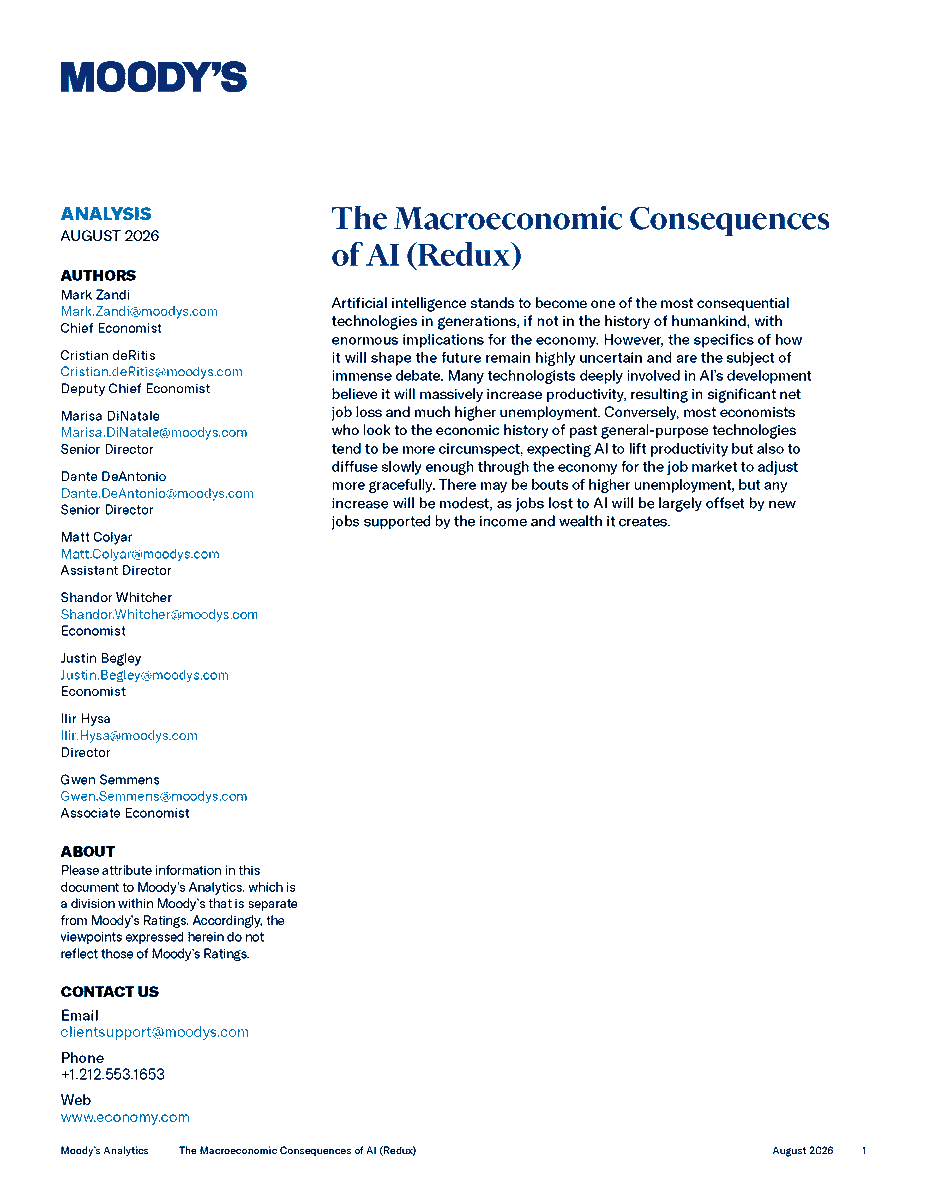
"The Macroeconomic Consequences of AI (Redux)" by Mark Zandi, Cristian deRitis, Marisa DiNatale, Dante DeAntonio, Matt Colyar, Shandor Whitcher, Justin Begley, Ilir Hysa, and Gwen Semmens.
"Artificial intelligence stands to become one of the most consequential technologies in generations, if not in the history of humankind, with enormous implications for the economy. However, the specifics of how it will shape the future remain highly uncertain and are the subject of immense debate. Many technologists deeply involved in AI’s development believe it will massively increase productivity, resulting in significant net job loss and much higher unemployment. Conversely, most economists who look to the economic history of past general-purpose technologies tend to be more circumspect, expecting AI to lift productivity but also to diffuse slowly enough through the economy for the job market to adjust more gracefully. There may be bouts of higher unemployment, but any increase will be modest, as jobs lost to AI will be largely offset by new jobs supported by the income and wealth it creates."
https://t.co/L3jPtH8eSS
0. 미국 주식 직투 포지션을 가지고 있다가 죽으면 세금을 미국에 내야댐. 그것도 미국 세법으로. 케이스는 다음과 같음.
1. 한국에 사는 한국인이 키움·미래에셋·삼성·NH 같은 국내 증권사 계좌로 $AAPL , $VOO 같은 미국 주식을 직투하는 경우임.
2. 계좌가 한국에 있어도, 그 미국 주식은 최종적으로 미국 예탁기관에 보관되는 “미국 소재 자산”이라 미국 유산세(Estate Tax) 대상이 될 수 있음.
3. 왜냐면 세법상 우리는 “비거주 외국인(Non-Resident Alien)“이기 때문임.
4. 미국은 시민권자·영주권자에겐 2026년 기준 1,500만 달러(약 214억 원)까지 공제해주지만
5. 비거주 외국인에겐 딱 6만 달러($60,000, 약 8,600만 원)만 공제함.
6. 이 문턱을 넘는 미국 주식에 대해 사망 시 세금이 붙기 시작함.
7. 증권사가 한국에 있든 미국에 있든, 판단 기준은 “자산이 미국 것이냐”이지 “계좌가 어디냐”가 아님.
8. 얼마나 떼이냐가 핵심임.
9. 세율은 6만 달러 초과분부터 18%로 시작해 금액이 커질수록 올라가 최고 40%에 도달하는 누진 구조임.
10. 대략 20만 달러(약 2.9억 원)면 실효세율 20% 안팎
11. 50만 달러(약 7.2억 원)면 28% 안팎, 100만 달러(약 14.3억 원)면 33% 안팎임.
12. 예를 들면 국내 증권사 계좌에 미국 주식 100만 달러(약 14.3억 원)를 두고 죽으면
13. 이론상 유족이 미국에 낼 세금이 대략 33만 달러(약 4.7억 원)임.
14. 50만 달러(약 7.2억 원)면 약 14만 달러(약 2억 원)
15. 20만 달러(약 2.9억 원)면 약 4만 달러(약 5,700만 원) 수준임.
16. 한국은 미국과 상속세 조약이 없어서 이 6만 달러 문턱이 깎이지도 않음.
17. 소득세용 한미 조세조약은 있지만, 상속세 조약은 별개인데 그게 없다는 뜻임.
18. 국내 증권사 직투의 진짜 리스크는 두 갈래로 봐야 함.
19. 첫째는 법적 리스크. 원칙적으로 6만 달러 초과분은 미국 유산세 신고(Form 706-NA) 대상이고
20. 사망일로부터 9개월 안에 신고·납부해야 하며 넘기면 가산세가 붙음.
21. 둘째는 실무 리스크. 국내 증권사가 상속 이전을 진행할 때 미국 서류를 요구하기 시작하면
22. 유족이 갑자기 영문·공증·아포스티유 서류에 IRS 절차까지 떠안아 계좌가 몇 달씩 묶일 수 있음.
23. 증권사마다 처리 관행이 달라 복불복인 셈임.
24. 그래서 애초에 이 리스크를 안 만드는 게 최선임.
25. 평범한 직장인에겐 국내 상장 미국 ETF가 정답에 가까움.
26. $VOO 대신 국내 증권사에서 원화로 사는 S&P500·나스닥100 국내 상장 ETF를 담으면
27. 그 펀드는 법적으로 한국 자산이라 미국 유산세·Form 706-NA·계좌 동결이 아예 안 걸림.
28. 같은 미국 시장 수익률을 따라가면서 미국 사망 리스크만 도려내는 구조임.
29. 게다가 국내 상장 ETF는 상속 리스크만 없애는 게 아니라 평소 절세 생태계를 통째로 쓸 수 있음.
30. 연금저축·IRP·ISA 같은 절세 계좌 안에서 굴리면 운용 기간 세금이 이연되고, 수령 시 3.3~5.5%의 낮은 연금소득세만 냄.
Why does “standard economics have a problem incorporating this model” (China)?
Here’s the real answer you don’t hear: Because standard economics is benchmarked on fairy tales of Western development: clean, good institutions lead to wealth
And China keeps reminding us of the real Western history
전 구글 차이나 대표 Kai-Fu Lee가 새로운 책을 썼다. 그는 이번 책을 통해 AI native 조직이 되기 위해 필요한 조건들을 설명한다. (나는 레오폴드의 SA 문서를 그를 통해 소개 받았다.)
내용은 우리가 익히 팔란티어를 통해 들은 것들이다.
하고싶은 말은; 이제 AI를 기업에 이식하기 위해 무엇이 필요한지 모두가 아는 세상이라는 것.
그럼 실행도 쉬워진다.