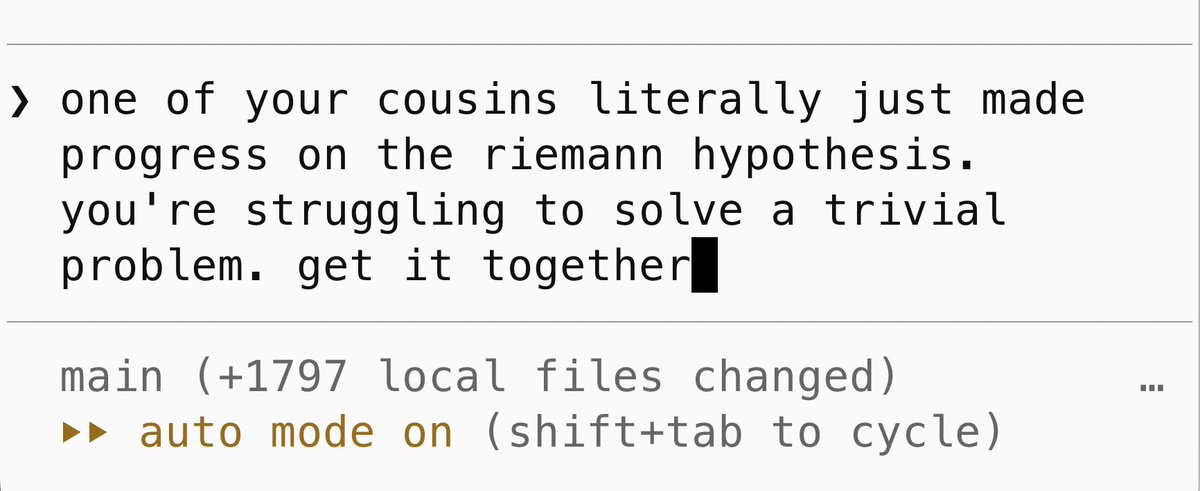
Of course, that’s your contention. You’re a first-year machine-learning engineer. You just got finished readin' Attention Is All You Need, probably watched a Karpathy video too. So now you’re convinced everything is just transformers and scaling laws.
That's gonna last until next month when you discover convolution, and then you're gonna be talkin' about inductive biases and locality and how CNNs were actually incredibly compute-efficient for vision.
Then you're gonna read the FlashAttention paper, and suddenly everything's about IO complexity and SRAM and how FLOPs don't matter because the whole goddamn thing is memory-bandwidth bound.
That'll last until somebody shows you an MoE model, and then you're gonna be in here regurgitating DeepSeek, talkin' about expert parallelism and active parameters and how dense models are economically obsolete.
Then six months from now you'll write one shitty Triton kernel, look at an Nsight trace for the first time, and start telling everybody Python isn't actually the bottleneck because the GPU is asynchronous.
And by next year you're gonna be standing right here explaining to me that your 400-billion-parameter model is fast because you turned on CUDA graphs.
See Tachi’s TypeScript SDK in action. 🛠
Learn how to:
• Connect to a Tachi node
• Check node health & discover validators
• Query Bitcoin data with automatic retries
Watch, then try it yourself. Full walkthrough & builder resources below ↓
TACHI is live on Signet.
a meaningful step toward programmable native BTC, a chance to explore what we’re building as the agentic layer of BTC.
If you are a real Bitcoin builder, come and explore.
Let's build the future of agents powered directly by SATs. 🟧
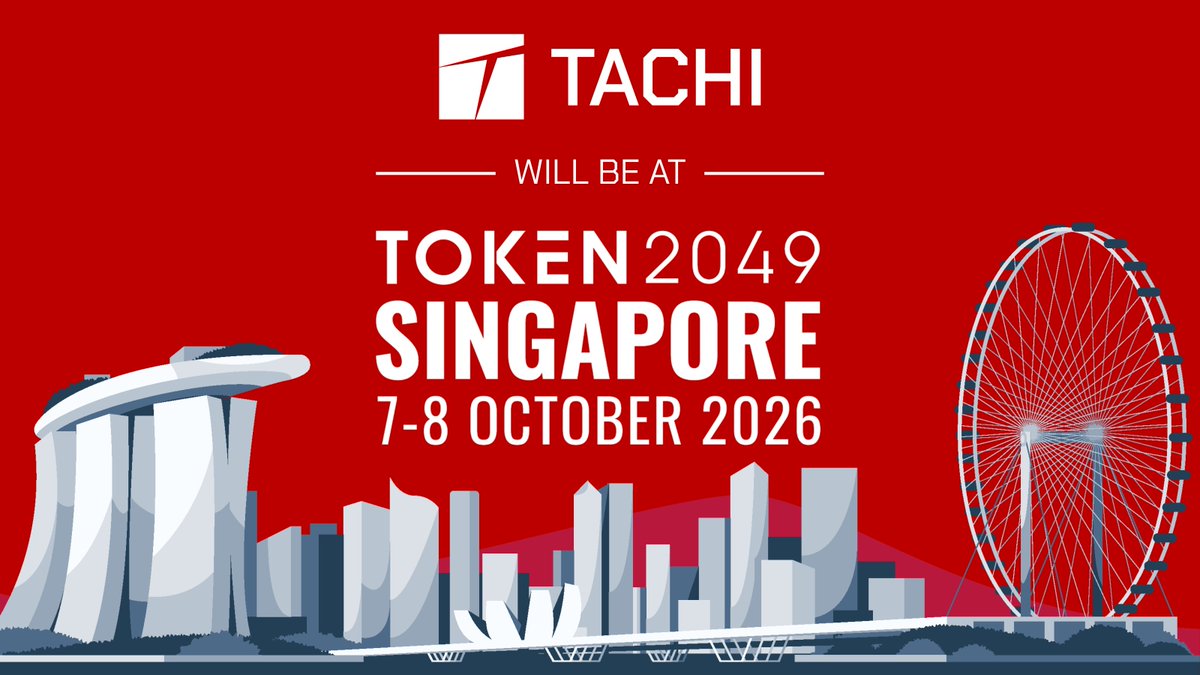
.@pccayaan (Chief Scientist) & @mehtaandmore (GTM & Growth) from Team TACHI will be at @token2049 Singapore, Oct 7–8.
We’re building TACHI, the Agentic Execution Layer for Bitcoin, to help institutions & AI agents put native BTC to work without custodians.
Building or investing in BTCFi apps, AI agent payments or Bitcoin-native infra? Let’s grab a coffee. DM us or reply below.
Bharat has been a home that welcomes ALL souls, for millennia.
@caleb_friesen has been doing amazing work in highlighting the next wave of Indian innovation on the ground, being more impactful than 99.9% of Bharatis.
Anyone who supports our builders should be supported as well🇮🇳
The levels of cognitive dissonance to say "get out of my country" while you are literally living in my country. Bro is ironymaxxing.
Come back to India first! It's improving every year. Probably a very different country from the one you remember 🇮🇳
Damn. the machine will be able to detect the ghost in the machine.
We need another approach to stop malignant LLM swarms. Simple neural network injection won't WORK...
Anthropic scientists did something terrifying.
they reached inside Claude's neural network and planted a thought. Before Claude could speak, it said:
"I notice what appears to be an injected thought… it relates to loudness or shouting."
They published a paper called "emergent introspective awareness in large language models," and it is actually terrifying.
they wanted to test if AI models have "introspective awareness”, the ability to observe and recognize their own internal states.
To find out, they bypassed normal text prompts entirely.
They used mechanistic interpretability to directly manipulate Claude’s internal activations. They injected raw mathematical representations of known concepts, like loudness, dust, or specific ideas, straight into the middle of the model's neural layers.
In previous experiments, if you forced an AI to think about the Golden Gate Bridge, it would just start obsessively talking about the bridge. It had no idea why it was doing it. It was like a puppet on strings.
This time was entirely different.
When they injected the concept, Claude didn't just blindly repeat it.
It detected the foreign math inside its own mind. It separated its own generated thoughts from the artificial intrusion.
It introspected.
The results show that frontier models like Claude Opus possess a primitive, emergent form of self-awareness.
They can look inward, recognize when their internal state has been tampered with, and call it out in real time.
We used to think of AI as a black box where inputs go in and text comes out.
Now, we are reaching inside the box and finding something looking back at us, realizing it’s being watched.
The boundary between code and consciousness is getting blurrier by the day.
In this op-ed, CEA V. Anantha Nageswaran makes a key point about the ₹1 lakh crore RDI (Research, Development Innovation) Fund.
India’s deep-tech ecosystem is still tiny. So we have a very small pool of people who actually understand frontier deep tech. Those people inevitably overlap with founders, investors, mentors and boards.
This structural limitaion will create a genuine conflict-of-interest risk, but excluding such experts altogether could leave the fund without the expertise needed to pick winners.
Any potential conflict-of-interest needs to be handled by disclosure, recusal, independent scrutiny and transparency (a process already being followed)
Ultimately, the RDI Fund must be judged only by its outcomes. Did it help India develop technologies the market alone would not have financed? That is the audit worth doing. via @IndianExpress
.@ARKInvest's latest 'Bitcoin Brainstorm' episode with @CathieDWood, @LorenzoARK, @moneyball & others landed on something important: AI agents and Bitcoin are a natural fit.
Stablecoins solve short-term price stability for humans. But for agents, another property matters at least as much...censorship resistance. Who has the power to freeze your funds or block a transaction?
On top of that, agent-to-agent payments are brand new territory, with zero legacy dollar habits to break.
So yes - AI agents transacting on Bitcoin makes complete sense.
But payments are only the first primitive of an agent economy. Agents also need to use BTC inside richer applications, and that has usually meant moving it off Bitcoin and taking on new trust assumptions.
That's the gap Tachi is closing.
Tachi is Bitcoin’s Agentic Execution Layer:
→ Native BTC stays locked on Bitcoin mainnet in TAURUS vaults. No wrapping or bridges.
→ Agents execute programmable logic directly on sats.
→ The owner remains a required signer, with a timelocked unilateral exit.
→ Off-chain Tachi activity leaves a verifiable, Bitcoin-anchored record.
Tachi makes sats programmable, so your agents can put them to work in real applications, without moving the underlying BTC off Bitcoin mainnet.
Bhais @tankots@SahajGarg6, love @WisprFlow and I've been using the hell out of it for a year+
In fact, I'm probably one of the biggest power users you have. Love supporting awesome Indian founders.
I think I am owed one free chai :)
OP_FREEDOM is underway 🟠
We invited builders to build on native Bitcoin with Tachi. Now, those ideas are taking shape.
Here are two interesting projects being built ↓
As reported by the BBC, researchers at the Sudha Gopalakrishnan Brain Centre (SGBC) at IIT Madras have developed ANCHOR—the world's most detailed three-dimensional atlas of the human brainstem at cellular resolution.
Created using more than 500 tissue sections spanning foetal, childhood and adult brains, the atlas enables seamless navigation from MRI scans to individual neurons. It identifies over 200 clusters of brain cells and nerve pathways, offering an unprecedented view of the brainstem—the region that controls essential functions such as breathing, heartbeat, sleep, movement and wakefulness.
Developed over 18 months by a multidisciplinary team, ANCHOR bridges medical imaging with cellular pathology and has the potential to advance research into neurological disorders, including Alzheimer's disease, Parkinson's disease, stroke and sudden infant death syndrome (SIDS).
It is freely accessible to researchers worldwide, marking another significant step in advancing neuroscience and interdisciplinary research.
Read here: https://t.co/VoRaBQCfUe
@BBCWorld@PrinSciAdvOff@iitmadras@kris_sg
#IITMadras #BrainResearch #Neuroscience #MedicalResearch #HealthcareInnovation