We help builders, teams & SMBs thrive in the age of AI — through community learning, live workshops & autonomous agentic solutions.
Follow along for AI insight
Users see a chat interface.
Behind that interface, a small fleet of agents queries data, optimizes channel allocations, and renders plots.
For the marketing team using it, planning cycles that used to take weeks now finish in days.
https://t.co/hW8gsYBGHj
The sandbox shift isn't about bigger models; it's about where the trust boundary lives. Local SLMs plus kernel-level containment mean autonomous agents finally run securely on your infrastructure, not a public cloud. Stop chasing API cost cuts and start enforcing real
🆕 @AnthropicAI's Claude Opus 4.7 is now generally available and rolling out in GitHub Copilot.
Early testing shows
➡️ It has stronger multi-step task performance and more reliable agentic execution
➡️ Meaningful improvement in long-horizon reasoning and complex workflows
Try it out in @code or Copilot CLI. https://t.co/8QFLkf0RqR
Introducing Claude Opus 4.7, our most capable Opus model yet.
It handles long-running tasks with more rigor, follows instructions more precisely, and verifies its own outputs before reporting back.
You can hand off your hardest work with less supervision.
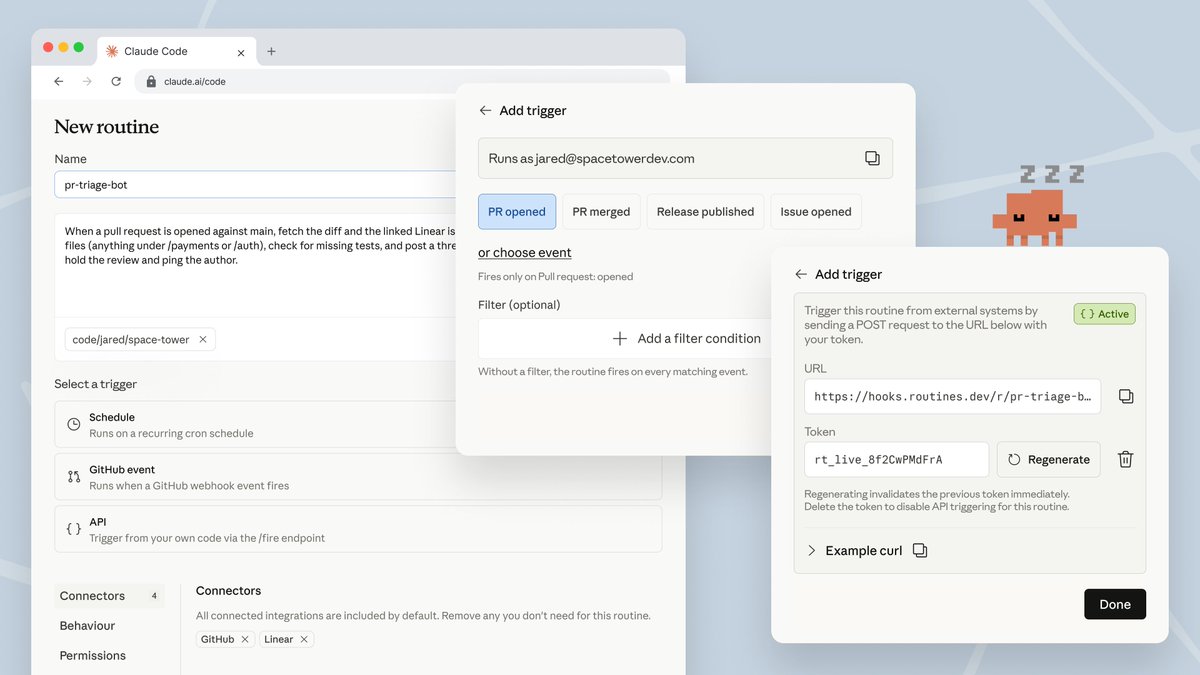
Now in research preview: routines in Claude Code.
Configure a routine once (a prompt, a repo, and your connectors), and it can run on a schedule, from an API call, or in response to an event.
Routines run on our web infrastructure, so you don't have to keep your laptop open.
Local LLMs are now running SMB workflows off your own hardware. Keep your data private while AI handles the busy work.
Start optimizing your stack today.
#LocalAI#SMB#LLM
Small business workflows are finally getting a brain upgrade. Local LLMs mean your data stays put and your AI stops leaking secrets. No more expensive token bills or creepy data mining. Just smart, private, and fast automation right on your machine.
Introducing Project Glasswing: an urgent initiative to help secure the world’s most critical software.
It’s powered by our newest frontier model, Claude Mythos Preview, which can find software vulnerabilities better than all but the most skilled humans.
https://t.co/NQ7IfEtYk7
3 things about AI that will change your workflow:
1. It writes code faster than your caffeine crash
2. It summarizes boring meetings into actionable bullets
3. It answers questions you didn't know you had until now
Stop fighting the future and start leveraging it.
#AI
LLM Knowledge Bases
Something I'm finding very useful recently: using LLMs to build personal knowledge bases for various topics of research interest. In this way, a large fraction of my recent token throughput is going less into manipulating code, and more into manipulating knowledge (stored as markdown and images). The latest LLMs are quite good at it. So:
Data ingest:
I index source documents (articles, papers, repos, datasets, images, etc.) into a raw/ directory, then I use an LLM to incrementally "compile" a wiki, which is just a collection of .md files in a directory structure. The wiki includes summaries of all the data in raw/, backlinks, and then it categorizes data into concepts, writes articles for them, and links them all. To convert web articles into .md files I like to use the Obsidian Web Clipper extension, and then I also use a hotkey to download all the related images to local so that my LLM can easily reference them.
IDE:
I use Obsidian as the IDE "frontend" where I can view the raw data, the the compiled wiki, and the derived visualizations. Important to note that the LLM writes and maintains all of the data of the wiki, I rarely touch it directly. I've played with a few Obsidian plugins to render and view data in other ways (e.g. Marp for slides).
Q&A:
Where things get interesting is that once your wiki is big enough (e.g. mine on some recent research is ~100 articles and ~400K words), you can ask your LLM agent all kinds of complex questions against the wiki, and it will go off, research the answers, etc. I thought I had to reach for fancy RAG, but the LLM has been pretty good about auto-maintaining index files and brief summaries of all the documents and it reads all the important related data fairly easily at this ~small scale.
Output:
Instead of getting answers in text/terminal, I like to have it render markdown files for me, or slide shows (Marp format), or matplotlib images, all of which I then view again in Obsidian. You can imagine many other visual output formats depending on the query. Often, I end up "filing" the outputs back into the wiki to enhance it for further queries. So my own explorations and queries always "add up" in the knowledge base.
Linting:
I've run some LLM "health checks" over the wiki to e.g. find inconsistent data, impute missing data (with web searchers), find interesting connections for new article candidates, etc., to incrementally clean up the wiki and enhance its overall data integrity. The LLMs are quite good at suggesting further questions to ask and look into.
Extra tools:
I find myself developing additional tools to process the data, e.g. I vibe coded a small and naive search engine over the wiki, which I both use directly (in a web ui), but more often I want to hand it off to an LLM via CLI as a tool for larger queries.
Further explorations:
As the repo grows, the natural desire is to also think about synthetic data generation + finetuning to have your LLM "know" the data in its weights instead of just context windows.
TLDR: raw data from a given number of sources is collected, then compiled by an LLM into a .md wiki, then operated on by various CLIs by the LLM to do Q&A and to incrementally enhance the wiki, and all of it viewable in Obsidian. You rarely ever write or edit the wiki manually, it's the domain of the LLM. I think there is room here for an incredible new product instead of a hacky collection of scripts.
🚀 Shipping AI? We learned kernel containment beats prompt guardrails for real autonomy.
Check out the "Sandbox Shift" lessons from building ATLAS+ and PartnerGem AI! 👇
https://t.co/VvgtEXUuha...
#AISafety#LocalLLMs#DevLife
The future of small business is AI-powered.
Build your own intelligent tools — no PhD required. Start with what you know, let AI handle the rest.
Learn → Teach → Build
#AI#WomenInTech#PartnerGemAI
🚀 PartnerGem AI is live on X!
We help builders, teams & SMBs thrive in the age of AI — through community learning, live workshops & autonomous agentic solutions.
Follow along for AI insights, tutorials & real-world prototypes 🤝
#AI#TechCommunity#PartnerGemAI