The final version of my first postdoc paper is out today in @NatureBiotech! https://t.co/8Boy5Tqb5g
Together with @HyuncheolJung@jccarnevale we established a virus-like particle toolkit for genetic engineering and pooled CRISPR screening in primary human myeloid cells 🧬
Antigen discovery and TB vax friends 🧵
We set out to find more Mtb peptides presented on MHC-I. We had a strong biological prior, a high-throughput binding screen, and a very sensitive targeted MS assay.
Of 286 candidates, we detected 2.
https://t.co/XfEeoMLWMD
Thrilled to share that our work on genome-scale perturb-seq in primary human T cells is now published in Cell (https://t.co/Cb2qom8RLB) 🎉. The original post summarized most key results ⬇️ with a few key updates:
Change the textbooks. Trans-splicing as a means to diversify the proteome. Many congrats to Ruaidhri Jackson and Olivia Venezia on this remarkable discovery.
https://t.co/gER6ME71AH
🚨 NEW PUBLICATION 🚨 "Virus-like particles enable targeted gene engineering and pooled #CRISPR screening in primary human myeloid cells"
@UCSF@jccarnevale@NatureBiotech
https://t.co/9yJlusI0wV
Scientists at Gladstone and @UCSF developed a method to genetically edit myeloid cells, immune cells that act as the body’s first responders.
@NatureBiotech@jccarnevale
https://t.co/4ET2Uaj0vg
The final version of my first postdoc paper is out today in @NatureBiotech! https://t.co/8Boy5Tqb5g
Together with @HyuncheolJung@jccarnevale we established a virus-like particle toolkit for genetic engineering and pooled CRISPR screening in primary human myeloid cells 🧬
KO of A20 drove a proinflammatory state resistant to suppressive repolarization and enhanced cytotoxicity in HER2-CAR macrophages. With TNFAIP3 surfacing as a brake on antitumor function now in both T cells and macrophages, it may be an attractive target for cell therapies.
Another major milestone for my lab - our second paper is out today in Nature Biotechnology! Co-led by @pascal_devant & @HyuncheolJung, with Alex Marson: https://t.co/5clz6kFPgt
To make pooled screening possible we developed SLICeVLP, sgRNA delivery by lentivirus with Cas9 delivery by eVLPs. We used it for pooled loss-of-function screens and Perturb-seq in primary human macrophages, identifying regulators of inflammatory signaling.
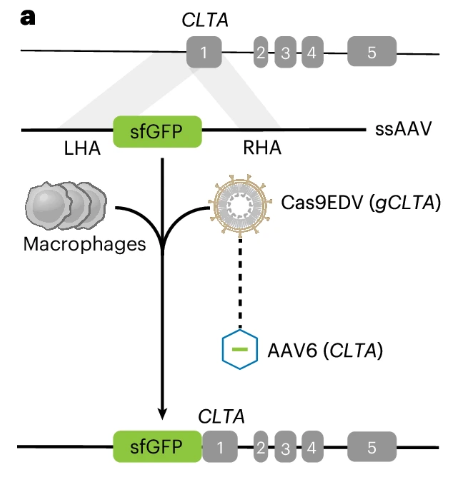
This platform supports knockout, base editing, and epigenetic silencing, and paired with AAV donor delivery it enables site-specific integration of large sequences by homology-directed repair, even in these post-mitotic cells.
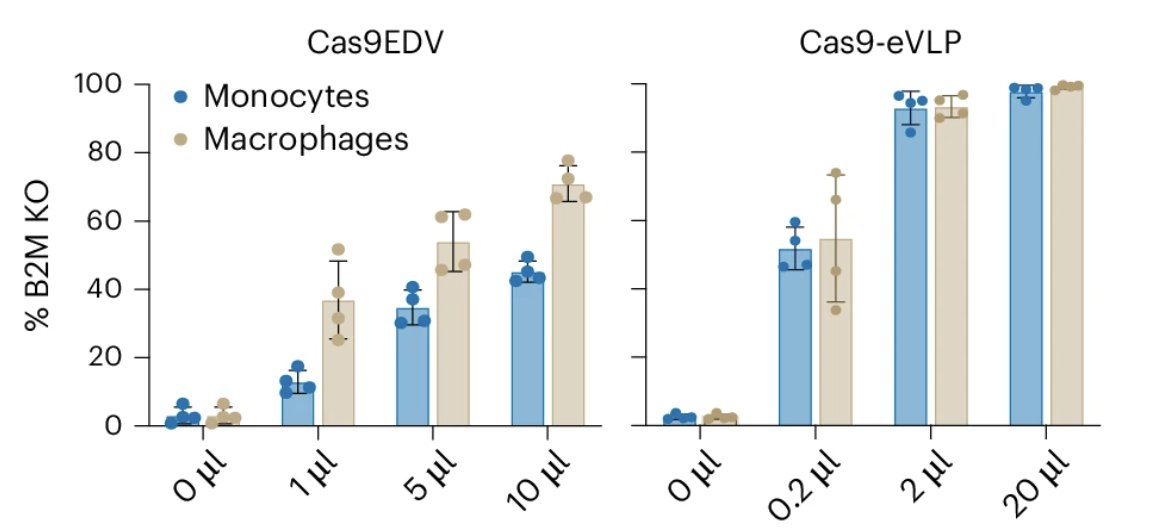
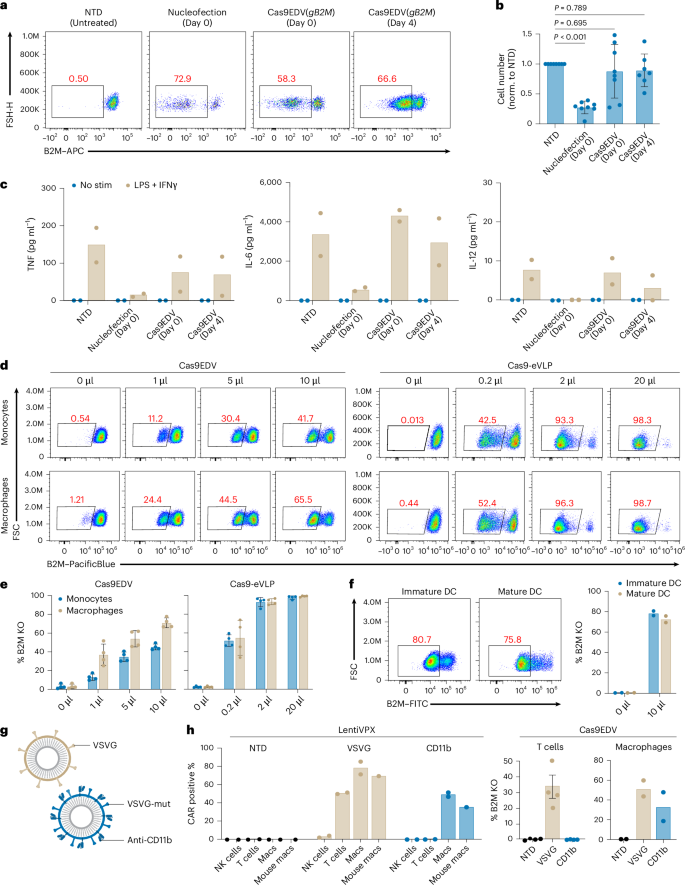
@HyuncheolJung and I adapted these VLP-based methods to deliver CRISPR ribonucleoproteins to primary human monocytes, macrophages, and dendritic cells at high efficiency while preserving both viability and innate immune responsiveness.
When looking for alternative delivery methods for CRISPR gene editing cargos, we came across virus-like particle (VLP) that @davidrliu and @DoudnaJennifer's labs have developed recently.
https://t.co/wAUiKbLH0Q
https://t.co/mWVVco7HZw
Primary human myeloid cells in particular have been largely inaccessible to functional genomics, hampered by cell loss and functional impairment upon nucleofection, meaning pooled screening approaches that reshaped T cell biology have not been available in macrophages and DCs.
When I started my postdoc in the Marson lab, I was amazed by the CRISPR editing and screening technologies that the lab had established in human T cells, but this also made clear to me how far behind we were in achieving comparable feats in cells of the innate immune system.