So many guys follow me with their burner account, them, and the people who slide into my DM requests nodding and agreeing with my tweets are my people.
I understand, optics ni muhimu sana, you're still beholden to those social forces. I'm just here to say I see y'all
🫶🏿🇰🇪✨
@JustEvansK@CuchulainKE It was quite a time juu you would talk to people who had internalized the lore that De Beers manipulate diamond prices na lab grown was just another angle being worked. That was despite all the warnings from the company and industry players. It was quite a time
Priority zones for immediate mapping & early warning infrastructure:
Tana River Basin
Garissa
Budalangi/Busia
Kano Plains,
Kisumu
Mandera & Wajir
Nairobi lowlands
Mombasa & Coast
Isiolo & Tharaka Nithi
Company establishes green rare earth fluoride manufacturing plant based on Necsa intellectual property | See the stuff SA is doing with flourspar. Kenya has flouspar, region has rare earths including neodymium in Tz.
https://t.co/jsXIbbVcj3
This is why a national airline is a strategic asset.
Kenya has never had an international crisis and therefore sees no value in strategic national assets - wewe uko na ngapi tukuuzie
I went back to Fortnum and Mason today and there are more Kenyan teas. There are 2 teas from Imenti Tea Factory, more coming soon apparently. Well done to Imenti tea factory. Kenyans in the UK, make sure you buy them, demonstrate demand so that they can buy more Kenyan teas
The French hate air conditioning.
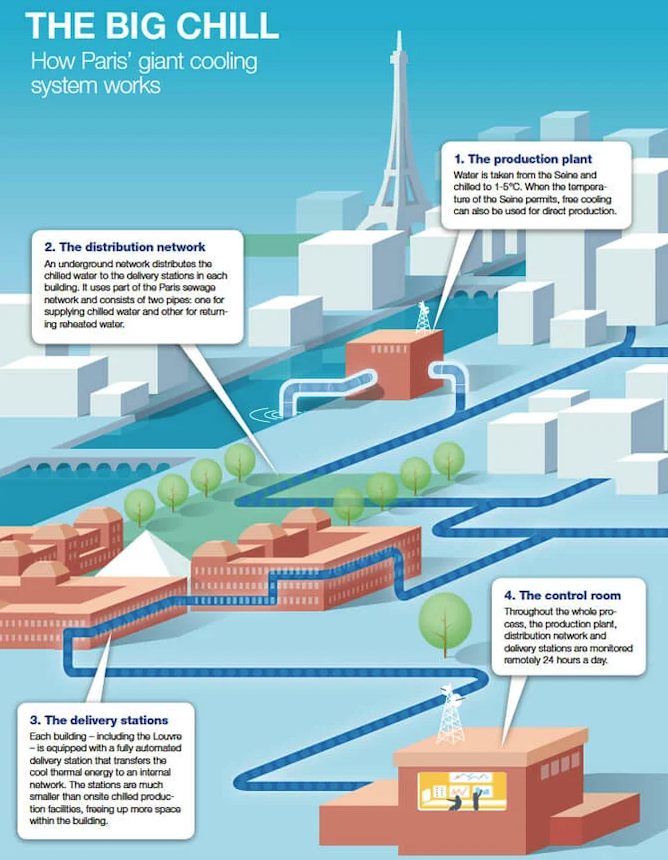
So Paris built a 120-kilometre machine under its streets for producing cold.
It’s called Fraîcheur de Paris, and it does for summer heat what district heating did for winter: centralise the problem.
Instead of every museum, office, hotel, hospital and shop bolting its own cooling plant onto the building, Paris moves cold through pipes.
The network sends water chilled to 2 to 4°C through buried supply lines. The water enters a connected building, absorbs heat through an exchange station, then returns at 12 to 14°C to be cooled again.
It essentially functions with two pipes. One carries the cold out, the other carries heat back.
The production plants cool the circuit from 12°C to 4°C. Some sites use the Seine as a heat sink. In colder periods, the system can use the river’s own temperature for free cooling, which means the machines work less and the electricity demand drops. The Seine water doesn’t become the building water. It stays separate, passing temperature across heat exchangers.
The scale is pretty strange when you see it written down though.
It's got 15 production sites, 4 storage sites, 120 km of underground network with 924 subscribers. This has resulted in 7 million square metres cooled, and 493 GWh of cooling sold.
A cold utility running beneath one of the densest cities in Europe.
The Forum des Halles has been cooled this way since 1979. The Louvre since 1986. Galeries Lafayette, Opéra Garnier, Hôtel de Ville, Station F, La Samaritaine and the National Assembly all sit on the same idea. Tourists stand in the Louvre looking at paintings while a municipal cold loop does part of the dull work below ground.
The boring part is the breakthrough.
Cold can be stored at night in chilled water or ice, then used during daytime peaks. The network is monitored from a control room with more than 125,000 control points. A delivery station inside a building takes 5 to 7 times less space than a standalone cooling installation and avoids the roof and façade clutter that turns cities into compressor farms.
That matters because conventional air conditioning solves heat by moving it somewhere nearby. In a dense city, thousands of private machines mean thousands of outdoor units rejecting heat into streets, courtyards and roofs, plus refrigerants, noise, vibration and maintenance spread across every building.
Paris’s public cooling network has a stated coefficient of performance of 4, against 3 for a wet standalone system and 2 for a dry standalone system. Against an equivalent set of autonomous installations, Fraîcheur de Paris says the network gives 100% higher energy efficiency, 35% less electricity use, 90% fewer refrigerant-fluid emissions and 50% lower CO2 emissions.
The climate backdrop is the real reason this exists.
Paris ran a full crisis exercise called “Paris at 50°C” in 2023. Météo-France’s 2050 reference trajectory for France points to heatwave days becoming five times more frequent, hot nights rising sharply in urban centres, and some local extremes around 48°C becoming possible.
The city signed a 20-year concession in 2022 with Fraîcheur de Paris, owned 85% by ENGIE and 15% by RATP. The contract is worth a projected €2.4 billion. The plan is to extend the network by 158 km by 2042, add 20 production plants and 10 storage sites, and reach more than 3,000 subscribers, including hospitals, nurseries, schools and care homes.
This is basically the infrastructure version of admitting that summer is becoming a public systems problem...
In a country where people don't want even better road signs, would they even dream of better corruption?
Kenyans purely lack ambition beyond raw accumulation
It is funny that if we had kept up provision of public transport and building more markets, we would have avoided the problems that have come with bodas, nganyas and hawkers.
But they were declared loss making and now cargo-cult.
@kinjeketile Even JICA admitted that tackling the matatu menace was a political minefield they couldn't untangle. My take? We didn't need to fight them directly. Sticking strictly to the master plan's trifecta, BRT, NMT, & Commuter Rail, would have starved out the nganya industry organically.
Meja Mwangi sets a bar so high, it's difficult to find many Kenyan authors that good. I'm of the opinion that he should be the most famous Kenyan author
Msijaribu.
This is probably some of you who are younger not remembering that the ban came into place because teachers were beating students into the hospital and even death.
Travel comfortably on the Nyahururu Safari Train with affordable Economy Class fares and premium First Class options to suit your journey.
Check the fare chart, pick your destination, and get ready to experience one of Kenya's most scenic rail routes.
#NyahururuSafariTrain