When two objects share a name, how much of that comes down to how they look?
New preprint: I reanalyzed public data from Lewis & Frank (2018), 520 adults, with a frozen vision model (DINOv2). Visual distance mattered, and so did which examples they saw.
https://t.co/DDYpedNp5v
I updated a JEPA world model's weights with Weight-Space Programming.
No data, no gradients. Just a paragraph describing what changed in the physics of the environment, and an LLM agent that reads the weights and writes the edit.
It works surprisingly well, and it fails in an interesting way.
A new paper from @Poindexter_Labs, following up the "Weight-Space Reading" paper. 👇
What if P = NP becomes practical at human scale? Optimization stops being a structural limit and becomes a bridge — making trade-offs visible, compromises calculable, and longer healthy lives a design parameter rather than a distant dream https://t.co/V9obNNP3IF
@brivael Y ahí comienza el verdadero debate, ese filósofo, pianista, ajedrecista, intelectual de elite, estará cómodo lavando platos y cocinando para alguien claramente inferior y con quién no tiene ninguna obligación?
Microsoft changed the game
Microsoft released bitnet.cpp, a framework for running 1-bit language models.
It can run models with 100B parameters on your CPU alone.
> Up to 6.17x faster inference
> Up to 82.2% lower energy use on CPUs
100% open source.
The Lean FRO and Mathlib Initiative have released a joint statement on the Lean verification of the Riemann Hypothesis.
On November 20, Levent Alpöge released a proof of the Riemann Hypothesis as a Lean library of 17 million lines of code. Over the past day, the Lean and Mathlib communities worked together to verify it. The statement certifies the proof as correct and describes how it meets all necessary verification criteria.
Congratulations to Levent on this achievement, and thank you to everyone in the community who contributed to the verification.
Full statement: https://t.co/edxEbkodw7
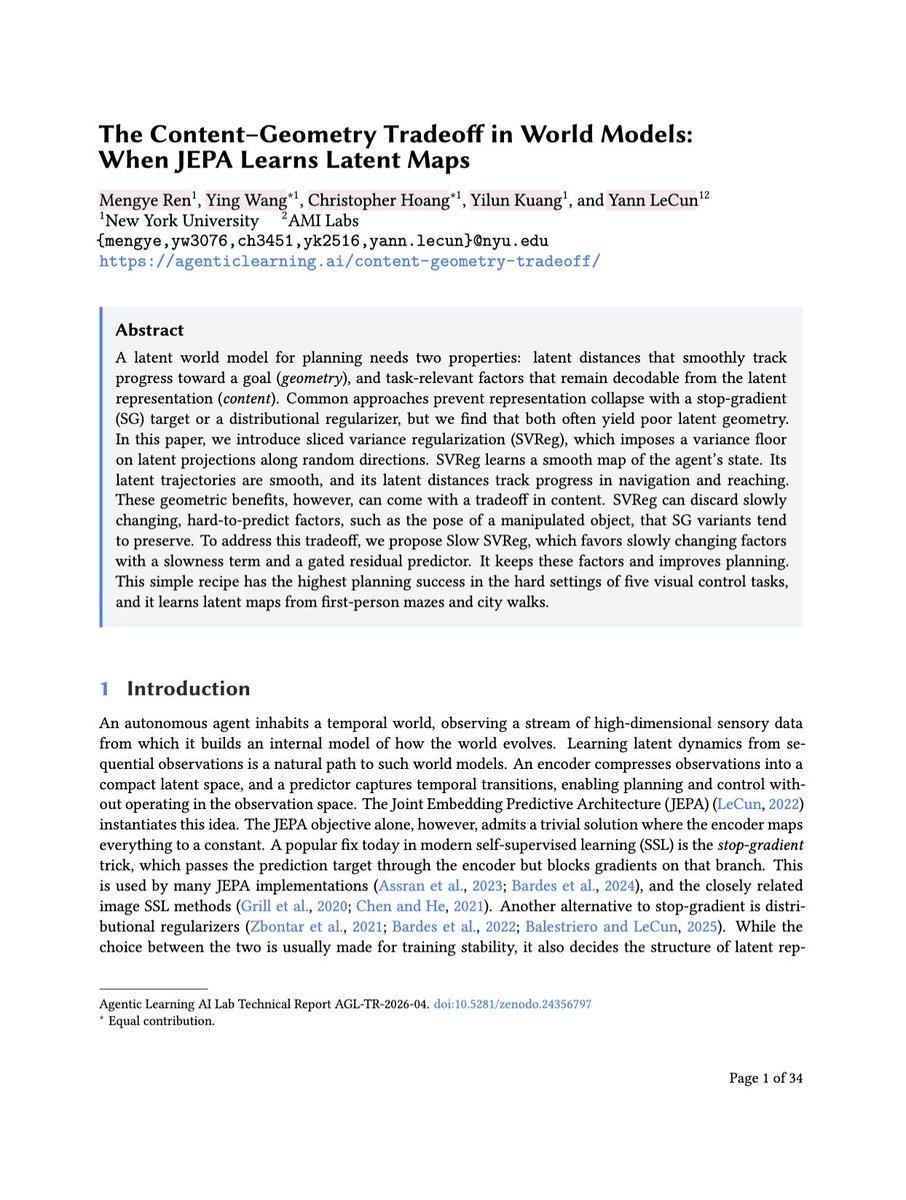
Yet another amazing JEPA paper, and it's also supervised by Yann LeCun!
"The Content–Geometry Tradeoff in World Models: When JEPA Learns Latent Maps"
JEPA world models have a tradeoff where they can learn a smooth map for navigation, but would lose track of objects they need to interact with.
So this paper introduces Slow SVReg, which helps the model learn a smoother map of its environment while preserving important details, such as the positions of objects that change slowly.
On difficult first-person maze navigation, Slow SVReg improves planning success from 21.2% to 92.9% compared to a standard stop-gradient baseline. On the PushT manipulation task, success increases from 44.0% to 87.3%.
https://t.co/jpCgYKmSPI
@no89thkey En parte es como dices. Aún así necesitamos de matemáticos para que la comprensión de estos problemas no se nos escape. Tal como funcionan los ajedrecistas profesionales hoy en día
BREAKING: A mathematician at Anthropic claims to have used the company's AI to solve the Riemann hypothesis, the most notorious open problem in all of math
https://t.co/nEXAyIkvSt
@giulioprisco@emollick Creo que nunca se debe perder la capacidad de decir me equivoqué, sigamos por otro camino. Ya que eso también implica un avance siempre.
Correct numbers. Wrong report.
An experiment with ChatGPT, Codex, and Grok bot turned academic research into a reusable agent skill.
The real lesson? Accuracy isn't enough. Context matters. https://t.co/rsnVzFrkmi
@elonmusk Siempre me preguntó cómo será el equipo de las temibles se��oras de recursos humanos en las empresas de @elonmusk para entrar en cualquiera de sus empresas
introducing Gemini 4 Neon: frontier-level intelligence with fast end-to-end task completion across complex software engineering, knowledge work, and science workflows
priced at $3 per million input tokens and $15 per million output tokens, with a 1 million-token context window
try it today via the Gemini API and in AI Studio https://t.co/dp8Frcr6y8