Part of why it's so important to have a hard line about absolutely no violence at a protest for any reason - even in response to govt violence - is that there are a lot of people who don't care about your cause but want an excuse to destroy things.
What happened when the U.S. sent 400,000 Mexican workers back to Mexico in the 1930s?
The employment rate of native workers went down noticeably as a direct result.
(Yes, you read that correctly.)
This is one of the best biotech 'request for startups' I've seen. Virtually all of these are also on my personal list of companies I'd like to help / support / invest in.
Stupid policy passes 100-0 bc it seems to benefit everyone - workers get more, businesses don’t have to pay for it.
But the carve-out costs billions that could 2x the EITC for all low-wage workers, not just tipped ones.
soundbites over sound policy, as per usual :(
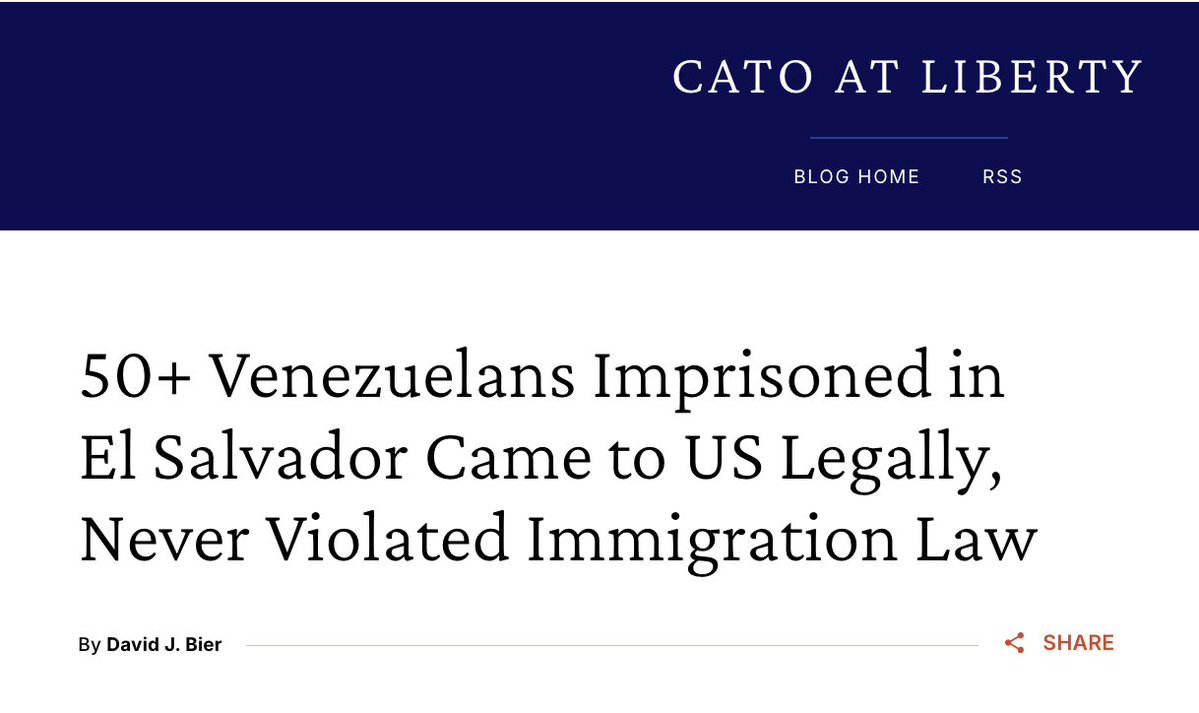
Cato published my review of the ~240 Venezuelans the US government renditioned 2 months ago to Salvador’s notorious prison. We identified FIFTY who came legally, never violated any immigration law, but are imprisoned at the US government’s request and at US taxpayer expense.
Purely individual decisions often produce the same paradox.
Some forecast better than others, and improvement is always possible. But misprediction—and, with it, surprise and regret—are unavoidable.
Trump's tariffs were popular before the election but became unpopular when implemented. Congestion pricing in NYC saw the opposite happen.
People like "populism" and dislike "neoliberalism," but then watch populism fail and neoliberalism succeed.
Paradox of democracy.
In addition to these obviously correct points, Trump’s demand for ideological diversity at Harvard makes one more carryover mistake from DEI: assuming ideological diversity in academia should be achieved through self-similar diversity within each institution.
In any healthy market-based system, inter-institutional variation will account for much of the overall diversity on any important dimension. It won’t all appear as intra-institutional diversity.
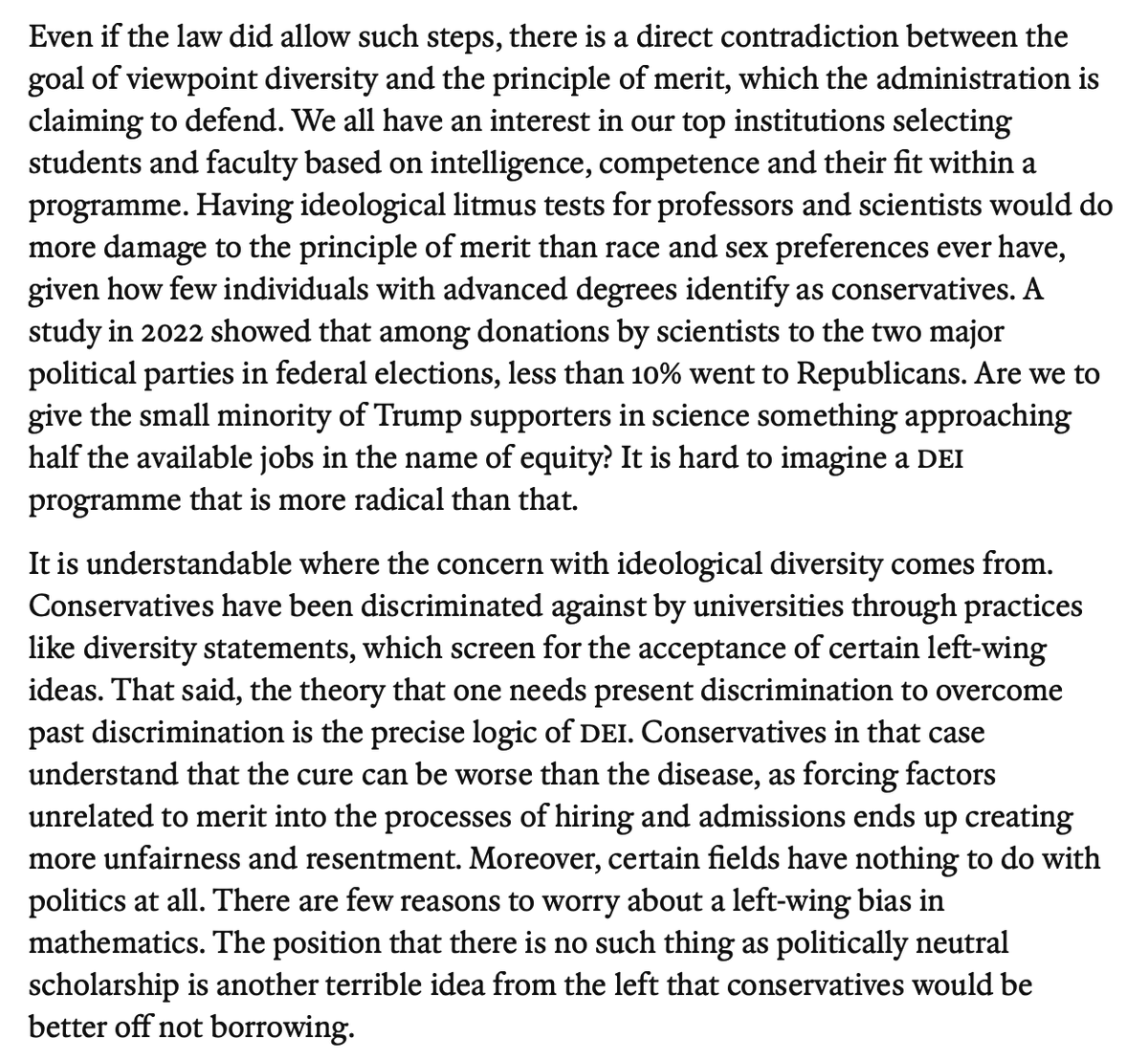
Me in The Economist on the problem with Trump's demand for "ideological diversity" at Harvard:
It is understandable where the concern with ideological diversity comes from. Conservatives have been discriminated against by universities through practices like diversity statements, which screen for the acceptance of certain left-wing ideas. That said, the theory that one needs present discrimination to overcome past discrimination is the precise logic of DEI. Conservatives in that case understand that the cure can be worse than the disease, as forcing factors unrelated to merit into the processes of hiring and admissions ends up creating more unfairness and resentment. Moreover, certain fields have nothing to do with politics at all. There are few reasons to worry about a left-wing bias in mathematics. The position that there is no such thing as politically neutral scholarship is another terrible idea from the left that conservatives would be better off not borrowing.
The absolute hardest thing to convince people of is that the optimal amount of fraud in a system is not zero. Obviously it would be ideal if there were no fraud, but at some point the cost of catching it outweighs the benefits
The timing of the anti-neoliberal story just doesn't add up.
Wage growth stagnated before globalization took off. When globalization took off, working-class men's wages started growing again.
Free trade didn't destroy the Rust Belt.
It was labor unions.
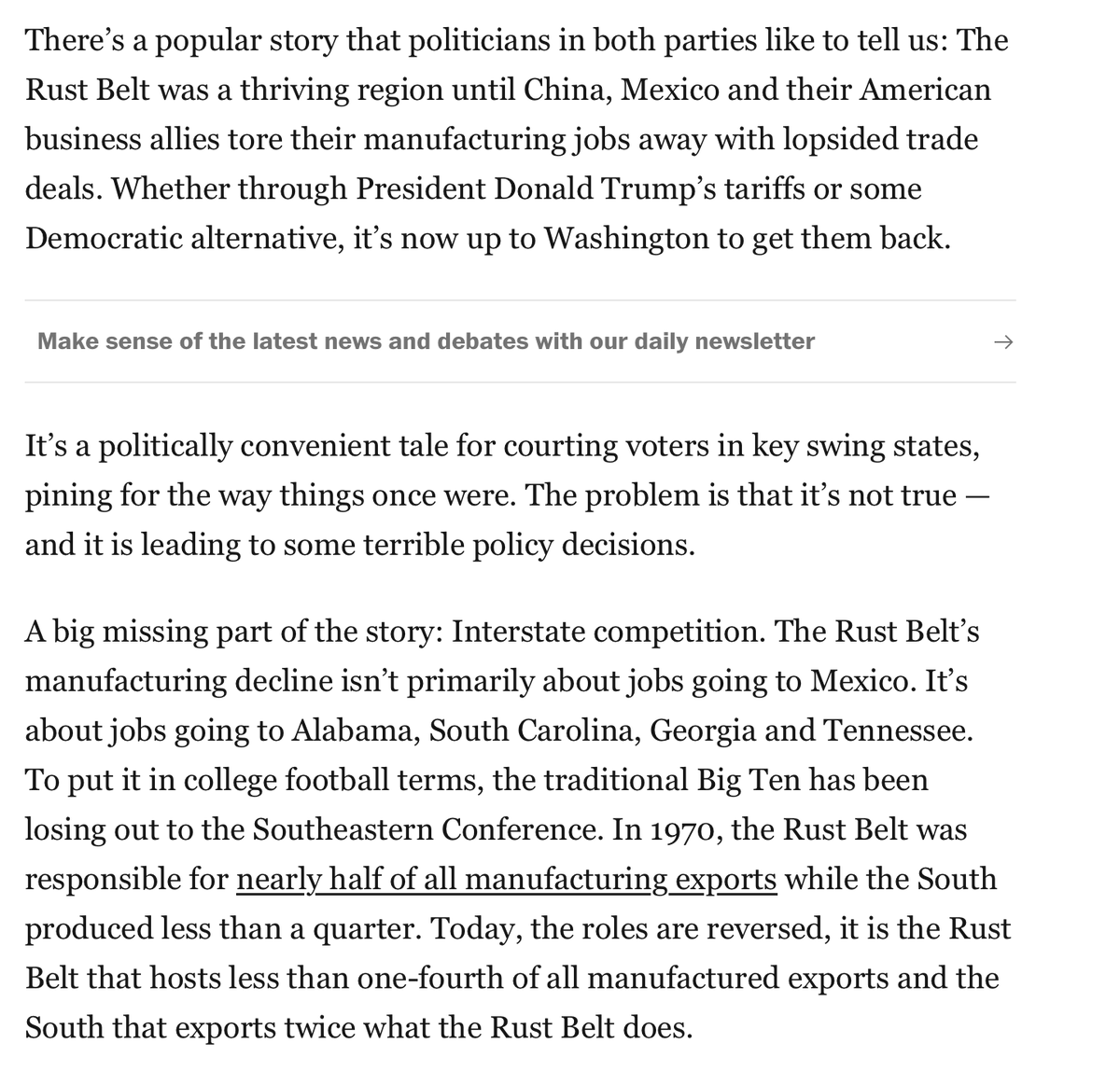
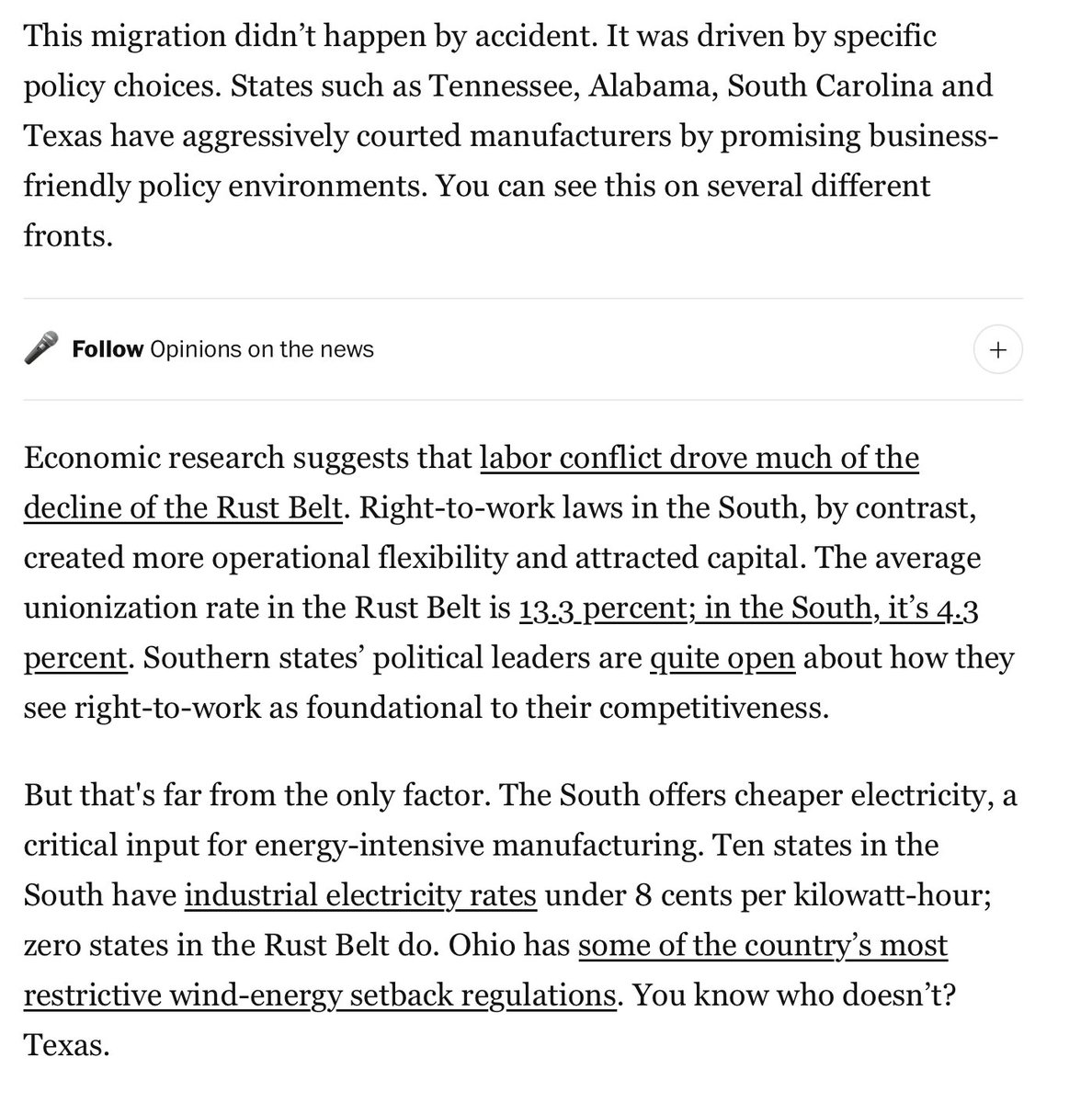
"The Rust Belt’s manufacturing decline isn’t primarily about jobs going to Mexico. It’s about jobs going to Alabama, South Carolina, Georgia and Tennessee."
I’ve got an article out in the Washington Post today explaining how the South is doing so well in manufacturing and why neither party wants to talk about it. The #1 auto exporting state isn’t Michigan, it’s Alabama. How did that happen? 1/4 (link below)
@devahaz The mistake seems to be here. While it may *feel* like an existential crisis to progressives used to continually winning, it hardly *is* an existential crisis.
https://t.co/MnbQHitIVs
10/ Stunningly, attitudes on trans went ‘backwards’ after 2022, the first cultural reversal for the liberal left in a century. For a movement used to being in the vanguard of history, this is an existential crisis (UK data via @YouGov, points for years 2021-24)