🚨 NEW AI Engineering Community
Join our Community server and connect with other data scientists, AI engineers, and software developers.
Share your knowledge, ask questions, and receive expert tips on AI, machine learning, and coding.
Join for free:
https://t.co/TAn7g5iZd6
ROC plot - Clearly explained 👇🏽
💡 You can use an ROC (Receiver Operating Characteristics) curve to evaluate the results of a classifier. The ROC curve represents the trade-off between the True positive rate (TPR) and the False positive rate (FPR).
🤔 Specificity and Sensitivity
The True positive rate is also called sensitivity, and the True negative rate (TNR) is called specificity.
Specificity is a measure for the whole negative part of a data set, while sensitivity is a measure for the whole positive part.
🤖 The ROC plot uses the True positive rate (TPR) on the y-axis, and the false positive rate (FPR) is on the x-axis (formula FPR = 1 - TNR). You see a visual explanation in the figure.
😎 To interpret the ROC curve, note that a classifier with a random performance level is a straight line from the origin (0, 0) to the top right corner (1, 1).
A poor classifier lies below this line, and a classifier improves as it deviates upward from the bisector.
📊 Another criterion in the ROC curve is the area under the ROC curve (AUC) score. Here, we calculate the area under the curve. A good classifier has an AUC-Score > 0.5.
---
If you found it insightful, repost it with your network.
Find us → @tinztwins
Every day, we share tutorials and insights on ML, LLMs, and AI Agents.
Do you want to learn how to implement an artificial neural network from scratch using NumPy?
Learn more in our FREE super-detailed guide.
https://t.co/obhw8b22Pu
It’s like a USB-C port for AI systems.
MCP is more than just hype; it will be a crucial part of almost every software product in the coming years.
Link to our Python guide:
https://t.co/HmRZqJjEGl
🚀 Expose Your Agno Agent as an AG-UI Compatible App!
AG-UI (Agent-User Interaction Protocol) standardizes how AI agents connect to frontend applications.
It’s like a universal translator for AI-driven systems.
https://t.co/vI4oyL3nNu
Let’s build a Local AI Agent with Knowledge and Storage Using @AgnoAgi 🚀
- 100% Local and Open Source
- Agno to implement the AI agent
- Agno Agent UI as an intuitive Agent interface
Link to our FREE guide in the comments.
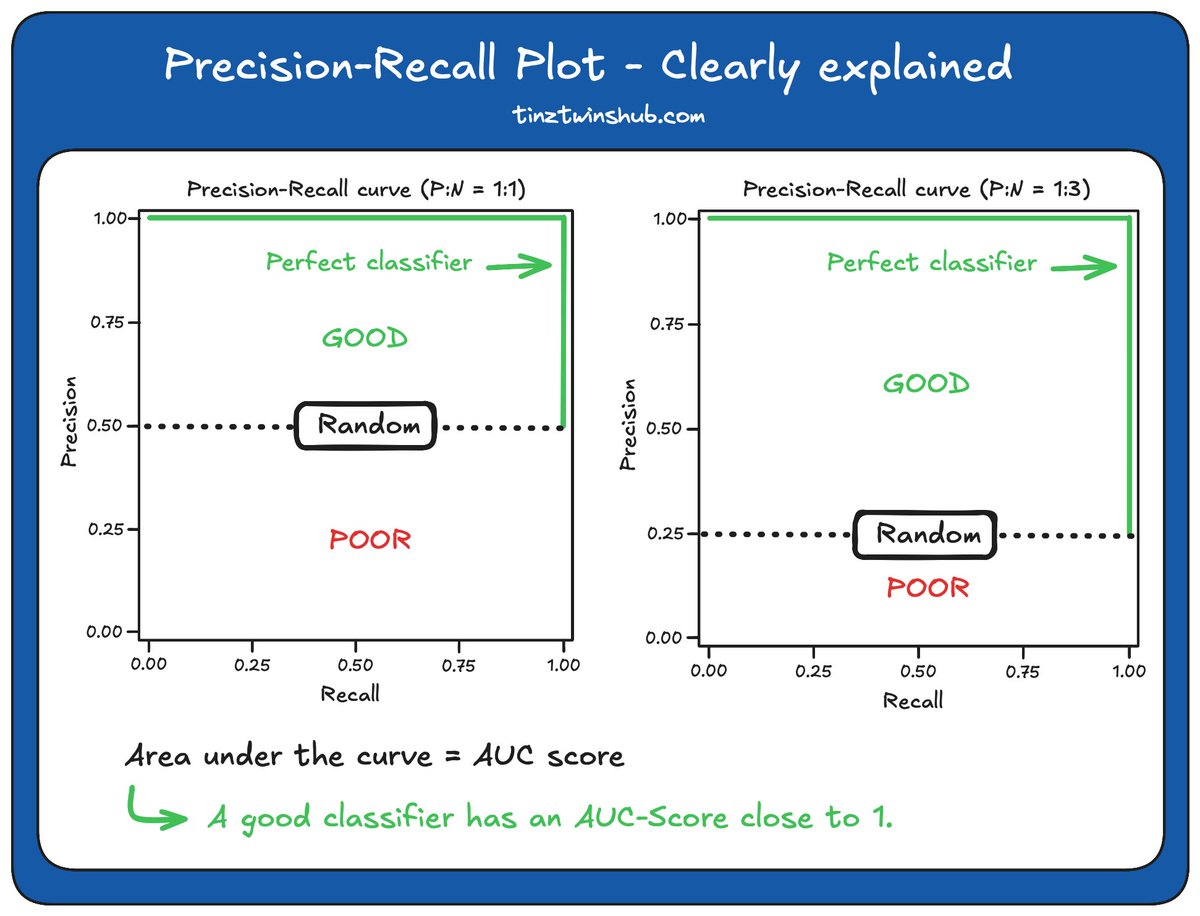
Precision-Recall plot - Clearly explained
🔍 The precision-recall plot is a model-wide measure for evaluating classifiers. The plot is based on the evaluation metrics of Precision and Recall.
🧐 Recall (identical to sensitivity) is a measure of the whole positive part of a dataset, whereas precision is a measure of positive predictions.
The precision-recall plot uses precision on the y-axis and recall on the x-axis. You see a visual explanation in the figure.
🤔 It is easy to interpret a precision-recall plot. In general, precision decreases as recall increases. Conversely, as precision increases, recall decreases.
💡 A random classifier lies on the y-axis (precision) at y = P/( P + N ) (P: number of positive labels, N: number of negative labels). A poor classifier lies below this line, and a good classifier lies well above this line.
🌟 You can see two different plots in the figure. On the left side, you see the random line is y=0.5. The ratio of positives (P) and negatives (N) is 1:1. On the right side, you see the random line is y=0.25. There, we have a ratio of positives and negatives of 1:3.
📊 Another quality criterion in the precision-recall plot is the area under the curve (AUC) score, where the area under the curve is calculated. An AUC score close to 1 characterizes a good classifier.
Let’s build a stock dashboard using pure Python! 🚀
- @getreflex to implement the UI
- @openbb_finance for the stock market data
- @plotlygraphs for the charts
Link to our detailed guide in the comments.