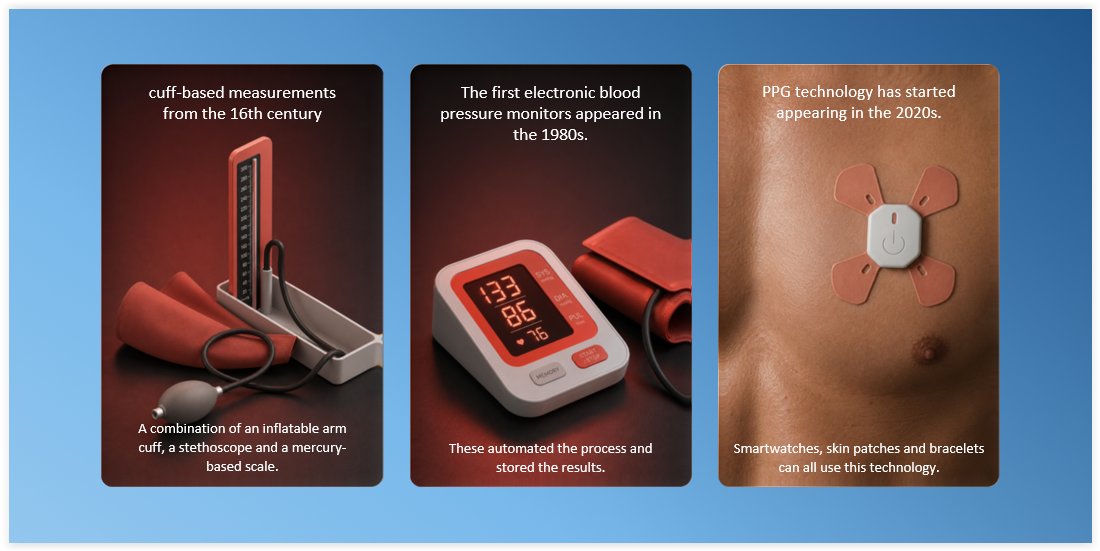
Analyzing the evolution of certain medical technologies tells us more about their future than what devices we can actually use today.
Here is an example everyone knows about: blood pressure cuffs.
From the first experiments in the 16th century, blood pressure (BP) monitoring has evolved tremendously; current devices can connect with our phones, allowing patients to record their readings and share them with their doctors.
But, with the use of PPG technology, devices became sleeker and lighter and can continuously monitor blood pressure in real-time, which might make blood pressure monitoring as common as heart rate monitoring on wearable devices.
We could even see them become as common as heart rate monitors on smartwatches in the near future; further increasing access to monitoring one’s blood pressure. And when such devices make it to the market, we’ll be sure to report on, if not review, them.
Roger Craig was the ultimate dual-threat RB and now he's headed to the Pro Football Hall of Fame 🙌
@ProFootballHOF Enshrinement -- Aug. 8, 12pm ET on @NFLNetwork
Stream on @NFLPlus
Attackers have frontier AI. Defenders need a frontier AI ecosystem—the best open and closed models, force-multiplied by a global community.
During the Hugging Face incident, closed AI blocked essential forensics. An open-weight frontier model helped contain the intrusion.
That’s why we created the Open Secure AI Alliance.
Proud to join @nvidia as a founding member of the Open Secure AI Alliance. Defenders need open tools, collaboration, and transparency to secure AI agents and systems. And customers want the ability to choose the best open or closed models.
https://t.co/xlDZKO0y89
Shipping containers full of B300s + open weight models + Palantir AIP running anywhere in the world managed by Apollo 🔥
We showed this off last fall as part of our Sovereign AI OS reference architecture.
Everyone is talking, we have been delivering.
BREAKING: @PalantirTech is deploying open-weight AI models at the edge using @armada_ai modular data center infrastructure, combining B300 GPU systems, AIP and Apollo to run sovereign AI in austere environments while maintaining control over sensitive data.
New Wearable Ring Tracks Glucose, Ketone and Other Biomarkers in Sweat Simultaneously.
Engineers at the University of California San Diego created a smart ring that simultaneously and continuously monitors up to four different chemical biomarkers from finger sweat.
The complete array of biomarkers the smart ring can monitor in sweat consists of: glucose, ketones, vitamin C, uric acid, lactate and alcohol.
In a new paper published in Nature Communications, UC San Diego engineers in the lab of Joseph Wang, professor in the Aiiso Yufeng Li Family Department of Chemical and Nano Engineering at the UC San Diego Jacobs School of Engineering, report results from what they believe is the first fully integrated smart ring for daily biochemical monitoring.
“Commercial rings only provide biophysical information, but they lack molecular information about biochemical markers that offers deeper insights about an individual’s health status,” said study first author Tamoghna Saha, a postdoctoral researcher in Wang’s lab.
For the ring to detect biomarkers in sweat, exercise or other exertion is not required; sweat is passively drawn up through the surface of the skin via osmosis using a technique pioneered by Saha.
Tracking multiple biomarkers simultaneously has the potential to broaden the real-time health picture in many different scenarios, including diabetes management and nutrition tracking.
“A ring capturing dynamic molecular information in real time would be extremely useful for making informed decisions regarding health, diet and lifestyle,” said Wang. “For example, the ring’s ability to track both glucose and ketone continuously and simultaneously would greatly benefit optimal insulin dosing for the management of diabetes.”
In trials with healthy volunteers and people with type‑1 diabetes, the biomarker smart ring’s glucose readings closely tracked those from commercial continuous glucose monitors (CGMs), while the ketone readings closely tracked ketone readings from commercial blood meters.
On track for Starship’s 13th flight test later today – the 90-minute launch window opens at 5:45 p.m. CT. Live coverage starts ~30 minutes before launch
We just unveiled the next era of Abridge.
An AI-native clinician intelligence platform built around the moment that matters most: a clinician caring for a patient. Happy Friday.