Studied Gdf15-Gfral in my PhD and it remains endlessly fascinating. Favorite protein by far. "A loss-of-function variant in GFRAL associates with increased alcohol consumption in humans" https://t.co/ydYMXhFdP0
Remarkable how much discussion there is about an n=1 dog cancer vaccine, meanwhile Moderna/Merck's Ph3 RCT of a personalized cancer vaccine in melanoma (>1000 patients) is expected to read out this year, with 2yr, 3yr, and 5yr Ph2b follow-up already in hand/published (~150 patients), plus 2 Ph3s in lung cancer ongoing and an additional 7 Ph1/2 studies in other cancers...
What the gel? "These 3D semiconductors, in the form of hydrogels, realize millimeter-scale modulation thickness while achieving tissue-like softness and biocompatibility." https://t.co/gBRTPxktPy
Cool paper. Another pro-natalist argument for your feed: "Parity and lactation induce T cell mediated breast cancer protection" https://t.co/Hao7nqk9J1
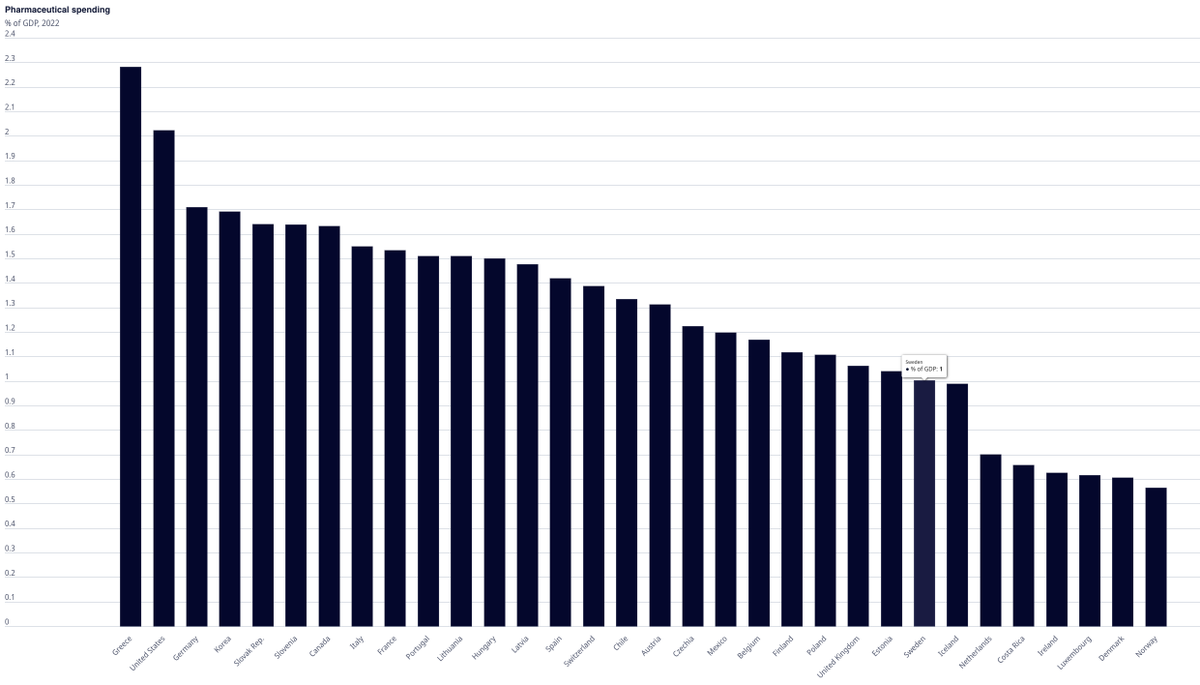
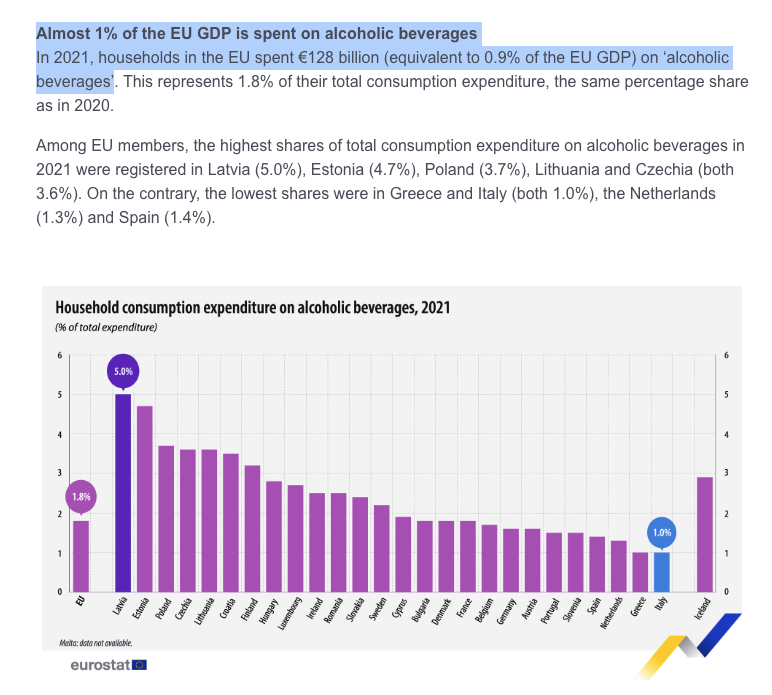
Here is a plot on %GDP spent on pharmaceuticals in 2022 from this link: https://t.co/ATrRZqmChT. USA at around 2% of GDP with all European countries (except Greece) below 1.7%. Sweden at 1% of GDP. Norway and Denmark at 0.6%. Meanwhile almost 1% of EU GDP is spent on alcohol. See here: https://t.co/bqnd5xbt8l. Make it make sense please.
Interesting: "We found that 1) people from cultures with short sleep durations do not suffer from more negative health outcomes; 2) the optimal amount of sleep duration varies between cultures, and 3) people whose sleep duration is closer to their cultural ideals enjoy better health." https://t.co/Nv0H50qMOI
Here is a plot on %GDP spent on pharmaceuticals in 2022 from this link: https://t.co/ATrRZqmChT. USA at around 2% of GDP with all European countries (except Greece) below 1.7%. Sweden at 1% of GDP. Norway and Denmark at 0.6%. Meanwhile almost 1% of EU GDP is spent on alcohol. See here: https://t.co/bqnd5xbt8l. Make it make sense please.
remarks from pascal, ceo of Astra, on their earnings call this morning that sums up current state of eu drug market well: "the US has been funding innovation for our industry for a long time. and we believe that europe has to invest a greater share of their healthcare expenses, and that share has been declining steadily over the last number of years, down to 7% of health care budget being allocated to innovative medicines in the UK. what can you do with 7%.. of course not much. so the investment in innovation and pharmaceuticals in europe has to go up.... i really think the key piece is that europe, at least the richer countries, have to contribute more to pharmaceutical innovation, just like they have to contribute more to their own defense."
@Medscape Unless someone could, you know, negotiate with the drug companies of pharmacy benefit managers to reduce the cost of these drugs so they become cost-effective. One can dream, I suppose...
PSA:
Thanks to Roche/Genentech and Amgen scientists, these 2 papers have probably the most extensive immunogenicity (ADA%) for approved antibodies.
https://t.co/RUezUIJayj
https://t.co/GUDBpAiXsR
🚨🚨🚨BREAKING:
Microsoft CEO was just asked about the future of building foundational models
“I do believe the models are getting commoditized. OpenAI is not a model company it’s a product company..”
LMFAOOO
You wrote: "these two reports, generated in a matter of hours, could potentially accelerate our understanding and treatment of this disease by months or even years!". So I was evaluating the AI output. Microbiome dysbiosis and SCFAs is 1/3 of the new hypotheses from deep research. Butyrate/microbiome is mentioned 100+ times. I write this as someone bullish on AI in bio.
I love deep research. But I have to say I find it hilarious that an "outstandingly good" research report from Deep Research has one of the key insights that we should study gut microbiome dysbiosis and butyrate in chronic fatigue syndrome.