🚨🔴 BREAKING: Can a Bank Still Auction Your Property After You Have Cleared the Default?
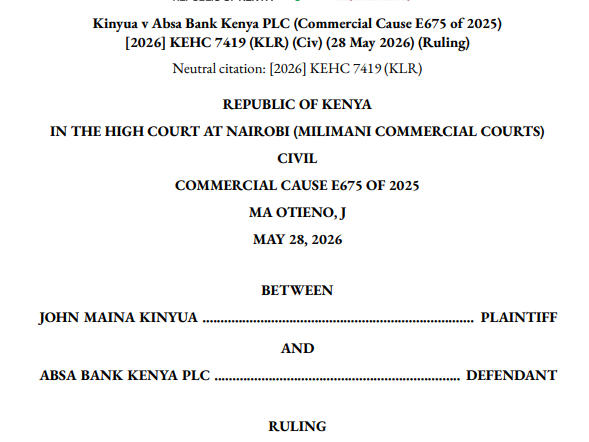
The High Court has confronted a question that keeps many developers, landlords, and investors awake at night. In Kinyua v Absa Bank Kenya PLC, a property owner had secured an KShs 80 million facility using two commercial properties in Sigona. When repayment difficulties emerged, the bank issued statutory notices and proceeded to recall the entire outstanding loan balance, nearly KShs 80 million, despite the facility having been structured to run for approximately fifteen years. The borrower rushed to court arguing that although there had been a default, he had subsequently brought the account up to date and cleared the arrears before the recovery process was completed. The dispute therefore shifted from whether there had been a default to a more complex question: once a lender accelerates an entire facility, can later payment of the arrears stop the auction process?
The Court found that this was not a straightforward debt recovery case. What persuaded the judge was the bank's own records showing that the arrears had been reduced to zero and the account regularized. Justice Moses Ado questioned whether a lender could lawfully proceed with a forced sale of valuable commercial assets when the very default relied upon to trigger the process had already been cured. The Court emphasized that statutory power of sale must be exercised strictly within the law and in accordance with equitable principles, warning against premature foreclosure where the underlying breach no longer exists. An injunction was consequently issued stopping the intended auction pending determination of the suit.
The decision is likely to attract significant attention within Kenya's real estate and banking sectors. It suggests that courts may increasingly scrutinize accelerated loan recalls, particularly where borrowers have demonstrated willingness and ability to regularize their accounts. For investors whose projects depend on long-term financing, the judgment raises an important commercial principle: the statutory power of sale is not merely a contractual remedy but a legal process subject to fairness, proportionality, and judicial oversight. The ruling may therefore become a valuable precedent in disputes involving distressed developments, income-generating properties, and large-scale commercial lending facilities.
Kindly retweet. 🙏🏽
🇮🇹🇬🇧 Ferrari just unveiled its first EV, and they brought in the man who designed the iPhone to do it.
Jony Ive's studio shaped the Luce into something that looks more like a glass house than a sports car.
€550,000, 5 seats, 530km range, and four electric motors, one on each wheel.
Ferrari added artificial engine sounds, inspired by an electric guitar, because petrolheads never fully forgive silence.
The waiting list is already full. The debate about whether it's a Ferrari or an Apple on wheels is just getting started.
Source: Financial Times
Ruqaya Jaber fled the city of el-Fasher on foot on the day the RSF took over. She fled with a group of men and women. When the RSF stopped them, the men were pulled aside and only the women were allowed to continue
Watch the full investigation on YouTube: https://t.co/X2q5NxhUBz
🇨🇳 Even in 2011, Lei Jun was handing out flyers in the streets for Xiaomi’s first phone while people ignored him like a complete nobody.
By 2026, he was sitting at a state dinner with Trump and Xi, taking selfies with Elon.
Most Americans still think geopolitics is politicians giving speeches at podiums.
That’s the old world.
What President Trump is doing in Beijing right now is something entirely different:
Using CORPORATE POWER as a geopolitical weapon.
Look at the delegation he assembled for China:
• Elon Musk - Tesla / SpaceX
• Tim Cook - Apple
• Jensen Huang - Nvidia
• Larry Fink - BlackRock
• Stephen Schwarzman - Blackstone
• David Solomon - Goldman Sachs
• Jane Fraser - Citigroup
• Kelly Ortberg - Boeing
• H. Lawrence Culp Jr. - GE Aerospace
• Brian Sikes - Cargill
• Cristiano Amon - Qualcomm
• Sanjay Mehrotra - Micron Technology
• Ryan McInerney - Visa
• Michael Miebach - Mastercard
• Dina Powell McCormick - Meta
This is not diplomacy.
This is strategic market penetration.
Now look at HOW carefully this lineup was built:
🚨 AI & CHIP DOMINANCE
• Jensen Huang (Nvidia)
→ AI chips powering the global AI revolution
• Cristiano Amon (Qualcomm)
→ Mobile chips, telecommunications, next-gen connectivity
• Sanjay Mehrotra (Micron)
→ Memory chips critical for AI systems and data centers
• Jim Anderson (Coherent)
→ Semiconductor materials and industrial laser tech
• Jacob Thaysen (Illumina)
→ Biotechnology and genomic technology leadership
This category alone represents the future of AI, computing, biotech, and technological supremacy.
🚨 FINANCIAL POWER
• Larry Fink (BlackRock)
→ Controls over $10 TRILLION in assets
• Stephen Schwarzman (Blackstone)
→ One of the world’s largest private equity giants
• David Solomon (Goldman Sachs)
→ Elite Wall Street investment banking influence
• Jane Fraser (Citigroup)
→ Global banking and cross-border finance
• Ryan McInerney (Visa)
→ Global payment rails
• Michael Miebach (Mastercard)
→ International transaction infrastructure
These people don’t just move money.
They influence where capital flows across the planet.
🚨 CONSUMER TECH & SUPPLY CHAINS
• Tim Cook (Apple)
→ One of the largest and most sophisticated supply chains on Earth
• Elon Musk (Tesla / SpaceX)
→ EV manufacturing, batteries, AI robotics, satellites, launch systems
China knows these companies are deeply tied into global manufacturing ecosystems.
🚨 AEROSPACE & INDUSTRIAL POWER
• Kelly Ortberg (Boeing)
→ Potential aircraft deals worth tens of billions
• H. Lawrence Culp Jr. (GE Aerospace)
→ Aircraft engines and aerospace systems
This is industrial leverage at the highest level.
🚨 AGRICULTURE & REAL ECONOMY
• Brian Sikes (Cargill)
→ Agriculture, food supply chains, commodity trade
Food security and agricultural imports are massive leverage points in U.S.-China relations.
Now step back and look at the entire picture.
This delegation covers:
- AI
- Semiconductors
- Aerospace
- Finance
- Payments
- Agriculture
- Consumer technology
- Manufacturing
- Supply chains
- Investment capital
Every major economic battlefield between the United States and China is represented in one room.
That is not random.
That is coordinated strategic planning.
The media will frame this as “just another summit.”
It’s not.
This is a private-sector strike force built to secure:
- Market access
- Investment deals
- Supply-chain positioning
- Regulatory concessions
- Tech leverage
- Aircraft purchases
- Agricultural agreements
- Financial expansion
The politicians are mostly in the background because politicians talk.
These people actually control:
- factories
- chips
- satellites
- patents
- software
- logistics
- payment systems
- manufacturing
- capital flows
That is where real power lives in 2026.
Whether people love Trump or hate him, Americans need to understand the scale of what they’re looking at.
This is statecraft merged with corporate power.
And it’s being deployed with military-level coordination.
MAKE AMERICA GREAT AGAIN!!!
God bless President Trump!
God bless America!
A standard Rolex has about 200 moving parts. The Patek Philippe on Jay-Z's wrist at the Met Gala has 1,580. Patek spent 8 years designing it. Then over 100,000 hours building the first one. About 11 straight years of someone working 24 hours a day, no breaks.
It's called the Grandmaster Chime, the most complicated wristwatch Patek has ever made. The inner mechanism alone has 1,366 parts. It fits in a circle smaller than an Oreo cookie. The outer case adds another 214 parts, and the case alone took four years to design.
In watchmaking, a "complication" is just any function beyond telling you the time. Most watches in the "grand complication" category have 5 to 7. This one has 20. When it launched, no wristwatch in history had combined that many. It tracks the phase of the moon, accurate to one day's drift over 122 years. It also has five different ways to chime: one that automatically rings the hours and quarters, one that rings only the quarters, one you press a button to hear the current time, one that rings whatever alarm time you set, and one that chimes today's date on demand. The last two had never existed in any watch before. Both were invented by Patek's own president, Thierry Stern, a trained watchmaker himself.
The chiming makes this watch nearly impossible to copy. Inside each one are tiny coiled steel wires called gongs. A single watchmaker shapes and tunes each gong by hand, testing every note with their own ears. Just putting one chime mechanism together takes 200 to 300 hours. Then the watch goes into a soundproof chamber where the chime gets recorded and compared against decades of past Patek chimes. Only then is it brought to Thierry Stern. He listens. If he doesn't like the sound, the watch goes back. Sometimes more than once. A rejected watch can take 500 hours of rebuilding before he approves it.
This watch holds four power springs in total. One is dedicated to the chimes alone, separate from the spring driving the time. Inside the mechanism is a ball bearing 7.2mm wide. It holds seven steel balls, each 0.3mm across, smaller than grains of fine sand. They handle 1,700 gram-millimetres of twisting force from the chime springs without slipping. The case has 11 holes drilled through it for buttons and pushers, and somehow none of them ruin the chamber that lets the chimes ring out clearly. The case itself flips around to show either of its two different dials.
Fewer than five workshops on the planet can build something at this level. Patek Philippe is the one all the others measure themselves against.
Jay-Z's version lists at $6.5 million. The unique steel version sold for $31 million at Christie's in 2019. It still holds the record for the most expensive watch ever sold at auction.
Nike spent ten years trying to break the 2-hour marathon. They named a project after it. They built special shoes. They paid the greatest marathoner alive to chase it. Yesterday, a Kenyan runner finally did it in 1:59:30, wearing Adidas.
Sabastian Sawe used to be a pacemaker. A pacemaker is the kind of runner you hire to set the speed for the first few miles of a race and then drop out before the finish. In January 2022, Sawe got booked to do exactly that at a half-marathon in Spain. He'd never raced more than three miles in his life. He stayed in for the full 13 and won the whole thing. Adidas signed him not long after. Four years later, he became the first human ever to run an official marathon under 2 hours.
Nike, meanwhile, started this whole project in 2016 with a public goal called "Breaking2." They paid for the shoes, the pacemakers, the science labs, and Eliud Kipchoge himself. Kipchoge ran 1:59:40 in Vienna in 2019, but the event was a closed-course exhibition with rotating pacemakers and a pace car projecting a green laser line onto the road. The sport's governing body never recognized it as a real race. It didn't count.
Then Nike's running business cratered. Digital sales fell 26% in one quarter. Their share of footwear sold at Dick's Sporting Goods went from 39% to 32% in five months. On Running grew from $330 million to $1.8 billion between 2020 and 2025. Hoka nearly quadrupled. Roger Federer left Nike for On. Nike's board fired the CEO in October 2024.
Adidas spent the same period building a better shoe. The new Adizero Adios Pro Evo 3 took three years to develop. It weighs 97 grams, about 3.4 ounces, lighter than a deck of cards. A Wall Street Journal-cited study found that wearing a shoe 3.5 ounces lighter saves a runner around 57 seconds across a marathon. Sawe beat the third-place finisher by 58 seconds.
Adidas also did something Nike never did for Kipchoge. They wrote a $50,000 check to the official anti-doping body for track and field, asking it to test Sawe more aggressively than any other runner alive. He got tested 25 times in the two months before last year's Berlin Marathon, and Adidas signed up to fund this for the length of his contract. The logic: the moment Sawe ran a marathon this fast, the world was going to ask if he cheated, especially after his countrywoman Ruth Chepngetich got a 3-year doping ban in 2025. Adidas got out ahead of it.
The shoe retails at $500 and is barely available. Adidas's Adizero shoes won half of all major marathon races in 2024. Yesterday in London, four of the top five finishers wore the same Adidas shoe. Yomif Kejelcha crossed the line 11 seconds after Sawe and also broke 2 hours. The top three runners all beat the previous world record.
Nike's only response was an Instagram post. Three sentences long: "The clock has been reset. There is no finish line." That was their entire public reaction to losing a 10-year moonshot to their biggest rival.
This is the video we all wanted to see!
This Bright Gen Z Roseline Alionya has undressed Commercial Activist Wanjira Wanjiru, leaving her bare naked!
She asked why Wanjiru and her fellow Commercial activists are using GenZ for their own selfish agenda!