Doctor of Computer Science, Principal Data & Applied Scientist. I enjoy science, business, art, philosophy, and more. TinyTroupe's creator. Opinions are my own.
Calling an autonomous LLM-powered system a "model harness" or "agent harness" is like calling an operating system a "processor harness" or a car a "fuel harness" -- it misses the abstraction entirely. It is a category error.
📢 We've released an improved version of the TinyTroupe paper on ArXiv. The main additions are controlled experiments comparing simulations to actual people! Some interesting findings about what works and what does not.
https://t.co/yk4cp3B7ec
@goktug_eth One thing that really helps is to build examples for us to share in the repo. There is only one using the new vision capability, so that would be particularly welcome as a PR.
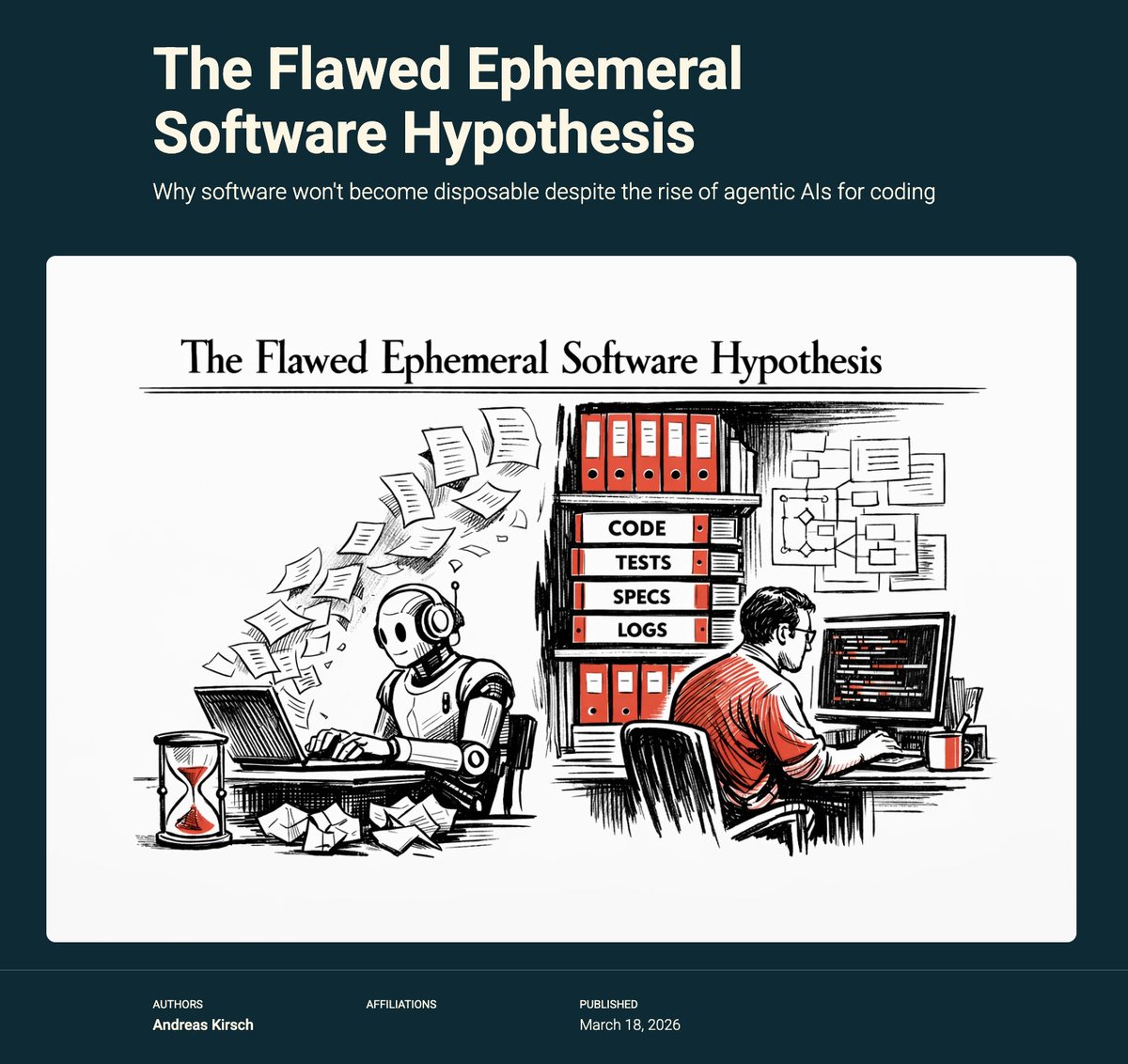
A while back, Andrej Karpathy said the app store will be replaced by generated, disposable software," and Amjad Masad predicted that the value of all application software will go to zero
I think this "ephemeral software hypothesis" is wrong, though, and I want to explain why:
Citadel Securities published this graph showing a strange phenomenon.
Job postings for software engineers are actually seeing a massive spike.
Classic example of the Jevons paradox. When AI makes coding cheaper, companies actually may need a lot more software engineers, not fewer.
When software is cheaper to build, companies naturally want to build a lot more of it. Businesses are now putting software into industries and tools where it was simply too expensive before.
---
Chart from
citadelsecurities .com/news-and-insights/2026-global-intelligence-crisis/
Prof. Donald Knuth opened his new paper with "Shock! Shock!"
Claude Opus 4.6 had just solved an open problem he'd been working on for weeks — a graph decomposition conjecture from The Art of Computer Programming.
He named the paper "Claude's Cycles."
31 explorations. ~1 hour. Knuth read the output, wrote the formal proof, and closed with: "It seems I'll have to revise my opinions about generative AI one of these days."
The man who wrote the bible of computer science just said that. In a paper named after an AI.
Paper: https://t.co/juSOmK9vOt
Hugo Duminil-Copin, French mathematician and 2022 Field Medalist told me he never participated in math competition and was very bad at it.
Innovative mathematics requires creativity, intuition, intense concentration, and long reflections, sometimes spread over several years.
Good performance at a math olympiad merely tests fast problem solving abilities. AI can do that nowadays.
One of the big activities of a researcher, in mathematics and elsewhere, is not to answer questions but to ask the right questions.
🚀Just released TinyTroupe v0.6.0, now supporting GPT-5 (took more time and effort than I expected 🥵). It also includes some new examples, comparing simulations to real-world human behavior! Have fun!
https://t.co/z8GyyPR1kq
@aakashgupta Admitting one's ignorance is often the best sign of wisdom. Socrates comes to mind. It's always refreshing to hear such comments by competent people, since most folks are just too scared to say "I don't know", sometimes even to themselves.
@coproduto É uma possibilidade intrigante. A principal questão que me permanece nebulosa é até que ponto as próprias especificações formais correspondentes seriam mais compreensíveis do que os programas subjascentes, para além de domínios classicos de FM (e.g., sistemas de transição, etc)
@karpathy It's never been so exciting to program, at least since I was a kid - an entirely new ground to explore, who knows what wonders will be found, and so many chances to leave one's mark.
Ever wondered how Q, K, V matrices are constructed exactly, which leads to the pattern recognition, or how the actual "attention" is paid?
Then you'll definitely love this post by @arpit_bhayani
https://t.co/jldAoQ8ePu