Interested in cyber operations and information warfare. PhD candidate @warstudies, @RoyalAirForce CAS Fellow, germanophile. Lover of good cable management.
The Research Handbook on Cyberwarfare is now available. Very grateful to @tcstvns and @josephdevanny for giving me the opportunity to contribute a chapter to this excellent volume @KCL_CSRG @KCLSecurity https://t.co/FYyRCpghi4
If rumours are to be believed I'll be living with a seventh different Prime Minister shortly. If it carries on like this I'm going to stop making the effort to learn their names.
I am deeply saddened to learn that Lily was among the Navy personnel who lost their lives in the helicopter accident yesterday in Devon. Lily was a force of nature, the only serving female Commando, and inspiration to other young women - and frankly to me as well.
When I met her in Parliament in May 2025, I put the following post out on LinkedIn with the photo below.
"Her journey ... is one of courage, persistence, and service.
Lily is doing a fantastic job helping young people understand what life in the Armed Forces is really like, and why service matters.
We need more stories like hers in the public eye."
The names of the three individuals who sadly lost their lives this week have been released in full: Lt Cdr Chris Gayson, Lt Lil-Mae Fisher, PO Owen Green. My thoughts are with their families and loved ones at this terribly sad moment.
In a statement carried on the Royal Navy website, Lily's family say of her:
“Lily-Mae was an extraordinary woman, daughter, sister, and partner. To say she was full of life is an understatement: she took every opportunity to push her limits, achieve more, and bring out the best in those around her.
“We are so proud of everything she accomplished. She has left an immeasurable hole in our lives, and in all the lives she has touched and inspired. The family kindly ask for time and space at this difficult time.”
Le Lieutenant Lily-Mae Fisher seule femme des Royal Navy Commando a été tuée hier dans le crash d'un hélicoptère Merlin Mk4 dans le Devon.
Le Lieutenant Commander Chris Gayson et le Petty Officer Owen Green ont également été tués dans l'accident
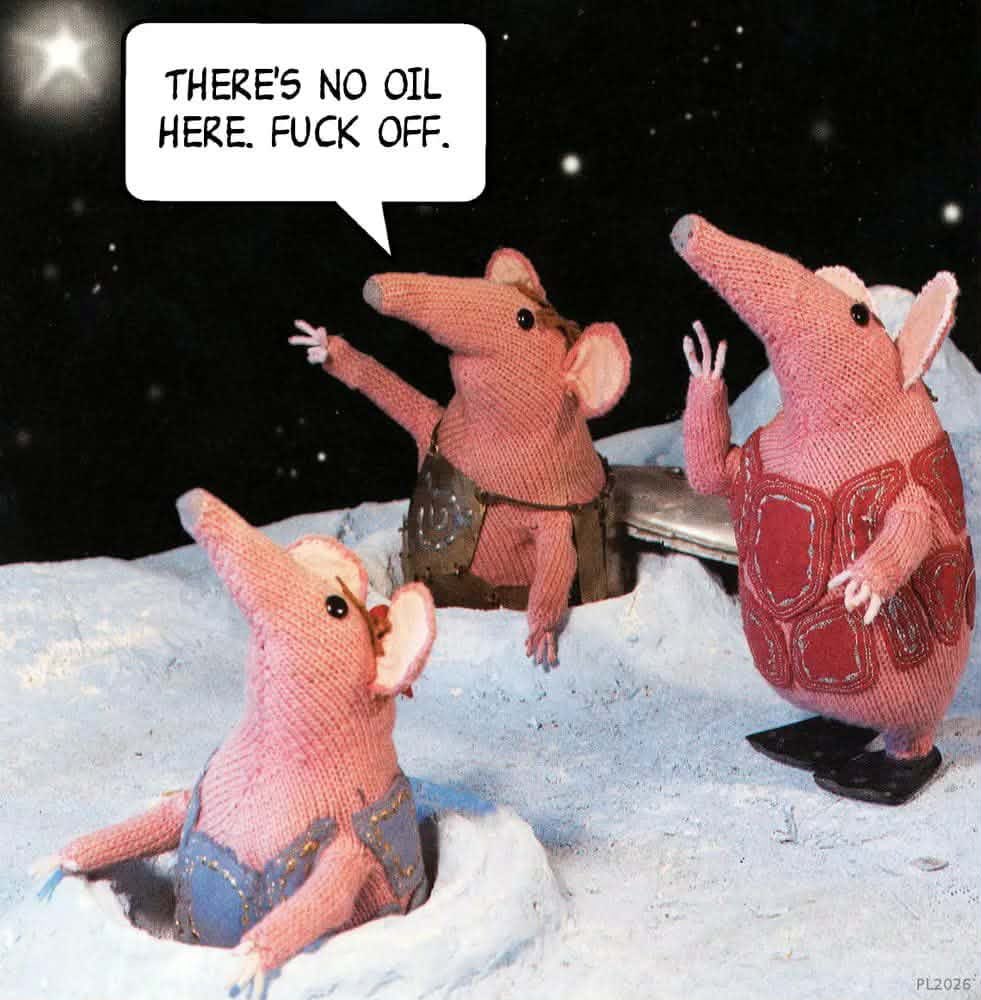
This is hilarious.
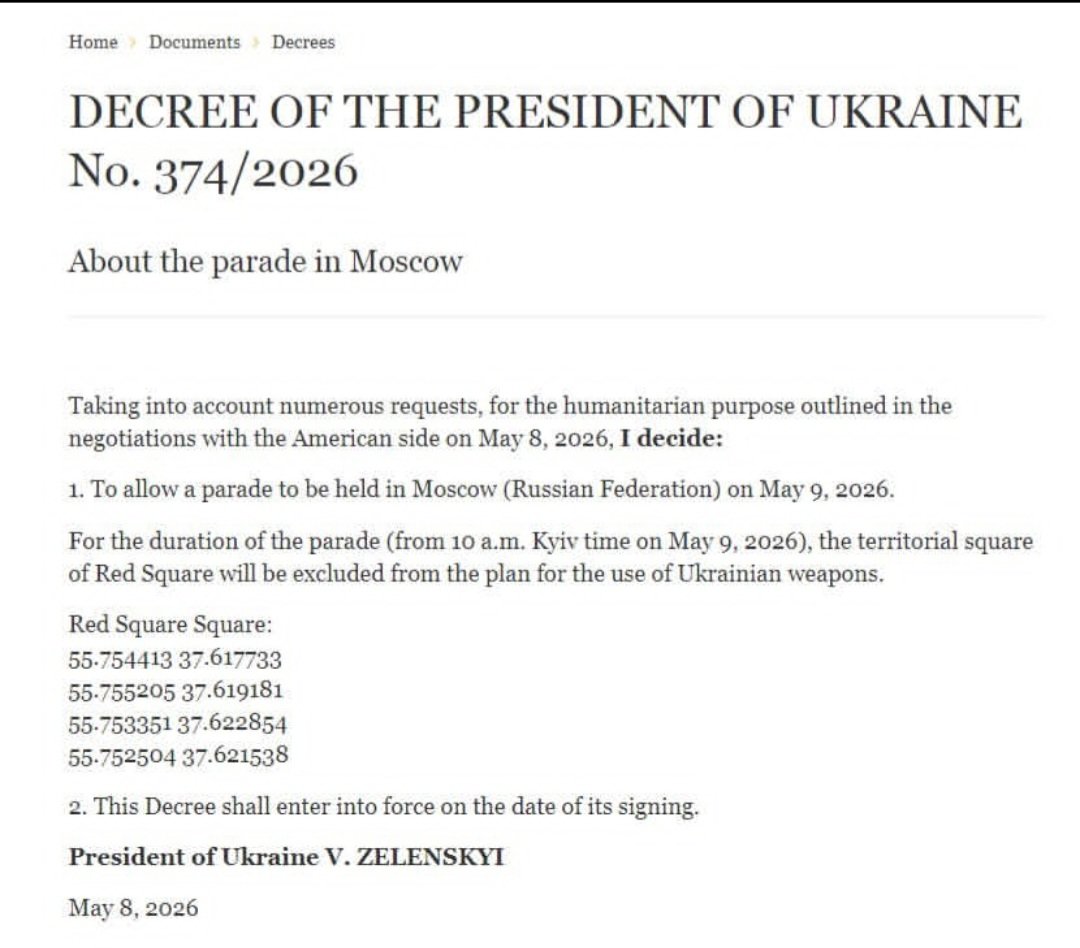
President Zelensky has "allowed" Putin to hold a Victory Day parade in Central Moscow today. A clever & well-worded decree - bravo!
In a historic move, Lieutenant General Susan Coyle has become Australia's first woman to be appointed as the chief of army. Coyle, 55, enlisted in the military in 1987, has held a number of senior command roles. She will be the first woman to lead any service branch of the Australian military https://t.co/EyVyic4e2R
In 1948, a 32-year-old at Bell Labs published a paper nobody fully understood.
Engineers found it too mathematical. Mathematicians found it too engineering-focused. One prominent mathematician reviewed it negatively.
That paper - "A Mathematical Theory of Communication", became the founding document of the digital age.
The man was Claude Shannon. Father of Information Theory.
At 21, he wrote the most important master's thesis of the 20th century.
Working at MIT on an early mechanical computer, Shannon noticed its relay switches had exactly two states - open or closed. He had just taken a philosophy course introducing Boolean algebra, which also operated on two values: true and false.
Nobody had ever connected these two things.
His 1937 thesis proved that Boolean algebra and electrical circuits are mathematically identical, and that any logical operation could be built from simple switches.
Howard Gardner called it "possibly the most important, and also the most famous, master's thesis of the century."
Every digital computer ever built traces back to this insight.
At 29, he proved that perfect encryption exists.
During WWII, Shannon worked on classified cryptography at Bell Labs. His work contributed to SIGSALY, the secure voice system used for confidential communications between Roosevelt and Churchill.
In a classified 1945 memorandum, he mathematically proved the one-time pad provides perfect secrecy, unbreakable not just computationally, but provably, permanently, against an adversary with infinite power.
When declassified in 1949, it transformed cryptography from an art into a science. It laid the foundations for DES, AES, and every modern encryption standard.
At 32, he defined what information is.
His 1948 paper introduced one equation:
H = −Σ p(x) log p(x)
Shannon entropy. The average uncertainty in a probability distribution. The minimum bits required to encode a message.
Three things followed:
> He defined the bit - the fundamental unit of all information. His colleague John Tukey coined the name.
> He proved the channel capacity theorem, every communication channel has a maximum rate of reliable transmission. You can approach it. You can never exceed it.
> He unified telegraph, telephone, and radio into a single mathematical framework for the first time.
Robert Lucky of Bell Labs called it the greatest work "in the annals of technological thought."
Where his equation lives in AI today:
Cross-entropy loss - the function training every classifier and language model, is derived directly from H. Decision tree splits use information gain, which is H applied to data. Perplexity, the standard LLM evaluation metric, is an exponentiation of cross-entropy.
Every time a neural network trains, Shannon's formula runs inside it.
He also built the first AI learning device.
In 1950, Shannon built Theseus, a mechanical mouse that navigated a maze through trial and error, learned the correct path, and repeated it perfectly. Mazin Gilbert of Bell Labs said: "Theseus inspired the whole field of AI."
That same year he published the first paper on programming a computer to play chess. He co-organized the 1956 Dartmouth Workshop, the founding event of AI as a field.
The man:
He rode a unicycle through Bell Labs hallways while juggling. He built a flame-throwing trumpet, a rocket-powered Frisbee, and Styrofoam shoes to walk on the lake behind his house.
He called his home Entropy House.
When asked what motivated him: "I was motivated by curiosity. Never by the desire for financial gain. I just wondered how things were put together."
In 1985, he appeared unexpectedly at a conference in Brighton. The crowd mobbed him for autographs. Persuaded to speak at the banquet, he talked briefly, then pulled three balls from his pockets and juggled instead.
One engineer said: "It was as if Newton had showed up at a physics conference."
He died in 2001 after a decade with Alzheimer's, the cruel irony of information slowly leaving the mind of the man who defined what information was.
Claude, the AI model, is named after Claude Shannon, the mathematician who laid the foundation for the digital world we rely on today.
🇺🇸 Brits couldn't do a rescue like we just did in Iran,they stand back a little...
🇬🇧 .. hold our beer son...
Apache pilot Captain Tom O’Malley who flew his Apache gunship into a Taliban stronghold with two Royal Marines strapped to the side in an extraordinary bid to save a wounded comrade
The official citation for the award of the Distinguished Flying Cross remains on the MOD restricted list, however extracts and the excellent book “Apache” by Ed Macy a fellow Apache pilot who participated in the rescue operation, gives an unprecedented insight and detailed account of the mission.
Captain Darren “Tom” O’Malley was serving with 656 Squadron Army Air Corps, at that time with the rank of Warrant Officer 1st Class. In November 2006 he returned to Afghanistan for his second tour on the Apache Attack Helicopters, at the time although holding the rank of Warrant Officer he was the most senior Pilot on the unit with the most air hours on the type, he was also the Squadron’s Qualified Helicopter Instructor and one of the few men on the Squadron qualified to sit in both seats.
656 Squadrons deployment to Afghanistan coincided with that of the 45 Commando Royal Marines and on the 15th January 2007 the “Royals” were deployed on Operation Glacier 2 an attack on Jugroom Fort in Garmsir in Southern Helmand, this being a Taliban stronghold. The Marines “Zulu” Company” were to be covered by two of the Squadron Apache’s. Tom was serving back at the units base at Camp Bastion with the Stand By Flight. The late deployment of the Royals into the attack, ate into the fuel of the two covering Apaches, which greatly reduced their time over target. Despite a heavy bombardment, the Taliban put up stiff resistance, forcing the Marines to withdraw and with fuel and ammunition running low on the tasked Apaches, Tom’s flight (2 Apaches) was scrambled, to take over air support, while the original Apaches returned for refuelling and rearming. In the second Apache was Warrant Officer Ed Macey,
Tom was flying in the front seat of call sign Ugly 50 and was mission Commander. Macey’s Apache call sign Ugly 51. As the pair flew to Jugroom they received a situation report and it was then they got an idea how things had deteriorated with a group of five Marines missing in Action. As they neared Tom was updated that one One Marine was missing Lance Corporal Mathew Ford. When on target it was the mission priority to locate Ford, assess if he was alive and protect him. Ugly 51 spotted a body which was identified as Ford, he was giving off a heat signature and was therefore alive,An order came through the radio from the CO let no Taliban near Ford, a ground rescue operation is under preparation. So began the long task of protection against constant Taliban fire from both machine guns and rocket propelled grenades, with ammunition running out and fuel low, there was no evidence of a ground rescue. Tom then came up with the plan to strap two Marines to the side of each Apache fly towards the fort, land, rescue Ford by slinging him under an Apache, whilst the Marines resumed their position on the side. The daring plan was tentatively authorised by the Squadron CO but flatly refused by the Royals. It was only when their Colonel was patched in on the radio that the Helicopter crews realised the CO was unaware of their rescue plan and he gave the go ahead.
This was the first time that British or American Apaches had flown with men strapped to the side, it was a procedure only to be used in the event of rescuing fellow pilots from a crashed Apache behind enemy lines.
*Note US Apaches have Tampax machine & Tanning solarium where the Marines sat.
Following a bombardment, and with top cover provided by the original Apache Flight, Ugly 50 & 51 went in problems became apparent straight away, Tom in the front helicopter was blinded by dust, blown up by the rotor blades and the landing field was too small for both helicopters,
Cont...
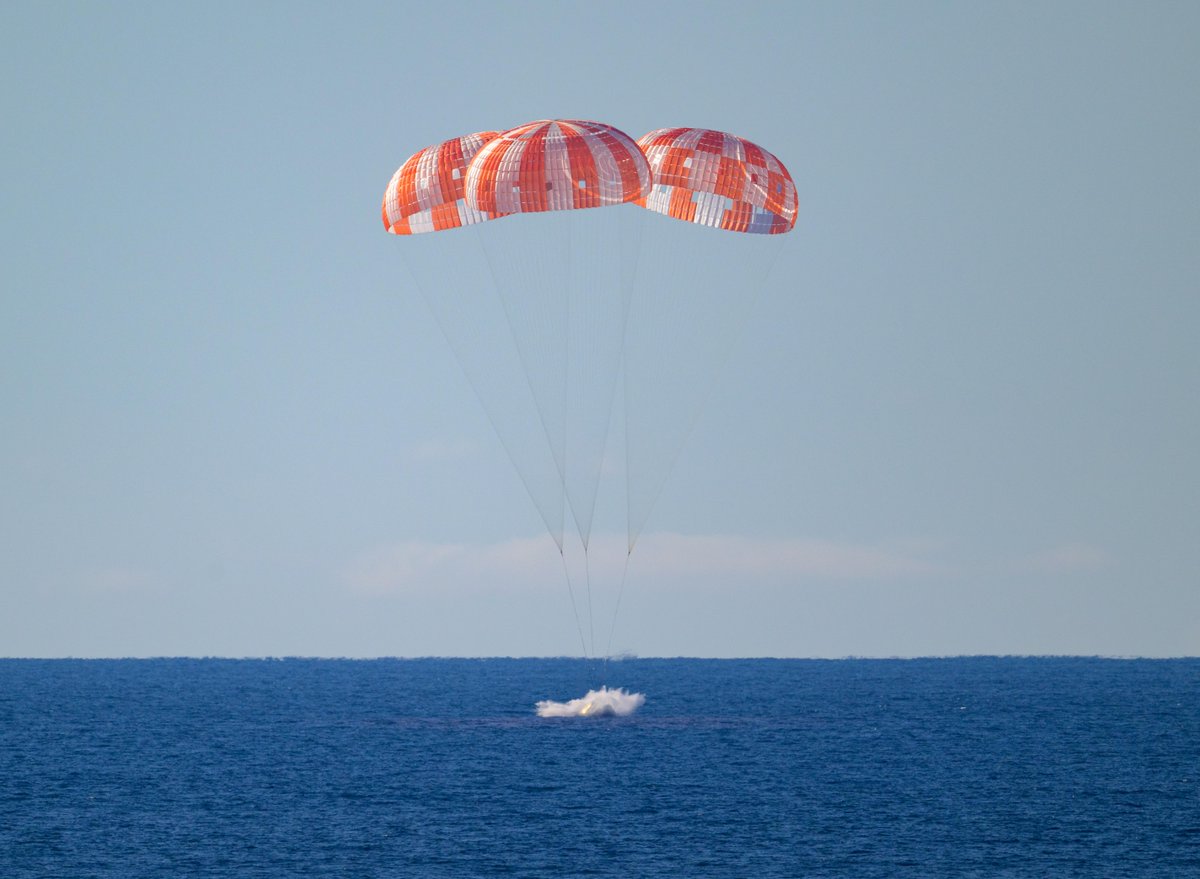
HOME.
The Artemis II crew has arrived back on Earth, ending a nearly 10-day journey around the Moon. The trip took them farther into space than humans have ever gone before, and now they're safely home with us.
https://t.co/XmDQwNlCPR
In addition to this, you can read Sid's Commentary from 2023, explaining the background to the Russian Main Directorate for Deep Sea Research (GUGI) - link in next message.
7️⃣7️⃣ years ago today, 12 nations met in Washington, D.C. 🇺🇸 to found an alliance that would keep the peace after decades of devastation.
The UK 🇬🇧 is proud to have been one of them.
#WeAreNATO#StrongerTogether
Airborne power on display🪂
270 troops hit the ground in the UK's biggest parachute drop in a decade — speed, scale, and readiness🔗https://t.co/45MGSmOnvw
JUST IN: You do not fire your Army Chief of Staff in the middle of a war for no reason. You fire him because of what comes next.
Pete Hegseth called General Randy George on April 2 and told him to retire immediately. The Pentagon confirmed it within hours. No reason was given. Not publicly. Not privately. A senior Army official told Fox News that Hegseth offered George nothing: no misconduct, no operational failure, no policy disagreement on the record. Just a phone call and a career ending in the middle of the most significant American combat operation in two decades.
George is the 24th general or admiral Hegseth has removed. But he is not the 24th. He is the one that matters. The Army Chief of Staff. The man whose signature sits between a president’s intent and the order that sends soldiers across a beach or into a tunnel complex. The 82nd Airborne is deploying right now. Marines from the 31st MEU are staged on the USS Tripoli. JSOC operators are at forward bases in Israel, Jordan, Saudi Arabia, and the UAE. Kharg Island, 90 percent of Iranian oil exports, sits 16 kilometres off a coast that someone will have to decide whether to approach. And the four-star general whose job it was to advise whether that approach should happen was removed 48 hours after Trump told the nation the war would continue for two to three more weeks.
The replacement is Vice Chief General Christopher LaNeve. He was Hegseth’s senior military aide before this appointment. The man who carried the Secretary’s briefcase now commands the Army the Secretary is reshaping. The chain of command did not break. It shortened. The distance between a television studio and a combat order just collapsed to zero intermediaries who were not personally selected by the man giving the order.
No reason was given. That is the tell. When someone is removed without explanation during a crisis, the explanation is the crisis itself. George either objected to something or was about to. The ground option. The power plant strikes. The Kharg raid. The escalation that turned a highway bridge in Karaj into rubble on the same day he was told to leave. Something in the next two weeks requires a chief who will not push back, and the Pentagon solved that problem by installing one trained as Hegseth’s aide.
A former Fox News weekend host just fired a four-star general with combat tours in Iraq and Afghanistan, replaced him with his own former assistant, and did it during a live war in which the next decision could put American soldiers on Iranian soil for the first time in history. No hearing was held. No misconduct cited. The Army woke up on April 3 with a new chief it did not choose, in a war it did not start, preparing for a phase the previous chief apparently could not be trusted to execute.
The question is not why George was fired. Every general in the building knows why. The question is what order is coming in the next fourteen days that required removing the one man in the chain of command who might have said no.
The war has no perimeter. The chain of command has no objectors. And the next phase has no one left to stop it.
https://t.co/dAOBBMsgDS