We quit our jobs.
There were six of us — Shiv Nadar, Arjun Malhotra, Yogesh Vaidya, Subhash Arora, D.S. Puri and me.
It was 1976. Startups were not really a thing in India. Venture capital did not exist. Banks were not exactly lining up to lend money to six young men with an idea and no collateral.
And computers? Most people had barely heard of them.
But we believed the microprocessor was going to change the world.
So we took the plunge.
Between the six of us, we managed to put together ₹1.87 lakh. We borrowed, pooled our savings and, in one case, even sold a car.
Our first office was a small barsati in Golf Links, Delhi.
We called ourselves Microcomp. We wanted to build an Indian computer.
There was just one problem.
We didn’t have a manufacturing licence.
That eventually led us to UP Electronics Corporation. They had the licence. We had the technology. And that partnership gave birth to Hindustan Computers Limited — HCL.
But perhaps the most audacious part of the story was what happened next.
We started selling a computer that was still being designed.
We had a brochure and a mock-up of the machine. That was it.
Our sales teams went across India, knocking on doors and convincing businesses to buy into a technology they had never used before.
The first orders came from IIT Kharagpur and IIT Madras.
Then came the harder part — convincing businesses.
In Coimbatore, we were up against DCM DP, a much bigger and more established name. I still remember sitting in the reception area of Premier Mills while the DCM team made its pitch.
We went in second.
And we won.
That one order gave us five more. Then ten.
That was HCL in those early years: not having the biggest balance sheet, the biggest brand or the easiest path — but finding a way.
We were restless.
We looked for gaps. We hired people who had what we called a “cowboy” spirit. We believed that technology had to be made useful and accessible, not intimidating.
And we kept moving.
From building India’s early indigenous computers to taking our business to Singapore when HCL was just four years old. From a small room in Delhi to a global technology company.
When I look back at 50 years, I think about six people sitting together in 1976, wondering if this crazy idea could actually work.
I think about a barsati.
A brochure for a computer that did not yet exist.
And the courage to knock on the next door.
That, to me, is the real HCL story.
50 years later, the technology has changed beyond anything we could have imagined.
But the spirit remains the same:
Dream big. Take the risk. And above all, Just Aspire.
Happy 50th, HCL.
What a journey it has been.
#AjaiChowdhry #JustAspire #HCL #50yearsofHCL #Nostalgic #Founders
In Parliament today, I spoke on the “cut money” arrangement between some doctors and diagnostic centres/ pathology labs.
Diagnostic centres call it "marketing expense." Doctors call it "referral commission." All gets added to Patient's hospital bill.
A silent transaction that isn't about your treatment. It's about who referred you.
Watch this before your next medical test.
PM Shri @narendramodi urges everyone to celebrate India’s rich handloom heritage by sharing videos featuring their favourite handloom products, including GRWM videos.
Use #NationalHandloomDay and promote Swadeshi.🥻
Indian Automakers just topped the world in EV efficiency. Not Tesla. Not BYD. Tata and Mahindra.
Among the world's 22 largest automakers, Tata Motors and Mahindra posted the lowest energy consumption per km in 2025, beating Tesla and BYD on efficiency.
Indian engineering, built for Indian roads, is now setting the global benchmark.
Study and Chart credit: @TheICCT & @restofworld@TataMotors@Mahindra_Auto
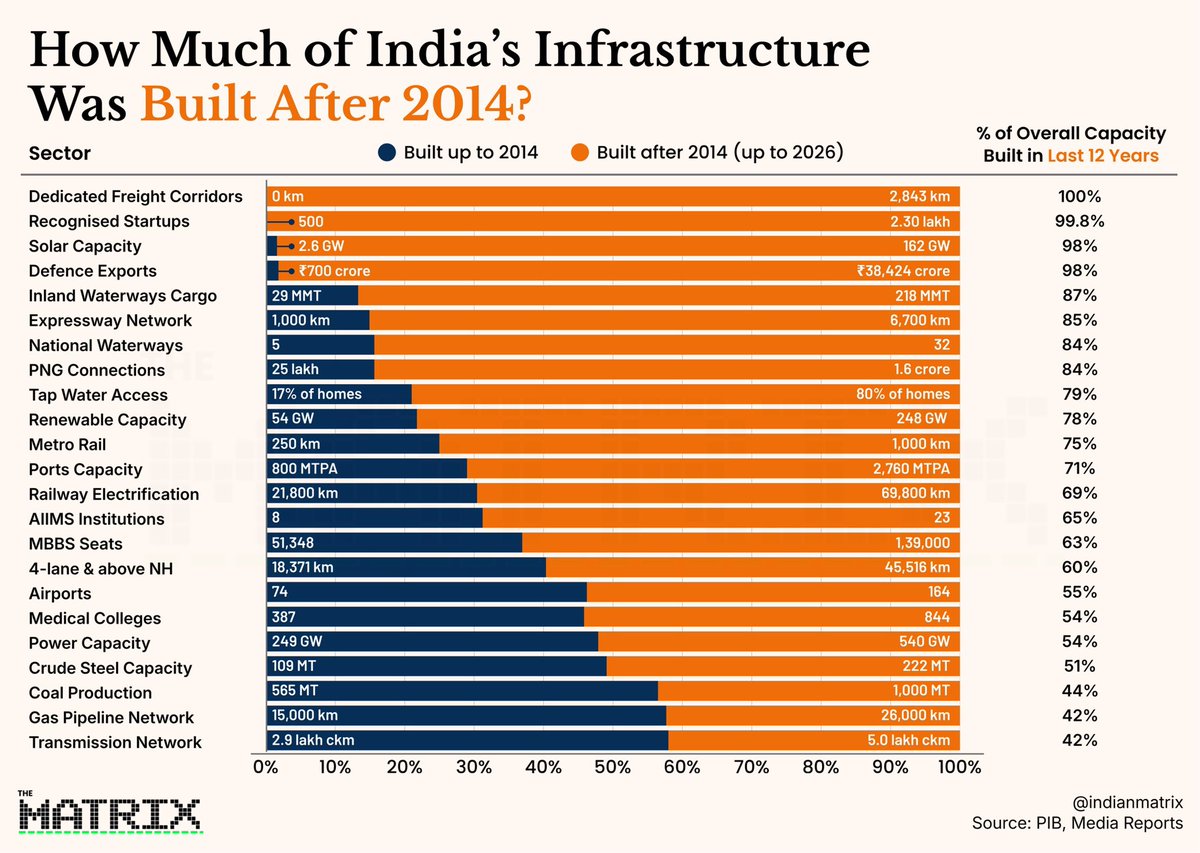
How much of India's infrastructure was built after 2014?
• 100% of Dedicated Freight Corridors
• 98% of Solar Capacity
• 85% of the Expressway Network
• 79% of Tap Water Access
• 75% of Metro Rail
• 71% of Port Capacity
• 69% of Railway Electrification
• 60% of 4-Lane National Highways
Infrastructure is built over decades.
But some decades build more than others.
आज हथकरघा पर कार्य कर इस कला के कौशल, श्रम और प्रक्रिया को समझने का प्रयास किया। हस्तकरघा पर बुना जाने वाला हर धागा बुनकरों के अद्भुत कौशल और कठिन परिश्रम की कहानी कहता है। हमारा प्रयास है कि बुनकरों के लिए कार्य को अधिक सुगम बनाया जाए, उन्हें बेहतर सुविधाएँ और नए अवसर उपलब्ध हों तथा उनके परिश्रम का उचित मूल्य सुनिश्चित हो, जिससे उनकी आय और सम्मान दोनों में वृद्धि हो।
India Did What The US And China Couldn't 🇮🇳
We Are The ONLY Country Running Double-Decker Cargo Trains On 100% ELECTRIC Lines.
Standard Grids Couldn't Clear The Height, So Indian Railways Literally Raised The Wires To 7.5 Meters To Make It Work ⚡️
One Train Replaces 270 Heavy Trucks Instantly. Pure Infrastructure Dominance. 🚂🔥
Needs to Be Viral & Shared Widely ✌️
#FI
India’s textile industry supports millions of lives and continues to power one of the country’s largest manufacturing ecosystems.
At Bhilosa, that impact extends across a network of 12,000+ lives.
Proud to contribute to a movement built on people and progress.
#Bhilosa
Join us at Yarn Expo 2026 as we showcase Bhilosa's manufacturing expertise, innovation and commitment to shaping the future of textiles.
📍 Stall No. 217
📅 21–23 August 2026
🕙 10:00 AM – 7:00 PM
📍 Surat International Exhibition & Convention Center
#Bhilosa#YarnExpo2026
Few leadership journeys are defined by both speed and scale.
Over the past 4,399 days, reforms, infrastructure, technology and citizen-centric governance have worked together to transform India's development story.
#LongestServingElectedPMModi@narendramodi