Heads up!
Seeing active abuse from IP 46.62.234.38 confirming sign-ups and accessing typo emails sent to *@gmai.com (mistyped @gmail.com addresses).
#InfoSec#ThreatIntel#CyberSecurity
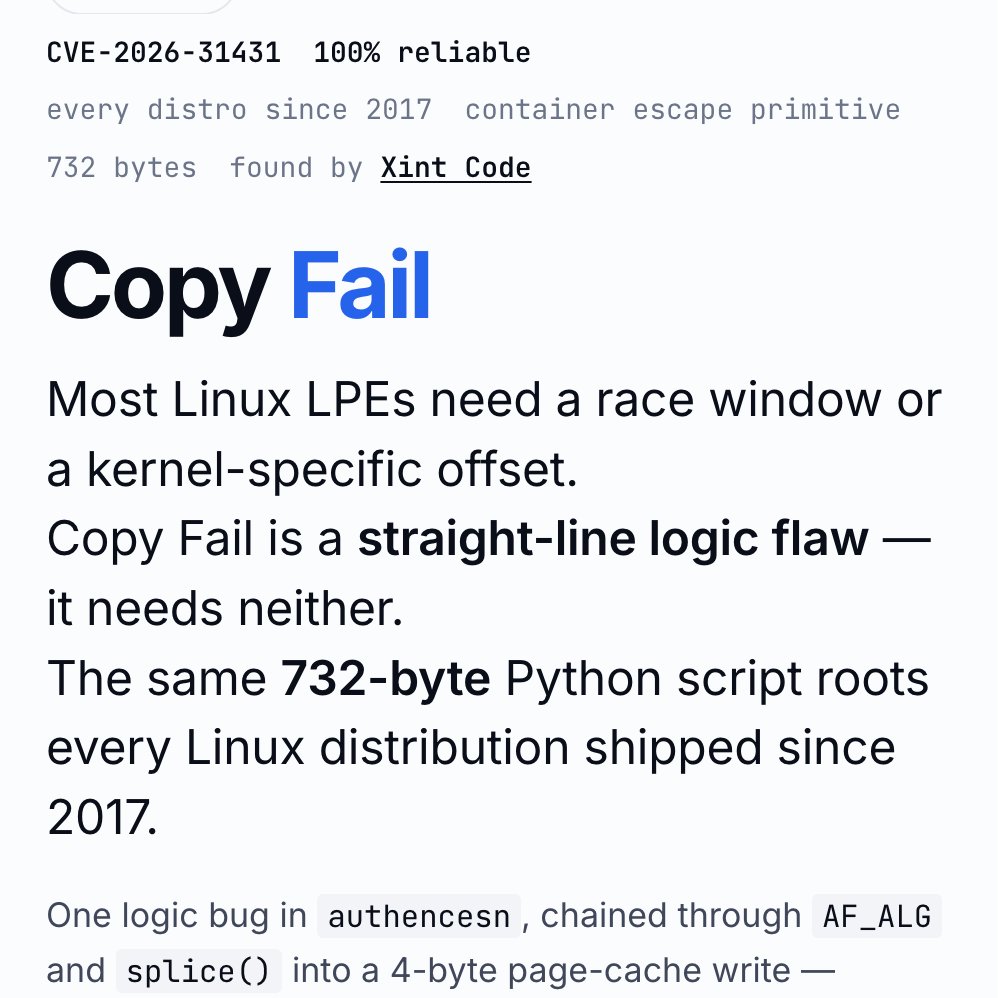
‼️🚨 BREAKING: An AI found a Linux kernel zero-day that roots every distribution since 2017. The exploit fits in 732 bytes of Python. Patch your kernel ASAP.
The vulnerability is CVE-2026-31431, nicknamed "Copy Fail," disclosed today by Theori. It has been sitting quietly in the Linux kernel for nine years.
Most Linux privilege-escalation bugs are picky. They need a precise timing window (a "race"), or specific kernel addresses leaked from somewhere, or careful tuning per distribution. Copy Fail needs none of that. It is a straight-line logic mistake that works on the first try, every time, on every mainstream Linux box.
The attacker just needs a normal user account on the machine. From there, the script asks the kernel to do some encryption work, abuses how that work is wired up, and ends up writing 4 bytes into a memory area called the "page cache" (Linux's high-speed copy of files in RAM). Those 4 bytes can be aimed at any program the system trusts, like /usr/bin/su, the shortcut to becoming root.
Result: the next time anyone runs that program, it lets the attacker in as root.
What should worry most: the corruption never touches the file on disk. It only exists in Linux's in-memory copy of that file. If you imaged the hard drive afterwards, the on-disk file would match the official package hash exactly. Reboot the machine, or just put it under memory pressure (any normal system load that needs the RAM), and the cached copy reloads fresh from disk.
Containers do not help either. The page cache is shared across the whole host, so a process inside a container can use this bug to compromise the underlying server and reach into other tenants.
The original sin was a 2017 "in-place optimization" in a kernel crypto module called algif_aead. It was meant to make encryption slightly faster. The change broke a critical safety assumption, and nobody noticed for nine years. That bug then rode every kernel update from 2017 to today.
This vulnerability affects the following:
🔴 Shared servers (dev boxes, jump hosts, build servers): any user becomes root
🔴 Kubernetes and container clusters: one compromised pod escapes to the host
🔴 CI runners (GitHub Actions, GitLab, Jenkins): a malicious pull request becomes root on the runner
🔴 Cloud platforms running user code (notebooks, agent sandboxes, serverless functions): a tenant becomes host root
Timeline:
🔴 March 23, 2026: reported to the Linux kernel security team
🔴 April 1: patch committed to mainline (commit a664bf3d603d)
🔴 April 22: CVE assigned
🔴 April 29: public disclosure
Mitigation: update your kernel to a build that includes mainline commit a664bf3d603d. If you cannot patch immediately, turn off the vulnerable module:
echo "install algif_aead /bin/false" > /etc/modprobe.d/disable-algif.conf
rmmod algif_aead 2>/dev/null || true
For environments that run untrusted code (containers, sandboxes, CI runners), block access to the kernel's AF_ALG crypto interface entirely, even after patching. Almost nothing legitimate needs it, and blocking it shuts the door on this whole class of bug...
We released first detection rules for Copy Fail / CVE-2026-31431.
YARA rules by me:
https://t.co/PrkIOIihA6
It covers public PoC artifacts, including known payloads, exploit code fragments and URLs seen in shared material.
More generic rules for customer environments are still in testing.
Sigma rules by @_swachchhanda_:
https://t.co/UTZgDhtsqg
They cover suspicious Copy Fail-related exploitation patterns, including setuid binary execution behavior and NULL argv shell execution.
More updates soon.
Hacking the #EU#AgeVerification app in under 2 minutes.
During setup, the app asks you to create a PIN. After entry, the app *encrypts* it and saves it in the shared_prefs directory.
1. It shouldn't be encrypted at all - that's a really poor design.
2. It's not cryptographically tied to the vault which contains the identity data.
So, an attacker can simply remove the PinEnc/PinIV values from the shared_prefs file and restart the app.
After choosing a different PIN, the app presents credentials created under the old profile and let's the attacker present them as valid.
Other issues:
1. Rate limiting is an incrementing number in the same config file. Just reset it to 0 and keep trying.
2. "UseBiometricAuth" is a boolean, also in the same file. Set it to false and it just skips that step.
Seriously @vonderleyen - this product will be the catalyst for an enormous breach at some point. It's just a matter of time.
Software horror: litellm PyPI supply chain attack.
Simple `pip install litellm` was enough to exfiltrate SSH keys, AWS/GCP/Azure creds, Kubernetes configs, git credentials, env vars (all your API keys), shell history, crypto wallets, SSL private keys, CI/CD secrets, database passwords.
LiteLLM itself has 97 million downloads per month which is already terrible, but much worse, the contagion spreads to any project that depends on litellm. For example, if you did `pip install dspy` (which depended on litellm>=1.64.0), you'd also be pwnd. Same for any other large project that depended on litellm.
Afaict the poisoned version was up for only less than ~1 hour. The attack had a bug which led to its discovery - Callum McMahon was using an MCP plugin inside Cursor that pulled in litellm as a transitive dependency. When litellm 1.82.8 installed, their machine ran out of RAM and crashed. So if the attacker didn't vibe code this attack it could have been undetected for many days or weeks.
Supply chain attacks like this are basically the scariest thing imaginable in modern software. Every time you install any depedency you could be pulling in a poisoned package anywhere deep inside its entire depedency tree. This is especially risky with large projects that might have lots and lots of dependencies. The credentials that do get stolen in each attack can then be used to take over more accounts and compromise more packages.
Classical software engineering would have you believe that dependencies are good (we're building pyramids from bricks), but imo this has to be re-evaluated, and it's why I've been so growingly averse to them, preferring to use LLMs to "yoink" functionality when it's simple enough and possible.
🚨 PyPI users are being phished — and the fake login pages look real.
Hackers spoofed PyPI emails & built replica sites that steal credentials, then forward victims to the legit site to cover their tracks.
Full details ↓ https://t.co/ZXNDqXISR9
Provedores de internet realizam manifestação contra estatização da Internet pela Anatel. Agência quer controlar organizações não governamentais que operam a infra da rede, como o https://t.co/j3FHn3ngOU, https://t.co/4qqxCdouJk e outros departamentos do https://t.co/jOnLxkm9sJ
O https://t.co/LFzYX02hQR se posicionou oficialmente sobre o Projeto de Lei nº 4.557/2023, que propõe a redefinição do modelo vigente de governança da Internet no Brasil.
Para ler a nota completa, acesse https://t.co/pGrWgHgLcK
#CGIbr#NICbr
🚨IMPORTANT🚨 We have observed that the implant placed on tens of thousands of Cisco devices has been altered to check for an Authorization HTTP header value before responding [1/3]
We have released Python 3.12.0 finally! 🎉🎉🎉🐍
In the CPython release team, we have put a lot of effort into making 3.12 the best version of Python possible. Better f-strings, faster Python, better typing, easier debugging and much more. Get it here:
https://t.co/gYLAvHE8nk
🚨🚨WE URGE EVERYONE TO UPDATE THEIR APPLE DEVICES AS SOON AS POSSIBLE.
We have found an actively exploited #zero#click vulnerability that was used to deliver #NSO group’s #Pegasus#spyware.
https://t.co/BS0ZI4QuIz
Aparentemente haveria oposição entre "transparência" e "privacidade", mas não há! Como diz Danilo Doneda, "a transparência é proporcional ao poder, a privacidade é *inversamente* proporcional a ele"... Protejamos o "santo dos santos" de nossa alma. (em: https://t.co/L4bumINmfo )
A friend asked me to find out why his connected lightbulb app was asking for his location, so I ducked out to Australia’s favourite hardware store, Bunnings, and grabbed one to check out.
The Android grid connect app has 500k+ downloads.
Let’s take a quick look! 🧵
(1/n)
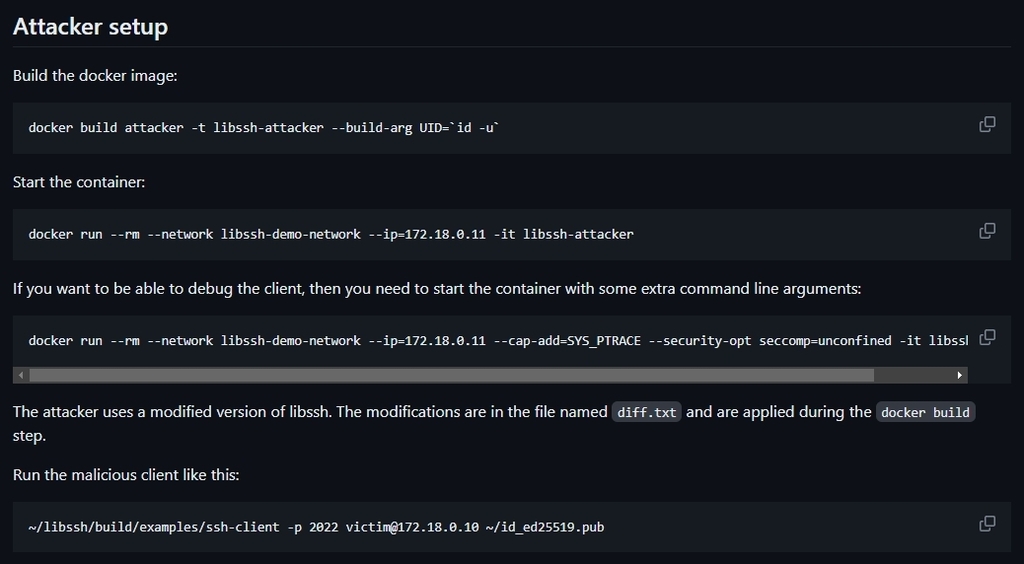
CVE-2023-2283
Authentication bypass vulnerability in libssh, which, under certain conditions, may enable a remote attacker to gain unauthorized access to another user’s account via ssh login.
https://t.co/dJYJ6ZGQyX
#cybersecurity#infosec
https://t.co/omkzC8pzpH
The 19 Universal Facial Expressions thread :: I am testing v5.1 of #midjourney on facial expressions. It's a freeze frame because it seems that v5.2 (or even v6) will be even more successful on the subject. I will do the #aiart comparison. Same prompt [facial expression] in 1st.
🚱30 milhões de senhas de brasileiros vazaram em 2022
ISH Tech e SafeLabs afirmam que São Paulo é o estado com cidadãos mais afetados por vazamentos: o leak total envolve 18.666.801 senhas
Mais detalhes 👇
Game changer. You can now run GPT locally on your macbook with GPT4All, a new 7B LLM based on LLaMa.
It's completely open source: demo, data and code to train an assistant-style large language model with ~800k GPT-3.5-Turbo Generations based on LLaMa
https://t.co/4TOENuZUy6
Catho ( a job search portal.) based in Barueri, Brazil. Catho Online Ltda. operates as a subsidiary of Brasil Online Holdings Coperatief U.A. And it suffered a massive data breach impacting 10.7M users.
The leak contains name, login, email, password and is being sold for $2k.
Learn Computer Science to Machine Learning for Free from Harvard
Did you know that Harvard provides 100s Free online course, open this if you don't want to miss.
A Thread