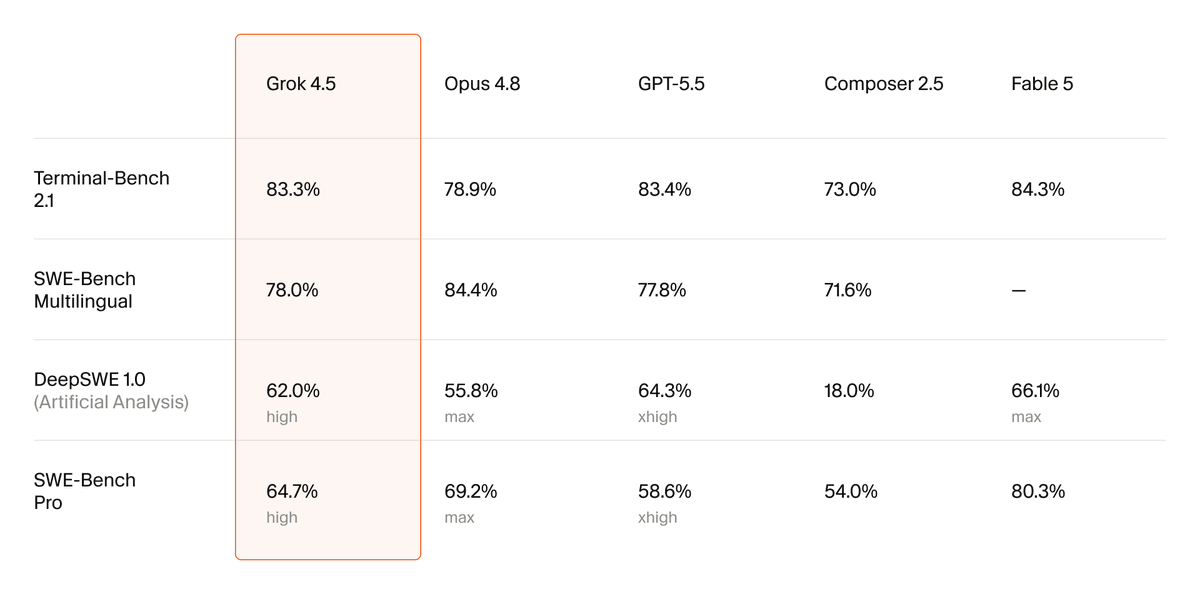
the best coding workflow that has been working for me:
- frontier model for planning
- smol fast model for execution
- frontier model for finding bugs
has reduced token spend by order of magnitude without affecting results
Stop using Claude Fable 5 or "ultra code" for every task!
@steipete and @DynamicWebPaige suggest orchestration:
- SOTA models to break down workflows
- smaller models for execution
...okay unless you're buying an airfryer
We just added Cursor's Composer models to our model breakdowns on Ramp AI Index.
In another sign of businesses switching to cheaper models, spend on Composer (in purple) increased 8x from 0.7% to 5.7% in June 2026.
A underrated player taking market share from OpenAI and Anthropic.
this is nuts - i guess we know what midterms and 2028 will be fought on and also why sam altman wants to give 5% of openai to the government.
when was the last time a technology had captured such a mind share?
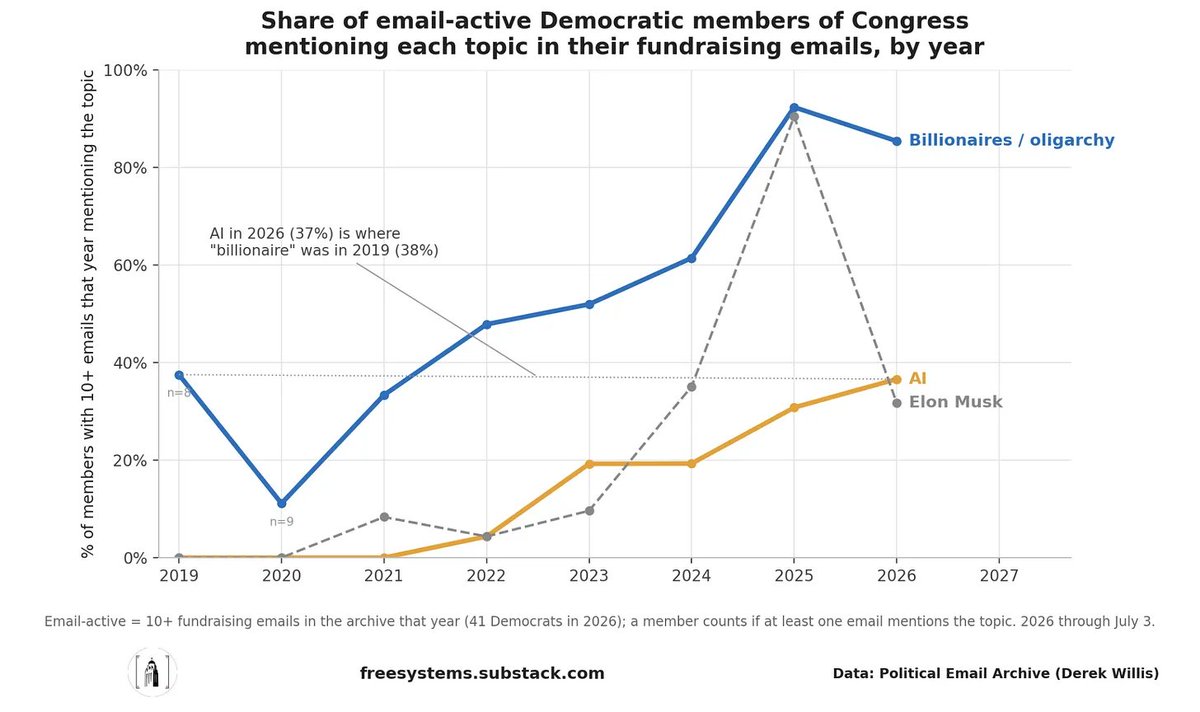
My new research: I analyzed 280,000 fundraising emails to track the recent, sharp rise in anti-billionaire populist rhetoric among Democratic politicians, and to show how it's slowly merging with a new kind of anti-AI populism.
We know from @davidshor, @jasminewsun, @ArchieHall and others' writing and research that American voters are skeptical of AI, but we know less about how politicians at large are thinking about it. Fundraising emails are a super useful way to measure, in roughly real-time, what politicians are saying to their most devoted followers about key issues.
Here are some of my main findings:
(1) Anti-billionaire rhetoric took off sharply in 2025 among Democrats, driven by anti-Elon fundraising appeals and now including a variety of tech themes.
(2) Anti-AI content is only a small fraction of Dem emails even today---but it's rising quickly.
(3) Anti-AI Dem emails don't tend to focus on job loss or x-risk; they're focused on how AI is the next thing that billionaires are "doing to us"---the latest symptom of an oligarchy rigging the economy against us.
(4) The spike in anti-billionaire populism looks similar to a previous spike in anti-social-media rhetoric among Republicans around 2021. That spike never really turned into meaningful policy.
(5) On the other hand, the adoption of the AI topic among Dems is on a similar trajectory to their previous embrace of anti-billionaire rhetoric---so it could be a major focus in the near future.
Lots more details in the full write-up here:
https://t.co/9o0w2XMgIb
My new research: I analyzed 280,000 fundraising emails to track the recent, sharp rise in anti-billionaire populist rhetoric among Democratic politicians, and to show how it's slowly merging with a new kind of anti-AI populism.
We know from @davidshor, @jasminewsun, @ArchieHall and others' writing and research that American voters are skeptical of AI, but we know less about how politicians at large are thinking about it. Fundraising emails are a super useful way to measure, in roughly real-time, what politicians are saying to their most devoted followers about key issues.
Here are some of my main findings:
(1) Anti-billionaire rhetoric took off sharply in 2025 among Democrats, driven by anti-Elon fundraising appeals and now including a variety of tech themes.
(2) Anti-AI content is only a small fraction of Dem emails even today---but it's rising quickly.
(3) Anti-AI Dem emails don't tend to focus on job loss or x-risk; they're focused on how AI is the next thing that billionaires are "doing to us"---the latest symptom of an oligarchy rigging the economy against us.
(4) The spike in anti-billionaire populism looks similar to a previous spike in anti-social-media rhetoric among Republicans around 2021. That spike never really turned into meaningful policy.
(5) On the other hand, the adoption of the AI topic among Dems is on a similar trajectory to their previous embrace of anti-billionaire rhetoric---so it could be a major focus in the near future.
Lots more details in the full write-up here:
https://t.co/9o0w2XMgIb
We are hiring for @Harvey’s model training team.
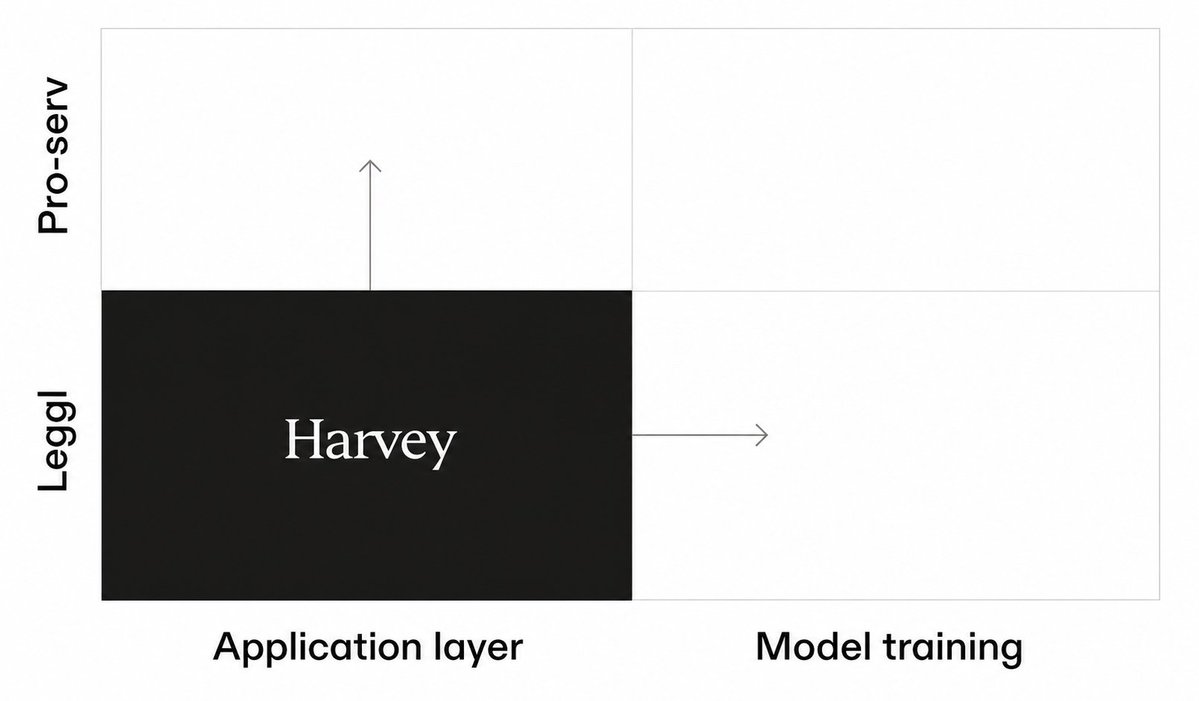
This team will help Harvey expand from the application layer into the model layer and from legal into high end knowledge work more broadly.
We are hiring AI researchers of all seniority, particularly those with experience post-training frontier or open source models.
Our program is centered around large-scale model training, synthetic data generation, long horizon reinforcement learning, and rigorous evaluation in real world deployments. We are scaling-pilled and believe that nothing beats the combination of larger models and better training data.
We’ve been able to generate incredibly realistic legal environments and validated that this allows us to post-train open source models to achieve frontier performance with agents. We plan to scale up these data generation and training efforts significantly across legal to start, and eventually other verticals.
As a researcher, you will have access to thousands of GPUs and unique training data from our product and customer relationships.
Your research will inform Harvey’s product strategy and power AI used for some of the most economically and societally impactful work in the world.
@gabepereyra@harvey then: what if the big model labs make the application themselves?
now: what if the application companies make the model themselves?
The future belongs to QUICK and CHEAP and SMART models
The future belongs to QUICK and CHEAP and SMART models
The future belongs to QUICK and CHEAP and SMART models
The future belongs to QUICK and CHEAP and SMART models
The future belongs to QUICK and CHEAP and SMART models
We're now at the point that most coding tasks can be solved by basically any top model (use-case saturation)
In other words, frontier knowledge capability isn't the only relevant benchmark anymore
The future belongs to QUICK and CHEAP and SMART models
On that scale this model absolutely mogs