The bond market is out of control.
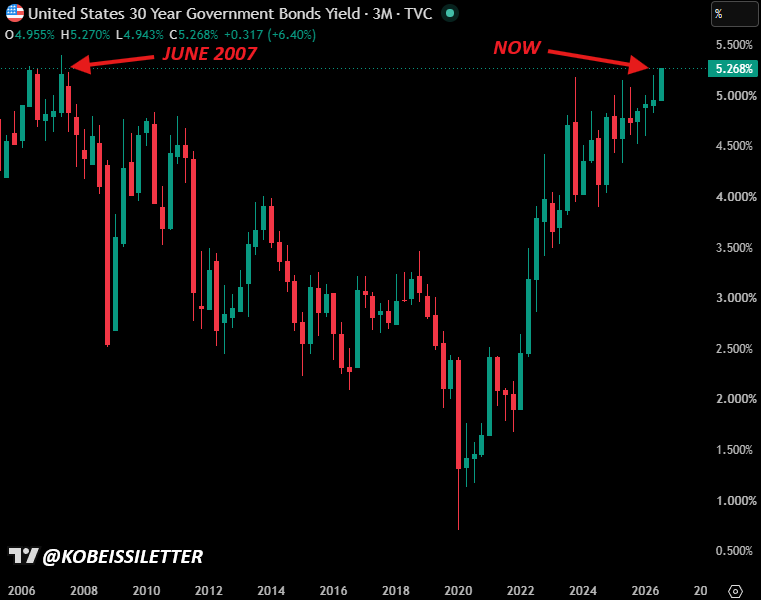
The US 30Y Note Yield is now up to 5.27%, its highest level since June 2007.
This officially marks a +450 basis point rally since the low seen in 2020.
At the current pace, we are on track to see US 30Y mortgage rates exceed 7.50% by year-end.
And to top it all off, Fed Chair Warsh is now adamant that the market should operate independently, without Fed guidance.
Even without rate hikes or Fed guidance, the market is sending rates higher; operating exactly how Fed Chair Warsh wants it to operate.
The bond market will soon be the most talked about component of global capital markets.
This simply is not sustainable.
Key Differences That Separate AI From the Dotcom Bubble
The AI infrastructure buildout has invited inevitable comparisons to the late-1990s internet boom. Both eras feature massive investment in digital infrastructure, but the similarities largely end there. While today's hyperscalers—Amazon, Microsoft, Alphabet, and Meta—are spending aggressively to build AI capacity, the financial foundation supporting this cycle is fundamentally stronger than the debt-fueled telecom expansion that preceded the dotcom bust.
1. AI Spending Is Larger—and Still Accelerating
Today's hyperscalers are investing a greater percentage of revenue in infrastructure than telecom companies did during the internet buildout. More importantly, capital spending continues to accelerate, suggesting the AI investment cycle remains in its expansion phase rather than a peak.
2. AI Is Already Being Monetized
Unlike the late 1990s, when many infrastructure projects generated little or no revenue for years, AI is producing meaningful cash flow today. Cloud revenue tied to AI continues to grow rapidly, with hyperscaler cloud sales expected to exceed $375 billion over the trailing four quarters. Demand continues to outpace available capacity, and AI usage has expanded at an unprecedented pace.
3. Earnings Support the Investment
Perhaps the biggest difference is profitability. The hyperscalers funding today's AI buildout are generating record earnings and cash flow, and their valuations have actually compressed relative to earnings despite massive capital spending. By contrast, semiconductor stocks have experienced much greater multiple expansion, leaving them more vulnerable if AI capital spending eventually slows.
4. Balance Sheets Are Much Stronger
The telecom companies that financed the internet buildout relied heavily on debt, making them vulnerable when financing conditions tightened. Today's hyperscalers are funding most of their investment internally with strong free cash flow while maintaining healthy balance sheets, substantially reducing financial risk.
5. Demand Remains Strong
Unlike the excess fiber capacity that sat unused for years after the dotcom bubble burst, there is currently little evidence of meaningful overcapacity in AI infrastructure. Data center vacancy rates remain exceptionally low, suggesting demand continues to absorb new capacity.
Bottom Line
The AI investment cycle resembles the internet buildout in terms of infrastructure spending and to a degree in price action, but the underlying economics are dramatically different. Today's leaders are financing expansion with substantial earnings, free cash flow, and healthy balance sheets, while AI adoption is already producing significant revenue growth.
That doesn't mean investors should expect a straight line higher. A correction similar to 2022 remains entirely possible—particularly for semiconductor stocks—as hyperscaler capital spending inevitably slows. However, today's fundamentals argue we are not yet in the type of speculative bubble that typically requires many years to recover from a secular bear market. The space is very likely to experience increased volatility, but at this point the long-term risks appear more cyclical than structural. https://t.co/JXzFFTmMtn
Forced liquidations due to excess leverage typically mark near-term historical bottoms. Situational Awareness at ~4x leverage & over $20B in assets at its peak is now wound down. While I heard there were at least 3 other funds in trouble, today’s rally may have fixed their issues.
I also wanted to put today’s rally in context. I gave the stats in my post yesterday about the historic meltdown and why “In summary, my view is that we could have seen at least a short-term bottom today with a strong rally ahead of us in the sectors most caught in the latest speedbump.”
The 10.7% rally today in the Morgan Stanley Momentum Index beats all but the 11.1% gain on 4/3/2001 during the dotcom bust. All the other moves in the top 10 occurred during either Covid (3x), the GFC (2x) or the dotcom bust (3x).
For the more concentrated Morgan Stanley TMT (Tech Media & Telecom) Momentum Index today’s gain of 19.1% crushes the prior 11.9% gain seen on 12/5/00 during the dotcom bust. 5 of the other top 10 gains were seen just since November of 2025 during the recent meteoric rally. There were 3 more during the dotcom bust.
While some give back is certainly likely in the days ahead given the ferocity of this one day move, I believe we have seen the near-term bottom yesterday due to the forced liquidations. I am hopeful the “speedbump” I started expecting back on my June 20th post is now behind us. Getting oil prices back into the $70 range with a decline in bond yields would certainly increase the odds even more.
I believe we are still early in the adoption of Agentic AI and the 10-100x increase in tokens needed since January relative to Chat-based AI.
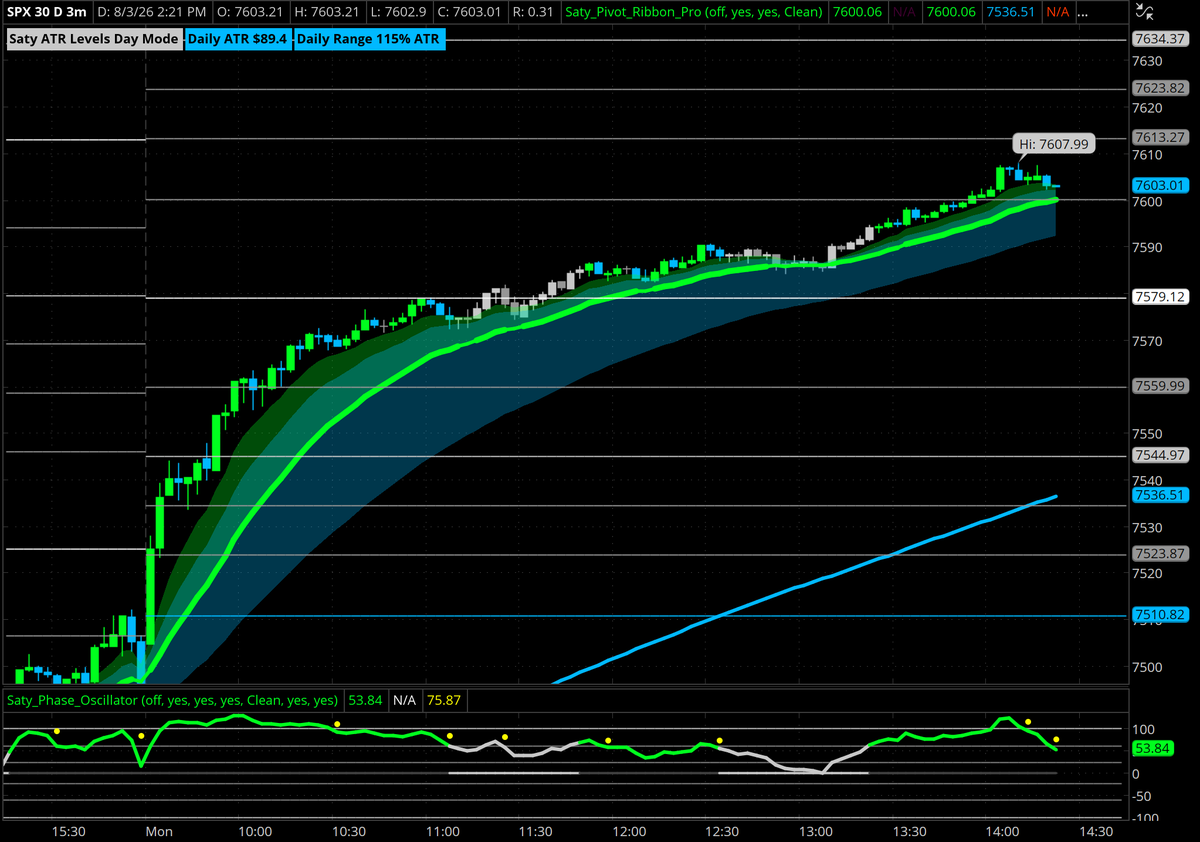
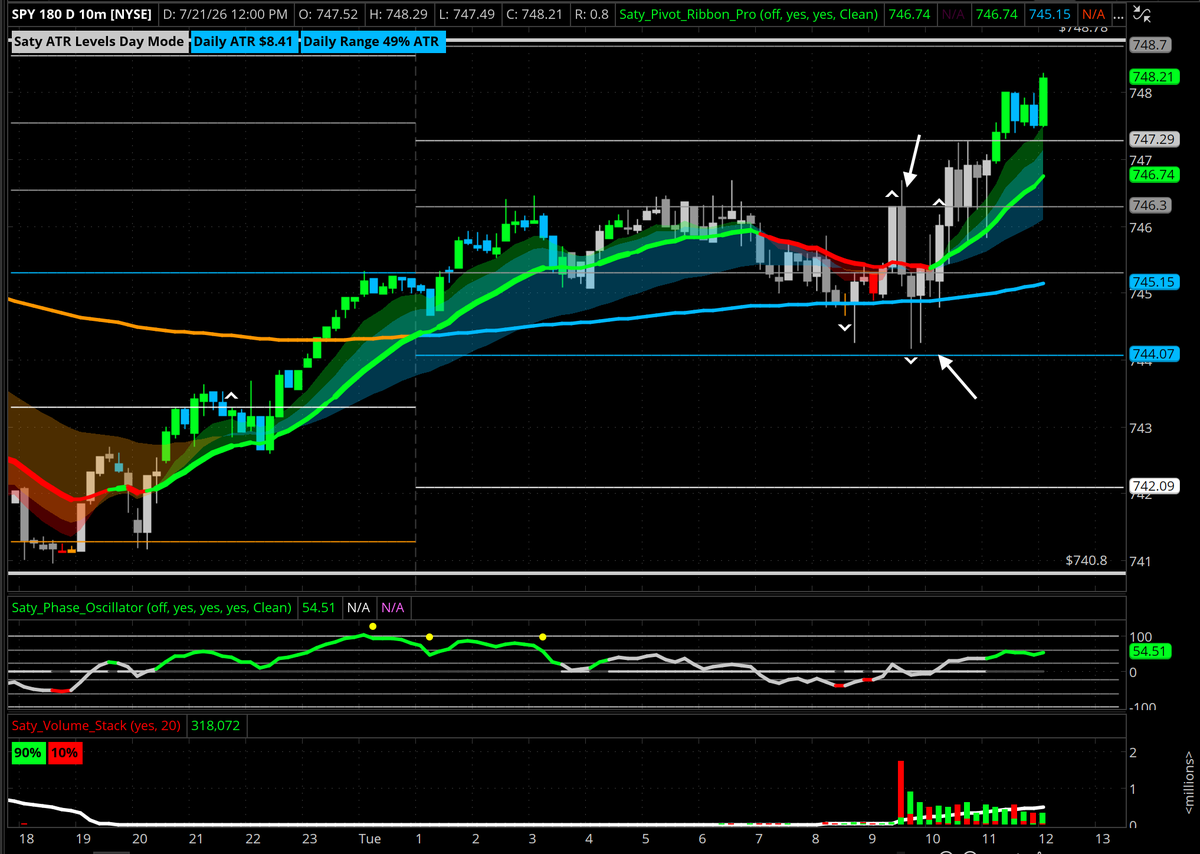
Some random guy on the internet 4.5 years ago made an algorithm that automatically calculates levels. For example yesterday after close, these were today's levels. Worked out well.
He gave this indicator out for free and even teaches you how to use it for free too. Nice guy.
Korea and memory bulls "explaining" the selloff based on some tweaky fundamental "mix" story are funny to me. It's like saying red tulips and yellow tulips are somehow "importantly" different
Free newsletter: The more you buy, the more you lose. Hyperscalers are trapped in a vicious cycle - the more AI data centers they build, the more expensive GPUs (and the debt to buy them) become, all as credit markets become exhausted by endless AI capex.
https://t.co/DkugpvYCfm
There is a reason $NVDA’s 5 year credit default swaps are going parabolic. All this overreaching by #nvda to push the circular spending to biblical proportions .
SK Hynix missed consensus by 6% for CQ2 rev & operating profits while guiding FY26 capex 11% below. While I have outlined before my case for a near-term AI “speedbump” (which can still be quite ugly like in late 1995/97 for internet buildout,) this is certainly ammo for THE TOP.
The fans got Deadpool off the ground so many years ago. Yesterday, 10 years after the first film and exactly 2 years after Deadpool & Wolverine, I felt so lucky to be on the #SDCC floor with everyone whose unapologetic devotion brings so much joy to this world.
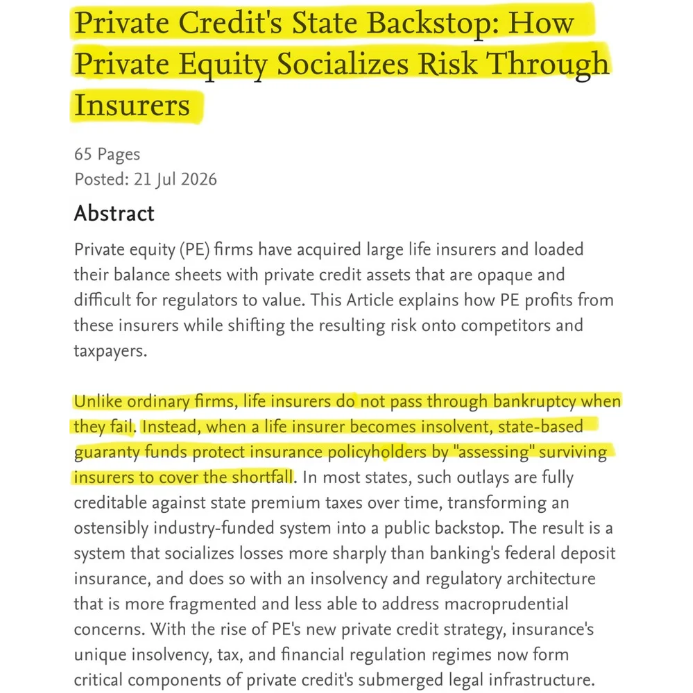
MICHAEL BURRY JUST WARNED THAT PRIVATE EQUITY MAY BE USING LIFE INSURERS TO PUSH LOSSES ONTO THE PUBLIC.
Burry is highlighting a new paper by two Yale/Texas researchers, "Private Credit's State Backstop: How Private Equity Socializes Risk Through Insurers."
Firms like Apollo, KKR, and Blackstone have bought up life insurers. They've filled these insurers' balance sheets with private credit, loans that are hard for regulators to check or price properly.
Life insurers now hold $849 billion in this kind of debt, more than double what they held in 2014.
Here's the trick: If one of these insurers can't pay its bills, states step in to protect policyholders. They do this by charging other insurance companies a fee to cover the gap.
Those companies then get to subtract that fee from the taxes they owe the state. So in the end, the public pays for it through lower state tax collections, without it ever being called a bailout.
This has already started happening. Two companies, First Brands and Tricolor, went bankrupt in 2025 after lenders realized they couldn't properly value the debt they were holding.
And the next risk is AI: Big tech companies are funding their AI data centers using the same kind of complex, hard to value debt.
If AI spending doesn't pay off fast enough, that risk doesn't stay with tech companies. It lands on the same insurers already holding piles of this debt.
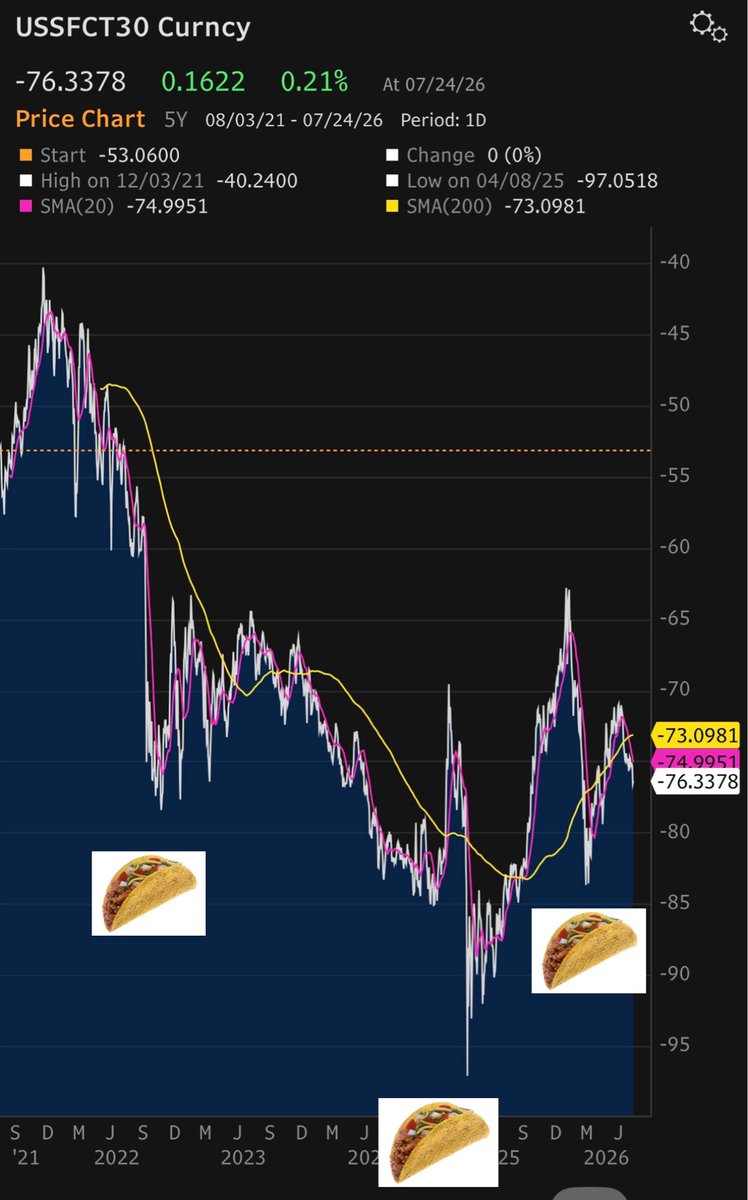
While we all enjoy a nice taco, since COVID, there's only been three times the administration and Fed have been forced to truly Taco. This weekend's taco is noise. There is no reason to taco. BUT if and when swap spreads truly dive the taco will be at hand. When it happens buy stocks, gold and sell USD. This weekend is just noise.
Donald Trump has earned more money in his first and second year, in his second term as president, than in the previous 60 years of his life, per Bloomberg.
This is such an insane thing to do on so many levels and it is about as bearish as it gets, especially considering this it is being built BY SOFTBANK! Also where’s the money gonna come from? Very silly stuff all round https://t.co/RfdONR71CN
🦔AI companies are bulk-buying rare books, scanning them through high-speed machines that cut the spines off, and shredding the originals. A service called ISBNdb facilitates orders of up to a million books and keeps buyers anonymous. Pre-2022 books are premium because they're free of AI-generated text. A federal judge ruled the practice is fair use because eliminating the original means only one copy exists at a time. Anthropic hired the former head of Google Books partnerships to obtain "all the books in the world."
My Take
This got to me. A bookseller told 404 Media that rare books with almost no surviving copies are being fed into this pipeline. Books that survived wars, fires, and centuries of handling are being shredded so an AI can learn to write a better marketing email.
ISBNdb's website literally says "'AI company destroys two million books' is not a headline that generates sympathy," and they still built an entire business around making it happen quietly. They offer NDAs as a feature. They coach clients to call it "digital preservation."
I've covered AI companies scraping the internet, torrenting libraries, and stealing music. This is worse because it's irreversible. You can re-upload a website. You can reprint a bestseller. You can't replace the last three copies of an 18th-century botanical text once someone shreds them for training data. And the judge said it's legal. So it's going to accelerate.
"We shred rare books and offer NDAs so nobody finds out" is a legitimate business model in 2026. What a timeline.
Hedgie🤗
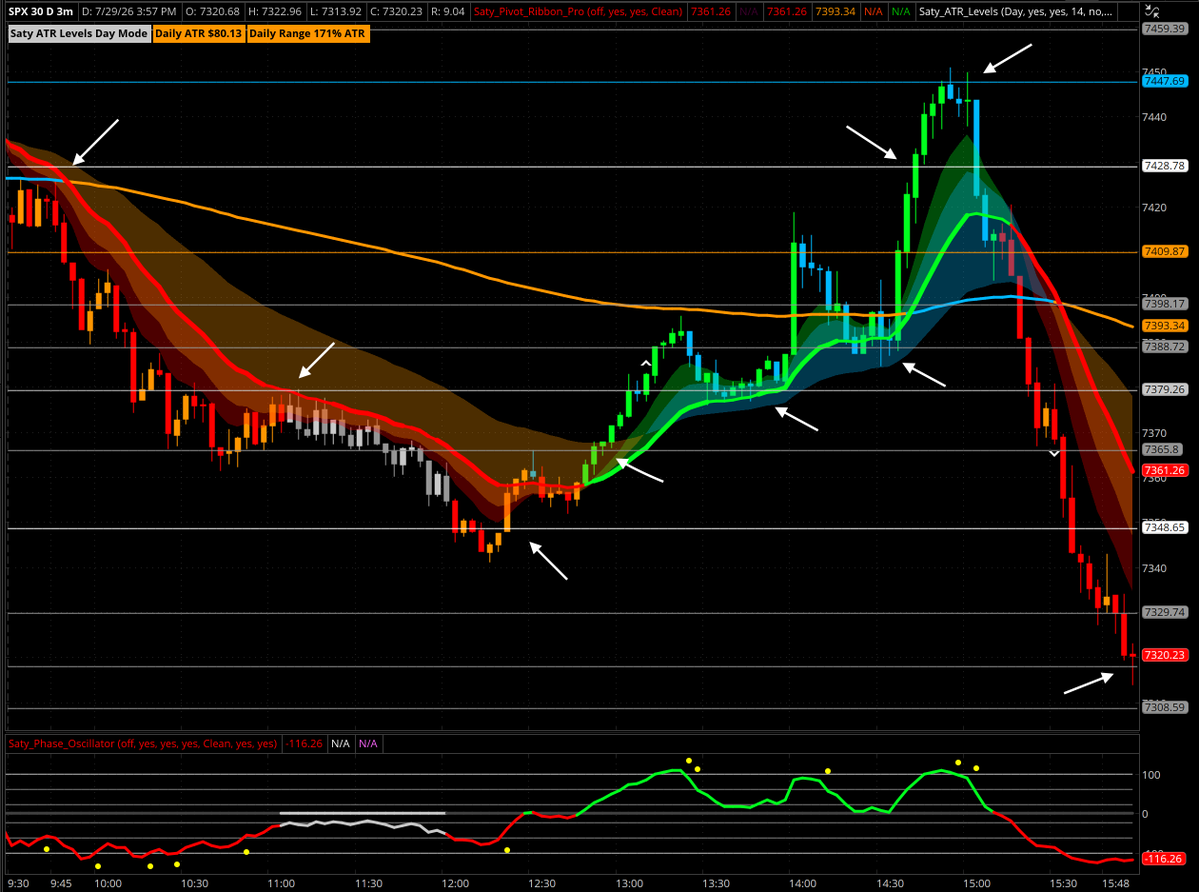
Plan worked great. I had trust issues. Took this opening move off resistance with 7450p which was great.
Didn't trust the upside move and ended up scalping downside again a couple times for little profit. Missed the entire move up and never joined the trend. 🤣
Excellent plan. Terrible execution.
You call this investing?
Oracle $ORCL in June: a $700 billion company. Oracle today: $122, down roughly 50% in six weeks. From the September peak near $346, the stock has lost about 64%.
This is not a broken startup. It's a 48-year-old database giant. What broke is the balance sheet math:
– free cash flow: minus $23.7 billion
– capex: $56 billion, up 162% in one year
– net debt: $97.6 billion, and another $40 billion of financing announced
– S&P downgrade to BBB-, one notch above junk
– 21,000 jobs cut, headcount down 13%
Against that: a $638 billion order backlog, much of it resting on OpenAI's ability to pay. Record bookings, and the market sells anyway. Because a contract is a promise, and the debt is a fact.
When a company borrows against the future faster than the future can arrive, the stock stops trading on earnings. It trades on faith. And faith reprices in weeks, not years.
Quality means never having to hope your biggest customer finds funding.