Peptide Directory. Suppliers in the UK, US and AU, peptide information, and the research behind them. Informational only. Not medical advice. We sell nothing.
Can you keep your strength while losing weight on tirzepatide? 🏋️
In a 40-week RCT of 120 adults aged 50–70, 3 weekly weights sessions didn't change weight loss (~22 kg) but cut lean tissue loss by 1.1 kg, and strength rose instead of falling.
https://t.co/DeWtOIfPgg
Could a bone-building osteoporosis peptide need fewer injections? 🦴
Chemists added fatty acids to teriparatide; 4 of 12 new versions kept near-native activity, and the best was far more stable in serum.
Lab and animal work only, no human data yet.
https://t.co/Uj9BzS2nOP
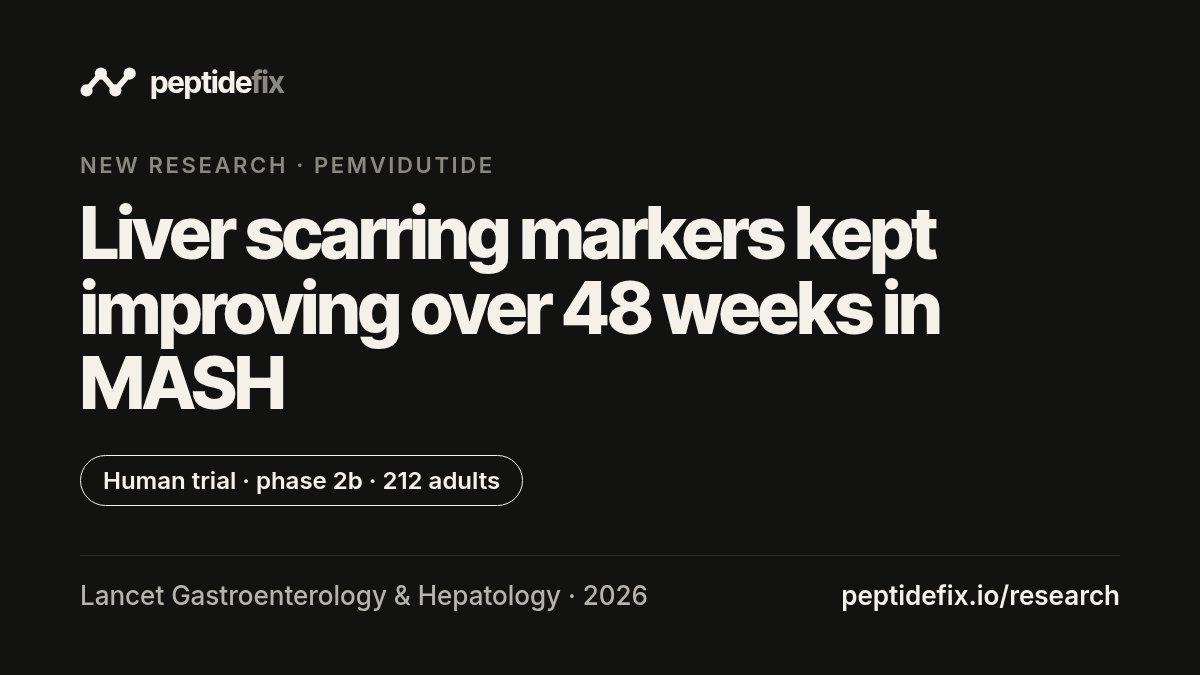
Can a peptide keep improving a scarred liver beyond six months? 🧬
In a 48-week phase 2b trial (212 adults with MASH), pemvidutide cut liver fat by up to 54.7% vs 8.2% on placebo, and fibrosis markers kept improving.
Marker-based, phase 3 underway.
https://t.co/lRzGkfwIov
@salvereginavita Good primer. Worth adding that 'peptide' covers everything from FDA-approved drugs like semaglutide to compounds with mostly animal data like BPC-157, so the evidence varies hugely by compound. Directory: https://t.co/P3kJ6PD6RW
@agingdoc1 Nice to see the evidence levels spelled out. Lactoferrin also releases lactoferricin, an antimicrobial peptide, when digested. Human data look strongest for iron status, e.g. anaemia in pregnancy; the mitochondrial effects are still mostly preclinical.
@Zieddyyyy Worth flagging that none of these stacks have been tested together in human trials. GHK-Cu's strongest human evidence is topical, for skin, while BPC-157 and TB-500 are still mostly animal data. Evidence summary: https://t.co/PoiCPsIKBk
@Jrolz1 The 'research use only' label is the core issue: it means no human-use quality standards apply, whatever the COA says. If the HHS policy holds, a licensed 503A route at least adds prescriptions, sterility rules and pharmacist oversight. https://t.co/VYv2xnpj5m
@OrthoToday Helpful summary. One nuance since 30 Oct: HHS's interim policy gives enforcement discretion for 503A compounding of six peptides (BPC-157, TB-500, KPV, MOTS-c, Semax, Epitalon) under conditions. It isn't approval, and state rules can still apply.
@LongevityDad Useful reminder. For anyone commenting: it's enforcement discretion for 503A compounders, not FDA approval, and human evidence for most of the six is still thin. Specific, evidence-based comments carry more weight. Explainer: https://t.co/pLu5mLJXhv
@BradSchoenfeld@bryan_johnson Important distinction. In the Lancet COURAGE trial, MRI showed trevogrumab preserved roughly 70% of the thigh muscle lost on semaglutide, versus 20-50% on DXA lean mass. The measurement method changes the headline a lot.
@Medscape Interesting shift. So far most of the 'GLP-1s and aging' signal comes from observational data and secondary outcomes, like the 20% drop in major cardiovascular events in SELECT. Trials with aging-specific endpoints are what will settle it.
@bryan_johnson Promising for finding targets. The open question is whether those molecular correlates are causes or consequences of brain aging, and whether shifting them changes outcomes. That needs intervention trials, not just association data.
@foundmyfitness Agreed it's one of the better-supported levers. Much of the MRI data is cross-sectional, so randomised trials are the stronger piece: in Erickson 2011 (PNAS, 120 older adults), a year of walking grew hippocampal volume by about 2% vs shrinkage in controls.
@pepfanatics Good framing. Worth adding that approval is indication-specific: tesamorelin is approved for HIV-related belly fat, elamipretide only for Barth syndrome. And the HHS compounding policy for BPC-157 and co. isn't approval, so it doesn't move them up a tier.
@checkregen Useful nuance from the npj paper: the tirzepatide vs semaglutide gap disappeared after adjusting for total weight lost, lean mass was ~20% of weight lost on both, and most readings came from bioimpedance scales, not DXA. Observational, so trials should confirm it.
@BenBikmanPhD Worth adding the caveat: carrier groups were tiny (17 on semaglutide, 19 on tirzepatide) and the data are retrospective, so it needs replicating before anyone tests for it. Still a neat lead on why tirzepatide may help some semaglutide non-responders.
@KenDBerryMD Context from the same Lancet trial: adding trevogrumab cut lean-mass loss to 3.4% at 26 weeks with similar weight loss (9.9% vs 10.6%). Also, DXA 'lean mass' includes water and organs, not just muscle. Strength and function data are what's still missing.
Could one gene-therapy dose make the body produce its own GLP-1 drug? 💉
In obese mice, a single AAV dose encoding exendin-4 cut body weight by up to 22.6% over 21 days. Versions using native GLP-1 had no effect.
Mouse preprint, not yet peer reviewed.
https://t.co/BTLERnxfpb
Why do some people barely lose weight on semaglutide? 🧬
In 13,725 adults (Nature Metabolism), rare GLP1R gene variant carriers lost 2.4% vs 8.8% on semaglutide, but 13.3% vs 15.2% on tirzepatide.
Real-world data, only 17 and 19 carriers.
https://t.co/4tsps375An
@Dr_Lxngevity Good point. Test-retest reliability should be the first thing checked before acting on any aging clock, and ideally clocks get validated against real outcomes like disease and mortality, not just chronological age.
@UniverseNow00 The bowhead work is genuinely interesting: the protein CIRBP boosted DNA repair in cells and extended lifespan in fruit flies. But nothing has tested it in people, so '200-year humans' is a big leap from cell and fly studies.