Druck - 8 incredible excerpts/masterclass on literally everything - risk, concentration, traits of great traders - from 2009 intvw with Jeff Feig (ht @kevg1412)
1. Druck on getting his start in the business
"You couldn't sell snowmobiles in Alaska if there was no other transportation vehicle there."
"And I got a job in construction. And then the only job I could get was at Pittsburgh National. And I started in the training program. In a bank, you're a teller, you go through the credit department, and everybody wants to go to the credit department. And I thought I was pretty smart. There were 12 of us. I had a pretty high opinion of myself, and I went in after we went through the training program, and the guy at credit said, You couldn't sell snowmobiles in Alaska if there was no other transportation vehicle there. So we have no use for you anywhere in the bank. But there's a guy up on the 30th floor whose personality is worse than yours, who runs the trust department. He's a great investor--you should call him up and see if he'll hire you. So I called the guy up and he said, Where'd you go to school? And I said, I met University of Michigan. And before I get out--he said, I went to Michigan. You're hired."
2. On charts, and fundamentals vs. technicals:
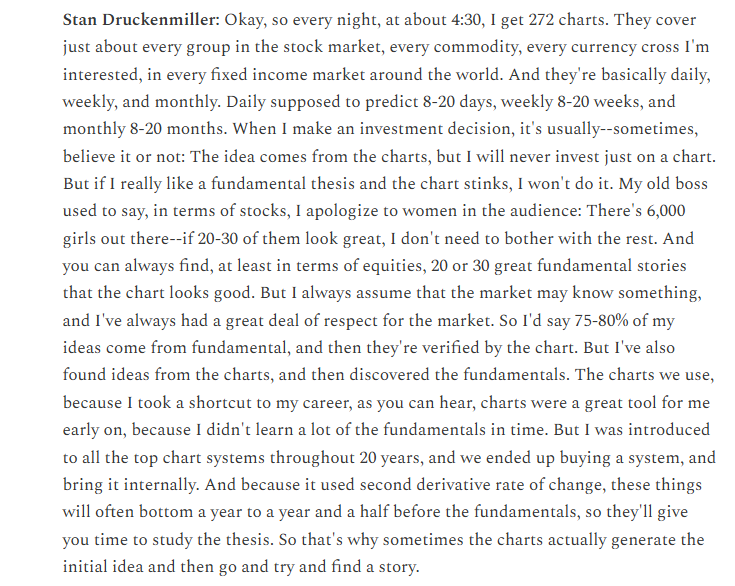
Okay, so every night, at about 4:30, I get 272 charts. They cover just about every group in the stock market, every commodity, every currency cross I'm interested, in every fixed income market around the world. And they're basically daily, weekly, and monthly. Daily supposed to predict 8-20 days, weekly 8-20 weeks, and monthly 8-20 months. When I make an investment decision, it's usually--sometimes, believe it or not: The idea comes from the charts, but I will never invest just on a chart. But if I really like a fundamental thesis and the chart stinks, I won't do it.
3. On Concentration
"So I went into him, and I said, George, I just want you to know I'm going to do $5bn worth of the pound. I don't think I had told him about the $1.5bn. I've been monitoring this for a while. I went through the thesis, and the whole economic pitch I gave you. And he goes, That's ridiculous. And I said, Excuse me? George, this is like a layup. He says, Exactly the point. Why are you only doing $5bn? So he says, This is a one way bet. It's not the way you manage risk. You should do $15bn, because the forwards are still, like 0.5-0.75%."
4. On Concentration (cont)
But you ask a great question, because--and this is not something I did, but this is a great trading lesson. I wasn't there, but [Oaken (ph)] will tell you the story, because he was. And this is a great investor--his name is George Soros. And when Plaza happened in '85, he was loaded to the brink with Yen--like, already too big. And all the little traders there--we didn't have this when I was running Quantum, but they had their little $25-50mn capital pools.
They were allowed to piggyback, so they were all long Yen, because, frankly, George was long Yen. So the next morning, after Plaza, the Yen opened up 800 ticks.
And George Soros is an interesting guy, but I worked for him for 12 years, and I never heard him swear, and I never saw much emotional change. Takes--that lasted me for about four minutes, if you were with me on a desk. But apparently, all these other guys started taking profits, and he had an absolute heart attack.
Stop it. Transfer all that stuff to me. They're idiots!
And the thing went another 40%--another 4,000 ticks. So the easy thing emotionally was to take a profit. And in fact, George was adding, and taking that too, because you can't just make yourself feel good by taking a profit when something goes your way. You have to remember your original game plan, your original thesis, and why you thought it would go from, if it's A to B, wherever B is.
5. Druck on stops - "I have them"
Yeah, I have never used a stop loss in my career. I don't use a--like a number. I know that's a disciplined system and I know it works, but I have like conditions: if it starts not acting well relative to news or other things I'm watching, I'll get out. So I probably do have a stop loss in my head.
6. Traits of great traders
Jeff Feig: So what is it you think that makes a good trader? I mean, I know you got a lot of friends who are pretty legendary traders, all with different styles. You've had a lot of people work for you, people that you've worked for. What is the common denominator?
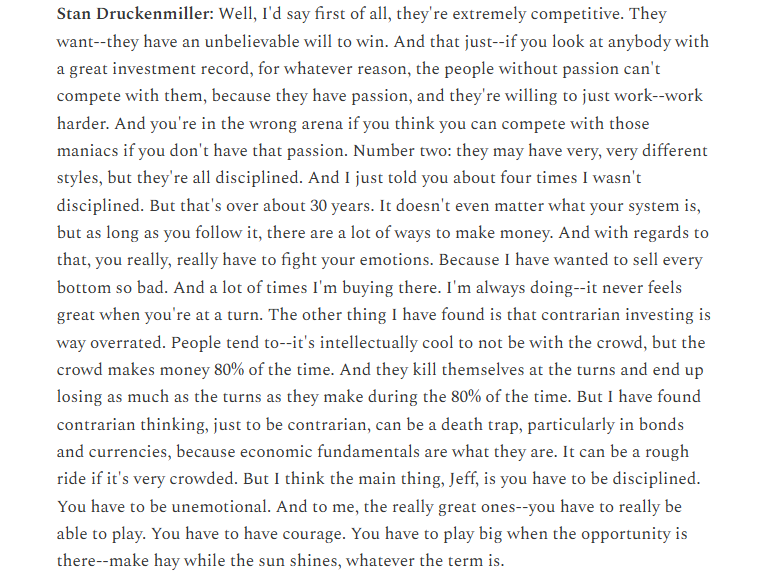
Stan Druckenmiller: Well, I'd say first of all, they're extremely competitive. They want--they have an unbelievable will to win. And that just--if you look at anybody with a great investment record, for whatever reason, the people without passion can't compete with them, because they have passion, and they're willing to just work--work harder. And you're in the wrong arena if you think you can compete with those maniacs if you don't have that passion.
Number two: they may have very, very different styles, but they're all disciplined. And I just told you about four times I wasn't disciplined. But that's over about 30 years. It doesn't even matter what your system is, but as long as you follow it, there are a lot of ways to make money. And with regards to that, you really, really have to fight your emotions. Because I have wanted to sell every bottom so bad. And a lot of times I'm buying there. I'm always doing--it never feels great when you're at a turn.
The other thing I have found is that contrarian investing is way overrated. People tend to--it's intellectually cool to not be with the crowd, but the crowd makes money 80% of the time. And they kill themselves at the turns and end up losing as much as the turns as they make during the 80% of the time. But I have found contrarian thinking, just to be contrarian, can be a death trap, particularly in bonds and currencies, because economic fundamentals are what they are. It can be a rough ride if it's very crowded.
But I think the main thing, Jeff, is you have to be disciplined. You have to be unemotional. And to me, the really great ones--you have to really be able to play. You have to have courage. You have to play big when the opportunity is there--make hay while the sun shines, whatever the term is.
7. On risk systems
Stan Druckenmiller: I don't remember when you walked in, but this is a terrific question, because I have never had a--well I did, but I didn't pay attention to it, and it's what Tom's alluding to--I have never had a fancy quantitative risk management control system overseeing me. And by the way, neither did George Soros in the 25 years he ran the fund before I did. And between us, there's one down year since 1969.
8. On P&L-watching as the best risk system
But when you really, really need risk management, they break down. Because by definition of a financial crisis, which I'm sure everybody here knows, because we had a recent one, correlations just go wacko. The stuff that has correlated for years breaks down. And you start seeing changes that make no sense whatsoever.
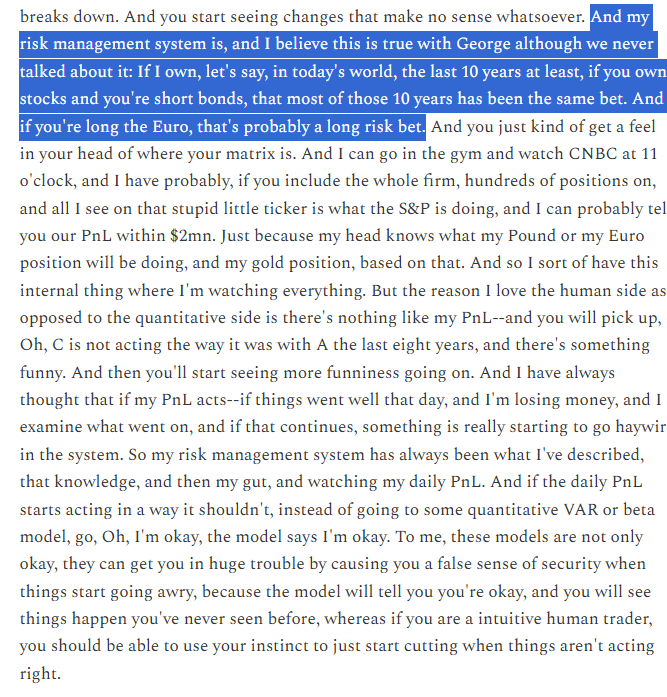
And my risk management system is, and I believe this is true with George although we never talked about it: If I own, let's say, in today's world, the last 10 years at least, if you own stocks and you're short bonds, that most of those 10 years has been the same bet. And if you're long the Euro, that's probably a long risk bet. And you just kind of get a feel in your head of where your matrix is. And I can go in the gym and watch CNBC at 11 o'clock, and I have probably, if you include the whole firm, hundreds of positions on, and all I see on that stupid little ticker is what the S&P is doing, and I can probably tell you our PnL within $2mn. Just because my head knows what my Pound or my Euro position will be doing, and my gold position, based on that.
And so I sort of have this internal thing where I'm watching everything. But the reason I love the human side as opposed to the quantitative side is there's nothing like my PnL--and you will pick up, Oh, C is not acting the way it was with A the last eight years, and there's something funny. And then you'll start seeing more funniness going on. And I have always thought that if my PnL acts--if things went well that day, and I'm losing money, and I examine what went on, and if that continues, something is really starting to go haywire in the system.
So my risk management system has always been what I've described, that knowledge, and then my gut, and watching my daily PnL. And if the daily PnL starts acting in a way it shouldn't, instead of going to some quantitative VAR or beta model, go, Oh, I'm okay, the model says I'm okay.
To me, these models are not only okay, they can get you in huge trouble by causing you a false sense of security when things start going awry, because the model will tell you you're okay, and you will see things happen you've never seen before, whereas if you are a intuitive human trader, you should be able to use your instinct to just start cutting when things aren't acting right."
--
intvw link: https://t.co/8rRREpwWn2
$NVDA is knocking on the 50/80 door, joining the list of MANY past leaders, particularly in the tech space. You can read about this phenomenon in my both my books Trade Like a Stock Market Wizard and Think & Trade Like a Champion.
A Google Cloud engineer just showed how to build a full app with Claude from scratch.
He spent 26 minutes live on stage doing what most teams take weeks to do.
It's worth more than any $500 vibe coding course. No team, no setup, just Claude and a goal.
The people learning what Claude can actually do are shipping what everyone else outsources to a team.
Goldman Sachs, Bridgewater, KKR and Man Group publish free research notes on their websites. Most investors never read them.
We read them every day and summarise the best. Last 30 days: 909 read, 469 kept, from 130+ banks and funds.
Free, no account needed: https://t.co/sCbJMQARiw
Know a firm we should add? Reply with the name.
Basic hedge fund economics 🧵. N.B.:
1. for educational purposes only and I will keep it super-simple
2. ofc, personal views
3. No soliciting! I am not coming to defend hedge funds, just to explain some basics. And I am not going to answer replies on the Current Thing.
1/
A thought-provoking piece by @HorizonKinetics on the risks faced by US markets, passive investing and some top ideas:
🧵👇🏼
The US has benefited from BIG, momentous events.
1️⃣ “The first economic miracle for the U.S. was the collapse of the Soviet Union and a hard commodity supply surge.”
1/12
We discuss RenTech briefly in this (picture attached): https://t.co/Bl6pHg2FAq
To state the obvious, if we (or I) had a deep knowledge of how Medallion did it we’d do it too! I have always assumed they were quite early to things like stat arb, HFT, factor investing, natural language processing of financial news, etc., and were particularly good at optimally trading very high frequency signals and slower ones (a non-trivial trade-off) together.
Also note I specifically say “Medallion.” One thing I find fascinating is RenTech has some products that, unlike Medallion, are open to outside investors. These look like good solid quant products but not, if I may say so, better than the rest of us.
Thus they figured out an amazing way to take out a few billion dollars a year from markets with very low (not zero) risk. That is nothing to sneeze at to put it very very mildly! But they didn’t crack how to run 100s of billions in institutional capital with anything like that risk-adjusted return. When they try to do that they look like the rest of us (which I hope is not an insult!).
As you see I have no answers, just some thoughts.
Robert Friedland (@robert_ivanhoe) is one of the most important voices in Metals & Mining.
When he speaks, we should listen.
He recently gave a 40-minute speech on Green Energy, Electrification, Metal Scarcity, and more.
Here are my notes from the talk 👇
WHAT DOES "ENERGY TRANSITION" MEAN?
"You have a billion people that burn firewood to live. They have no access to electrical energy."
"We're burning more coal and more oil today than in the history of the world."
"We spent $4T putting up solar panels for hydrocarbons to still capture 83% of energy source."
"You're not going to stop global warming by buying an electric car."
ON ELECTRIC CARS & EV BATTERIES
"With current lithium ion technology, the destruction we cause, the global warming gas we cause, we might as well sit on our chairs and do nothing."
"You just bought your wife a coal-burning car by buying an EV."
"The current generation of EV batteries will be toast in 2-3 years."
"I would short every lithium company in the world."
"We're going to kill the lithium hydroxide business over time."
COMMON METALS VITAL FOR TRANSITION
"If we're going to have a transition, we need common and abundant materials. We can't rely on things like nickel."
"The batteries they're making now are low-grade lithium metal. You don't need nickel, cobalt, graphite, They're out the window."
"You want batteries made out of common materials so billions of people can use it."
WOMB TO TOMB EXAMINATION OF NET ZERO
"Look at the whole system if you're trying to eliminate global warming."
"The Chinese are saying 2060 and India is now saying 2070. What does that tell you?"
"There's zero chance that the twelve major automakers will find enough nickel to make their batteries."
"The amount of metal we need doesn't exist currently in a way that's green or sustainable. It's apparent to any readily intelligible person."
"How can we stop burning coal and oil and not have an energy transition?"
TWO COMPETING PARADIGMS
"We have two competing tribes. One tribe says 'I want to save the world, I'm green, I need cobalt, nickel, platinum, or palladium'. The other tribe says 'Holy shit, the Army/Navy wants these metals for national defense.'"
"The intensity of metal demand in conflict is beyond your wildest imagination. In WWI you needed a telescope to see the price of copper."
"So we're heading to a world where both tribes have a strong demand for more metals. We're balkenizing the world into two camps and its tearing the global supply chains apart."
A VERY DIFFICULT TIME
"It does appear that the world is warming, and there's zero chance we'll reduce that. The question is how bad will it get?"
"I was in CA recently, it was $6.20 per gallon. The average citizen is pissed off."
"I agree with Jamie Dimon that this is the most dangerous time since I've been alive."
"The Fed are idiots. They told us that inflation was over. And it's not even close."
WE NEED TO REINVENT THE MINING INDUSTRY
"First of all, we have to try to mine in the United States. No intelligent person has tried to do that in the last few generations."
"Everything is blown out of proportion because mining is viewed as a bad thing."
"We also have to determine what metals we actually need for the future. Which is copper."
"Imagine you're plugging an EV w/ 1MW charger. Our grid is literally a 110 year old lady waiting to die. The Chinese tell me it will take $21T to rebuild the electrical grid."
"Our grid is like balancing a pencil vertically on your palm. There's no storage there."
"The symbol of the US, the bald eagle, is flying into offshore windmills. They're just chewing them up. Who wants to live near them? They're very low density."
"At least real miners know how hard it is to actually find metals and mine it."
ENERGY CONSUMPTION
"A Google search requires 1,000 joules of electrical energy. You think its free, but its paid for by advertising."
"You think the internet is green? You know how much energy it requires to use AI/ChatGPT? You think Bitcoin/crypto is green?"
IMPORTANCE OF COPPER
"I don't know if we need gold. But I do know we need copper. And we need it really badly."
"Having said that, I'd rather there be gold in my copper. Because people will always want gold."
"People are getting rid of their excess copper because they're de-stocking to reduce their interest cost. But we're nearing the end of de-stocking and paper selling."
"This huge clash is coming between Army, Navy, Air Force and the Greening of the world economy. And the miners have an unbelievable burden to make that happen."
"At the same time we need these metals, its harder to get the equipment needed to mine the metal!"
"The miners have a very important role to play to supply the world with the metals it desperately needs."
IMPORTANCE OF SAUDI ARABIA
"If Saudi Arabia can't maintain basic energy security, we'll have $200-$300 oil. We need stability in that pricing. At $100-$300 oil, people in Egypt don't eat."
"Saudi is playing a beneficial role by keeping oil between $70-90 per barrel."
AUDIENCE Q&A
"The valuation of the mining industry relative to the S&P 500 is the lowest in living memory. The general person thinks that mining is evil and must be eliminated."
"50% of what goes into an EV is hydrocarbon. If we stopped producing oil, half of humanity would die from starvation."
"I don't think we understand how formidable the Chinese are."
"In a Balkenized economy, we went from a Just-in-Time supply chain to a Just-in-Case supply chain."
"How much metal do we need to build nuclear reactors? How much steel, concrete, rebar, nuclear engineers do you need to build these things?"
"The problem is that the world economy is Balkenized. Where is the steel coming from? Where are the pumps coming from? The French want nuclear power, and the Germans are burning coal. Even within Europe, its Balkenized. That's all I see."
"I think the mining industry needs to defend itself more. Where do you think stuff comes from? There's the hardware of the mine (tons, grade, engineering).
Then there's all the people around the mine (locals). There's invariably a clash with the locals around the mine. Unless they're buying into it, its not going to happen. That's the software around mining."
ON KNOWING WHERE THINGS COME FROM
"People don't realize where things come from. As people live in urban environments, they forget where things come from."
"We need to communicate the importance of mining and humanize it as an activity. We need to mine in the United States. We need to figure out what should be mined, where we're allowed to mine, and how."
➡️How NOT to beat the market
1 | Invest with the same time horizon as other investors (holding period less than a year)
2 | Own lots of companies so you don’t differ too much from the average
3 | Be certain not to be left out of the current fashion/fad/trend (crowd following)
4 | Believe that you are ‘smarter’ than others and can predict the stock market
5 | Keep some level of cash (that inevitably will underperform equities)
2/6
Sharing the "Lessons from 30 years of investing" by Francois Rochon, his presentation at the 10th Value Spain conference.
My favourite quote:
"Holding on to a company that is reporting bad results or going through serious troubles is not patience. It is denial.”
🧵👇
1/6