Journalist, author, wheelchair user, podcast host, reservist @BritishArmy, columnist @Reuters, @uklabour member, proud of all of the above. Open to DMs
Hello! My next book "The Next World War: The New Age of Global Conflict and the Fight to Stop it" is out on January 29 from @headlinepg. Here are the top ten questions I've had about the book in recent weeks…
https://t.co/ltITrPpXre
EUCOM and SACEUR making it clear they are on the same page as the Pentagon and administration in telling Europe US forces will be "rightsized" and other NATO members must fill the gap…
@DeptofWar officials notified Allies the U.S. would rightsize its contributions to the @NATO Force Model, consistent with the burden sharing direction in the 2026 National Defense Strategy and the Department’s vision for a “NATO 3.0.” FULL PRESS RELEASE: https://t.co/XMCjV2fjFt
Marilyn Monroe was born a hundred years ago today. She was famous enough in her lifetime to be one of those rare figures referred to by their first name alone. Such fame seldom lasts. Even Frank now needs to be called ‘Sinatra’.
She is still ‘Marilyn’ partly because the name fell out of use; her fame survives partly because she died young – of a barbiturate overdose, presumed to be suicide – at the age of thirty-six.
My favourite Monroe story is one told by Billy Wilder, who directed and co-wrote the film Some Like It Hot. Newly engaged to Arthur Miller, the actress was taken to meet Miller's parents in a small New York apartment with thin walls.
Nervous of being overheard while she was using the bathroom, Monroe turned on the taps to cover the noise. Miller phoned the next day to ask what impression his bride-to-be had made. ‘Sweet girl,’ his mother replied. ‘Wonderful girl. Pisses like a horse.’
✍️ Druin Burch
Article | https://t.co/M22JMEznnL
“Perhaps because of distance, or perhaps because of the hard-learned lessons of history, the default Asian lens on America has been clearer, and far more pragmatic…Our partners in Asia have long understood that the bedrock of a durable partnership is not based on idealistic shared values, but on the concrete alignment of national interests.” 4/
"Warrior scholars" and "geeks with guns": my latest Reuters column goes behind-the-scenes at Special Operations Forces week in Tampa, Florida https://t.co/9mvyxwwtmH
Amid all the growing questions over US-Europe military relations, can NATO survive? My latest video for my YouTube Channel, Battle For The World #NATO#Defence#Defense#AvoidingWar https://t.co/aDaB7LD9pn
Hello! My next book "The Next World War: The New Age of Global Conflict and the Fight to Stop it" is out on January 29 from @headlinepg. Here are the top ten questions I've had about the book in recent weeks…
https://t.co/ltITrPpXre
I don't think this is about Washington. I think it's about signalling from Palantir – including, I'm afraid, a Moseley in a black shirt – that raise questions over the wisdom of trusting an otherwise very effective company with sensitive health and policing data…
Palantir’s software helps the police catch criminal gangs, root out misconduct, and protect women from abusive partners. The Met Police wants this software to keep Londoners safe, but @SadiqKhan prefers sending political messages to Washington. Read my op-ed in @theLDNstandard ⬇️
Darren on Xi and Taiwan
He explains why Xi may not need to invade. But if he does, it wouldn't stop at Taiwan.
"You've gotten to a certain age and you view it as the apotheosis of your life's achievement in order to complete the journey.
Imperial China is what Taiwan is, and the takeover by the CCP is not complete until Taiwan falls.
I don't think Xi needs to go if KMT wins the election coming up.
KMT almost won last time, and that is a rapprochement party to the CCP. It's an accommodation party.
I believe a bullet may never need to be fired in order for China to get what they want. That's the more likely outcome.
If Taiwan is overtaken in a military exercise, is there any doubt that these other countries that have real historical beefs will be next?
That's why Japan has been so vociferous at advocating for strong defense now under this new prime minister.
There's a real historical beef between China and Japan. I think that would be exercised.
It would not stop at Taiwan."
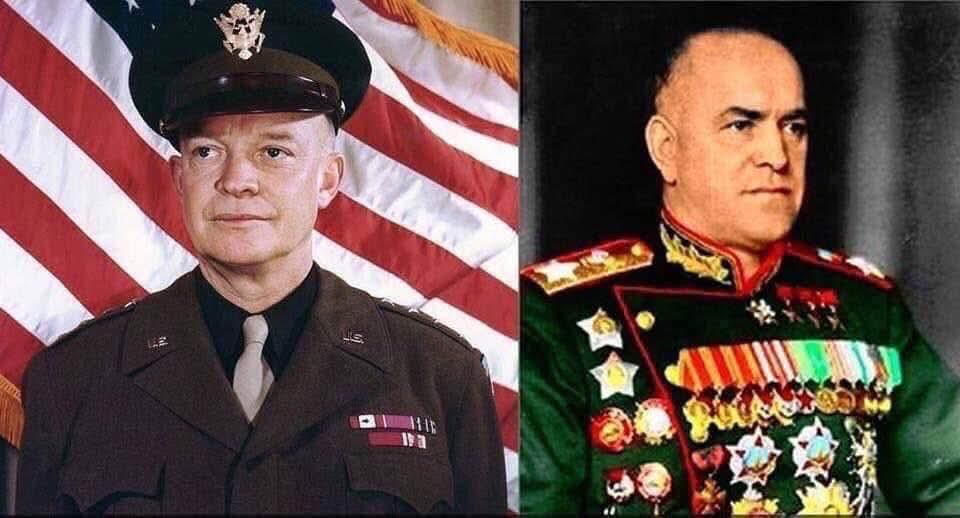
Interesting excerpts from the memoirs of Supreme Allied Commander General Dwight D. Eisenhower (later President of the United States from 1953–1961) about Marshal Georgy Zhukov:
“During the several hours we spent together in the airplane, Marshal Zhukov and I often discussed military operations... A great revelation to me was his description of the Russian method of attacking through minefields. German minefields, covered by enemy defensive fire, were tactical obstacles that caused us heavy casualties and many delays. Breaking through them was always difficult, despite the fact that our engineers had invented every imaginable mechanical device for the safe clearing of mines.
Marshal Zhukov casually remarked to me: ‘There are two kinds of mines: antipersonnel and antitank. When we encounter a minefield, our infantry continues the attack as though it were not there at all. We consider the losses from antipersonnel mines to be equal to the losses we would have suffered had the Germans defended that sector with concentrated manpower instead of minefields. Advancing infantry does not detonate antitank mines, so once they have crossed the minefield and secured the opposite side, the engineers then come forward and clear lanes through which vehicles can pass...’
I could vividly picture what would have happened to any American or British commander who attempted to use such tactics, and an even clearer picture of what the men in any of our divisions would have said if we had tried to make such practices part of our tactical doctrine...
Americans measure the cost of war in human lives, while the Russians measure it in the total expenditures of the nation.
As far as I could see, Zhukov cared little for the methods we considered essential to maintaining the morale of American troops: systematic rotation of units, opportunities for rest and recreation, short leaves, and above all the development of methods designed to avoid exposing men to combat risks that were not absolutely necessary. All of this, common practice in our army, was largely unknown in his army.
...The fundamental difference between American and Russian attitudes toward the treatment of people was illustrated in another incident. In a conversation with a Russian general, I mentioned the difficult problem of caring for large numbers of German prisoners of war — a problem we faced at various stages of the war. I noted that we gave German prisoners the same food ration as our own soldiers.
‘Why would you do that?’ Zhukov exclaimed in astonishment.
I replied that, first of all, my country was bound to do so under the Geneva Conventions. Secondly, thousands of American and British servicemen were prisoners in German camps, and I did not want to give Hitler any excuse to treat them even worse than he already did.
Zhukov was even more astonished by this answer and exclaimed: ‘But why should you care about soldiers captured by the Germans?! They were prisoners already and could no longer fight anyway!’
The excerpts are quoted from Dwight D. Eisenhower, Crusade in Europe, The Johns Hopkins University Press, 1997 (first published in 1948), pp. 468–470.
Interestingly, in the Russian translation of Eisenhower’s memoirs (2000 edition), these passages — seemingly of particular interest to Russian readers — were removed.
Everyone shouting “we can do it again” should remember that they would be sent to fight using Zhukov’s methods and traditions.
It also points to what is arguably the biggest single shift: in the Cold War, the US wanted to micromanage any risk of European conflict escalation. Now it no longer does, and that inherently complicates the picture
This is a very good point, the dependencies the U.S. presently laments are a product of its own doing in many ways. This is not to excuse the lack of European NATO member spending, but Washington needs to accept its own hand the current dynamic.
One of the interesting details of the current era is that it makes French choices in the second half of the twentieth century look much more sensible than previously…
A massively under-communicated part of the "Europe-is-free-riding"-story is that the total American dominance of NATO it enabled was a desired and intended outcome for much of the US national security establishment.
That doesn't excuse European leaders for leaving us weak and taking advantage of the opportunity to prioritize spending elsewhere. It was reckless, stupid, and short-sighted. And it was a mistake entirely of our own making, regardless of American foreign policy decisions.
But the Trump-Vance song and dance about the US somehow being a victim of European screwing them over is nevertheless complete nonsense. The US preferred its European allies to be good sidekicks and reliable customers of US defense contractors - but they never wanted Europe to stand on its own two feet.
⚡️ BREAKING: US halts Ukraine peace talks
“We were the only ones both Russians and Ukrainians were willing to talk to. So we got involved. Unfortunately, it didn’t yield results. That’s the point,” — said Secretary of State Marco Rubio.
Rubio added that Washington will return to negotiations only if the dynamics change, and noted: “If someone else wants to take this on — please, be my guest.”
In a parallel universe Labour would be talking about economic growth outperforming expectations and being revised upwards this year, NHS waiting lists hitting the lowest in 3.5 years and - just now - net migration halving last year to 171,000. Instead they’re in crisis.
Just caught @pete_apps Youtube Channel. Excellent analysis on NATO and the conflict with Iran from currently perhaps the most insightful commentator on PolMil affairs.
https://t.co/MjCS7ri9YD
That this is a bigger deal than Europe was expecting, particularly with the apparent cancellation of an imminent deployment of US troops to Poland https://t.co/a95Zff5joc
Lithuanian Defense Minister Robertas Kaunas said the U.S. has informed allies of a possible pause in troop rotations to Europe while the Pentagon reviews deployment plans, Bloomberg reports.
“Lithuania has been informed of possible changes of the rotation in the US presence in Europe,” Kaunas said
Finally, either @louismosley or his handlers have ditched the black shirt, an unforced error (amongst several) with enormous implications for the trust in which @PalantirTech is held at a time with colossal implications…
Readiness, viewed from inside defence tech.
@louismosley Head of UK and Europe at @PalantirTech shares his thoughts on the evolving security landscape and what real preparedness demands today, from the sidelines of @LondonDefConf#LDC2026
BREAKING: Sweden's Supreme Commander Michael Claesson, in an interview with SVT, warned that Russia may test NATO sooner than the one to five year window most alliance security services have been working with.
Claesson stressed the window is now while NATO is still rearming and before defenses reach their intended strength.
Claesson emphasized that Russia cannot defeat NATO militarily, so the target is alliance cohesion. He warned about a potential strike on a Baltic island not to seize territory, but to test whether every NATO member would respond to an attack on one of them.
He stressed that such an operation would not require troops from Ukraine. A smaller, limited move would be enough to run that test. When asked directly when Russia might be ready he answered with one word: "Now." He added: "They know the entire Western world is getting ready. Why would one wait to exploit perceived vulnerabilities?"
Asked if it sounds dangerous, Claesson did not soften it. "Yes, it is clear that it is dangerous." He stressed that Sweden and its neighbors must continue rearming, training, and maintaining readiness persistently over time. On the Baltic Sea, he pointed to Russia's growing shadow fleet and tightening escorts around those vessels as a direct and growing source of escalation risk. Asked whether the situation is worse than a few years ago Claesson said yes.
NATO is not – quite – a "Paper Tiger" as @realDonaldTrump has put it. But whatever creature it might be, so much of its central nervous system in particular is US made that the alliance has a problem. My latest YouTube video https://t.co/mujjI0zLfM
That doesn't mean the young Kennedy wasn't right then and isn't right now: the question, as he correctly identified in 1951, is the future of Germany… And we might finally be getting a significant change on that front…
This is a sharp rhetorical twist that just about ties together what was increasingly looking like wildly mixed messaging between US commanders in Europe and Washington. The US wants to stay in charge, but is "resetting" its military commitments…
This week's USNATO Huddle is on NATO 3.0. The era of America footing an outsized bill for Europe’s defense has ended. Led by President Trump’s America First Foreign Policy, the United States demands actions, not words, from our Allies.
The problem with an actual "factory reset", of course, is that you end up being stuck in this speech by a young Congressman Jack F Kennedy in 1951 demanding limits to US troop contributions in an argument that has never ended since… https://t.co/qQRZLSnu9Z