Everyone is born with infinite ignorance… and will die with infinite ignorance…
Blindspots are, as far as I see it, part of the infinite ignorance…
The problem is not that we have the infinite ignorance, the problem is that almost all are ignorant about having it…
This… is… Legend… -ary…
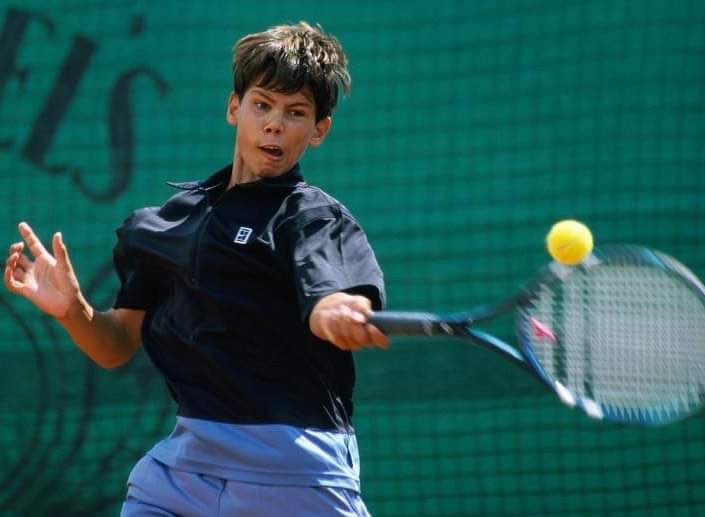
Cash has said that after Nadal’s 14 French Open titles it made it sting a bit less… 😊
To Cash defense… Rafa had home court advantage in every possible way…
Pat Cash: “I was meant to play an exhibition match in Mallorca. 30 mins before, Becker says he can’t play. They tell me ‘you will play a 14 year-old’. I go on court, ready to give him a few games, so he won’t be upset.
I lose 2-0, and ask him for his name:
‘Rafael Nadal.’” 🐐
NeXTStep Release 3.
Steve Jobs demonstrates it and sells it.
I can only think of one founder today that has the guts to present their products, use their products, develop their products and test their products in public to this level.
Context Matters...
Had he shoved with his AA then Laak may have re-evaluated his 66 and folded...
After Action Reviews can benefit greatly by separating the outcome from the decision...
Was it the best decision in this context?
Just because the result was a 'Win' does that mean it was the best decision...?
What about the wider context?
The better the 'Quality' of contexts you can create and evaluate; the better the future decisions...
This can be the difference between a great Poker / Life Player and an average one... 🙂🙃
Terence Tao has won every award mathematics can give a human being.
Fields Medal. Breakthrough Prize. MacArthur Genius Grant.
He is widely regarded as the greatest living mathematician. Not one of. The greatest.
He just said something that should terrify every university on Earth.
Tao: “We live in a particularly unpredictable era. I think things that we’ve taken for granted for centuries may not hold anymore.”
Not years. Not decades. Centuries.
The assumptions governing who gets to contribute to knowledge have been in place longer than most nations have existed.
Tao just told you those assumptions are dissolving.
Tao: “The way we do everything, not just mathematics, will change.”
This is not a man who deals in hyperbole. He builds arguments the way he builds proofs. Piece by piece. Nothing unverified.
When he says everything, he means everything.
Tao: “In math, you previously had to basically go through years and years of education, be a math PhD before you could contribute to the frontier of math research.”
That was the contract. You give a decade of your life to an institution. You grind through coursework, committees, dissertation reviews, postdoc rotations.
Then maybe you get to touch the boundary of what’s known.
The entire system was built on that bottleneck. Time was the gate. Credentials were the key.
Tao: “Now it’s quite possible at the high school level that you could get involved in a math project and actually make a real contribution because of all these AI tools.”
A high schooler. Contributing to frontier mathematics. The same frontier that used to require a decade of institutional obedience to even approach.
He said this about math. He already told you this applies to everything.
AI didn’t just speed up the path. It removed the path entirely.
The university sold you a ten-year toll road. AI just paved around it overnight.
The toll booth operators haven’t realized yet that no one’s coming.
Tao: “In many ways, I would prefer the much more boring, quiet era where things are much the same as they were ten years ago, 20 years ago.”
This is the line that should haunt you.
The smartest mathematician on the planet would rather this wasn’t happening.
He is not selling this. He is not positioning himself for a funding round.
The acceleration is so violent that even the mind best equipped to process it would prefer it stopped.
If Tao is uncomfortable, you should be paying very close attention to your own assumptions about what’s coming.
Tao: “The things that you study, some of them may become obsolete or revolutionized, but some things will be retained.”
That word “some” is doing enormous work in that sentence.
It means the rest won’t be.
Entire fields that people spent their careers building will collapse. Not slowly. Not politely. And Tao is telling you he can’t predict which ones survive.
Tao: “You should be open to very, very different ways of doing science, some of which don’t exist yet.”
Most people will scroll past this. It’s the most important line in the entire clip.
He’s not saying learn new tools. He’s not saying adapt your workflow.
He’s saying the methods themselves haven’t been invented yet.
The frameworks don’t exist.
You cannot prepare for what hasn’t been created. You can only build the kind of mind that doesn’t break when the ground shifts beneath it.
Tao: “It’s a scary time, but also very exciting.”
He said scary first.
Every tech founder says exciting first and mentions risk as a footnote.
Tao reversed it.
When the most brilliant mind of a generation leads with fear and follows with possibility, that is not optimism.
That is a man telling you the truth about what’s coming while still choosing to walk toward it.
The people who survive the next decade won’t be the ones with the best credentials.
They’ll be the ones who stopped mourning the world that was and started building for the one that doesn’t exist yet.
Misleading summary. Should be deleted.
Altman doesn’t say a (known) new architecture is coming; he says he anticipates one will come someday.
PS: I also think we need something radical and new. In fact that’s what I’ve been saying for the last decade.
Excess focus on exploiting LLMs has likely delayed discovery.
💥25 Of the Most Famous Classical Music of All Time🌸🌸🌸
0:00 Handel - Hallelujah
0:33 J.S. Bach - Prelude no. 1
1:05 Franz - Hungatian Rhapsody no.2
1:42 Tchaikovsky - Waltz of the flowers
2:37 Beethoven - Moonlight sonata
2:59 Mozart - II Andante
3:47 Vivaldi IV - Winter
4:39 Schubert - No. 4, Ständchen
5:42 Camille - Dance Macabre
6:19 Ravel - Bolero
7:12 Franz - Ave Maria
7:49 J.S. Bach - Air
8:45 Brahms - Lullaby
9:40 Beethoven - Fur Elise
10:25 Mozart - Rondo alla turca
10:58 Puccini - O mio babbino caro
12:05 Johan Straus ll - The blue danube
12:55 Mozart - Lacrimosa
13:50 Debussy - Clair de lune
14:25 Beethoven - Ode to joy
15:02 Beethoven - Moonlight sonata I
15:46 Pachebel - Canon in D
16:39 Beethoven - Symphony no.5
17:05 Puccini - Nessun dorma
17:53 Chopin - Nocturne
Is Traditional Software Engineering Dead?
“Does this mean that traditional software engineering is dead? Absolutely not. Software engineers—even the ones who are not necessarily tuning or training AI models—these are now among the most leveraged people on earth. Sure, the guys who are training and tuning models are even more leveraged because they’re building the tool set that software engineers are using.
But software engineers still have two massive advantages on you. First, they think in code, so they actually know what’s going on underneath. And all abstractions are leaky. So when you have a computer programming for you—when you have Claude Code or equivalent programming for you—it’s going to make mistakes.
It’s going to have bugs. It’s going to have suboptimal architecture. So it’s not going to be quite right. And someone who understands what’s going on underneath will be able to plug the leaks as they occur.
So if you want to build a well-architected application, if you want to be able to even specify a well-architected application, if you want to be able to make it run at high performance, if you want it to do its best, if you want to catch the bugs early, then you’re going to want to have a software engineering background.
The traditional software engineer is going to be able to use these tools much better. And there are still many kinds of problems in software engineering that are out of scope for these AI programs today. The easiest way to think about those is problems that are outside of their data distribution.
For example, if they need to do a binary sort or reverse a linked list, they’ve seen countless examples of that, so they’re extremely good at it. But when you start getting out of their domain—where you have to write very high-performance code, when you’re running on architectures that are novel or brand new, when you’re actually creating new things or solving new problems, then you still need to get in there and hand code it.
At least until either there are so many of those examples that new models can be trained on them, or until these models can sufficiently reason at even higher levels of abstraction and crack it on their own…
And remember: there is no demand for average. The average app—nobody wants it, at least as long as it’s not filling some niche that is filled by a superior app. The app that is better will win essentially a hundred percent of the market. Maybe there’s some small percentage that will bleed off to the second-best app because it does some little niche feature better than the main app, or it’s cheaper, or something of the sort.
But generally speaking, people only want the best of anything. So the bad news is there’s no point in being number two or number three—like in the famous Glengarry Glen Ross scene where Alec Baldwin says, “First place gets a Cadillac Eldorado, second place gets a set of steak knives, and third place you’re fired.”
That’s absolutely true in these winner-take-all markets. That’s the bad news: You have to be the best at something if you want to win.
However, the set of things you can be best at is infinite. You can always find some niche that is perfect for you, and you can be the best at that thing. This goes back to an old tweet of mine where I said, “Become the best in the world at what you do. Keep redefining what you do until this is true.”
And I think that still applies in this age of AI.”
Reality… What is Reality…?
The below is in a way reality… but set up in a way that makes people believe it is something different… and shows what can be done without AI… (even if this can be created by AI, and maybe is…)
#TaoIsReality
It's not Tolerance for Uncertainty that is the Truly Important thing...
What really matters is the Ability to Understand/Figure Out what is going on in situations where some/most see Uncertainty...
...this is what to outsiders looks like "Tolerance for Uncertainty"... but isn't...
THIS is an enormous competitive edge, and offers huge opportunities, and makes the few who can do it see great possibilities everywhere...
...and best of all. it can be learned...