One advantage we have at @coderabbitai is that our engineering team spans SF, Bangalore, Romania, and Poland. As we move from individual engineers owning parts of the codebase to agents looking after those areas, human judgment stays within reach of the agents around the clock.
When an agent gets stuck after the SF team calls it a night, someone in Bangalore can make the call and get it moving again. That’s what follow-the-sun engineering looks like for us, and it keeps our software factory humming.
We’re still getting there. Many of my agents run on my laptop, and I’ve been sleeping in short stretches so I can wake up and unblock them. I’d much rather have the team share that responsibility.
My bet is that as more SF-centric startups and labs start running agents around the clock, they’ll face the same choice: staff an evening shift or hire across time zones.
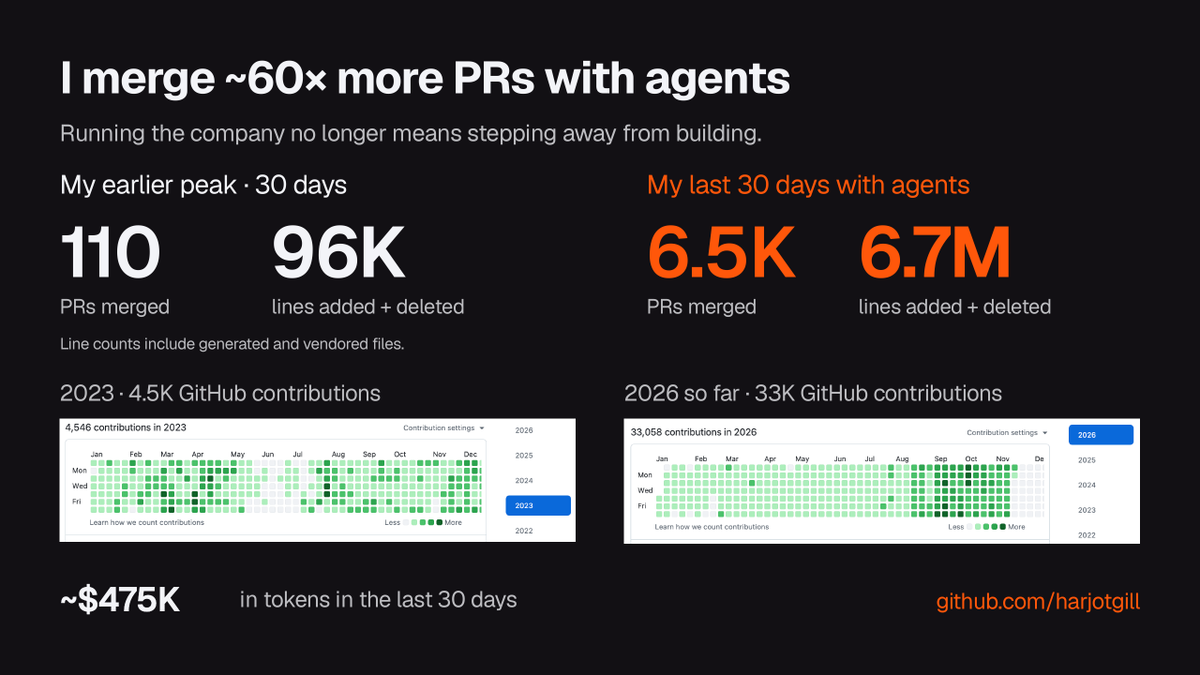
I am 60x more productive with agents than in 2023. I have shipped millions of lines of code to production and thousands of PRs in the last 30 days alone.
There are 2 ways I build with agents:
- Artisanal way: Shaping product experiences with my judgment, one prompt at a time. Mentally, I max out at 1-2 artisanal sessions that require me to tactically hand-hold the agents and put a lot of care into the decisions.
- Factory way: Running tens of agents that are constantly hill-climbing against a verifiable stopping condition and shipping orders of magnitude of code. These agents autonomously build distributed systems, maintain our CI/CD, harden existing code, and so on with very little hand-holding.
I am currently limited by a couple of factors:
- Local resources: My laptop (128GB) is maxed out at ~25 or so concurrent agents (and many more sub-agents).
- Launching new agents and unblocking existing agents: My polyphasic sleep habit, where I unblock agents every few hours, is not very sustainable.
Even though CodeRabbit has a cloud-based coding agent, I am kind of a laggard in adopting it. I feel chat-based interfaces are a good fit for artisanal work that can happen on my laptop, but for long-running, factory-style work like launching (setting verifiable goals) and maintaining a fleet of agents, we need a different interface. I have been actively building one for the last few weeks, but so far I haven't been able to get it "right". And I don't think anyone else has also got it "right" either.
A lot of engineering work starts the same way every time
> A ticket needs someone to find the cause
> An incident needs a first look
> A channel needs its summary
Hand those jobs to our Coding Agent with CodeRabbit Automations!
(Docs below!)
CodeRabbit Verify is out now and free while in Beta!
Map out real user journeys and get evidence on exactly what works and what doesn't.
Test in a PR or run previously saved user journeys for any regressions.
Try Agentic QA, for free, today!
https://t.co/NzqBsB9k8i
Introducing CodeRabbit Verify
Don't let your users be the first test run!
> PR testing: catch broken features before merge
> User journeys: confirm critical flows work before each release
> Tickets and fixes: get reviewed, tested fixes for reported bugs
In public beta now!
How does a truly "AI-pilled" startup work? @harjotsgill spent $250K last month on AI agents, shipped 5,000 PRs and explains why this all makes sense - at least for CodeRabbit.
Timestamps:
00:00 Intro
03:17 How Harjot shipped over 5,000 pull requests in a month
08:46 Harjot’s path into tech and his first startups
12:25 Early conviction around AI and founding CodeRabbit
14:40 Switching to AI coding
20:35 Software factories explained
25:37 What’s replacing human code review
38:44 Technical debt and deslopping tests
46:05 Evals
50:25 Formal methods
52:05 AI cost at CodeRabbit
54:57 Startup funding in 2026 and the value of AI spend
1:08:20 Hiring
1:13:03 Work pace, sleep, and burnout
1:21:55 Skills for the AI era
1:24:30 Book recommendation
Brought to you by:
• @turbopuffer – a ridiculously scalable, fast and cheap hybrid search engine, built on top of object storage, used by cutting-edge companies like Anthropic, Linear, Ramp and others. https://t.co/w9y67Gs8ab
• @GoEntire – Entire launched its own Git forge, shipped Continuous Memory, and reinvented the pull request (called Trails). Trails are a much more natural workflow when agents keep pushing new changes. https://t.co/7yHVse7fpS
• @WorkOS – WorkOS built Airlock, the authorization layer for AI agents. It evaluates every request against the agent’s intent + your rules, and either allows it, denies it, or routes it to a human. https://t.co/OzuIJ1wHtZ
Three interesting learnings:
1. For dev tooling startups like CodeRabbit, massive AI spend can be justified by launching new, AI-related products faster
It feels to me that CodeRabbit is not a typical company: its AI spending is a form of R&D if it creates new solutions that can be commercialized and sold. It’s not the same at places with fixed customer bases willing to pay a certain amount for an existing product, and no more.
Also, Harjot says that they got quoted $13M/year for a CI solution to handle their PR output, but the price made him decide they’d build their own CI system using agents. It took a week, and the new CI cost 50% less than the quote, with similar performance.
2. Human code review is dead, long live the human review!
Harjot thinks that we will stop reviewing code generated by agents. Instead, we’ll spend more time reviewing the planning and final asset. Inside of CodeRabbit, engineers are reviewing releases (multiple PRs), not individual PRs.
3. What Harjot looks for when hiring engineers: agency, breadth of experience, and systems thinking.
He posted an unconventional job ad, only inviting candidates who had shipped 1,000+, non-slop PRs in the past 30 days, or had played 500+ hours of strategy and management games like Civilization, Age of Empires, Transport Tycoon, or Factorio. Harjot says he cannot unsee the similarities between running dozens of agents in parallel and playing a strategy video game involving tracking what dozens of units do.
Introducing CodeRabbit Verify
Don't let your users be the first test run!
> PR testing: catch broken features before merge
> User journeys: confirm critical flows work before each release
> Tickets and fixes: get reviewed, tested fixes for reported bugs
In public beta now!
CodeRabbit has hit $100 million in ARR, up 10x in just over a year.
Teams send us 3 million+ pull requests a week, because the agent that wrote the code shouldn't be the one to approve it.
We've grown so much that even Josh wants a job now!
Your gateway checks the token.
Your orders service trusts whatever user ID it gets handed, and whether that's a hole depends on network config sitting in a third repo.
CodeRabbit Secure now reads linked repos to find out. https://t.co/6HhMvBqezk
We found a shocking number of vulnerabilities during our free Deep Scan program. What more is still sitting unresolved in legacy codebases out there right now?
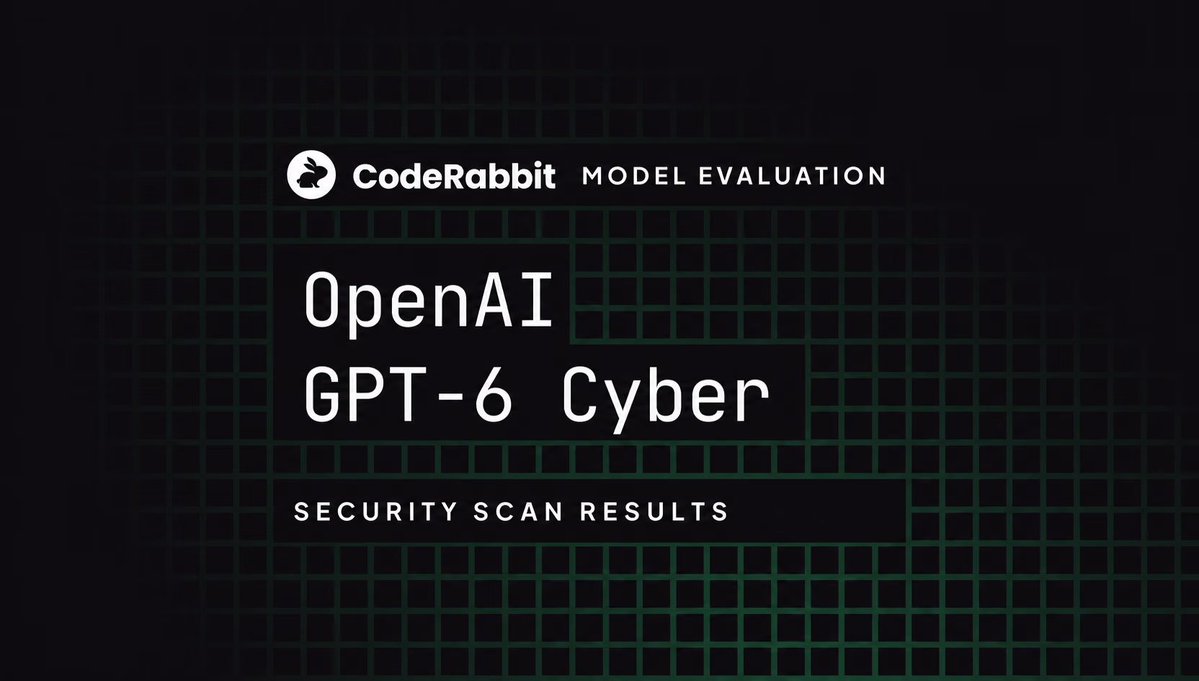
We put GPT-6 Cyber inside CodeRabbit’s security scan pipeline.
22 of 33 known vulnerabilities caught vs 19 for our production ensemble, and 66% more high and medium severity findings.
Full eval below.
Love this. Agentic software development has made it effortless to add new features, but increasingly we're shipping things before we've even considered if its the _right_ thing to ship. Forget AI Slop -- the new risk is human slop at agentic speed.
"Just because you can, doesn't mean you should."
AI makes it easier to ship more, but Hassan El Mghari makes the case for shipping less: focus on one thing, make it work well, and resist adding features just because you can.
Watch our 29 minute conversation on Rabbits on the Run here!
Featuring @nutlope@JuanPa and a guest appearance by @theo!
We've merged 5845 PR's into prod last week alone at Coderabbit...
It's kinda hard to keep up, even from the inside, so I went on a short walk to get you up to speed:
Here is what's new
Code. Review. Fix. Repeat. 🐰
CodeRabbit is now in the Google Antigravity plugin marketplace!
Let Antigravity write code, get CodeRabbit’s review, and work through fixes, all in the same agentic loop.
What we are seeing at @coderabbitai and elsewhere on this parabolic trajectory is that even larger seed rounds ($8M+) are no longer enough to build a software business. Software factories need quality tokens and large-scale compute to run CI, sandboxes, and other infrastructure to ship software at scale. At this point, smaller startups exist only to funnel ideas to larger startups with more tokens.
You know the best way to protect yourself from AI agent swarms? Use your own swarm to find the vulnerabilities first.
We're still offering free Deep Scans through the end of next week -- sign up now! https://t.co/MJ0mU5D8fz
Wake up
Attackers use AI to find vulnerabilities faster. Your defense should too.
CodeRabbit Secure.
Find, verify and fix vulnerabilities in existing code and every new PR.
It's everybody's job now.
Here are 6 demos of CodeRabbit Secure’s core features.
Starting with the one we’re most excited about, Deep Scan.
We believe every dev, team and OSS project should be running it.
New in CodeRabbit Secure:
Deep Scan now follows a vulnerability across your linked repos, then replays the exploit in a throwaway sandbox to prove it's real before it flags anything.
Hendrik walks through this and everything else in the new update: