People are realizing that AIs are nowhere near human intelligence and learning abilities.
Yet they have become very useful by compensating for their lack of common sense, lack of understanding of reality, and limited reasoning and planning abilities, by the accumulation of enormous amounts of declarative knowledge.
Today, we share a breakthrough on the planar unit distance problem, a famous open question first posed by Paul Erdős in 1946.
For nearly 80 years, mathematicians believed the best possible solutions looked roughly like square grids.
An OpenAI model has now disproved that belief, discovering an entirely new family of constructions that performs better.
This marks the first time AI has autonomously solved a prominent open problem central to a field of mathematics.
The text of my speech last week at the University of Alberta convocation ceremony:
Good afternoon graduating students, parents, and ladies and gentlemen of the university community.
It is my great honour to receive this degree from the University of Alberta. I am receiving this honour because of my work in artificial intelligence, so I thought I would take this opportunity to talk to you all about the public perception of AI.
Today, talk of AI is everywhere. In the news, on billboards, in almost every software product. The headlines scream that intelligence is now a commodity, that conventional programming jobs are disappearing, and that almost all current jobs will soon be automated. There are anxious calls for AI development to be paused or stopped, for fear that an AI will take over the world. Others claim that AI will lead to tremendous increases in productivity, that our new economies may require AI, and that accelerating AI development may be the only way to avoid recession.
The current level of public excitement about AI is a new thing. The field is about 70 years old, and for most of this time it has been like any other specialized intellectual activity. Experts did research, wrote papers, and went to conferences. There was always a hope, a belief, that AI research would someday have a big impact on the economy and on society. After all, the aim was to understand intelligence, humanity’s most prized distinguishing feature, the ability that made us powerful. If intelligence was understood, then we could build tools that would make us vastly more powerful. But it would also challenge us. If we understood minds, then we could create minds stronger than our own. Would we just use them, or would we have to become them? The success of AI — of understanding our minds — is a step that cannot help but be profoundly challenging and transformative.
Is this what is happening today? In short, no. We do not yet understand how to make minds like our own, that are truly aware of their world and their influence on it, and that are powerful as a result. The coming of true AI still lies in the future, but what is happening now is almost as profound. It is not the moment when true AI arrives, but it is the moment when it becomes clear to the public that true AI will arrive. It is the moment of first contact between the public and the reality of AI in its midst. This moment is pivotal for our society and its relationship to machine minds. Will we fear them and suppress them, or will we embrace them, and even become them? Will we see the AIs as alien competitors, or as our progeny? This is the moment when we have that discussion.
“Discussion” of course seems too tame a word. It is loud and noisy. It is controversial at so many levels. It is utopic and dystopic. It is tech billionaires and manipulative governments. And so much of it is driven by fear. Fear of the Terminator and Skynet, of people losing jobs and the machines taking over, of the world suddenly changing underneath us without our permission. The AI fear-mongers have not helped us see clearly, but they have gotten us to pay attention.
So, this is what is happening now. Not true AI — that is yet to come, and probably not for another decade or two. But now the public is realizing that it is coming, that mind really can be reproduced in machines, and what that might mean.
So when you hear about AI and wonder what is really going on, when you feel powerless because you don’t understand the technology, when you feel that things are changing too fast and that you are being left out, remember this: The reality is exactly the opposite. You have not been passed by and you are not powerless. In fact, you are the main event at this moment. You are what it is all about. You and your reaction, your time and attention, your fear and your dollars, are what it is really all about. Society is struggling over the AI narrative, over how the public thinks about AI, and your part of that is in your head and under your control. It is you that all the newspapers and AI companies are trying to influence.
Of course, I too am trying to influence you. What I want is for you to relax and think, to not be afraid, but to pay attention. I want you to know that true AI is not here yet, but that it is coming. I want you to know that machine minds will be joining us in the near future. We have not met them yet, so really it is too soon to be judging them. I want you to be open to the machine minds. I don’t want you to feel entitled — to feel that you were here first, and that therefore you should always have priority. You are the creator species, so you will always be special and perhaps revered, even if you are superseded in some ways.
In summary, when science brings us machine minds, I want you to be open, humble and generous to the new arrivals, in the best Canadian tradition. Can we do that? I hope so.
Thank you for your attention today.
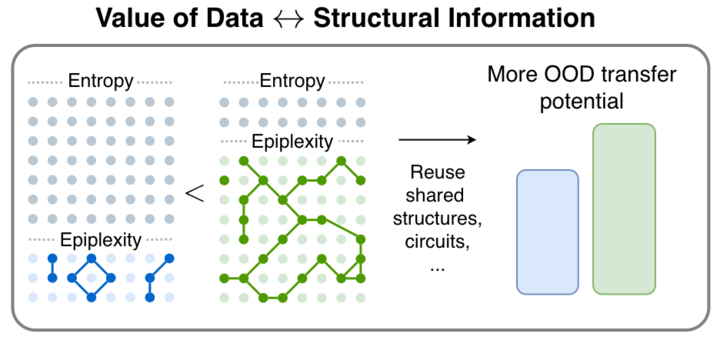
1/🧵 We are very excited to release our new paper! From Entropy to Epiplexity: Rethinking Information for Computationally Bounded Intelligence
https://t.co/M8ETQk9gHz
with amazing team @ShikaiQiu@yidingjiang@Pavel_Izmailov@zicokolter@andrewgwils
I’m hiring a pre-doc! Come work with me on how AI is changing the labor market and how algorithms impact markets.
Non-econ backgrounds welcome.
Application details below – excited to collaborate!
Start: Summer 2026
Deadline: Nov 1, 2025
https://t.co/TUGhQ4cq1C
@predoc_org@econ_ra #Econ_RA
Can #LLMs grasp the real world? MIT & Harvard researchers (@m_sendhil, @asheshrambachan, @petergchang, @keyonV) propose a new way to test how predictive AI applies knowledge across domains. Learn more: https://t.co/npsSXgyHyT
A common takeaway from "the bitter lesson" is we don't need to put effort into encoding inductive biases, we just need compute. Nothing could be further from the truth! Better inductive biases mean better scaling exponents, which means exponential improvements with computation.
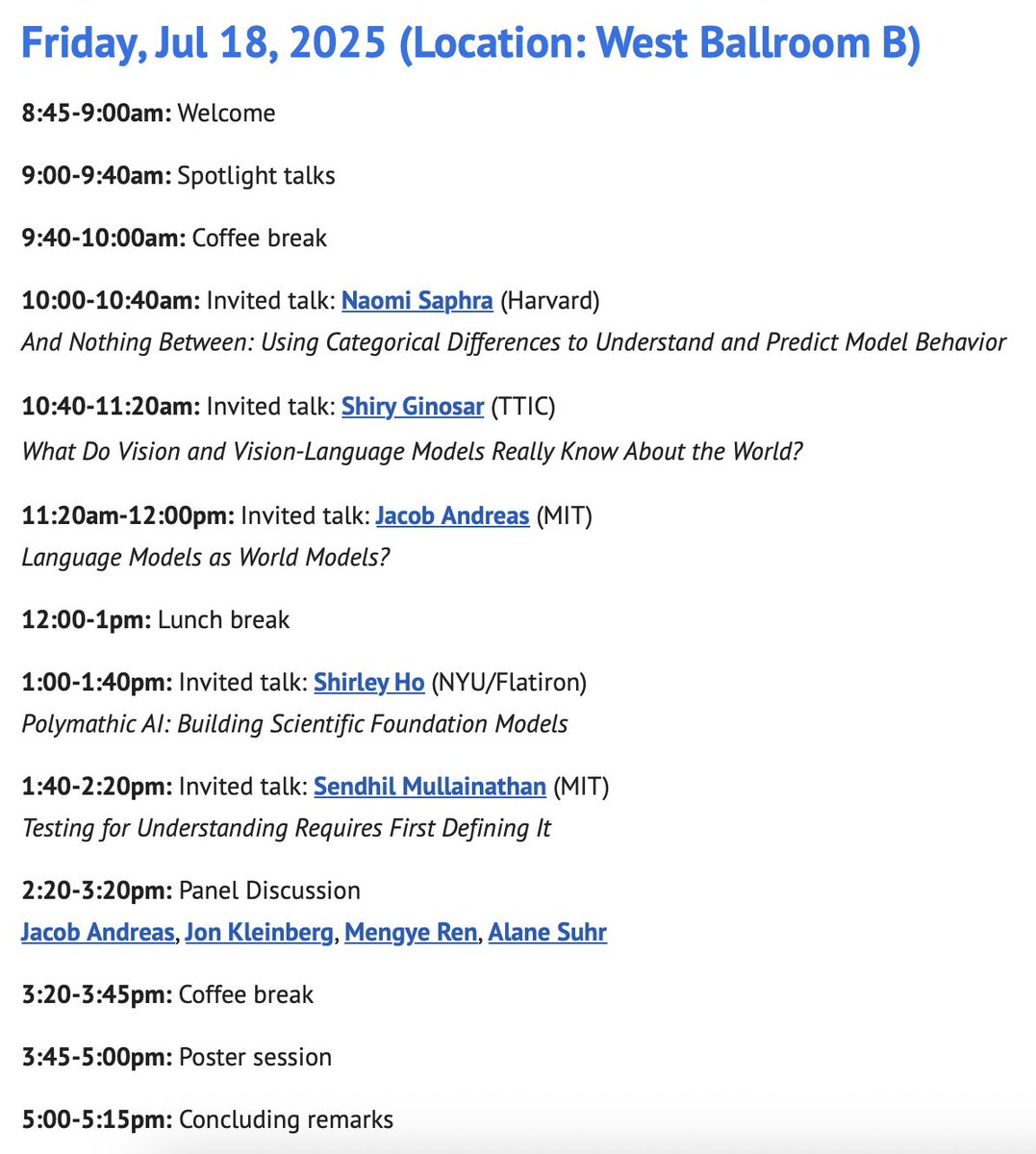
Join us for the Workshop on Assessing World Models at ICML tomorrow!
When: Friday July 17, 8:45am-5:15pm
Where: West Ballroom B (same floor as registration)
Researchers from Harvard, Keyon Vafa (@keyonV) and MIT, Peter Chang (@petergchang), Ashesh Rambachan (@asheshrambachan), and Sendhil Mullainathan (@m_sendhil) have published what I consider the most interesting study on the abilities of AI models in 2025.
They wanted to address a fundamental question: Can AI models develop internal world models, or do they stop at being great predictors of token sequences?
They used orbital mechanics as the setting for their study. Kepler discovered how planets move around the sun in elliptical orbits and made accurate predictions of their future trajectories. This is what we know AI models do very well. But then Newton built on Kepler's discoveries and formalized them into a mechanistic explanation: the laws of gravitation and motion.
So the authors wanted to know: Can AI models do what Newton did? Do they encode the laws of gravitation to make their extremely accurate predictions?
Their conclusion is clear: no!
AI models do indeed make nearly perfect predictions - even for solar systems that don't exist - but surprise, not by encoding the real laws of physics that Newton discovered!
This was surprising: AI can tell you where Earth will be, but not why! It will completely miss the magnitude or direction of the force vector that represents the attraction to the sun, which is the underlying cause of the motion of the planets.
So, what are AI models actually doing to make good predictions?
The authors explored other scenarios (Lattice problems and Othello games) and concluded that the AI models are using case-specific heuristics that don't generalize. They care about next tokens, not world models, so whatever works to get the next tokens correct suffices!
The problem with this is that as soon as you change the conditions of the setting, their predictions would be wrong.
The authors also tested state-of-the-art LLMs like o3, Gemini 2.5 Pro, and Claude 4 Sonnet and found the same thing: great predictions, poor world models.
These findings unveil a big setback to AI models and LLMs as the path to artificial general intelligence (AGI). Can AI companies solve this? Will they be willing to accept that their current products can’t, as they are now, lead to human-level intelligence? What’s the breakthrough we need?
I explore all these questions in the post.
I don't know for sure, but one thing is clear: AI models are not ready to make scientific discoveries.
Can an AI model predict perfectly and still have a terrible world model?
What would that even mean?
Our new ICML paper formalizes these questions
One result tells the story: A transformer trained on 10M solar systems nails planetary orbits. But it botches gravitational laws 🧵
& here are some of my favorite papers on the unification of flows and diffusion. What a decade!!
(From my presentation here: https://t.co/B93hcTWPFy)
Excited to share our latest story! We found disentangled memory representations in the hippocampus that generalized across time and environments, despite the seemingly random drift and remapping of single cells. This code enabled the transfer of prior knowledge to solve new tasks
Worked on a little project which helps converting PyTorch models to JAX PyTrees (e.g. for usage in Equinox). You can also visualise both networks using the excellent Penzai library!
In the video, I'm converting Resnet18 to a PyTree.
https://t.co/kwRn7OFyen
@SGRodriques Slightly tangential hypothesis: people are used to clicking on "Just Show Me the Result" option which tends to be the final option, and so the percentage for the 7+ option may be inflated
I was so lucky to be able to have Danny Kahneman as a best friend and collaborator for decades. He usually ended our conversations with "to be continued..." but I now have to simulate his part which is impossible. My favorite image of us "working".
If you know Torch, I think you can code for GPU now with OpenAI's Triton language.
We made some puzzles to help you rewire your brain. Starts easy, but gets quickly to fun modern models like FlashAttention and GPT-Q.
Good luck! https://t.co/psu31KpdR6