LIDS is an interdepartmental research lab in @MIT_SCC Affiliations include @MITEECS @MITAeroAstro @MITMechE @MIT_CEE @ORCenter @MITIDSS @MITSloan @eapsMIT
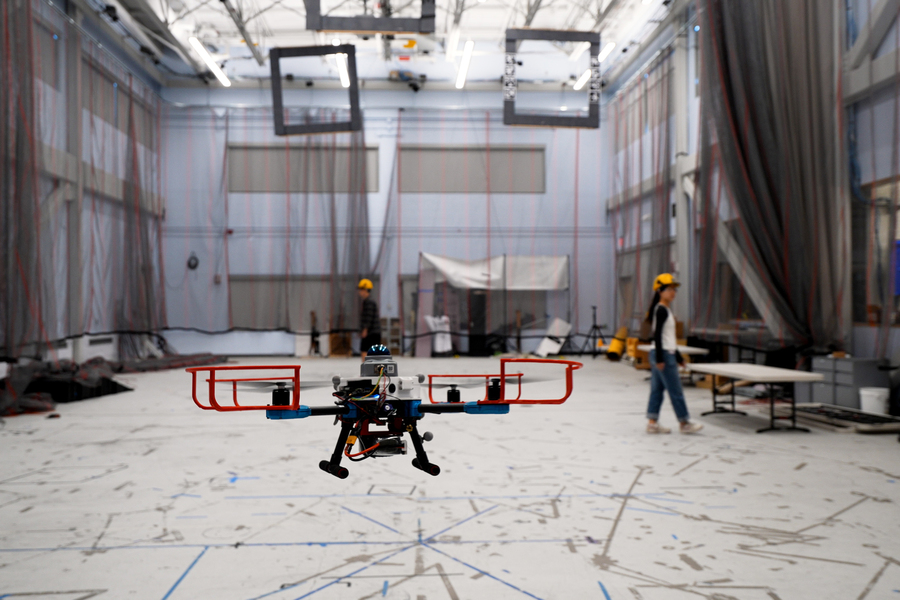
How can drones safely navigate unknown environments with moving obstacles? @MITLIDS researchers developed SANDO, a system that plans efficient flight paths with mathematical guarantees against collisions. The tech could advance disaster-response robotics.
https://t.co/twUVES4xNy
What happens when companies use the same #AI to screen job applicants? A new study from @MITLIDS PIs Brian Hedden and Manish Raghavan finds that “algorithmic monoculture” isn't always harmful to job seekers — and may even benefit them in some cases. More: https://t.co/DMtiWb4FvR
How can AI help improve the complex systems that shape everyday life? @MITLIDS PI and associate prof @MIT_CEE and @mitidss, @wucathy uses Reinforcement Learning to develop safer, more efficient transportation systems.
Read her @MITNews profile: https://t.co/LFl3KVHhTn
@MIT_SCC
This game-playing AI is the new champ at Stratego. LIDS grad student Zhiyuan Fan, PI @gabrfarina, and collaborators developed Ataraxos, an AI that defeated top-ranked human players of the complex board wargame — with potential applications beyond games. https://t.co/8N6dvod90j
Did you know the original Claude — the chatbot’s namesake, according to Anthropic lore — was a renowned MIT professor? Claude Shannon SM ’40, PhD ’40, who taught at MIT from 1956 until his retirement in 1978, was known to many as the father of information theory and of modern digital communications.
When #AI operates in the physical world, “pretty close” may not cut it. LIDS researchers developed HardFlow, a method that helps pretrained generative AI satisfy hard constraints while improving solution quality — without retraining. https://t.co/uJ8vywoF3x
Thinking about adding machine learning to your engineering toolkit? Start by hearing from the person who teaches it.
On Wednesday, September 9 at 12pm ET, MIT professor Youssef Marzouk will walk through MIT xPRO's machine learning, modeling, and simulation: engineering problem-solving in the age of Ai. You'll learn what to expect from the program and get to ask the course team directly.
Register now: https://t.co/XVMVTW3yKS
🗳️ What is AI telling voters about elections?
MIT’s new LLM Election Observatory, from LIDS PI @charapod and collaborators, is tracking how major AI models answer questions about candidates and issues — and how those answers evolve throughout the midterms.
https://t.co/Ksox4xstg6
When it comes to AI-assisted medical diagnosis, one size may not fit all.
A new study from @MarzyehGhassemi and team found that AI explanations affect clinicians and non-experts differently—highlighting the need to design AI support around user expertise.
https://t.co/NTbynwmUKj
📣 Planning to submit our #NeurIPS2026 workshop? we are using OpenReview this year, & account creation can take up to 2 weeks. We recommend creating your OpenReview account by Aug 15 to ensure you can submit on time for the Aug 29 deadline.
👉Learn more: https://t.co/NqiENwTCyj
Hiring a postdoc at @MIT 🚨
Compositional design, applied category theory, optimization → autonomy stacks, control architectures, multi-agent systems, agentic AI, mobility & energy networks.
Rolling review, first pass Sept 15 👉
The 2026 volume of the Annual Review of Economics is now online. Take a look at the most read article, "Large Language Models: An Applied Econometric Framework" by @jensottoludwig, @m_sendhil, and @asheshrambachan
https://t.co/DcO4gBWXbm
Congratulations to LIDS PI Sasha Rakhlin, named director of MIT’s Statistics and Data Science Center! @rakhlin aims to strengthen connections across MIT and advance the rigorous foundations of data science and #AI. MIT News: https://t.co/NyoIOWrQBK
MIT Researchers combined an efficient algorithm with dedicated hardware to rapidly generate 3D maps for navigation using minimal memory and power. https://t.co/bMo5trugPd
Inspired by pinecones, tree bark, and seedpods, MIT researchers developed a mathematical framework for designing manufacturable, adaptive materials that mimic complex behaviors found in nature — with applications from robotics to aerospace. https://t.co/StBbh9L77s
Deep learning runs on math, but we've never had a formal language for architectures!
Now we do. Our new work is out on @TmlrOrg , led by @Vincent Abbott 🎉
https://t.co/8O1xejyA8d
Using reason, again and again
A profile explores the work of LIDS PI Brian Hedden, whose research connects ethics and computing. From "Time-Slice Rationality" to MIT's SERC initiative, Hedden is helping shape a more thoughtful future for AI and computing. https://t.co/OZ24fV8DkH
Ashia Wilson, a professor in @MITEECS, is a recipient of the 2026 Junior Bose Award. The award is given annually to an outstanding contributor to education.
📸: Conor McArdle
https://t.co/NyLh7Uun4N
MIT LIDS PI Dimitri Bertsekas, whose groundbreaking work shaped optimization, control, reinforcement learning, and AI, has passed away at 83. A prolific author, educator, and mentor, his impact will continue through generations of students and researchers. https://t.co/EEr3EckeT5