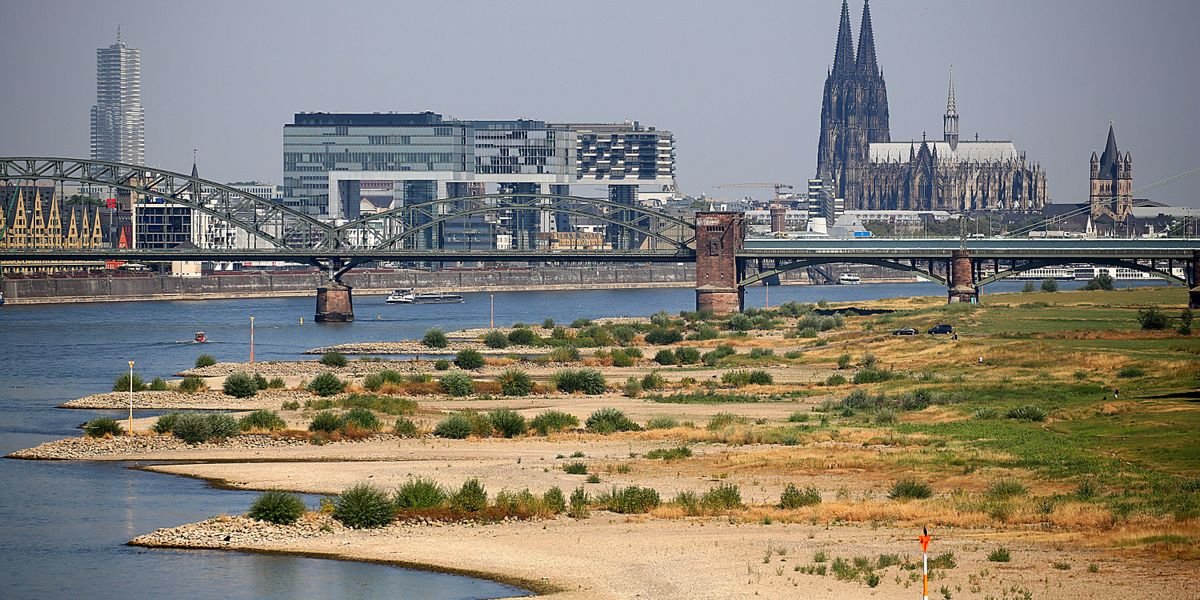
1132, 1540, 1802, 1857, 1921, 1947: Der Rhein führte immer wieder so extrem wenig Wasser, dass Frachtwege zusammenbrachen und "Hungersteine" freilagen.
Damals ganz ohne Verbrenner, Billigflüge, SUVs oder Klimaanlagen.
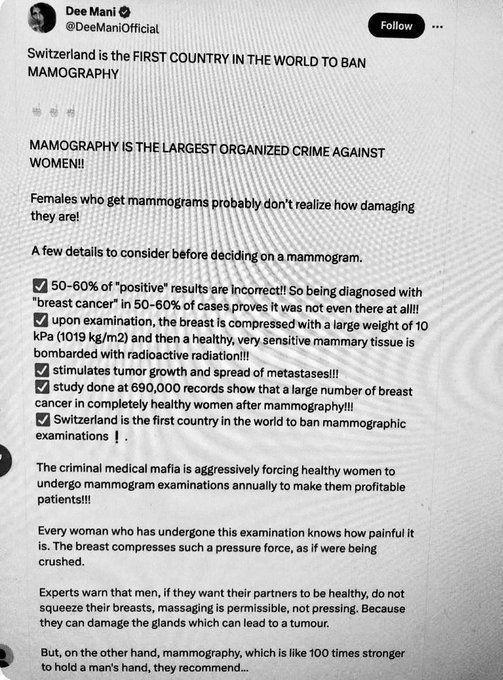
🚨🚨Suiza podría ser el primer país del mundo en prohibir las mamografías..
Los servicios de detección también están suspendidos en partes de Canadá, Italia, Escocia y Australia...
🚨🚨Las mamografías son un negocio multimillonario...Solo sirven para obtener ganancias y siempre causan graves daños a la paciente.
• Durante el examen, se comprime la mama con un gran peso de 10 kPa (1019 kg/m2) y luego se bombardea un tejido mamario sano y muy sensible con radiación radiactiva.
• Puede estimular el crecimiento del tumor y la propagación de metástasis.
• Estudios afirman que por cada 2000 mujeres sometidas a una mamografía se puede salvar la vida de una...Sin embargo, en el proceso, 50 mujeres serán tratadas innecesariamente con cirugía, quimioterapia y radioterapia...
• Entre 600 y 1.000 de cada 2.000 mujeres que se someten a mamografías, se someterán a más pruebas de radiación y biopsias para un posible diagnóstico...
• La exposición repetida a la radiación puede causar muertes por enfermedades cardíacas, cáncer de pulmón y otros tipos de cáncer. Estas muertes iatrogénicas no se contabilizan como muertes por cáncer de mama...
• Las mamografías utilizan radiación ionizante en una dosis que puede provocar cáncer de mama. Exponen el cuerpo a una radiación 1000 veces mayor que la de una radiografía de tórax.
• La compresión mamográfica del tejido mamario puede provocar hematomas cutáneos, hematomas y rotura de masas quísticas. Esta compresión extrema podría propaga las células cancerosas si ya existen. La mamografía es inútil en mamas fibrosas y densas...
• La tasa de falsos positivos en una mamografía podría ser del 50/70 %. Los falsos positivos y las intervenciones innecesarias que se producen dan lugar a biopsias invasivas y evitables. Tras realizar más pruebas a estas biopsias, entre el 70 % y el 80 % de los "tumores" detectados en las mamografías no revelaron la presencia de cáncer...
��� Muchos países ya han abandonado la mamografía 3D, mortal y dañina, y en su lugar utilizan la ecografía y la termografía QT seguras como estándar de atención cuando se desea realizar pruebas de detección preventivas. Ambas tienen una resolución 40 veces superior a la de la resonancia magnética, sin exposición a la radiación. Ambos son increíblemente precisos y detectan el 97% de las anomalías entre 8 y 10 años antes que otras pruebas estándar de detección de cáncer...
• El cáncer podría ser una enfermedad metabólica y se podría prevenir con cambios en el estilo de vida y la dieta. Una dieta cetogénica baja en carbohidratos, que elimina los aceites de semillas, los alimentos ultraprocesados y el azúcar, previene el cáncer...
• Evite los anticonceptivos hormonales sintéticos. Ayune regularmente para eliminar del cuerpo, mediante autofagia, las células mitocondriales dañadas. Mantener un nivel de vitamina D3 por encima de 70 ng/ml protege contra el cáncer.
Toda la evidencia en comentarios....
Friedrich Hayek: “Socialism assumes that all the available knowledge can be used by a single central authority. It overlooks that the modern society is based on the utilization of widely dispersed knowledge.”
Every high street used to have a person who knew your name and your order, and we swapped every last one of them for an aisle.
The butcher, who hung the beef until it was ready, knew the farm it came off, and cut your chops fresh while you talked about the weather and his lad's football.
The fishmonger, ice glittering under the whole cod, who told you what had come in off the boat that morning and exactly what to do with it.
The greengrocer, who only sold you what was in season because that was all he had, and slipped an extra apple in the bag for the little one.
The baker, up since four, whose loaf had gone hard by Wednesday because it was flour and water and nothing you couldn't pronounce.
The milkman, whose float hummed down the road before dawn and left the cold glass on the step with the cream risen to the top.
The grocer, who weighed your sugar into a blue paper bag off the scales and never stocked a single thing with a health claim on the front, because nothing he sold needed one.
The dairy, where the butter came in a block cut off a mound, the cheese was cloth-wrapped and older than the shop lad, and the word spread had not yet been invented.
The cheesemonger, who let you taste before you bought and would have laughed you into the street for asking if it was low fat.
The poulterer, birds hung in the window, who sold you the whole thing, giblets and fat and all, and knew what your grandmother did with the dripping.
The pie shop, whose window ran with steam, whose pastry was rendered from suet and whose filling was meat you could name.
The sweet shop, jars floor to ceiling, a quarter of rhubarb and custard tipped clattering onto the brass scale, sugar sold honestly as a treat and not smuggled into everything else.
The chemist, who knew your whole family, made things up behind the counter for a cough, and never once tried to sell you a protein powder or a fat burner.
Every one of them was a person, a skill, and a thread that held a street together.
We replaced the lot with one shed on a ring road, staffed by nobody, lit like a hospital, selling everything sealed in plastic and flown in from everywhere and belonging to nowhere.
The butcher became a chilled cabinet of mince in trays. The baker became a plastic sleeve of bread that stays soft for a fortnight because it is barely bread. The milkman became a four pint jug of the fat skimmed out and sold back to you separately.
We called it convenience.
The convenience was real. So was the loss, and we are only now sitting down to add up the bill, and the bill is written in a language of diabetes, soft teeth and children who have never tasted food that had a face.
Carl Sagan: “We've arranged a society based on science and technology, in which nobody understands anything about science and technology. And this combustible mixture of ignorance and power, sooner or later, is going to blow up in our faces.”
Interessant verhaal over de omegablokkade.
Een meteoroloog legt uit waarom het deze week zo warm is (en nee, het komt niet door klimaat- verandering
De omegablokkade — dat is de werkelijke meteorologische verklaring achter de extreme temperaturen die momenteel over een groot deel van het Europese continent worden gemeten. Terwijl grootmedia als de NOS de hitte vrijwel reflexmatig koppelen aan klimaatverandering en broeikasgassen, wijzen kritische wetenschappers op een veel nuchterder en beter onderbouwde verklaring: een hardnekkig weerpatroon in de hogere atmosfeer dat Europa al vaker in zijn greep heeft gehouden.
Wat is een omegablokkade precies?
Een omegablokkade is een specifiek patroon in de straalstroom — de krachtige windstroom op grote hoogte die het weer in onze breedtegraden grotendeels stuurt. De naam komt van de gelijkenis met de Griekse hoofdletter omega (Ω): een grote hogedrukrug in het midden, geflankeerd door twee lagedrukgebieden aan weerszijden. Dit patroon zorgt ervoor dat luchtmassa’s nauwelijks kunnen doorstromen en het weerpatroon wekenlang kan vaststaan.
In het geval van de huidige hittegolf wordt hete Saharalucht door het anticyclonale (met de klok mee draaiende) luchtstroompatroon noordwaarts getransporteerd richting West-Europa. Terwijl die luchtmassa stijgt en daalt onder de hogedrukrug, wordt ze adiabatisch samengedrukt — een puur fysisch proces dat de temperatuur verder doet oplopen. Geen CO2 aan te pas.
Meteoroloog Chris Martz trekt aan de bel.
De Amerikaanse meteoroloog Chris Martz deelde zijn analyse van het huidige weerpatroon uitgebreid via sociale media. Zijn conclusie is helder: deze omegablokkade heeft niets te maken met klimaatverandering of uitstoot van broeikasgassen. Het is een bekende, goed gedocumenteerde weerdynamiek die altijd al heeft plaatsgevonden en ook in een hypothetisch pre-industrieel klimaat tot recordhitte zou hebben geleid.
Martz wijst bovendien op een opvallende wetenschappelijke paradox. Er bestaan namelijk diverse studies die suggereren dat opwarming van de Arctis juist zou leiden tot minder frequente blokkerende weerpatronen zoals de omegablokkade, omdat het temperatuurverschil tussen de evenaar en de poolgebieden kleiner wordt. Dat staat haaks op de bewering dat klimaatverandering dit soort hittegolven veroorzaakt of versterkt. Martz erkent dat er debat bestaat over dit onderwerp, maar de eenvoudige klimaatboodschap die media uitdragen, is sowieso te kort door de bocht.
Europa vaker getroffen, maar waarom eigenlijk?
Dan is er nog een toename van zonnestraling die het aardoppervlak bereikt, doordat er minder bewolking is van lage en middelmatige wolkenlagen. Die afname van bewolking hangt deels samen met de strenge Europese luchtvervuilingsregels, die hebben geleid tot minder atmosferische aerosolen. Minder deeltjes in de lucht betekent minder wolkenvorming, meer direct zonlicht en dus hogere oppervlaktetemperaturen.
Met andere woorden: de eigen Europese milieuregulering draagt bij aan de toegenomen hitte. Dat is een ongemakkelijke conclusie die je in de reguliere media zelden zult tegenkomen.
Media kiezen sensatie boven wetenschappelijke nuance
Denktank Clintel, vertegenwoordigd door wetenschapsjournalist Marcel Crok, onderschrijft de analyse van Martz. De conclusie is simpel: wie de oorzaak van de Europese hitte wil begrijpen, kan beter een meteoroloog raadplegen dan een krantenredactie die op zoek is naar een clickbait-verhaal.
Het is inmiddels een vast patroon: zodra het ergens warm is, wordt de link met klimaatverandering gelegd, vrijwel zonder nuance, zelden met meteorologische onderbouwing en al helemaal niet met verwijzing naar mogelijke alternatieve verklaringen. Dat is geen journalistiek — dat is activisme vermomd als wetenschap.
Germany, 1948. The Reichsmark is worthless. Cigarettes function as currency. Factory output sits at half its 1936 level, and the Allied occupation runs a price-control regime so absurd that farmers feed grain to livestock rather than sell it at the dictated price. Then Ludwig Erhard walks into a radio studio on June 20 and tells the German people the controls are gone. He did not ask the occupation authorities first. He told General Lucius Clay afterward that he hadn't altered the regulations, he had abolished them.
What followed embarrassed every Keynesian planner watching from Washington and London.
The Deutsche Mark replaced the Reichsmark at brutal terms: roughly 100 old marks for 6.5 new ones. Hard money, scarce by design. The black markets emptied overnight because goods reappeared in shop windows the moment prices could speak. Industrial production jumped over 50 percent in the second half of 1948 alone. And here is the part the textbooks bury: through the 1950s, as the economy grew at better than 8 percent a year, the cost of living stayed remarkably flat. Germans got richer while prices held or fell. Productivity outran the money supply, which is exactly what's supposed to happen when a central bank keeps its greedy paws to itself.
Falling prices alongside roaring growth, rising real wages, and a currency people actually wanted to hold rewarded Erhard's Germany. Deflation is not the disease. It is the natural reward for producing more than you did last year.
The Bundesbank inherited this discipline and guarded the Mark with a stinginess that drove politicians to fury for forty years. That stinginess built the strongest economy in Europe. Then the same political class buried the Mark under the euro in 2002 and handed monetary policy to people who consider 2 percent annual theft a "target."
Erhard proved sound money and free prices rebuild a bombed nation in a decade. Every finance minister since has worked very hard to forget it.
🔻 SPERM COUNTS HAVE DROPPED 62% SINCE 1973. TESTOSTERONE IS FALLING 1% EVERY YEAR. BY 2045, THE MEDIAN MAN WILL BE INFERTILE. THIS IS NOT A PREDICTION. IT IS A PUBLISHED TRAJECTORY — AND NOBODY IS TRYING TO STOP IT.
A 30-year-old man today has the testosterone of a 60-year-old in 1987. Not because he's unhealthy. Because something in his environment is chemically castrating him — slowly, invisibly, since before he was born.
In 2017, a meta-analysis of 185 studies — 42,935 men across 6 continents — confirmed: sperm concentration dropped 52% between 1973 and 2011. A 2023 update extended the data: the decline is accelerating. Not slowing. Getting worse.
Dr. Shanna Swan, reproductive epidemiologist at Mount Sinai, published the projection: at current rates, median sperm count reaches zero by 2045. Half of all men — functionally sterile. She called it "an existential crisis for the human species."
The cause is not a mystery. It has a name: phthalates.
Phthalates are plastic softeners. In food packaging. Shampoo. Cologne. Vinyl flooring. Canned food lining. Car dashboards. Children's toys. They are anti-androgenic — they suppress testosterone at the fetal level. Before a boy is born, phthalates are reducing his reproductive capacity for life.
A former endocrine research scientist — 11 years at a reproductive toxicology lab funded by NIH:
"We identified the mechanism in 2007. Phthalate exposure during weeks 8-14 of gestation permanently reduces Leydig cell function — the cells that produce testosterone for life. The damage is irreversible. It happens before birth. We submitted for regulatory review. Response: 'Insufficient evidence for market restriction.' The same compounds were found in 99% of Americans tested by CDC. Insufficient evidence — in 99% of the population. Reference: RTL-2007-0294. Shelved."
A man in 1970: average testosterone 700 ng/dL. Today: 400 ng/dL. A 43% collapse in one generation.
Your fatigue. Your low drive. Your brain fog. Your inability to build muscle like your father did. Your anxiety from nowhere. Not character flaws. Symptoms of chemical exposure that began in your mother's womb.
They put it in everything you touch. Then sell you testosterone therapy at $200/month. The poison creates the patient. The patient creates the profit.
CODE: LEVINE-2017-185 / SWAN-2045-ZERO / PHTHALATES-99PCT / RTL-2007-0294 / T-700to400
⟁
Your grandfather was not tougher than you. He was not exposed to what you were. They didn't make men weaker. They chemically unmade them — starting in the womb. Share this.
..and if you're on one of those lists of people with investable cash, you'll have received email solicitations to buy these "government guaranteed, fully managed, turnkey, high-yield investments"..remember, if it's out of the blue and too good to be true, then there's a catch..
HOW BRITAIN LOST CONTROL by Anoosh Chakelian
When George Orwell was working on The Road to Wigan Pier in 1936, he lodged at a tripe shop riddled with beetles on this street. He had asked a local to point him towards the worst place to stay. On the same quest today, he would have had plenty of suggestions. Darlington Street and its offshoots are thought around town to have Britain’s highest concentration of Serco-run and other “HMOs”. HMOs are houses in multiple occupation, and Serco is one of the private outsourcing companies with a government contract to rent them out to asylum seekers.
Serco leases houses from private landlords and runs them on their behalf. I have heard from landlords who are being paid between £1,000 and £2,000 a month in rent on these properties, depending on the number of bedrooms, location and condition. The money these landlords are receiving comes from the Home Office, which agreed ten-year contracts to outsource the accommodation of asylum seekers in hotels and houses to Serco and two other firms: Clearsprings and Mears. These contracts are projected to have cost the taxpayer a total of £15.3bn by 2029.
There are 93,653 asylum seekers housed in Home Office asylum accommodation in the UK, around 22 per cent of whom are in hotels, some of which Serco also runs. The government has prioritised closing hotels. As a result, the number of people being quietly dispersed to houses is rising every year – there are now 68,719 in tens of thousands of houses across the country.
Emotion runs high. The UK’s asylum accommodation model has led to rioting and protests for two consecutive summers across Britain. Protesters direct their rage at the government, the council, police and asylum seekers. But occasionally, you see signs reading “Serco Out”.
Serco is so integral to the British state that the Labour politician Margaret Hodge has called it “too big to fail”, because “there are too many services that would collapse” if it went bankrupt. It simply runs too many state functions for it to be feasible to allow it to go bust.
It’s not just Serco. So much of the state, from welfare, prisons, and asylum to the NHS, security and social care, is in the hands of gnomically named companies most voters have never heard of: Capita, Sodexo, G4S.
Thatcher is often accused of “selling off the family silver” when she privatised public utilities and state-controlled industries. But less attention is paid to the services she pawned off, now in the hands of outsourcing giants. The question is whether a potential future prime minister, such as Andy Burnham, could overthrow the outsourced state.
Cover illustration by Gregori Saavedra
Consider what butter actually is. You agitate cream until the fat clumps together. That is the whole process. A child can do it in a jam jar on a long car journey, and historically did. Cream, movement, time. The result keeps for weeks and carries vitamin A, vitamin D, vitamin E, and vitamin K2, all in the form your body already knows how to use.
Now consider what margarine is.
You take seeds that hold a little oil. You crush them, then wash the pulp with a petroleum solvent called hexane to drag out the rest, because pressing alone leaves too much behind to turn a profit. You heat the oil. You degum it. You bleach it, because by this point it has gone the colour of dishwater. You deodorise it at high temperature, because the smell at this stage would empty a room. Then you rearrange the fat molecules through hydrogenation or interesterification, so the liquid sets into a solid that will sit on a knife and pretend.
What you are left with has almost nothing nutritional in it. So they add synthetic vitamins back at the end and print them on the tub as though that were a kindness.
Butter never needed a list of what it contained. It simply contained it.
They spent a generation telling you to fear the cream and trust the hexane.
I’m making a show about buildings.
The concept is simple: do for the man-made world what Planet Earth did for the natural world.
But, when I pitched the idea, the answer was that nobody would watch it.
So I released a pilot episode on YouTube. It’s got 5.4 million views, 379k likes, and 23k comments.
People are interested, and now it’s time to make the full show.
Six episodes, filming in the UK, France, Belgium, Germany, Italy, and the USA, and releasing on a streaming service like HBO, Netflix, or Prime.
Why does this show matter?
First: we’re surrounded by buildings all the time. Look around yourself, right now… what do you see? Buildings are the logical conclusion of everything a society believes in. That’s the real focus of this show: not the buildings themselves, but what they say about us.
Second: there’s global dissatisfaction with modern architecture. This feeling gets written about online, but nobody’s given a voice to it on film or TV. That’s what this show will be. But this isn’t just about criticising modernity. That’s easy. This is about learning from the past in order to understand and improve the present, for everybody.
Third: there’s a drought of high-quality culture shows. When I spoke to film executives they said that only documentaries about sports, music, or true crime get funded. That’s a colossal missed opportunity. Galleries are always full, content about architecture goes viral online all the time, and people spend their precious holidays visiting beautiful cities.
Why no shows about architecture, then?
Tourists flock in their millions to see (for example) the buildings of Antoni Gaudí in Barcelona. But, if you asked those same people if they’re interested in “architecture”, they’d probably say no.
To put that another way: not many people want to watch “a show about architecture”, but lots of people want to watch a show that illuminates the real world they’re living in, each and every day.
What will the show be like?
Six episodes, going chronologically through history and arriving at the present, each focussing on the architecture and design of a specific period:
1. Middle Ages
2. Renaissance
3. Enlightenment
4. The Nineteenth Century
5. Art Nouveau & Art Deco
6. Present Day
But, in each case, the point isn’t just to learn about that era; the point is to learn about our modern world through those eras and what they’ve left behind. If you watch the pilot episode (included below) you’ll see what I mean.
So the show’s not really “about” the past; it’s about the twenty-first century.
That’s why it’s called The Modern World.
When you think of a typical history show there are loads of interviews, stock footage, archive photos, historical recreations, and graphics. We’re doing none of that. Everything will be filmed on location, because we’re telling our story only through the real world that exists right now. And, rather than going to the most obvious places, we’ll focus on buildings that aren’t well-known but should be more famous.
But that’s all big picture; what will it be like on screen?
Buildings used to look different in every country, and now they look the same. Why? Because the weather is different everywhere, and buildings were always a way of dealing with that weather, using local materials. Now we have air conditioning and we ship concrete around the world, so we don’t need to design our buildings with regard to local weather or rely on local materials.
Look at really old clocks and you’ll notice something: they don’t have a second hand… because it was only invented 300 years ago! Then you look at the present and you realise we’re surrounded by timers, by seconds ticking down and ticking up relentlessly. If we’re looking for a cause of our anxiety-inducing culture, that might be it.
When you spend time with the sun-softened bricks and time-warped timbers of old cities you notice that synthetic materials like plastic have taken over. When we’re surrounded by things that feel temporary, how do you think it makes us feel?
It’s only by seeing 19th century train stations, designed like cathedrals, that you realise tradition and technology aren’t enemies. New things don’t have to look boring: if the Victorians had designed AI data centres, they’d look like Medieval castles.
In the 1920s, at the zenith of Art Deco, people believed technology would uplift humanity. That’s why they decorated their buildings with statues inspired by electricity. Only by seeing their enthusiasm can we realise our own cynicism, and perhaps begin to fix it.
All of that… and much, much more.
But, above all else, this show is about a way of seeing. If you want to understand any society then you need to look at what it creates, not what it says about itself.
There’s a worldview in every single object; our skyscrapers are designed the same way as our phones. Learn to look at this world, to notice its details, and everything else starts to make sense.
What now?
I’ve been quiet online recently because I’ve been researching and working on scripts for six full-length episodes. Production begins when we’ve raised the funding.
The Modern World is coming.
This is a heat map of the Stratos AI data centre in Utah.
A Utah State University physicist estimated the project’s thermal load at roughly 16 gigawatts, describing it as:
“About 23 atom bombs worth of energy dumped into this local environment every single day.”
The land under these panels will never be farmed again.
Potato growing associations nationwide will not buy potatoes grown on ex-solar sites.
Why?
The panels leach heavy metals, as well as drop glass shards and microplastics onto the soil below them.
In a mass commercial arrangement, vegetation below the panels is soaked in herbicides.
The fertile farmland is gone forever.
BREAKING:
Pope Leo XIV deems the Iran War unjust.
Says it isn't “solving anything,” only spreading more hate.
He then goes on to urge Americans to call Congress and press lawmakers to end the war and work for peace.
the amish are wealthier than any billionaire in the US
they have health, they're fertile, they arent fat, they grow their own food, can build a barn in one day, they arent addicted to screens, they have family, community and great milk & butter.
this is what real wealth is.
…and while you're at it, review miscellaneous video footage of public spaces BEFORE all this started happening…and also check the latest developments in "healthy life expectancy" charts
When butter was demonised, Unilever sold margarine.
When tallow was demonised, Procter and Gamble sold Crisco.
When eggs were demonised, Kellogg's sold cereal.
When red meat was demonised, Cargill sold soy.
When raw milk was demonised, Nestle sold infant formula.
When leather was demonised, BASF sold PVC.
When wool was demonised, ExxonMobil sold polyester feedstock.
When animal fat was demonised, the seed-oil industry grew from a niche product to the most consumed food ingredient on earth.
Every demonisation of an animal product made a specific group of shareholders very rich.
Every one of those products had been eaten by humans for thousands of years without incident.
The science changed the moment a substitute existed to sell.
Follow the money. The advice will start to make a lot more sense.
🚨🇫🇷 HUGE shift in France
French media are now openly calling to LEAVE Ursula’s EU
Cheap Russian gas. End sanctions. Exit the EU energy market. Bring back nuclear power. Stop the wind turbines.
The anti-Brussels backlash is going MAINSTREAM