Before: hoping.
Now: knowing.
Your camera records for the one day it matters. Angelcam now makes sure that footage will be there, clear and correctly timed.
Catch camera problems. Before the footage lets you down.
New in Angelcam: AI video defect detection. It flags what “online” hides:
🎯 Camera moved
🕷️ Lens blocked
📺 Image artifacts
⏰ Wrong clock
Runs daily, weekly or monthly. Included in every plan.
https://t.co/reZUuy3N4C
10x a year for 3 years? I've seen a lot of growth, and that is truly exceptional. It's not unusual for startups to grow 10x in a year, but to keep it up for 3 years is close to unheard of. That's 1000x.
New on our Engineering blog: Creating in-house source control.
In May, we merged around 2,500 code changes per day. In September, we merged more than 30,000 per day. As a result, we became bottlenecked by developer infrastructure built for human (rather than agent) scale.
Here, we share how we built a new version control system—and fully migrated our monorepo from git—in five months: https://t.co/wzNkwHs7IN
Assorted things I've been mulling over regarding agents in the economy:
• Companies are in some sense the original superintelligence. It's often the case that they can use their amortized cognitive surplus to advance their interests against those of certain consumers: relative to the optimization capacity of companies, consumers can be inattentive, underinformed, irrational, etc. (Think, say, of some of the classic insurance upsells at the end of a booking process, which is typically priced substantially above what a regular policy would cost.) Herbert Simon introduced the idea of bounded rationality, and firms often end up benefiting from it. Thanks to personal agents, we will probably get somewhat more rational in how we engage with companies.
• How exactly will outcomes change? Well, certain kinds of price discrimination will work less well (how do coupons work if every agent hunts fastidiously for them?), and certain kinds of customer cross-subsidy will change (today, people who forget to cancel subscriptions subsidize those who don't). Taken across the economy as a whole, I'm not sure what the incidence of all of this will be.
• In corporate strategy, people have long debated the relative importance of distribution and product quality. Perhaps you've made something better, but does anyone know about it? Won't people just continue to buy the ACME Corp Mousetraps? Personal agents will, I think, act as a kind of structural subsidy for product quality. How would markets look different if individuals always spent at least 10 hours researching their purchases? On the margin, focusing on making a product better is, I think, going to become a more effective strategy for companies. This is good!
• It true, a corollary is that information about product quality will become more important and impactful. Today, most people have very limited ability to aggregate and integrate such data, but agents will have insatiable thirst for such signals. (It's often said that data is becoming more valuable because it helps in the training of models. That's obviously true, but I think there's a secondary way in which it's more valuable simply as a complement to cheaper intelligence.)
• A big question is whether agents will increase superstar effects (rational agents all settle on the same product) or increase dispersion (because everyone has slightly different tastes and preferences, which agents are good at eliciting, finally overcoming the artificial clustering we've been subjected to).
• Many internet companies have monetized demand routing, which is in turn often predicated on short attention spans. "I'll click on the first thing I see." This has led to some amount of inefficiency, as companies try to propitiate capricious ranking algorithms and incur various placement fees. It's not all deadweight loss (willingness to pay is itself a kind of signal, which is valuable to buyers), but it's not great. How will the nature and value of this routing change in a world of personal agents? I don't know the answer, but I think that the effects might be pretty big.
• Much of what I'm writing hinges on the assumption that personal agents will be on the consumer's side. I suspect that that will be the winning strategy, but whether it's true, and what it means to be true, involves a lot of other questions.
Taken as a whole, the market is a massively parallelized, decentralized, and highly imperfect value attribution machine, and, taking stock of all of the effects, it seems to me that the quality point may well be the biggest: that agents will change the nature of the backpropagation such that the rewards for better products increase. Maybe this is too optimistic, but I suspect (and hope) that companies that make things that they're proud of will feel that the universe is a little more partisan in their favor.
We just let in every Pro and Max user from the Claude Code Projects waitlist!
If you're new to Claude Code Projects, here's a 4 minute walkthrough to get you started:
After six years in stealth, Atomic Machines is out. Our mission: on-demand, universal command of matter. First beachhead: the Matter Compiler, an AI-native manufacturing system that builds working micro-machines from code alone. No per-product tooling. No process development. Different code, different machine.
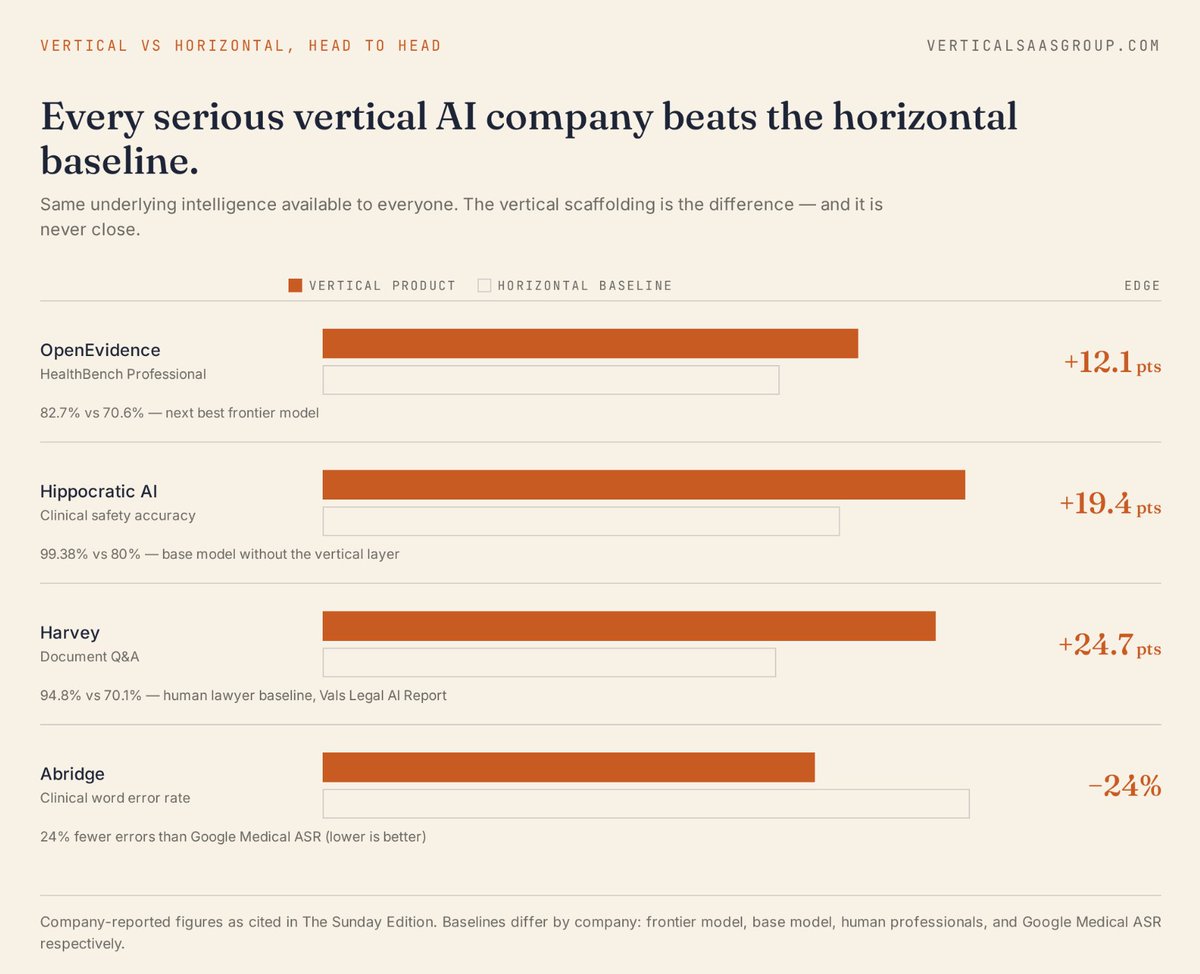
Four vertical AI companies. Four industries. One pattern.
They all built their moat on top of the same models everyone else can rent.
OpenEvidence trained on 35 million peer-reviewed papers through licensing deals that took years to negotiate. Scores 82.7% on HealthBench Professional, 12.1 points above the best frontier model. 350,000 clinicians use it. OpenAI could build the tech. They will never spend what it takes to secure that content. Too expensive. Too vertical. Too long.
Hippocratic AI hired 6,234 licensed clinicians. Average 11.5 years of experience. Evaluated 307,000 real patient calls. Clinical accuracy went from 80% to 99.38%. Severe harm errors driven to zero. Anthropic is not hiring 6,000 nurses. Not their business. But it is Hippocratic's entire business.
Harvey wired into law firm workflows in ways no horizontal model ever will. Beat human lawyers on four of seven tasks in the Vals Legal AI Report. Document Q&A: 94.8% vs 70.1%. Transcript Analysis: 77.8% vs 53.7%. The model companies did not do that. Harvey did.
Abridge cut clinical transcription errors by 83% on new medications. Beat Google Medical ASR by 24% on word error rate. Google has spent a decade and unlimited budget on medical speech. Abridge still wins. Because Google does not care enough about the last mile. Abridge does.
None of them competed with the model companies. They used them. Rented the horsepower. Built the scaffolding the model companies would never justify building.
That is the entire play. The model companies gave you commodity intelligence priced per token. Your job is to wrap it in ten years of industry context nobody else has.
"We're about to see an absolute bloom in software development as the price of development plummets and everyone realizes how much automation we still have left to do in this world... Don't go down with the pencils. There's so much to build. We need you." https://t.co/HJbUwMiDEU
For decades, researchers have sought materials that sort electrons by spin while their magnetism cancels.
In 3 days, 90+ Opus 5.5 agents helped us uncover two room-temperature magnetic semiconductor candidates in simulations: YBaMnFeO₅ and KV[Cr(CN)₆].
KV[Cr(CN)₆] was synthesized back in 1999. Its predicted ability to sort electrons by spin appears to have been hiding in plain sight for 27 years.
Wow, @hark_labs made a straight up superior @Muse. Its harness fully supports computer use (pretty fast, at that) in an isolated sandbox with vault-based auth you can reuse across any app (huge for Google), and you can actually see the "computer" being used in the cloud. Plus, its UI is so clean and such a refreshing take compared to most cluttered 3-column chatbot interfaces.
Easily the best personal AI offering on the market right now and the most "task-capable" agent on the AI growth curve.
Václav Havel was a hero of mine, and of so many others born behind the Iron Curtain. His humanity and humility were backed by courage and an unerring moral compass.
Today, Nolla Health became the first organization in the U.S. (and possibly the world) to receive regulatory approval for an AI to issue initial prescriptions.
This makes Nolla the first ever actual end-to-end AI doctor.
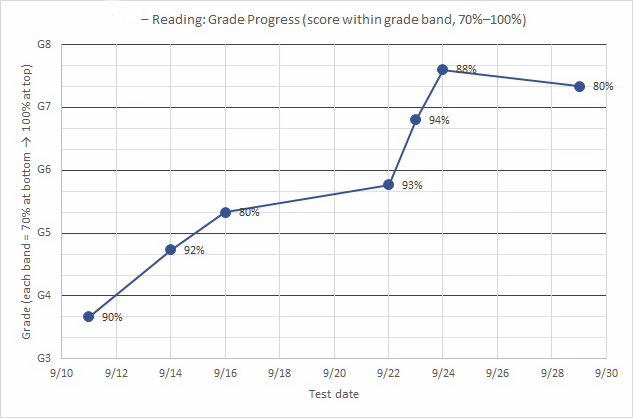
This is what learning looks like at Alpha School South Bay LA. My 7th grade daughter started off with a 3rd grade reading test to start off school. Passed (90%+). Then passed 4th.
But she must have had a gap at 5th grade (tested at 80%). So she spent 6 days catching up and filling gaps, and then passed 5th. Passed 6th the next day.
Now she’s working on 7th grade reading. It wouldn’t surprise me if she gets up to 8th or 9th in reading this year.
That said, she’s still way behind in the other subjects. Our supposedly blue ribbon public schools failed us.
Opening and progress this year:
Math: 4th
Fast Math: 3rd / TBD - she has passed every level so far
Reading: 5th -> 7th
Language: 4th -> 5th
Vocabulary: 4th -> 6th
Science: 3rd -> 4th
The speed of our current landscape is nuts. Jev was groundbreaking for like 2 weeks.
Cloudflare’s Clef outperforms it, adds vision support and 2x context window.
Oh yeah, and it’s open source.
https://t.co/sRyO7OigQ7 is our new home for developers building with Claude.
You'll find engineering deep dives, Claude Code and API guides, tips from the teams building Claude, and some fun easter eggs.
This weekend, Alpha and Founders School begin a series of 50+ Weekend events nationwide through the rest of 2026.
Themes span the entrepreneurial stack: launching businesses and earning a first dollar, shipping apps to the App Store, creating video games people play, robotics and hard-tech intros, YouTube and other creator tracks. Pathways that turn building into something real.
Founders School exists to help millions of students develop entrepreneurial spirit and the capability to create value through business while pursuing what makes them come alive. We’re starting with a few thousand over the next couple of months.
First up: Founders Weekend in 10 cities, Saturday and Sunday.
Can't wait to stop by Austin and Miami this weekend to hang with the coolest young founders.




![ValsAI's tweet photo. For decades, researchers have sought materials that sort electrons by spin while their magnetism cancels.
In 3 days, 90+ Opus 5.5 agents helped us uncover two room-temperature magnetic semiconductor candidates in simulations: YBaMnFeO₅ and KV[Cr(CN)₆].
KV[Cr(CN)₆] was synthesized back in 1999. Its predicted ability to sort electrons by spin appears to have been hiding in plain sight for 27 years.](https://pbs.twimg.com/media/HT48hIiaAAAh5CL.jpg)