A very impressive study for how we could prevent lung cancer more than 5 years before it is diagnosed. Using machine learning, discovery of a 14-plasma protein signature of risk that predicts responsiveness to an antibody therapy to interleukin, IL-1β
Validated across 8 cohorts
@CellCellPress@CharlesSwanton
https://t.co/qpPtgs1dH0
i once analyzed the financial statements of a cardiologist with a $150MM net worth who owned a string of five guys burger restaurants too. he called it vertical integration.
Personalized Cancer Vaccine Reduces Melanoma Recurrence by 49%
Adding a personalized mRNA vaccine to standard #immunotherapy reduced the five-year risk of recurrence and death by 49% in advanced melanoma
@JaniceM10@nyugrossman#cancervaccine#melanoma
https://t.co/QNCFdmH3TY
Vertex's version of this already got 10 of 12 type 1 patients off insulin for a full year, published in NEJM last summer. so the cells genuinely work.
the part the post skips: every one of those patients needs lifelong anti-rejection drugs, and one died from an infection tied to that immunosuppression.
the device built specifically to avoid those drugs, by sealing the cells away from the immune system, got discontinued in 2025 because the cells could not make enough insulin trapped inside it.
so you are swapping insulin shots for immunosuppressants, not for nothing. also that photo is a glucose sensor, not a pancreas.
#ClearPoint Neuro Enters into 10-year Focused Ultrasound Development Partnership with Sungkyunkwan University, South Korea, Further Expanding Our Drug Delivery Ecosystem and Global Footprint - Read More Here: https://t.co/ubbC5bFV6m
#CLPT
$CSL Gordon Naylor bought AUD$107k worth of shares.
For context, his paycheck is USD$2m, and his sign on equity grant is USD$4m.
Nothing really to see here....
Brunello Cucinelli $BC.MI has 5,448 items listed as "new with tags" on The RealReal.
Loro Piana, on the same platform, has 437.
Same filter. Same condition. 12x more Cucinelli.
I spent time figuring out why.
What I found isn't great. 🧵
The "China Biotech Out-Licensing Boom" is facing a harsh dose of reality. While headlines celebrate multi-billion dollar cross-border deals, new data from PharmCube highlights a dangerous structural bottleneck: 80.8% of all Chinese BD deal value is monopolized by just the top 10 companies.
The underlying data shows that beneath the surface-level hype, the broader sector is struggling to capture real global market share:
The Domestically Confined Pipeline:
Despite an explosion in total pipeline size, 92% of all patents granted to Chinese biotechs only protect the domestic Chinese market. Only a tiny 8% cohort has secured international patent protection. If you don't own the global IP rights, an out-licensing deal is fundamentally impossible.
The US Clinical Disconnect:
While many boast about global development, only 9.4% of China-originated novel assets have actually filed or commenced clinical trials in the US. More dangerously, there are currently 38 Chinese assets sitting in active US P3 trials that skipped US P1/P2 entirely—making them immediate targets for the ongoing US regulatory push to ban historical clinical data generated entirely outside Western populations.
The Commercially Stagnant Reality:
China's domestic hospital market for innovative therapeutics expanded slightly to 28.5% share. However, imported therapeutics from MNCs still outsell domestic innovative drugs by a massive 5:1 ratio inside Chinese hospitals.
The asymmetry is staggering: The actual sales footprint of native Chinese innovative drugs on home turf is just 1/88.9th the size of the US innovative drug market.
This confirms why out-licensing isn't an optional growth strategy—it is a binary survival requirement for Chinese biotechs to escape a low-margin domestic market. But with top players sucking up 80.8% of the deal capital and Washington actively moving to label biotech a "prohibited technology" under the COINS Act, the long-tail of Chinese biotech is running out of options.
$600276.SH $BGNE $ZLAB $XBI $IBB
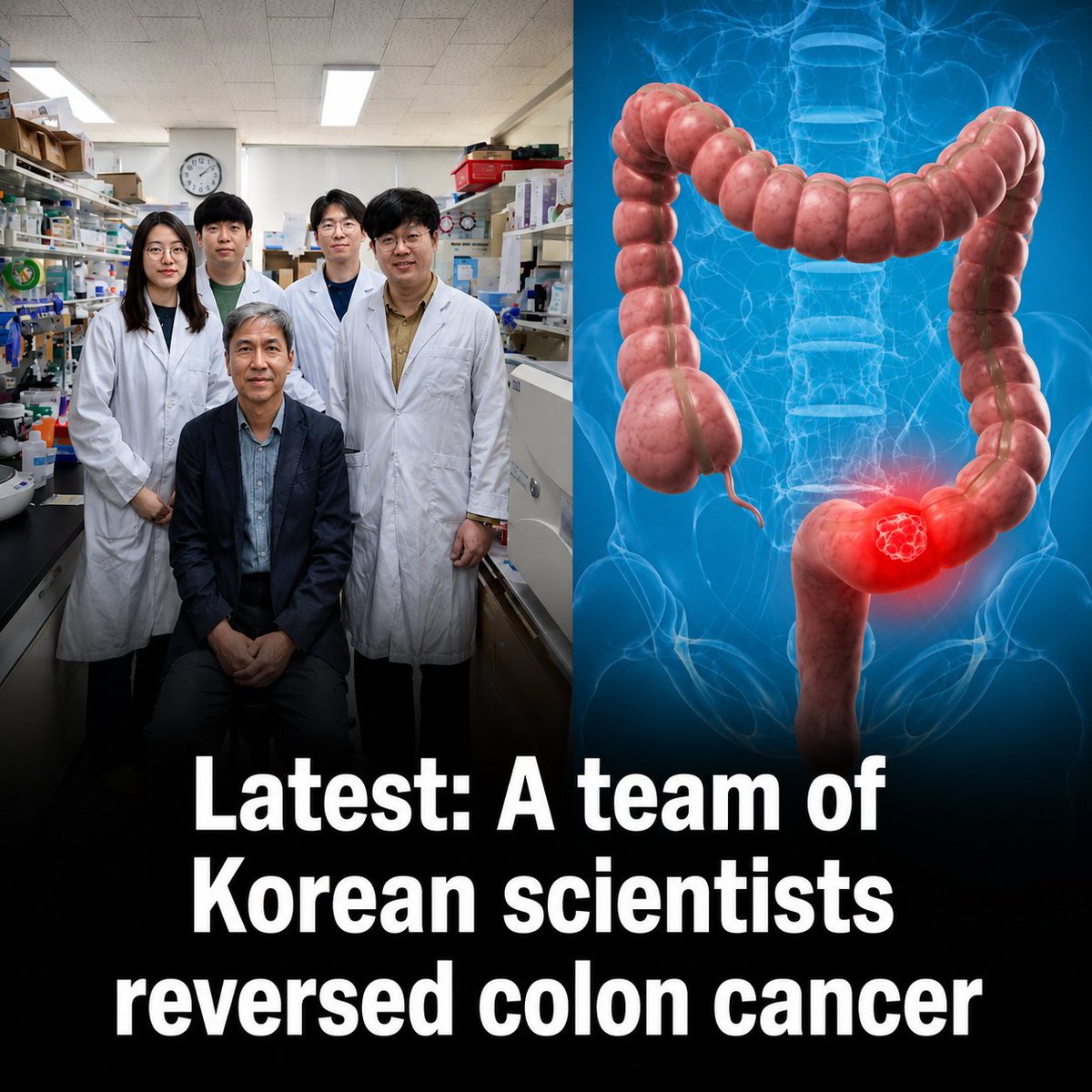
They didn't kill the cancer. They told it to go home.
A team of Korean scientists at KAIST just pulled off something that sounds like science fiction.
Instead of nuking colon cancer cells with chemo or radiation, they convinced them to turn back into normal, healthy colon cells.
No killing. No collateral damage. Just a quiet U-turn at the cellular level.
Here's how it works.
Led by Professor Kwang-Hyun Cho at the Department of Bio and Brain Engineering, the team built a "digital twin" of the gene network that controls how a normal cell becomes cancerous.
They ran simulations. They hunted for the exact moment a healthy cell flips into a malignant one.
Then they found the switches.
Three master regulator genes — MYB, HDAC2, and FOXA2 — were the keys to the whole transformation.
Flip those switches back, and the cancer cell stops behaving like a cancer cell. It starts looking and acting like a normal enterocyte, the kind of cell that lines a healthy intestine.
No gene editing. No permanent rewiring. Just the body's own natural signals, used in reverse.
The team confirmed it in molecular experiments, cellular experiments, and animal studies. The malignant cells stopped multiplying out of control and went back to doing their actual job.
The research has already been handed off to a company called BioRevert Inc. to develop into real-world treatments.
This isn't a cure tomorrow. But it rewrites the entire playbook for how we think about cancer.
You don't always have to destroy the enemy.
Sometimes you just have to remind it who it used to be.
Source: KAIST / Advanced Science (Gong et al., 2024) via ScienceDaily and OncoDaily
A 22-year-old graduate student in Kazakhstan got so angry at journal paywalls in 2011 that she built a pirate website holding 88 million scientific papers, and last month she turned the whole thing into an AI that lets you ask one question and get the actual research as the answer.
Her name is Alexandra Elbakyan, and the website is called Sci-Hub.
The AI she just launched is called Sci-Bot. It lives at https://t.co/6w0IBtOEYB and almost nobody outside academia knows it exists yet.
Here is the story, because it is one of the strangest things to happen in science publishing in the last 50 years.
Elbakyan was born in Almaty in 1988, the year the Soviet Union started to collapse. She taught herself programming at 12. She read Soviet science books that explained things her family used to call miracles. She got into computer security at university and graduated in 2009 with a degree she barely needed because by then she was already a serious hacker.
Alexandra moved to Moscow that fall. Then Germany. Then a research internship in the United States. She was working on brain-computer interfaces, the kind of research that requires you to read hundreds of papers a year just to keep up with the field.
And every single one of those papers was locked behind a journal paywall that cost between 30 and 50 dollars to read once.
She did the math. A graduate student in Kazakhstan could not afford to read science.
The first thing she did was learn how to get around the paywalls one paper at a time. She passed the trick around to other students. They asked her for papers constantly. She got tired of doing it manually.
So in September 2011, in three days, she wrote a script that automated the whole thing. A user pastes a DOI. The script logs in through a donated institutional credential. The paper comes back free. The website caches it.
The next person who asks for that paper gets it instantly because the previous request already saved a copy.
That was Sci-Hub. Three days of code. One graduate student. Done.
15 years later, the cache holds 88 million scientific papers. Almost every piece of scholarly literature published before 2020 is sitting on her servers. Researchers in 190 countries use it. Studies in Nature have shown that roughly half of all academic paper downloads worldwide now go through Sci-Hub, not the publishers who actually own the copyrights.
Elsevier sued her in 2015 and won a 15 million dollar judgment. She did not pay. The American Chemical Society sued her and won an injunction. She did not comply. Courts in India, France, Russia, and the UK have tried to block the domain. She just moves it. https://t.co/3sAWJzNe8I. https://t.co/tGIETesZ8i. https://t.co/H5WQ1f9lqR. The site has had over 20 domains and is still up.
Nature put her on its list of the 10 people who mattered most to science in 2016. The New York Times compared her to Edward Snowden. The Verge called her the pirate queen of science.
She has not been to the United States in over a decade because she would be arrested at the airport.
The Sci-Bot launch in April 2026 is the part that nobody is talking about.
She took the 88 million paper database and put a small language model on top of it. You ask a question in plain English. The model searches the entire shadow library, pulls the relevant papers, synthesizes an answer grounded in real citations, and links you to the full text of every source. Free. No login. No institutional credential. No paywall.
Three real scientists tested it for a Chemical and Engineering News article last month. They asked it medical and chemistry questions. The radiologist said the answer he got was usable. The chemist said the gaps in recent literature were obvious but the older science was solid. The publisher community is furious.
What she built is what the paid academic AI tools are trying to build. Except the paid ones are limited to what their parent publisher legally owns. Hers is limited to almost nothing.
Alexandra still lives somewhere in Russia. She does not give her address. She does not do video interviews. She gives talks over Skype with the camera off. She runs the largest illegal library in human history from a laptop and a donation page.
A graduate student who could not afford to read science built the system the entire scientific community now quietly depends on.
The publishers have spent a decade trying to shut her down.
She just shipped an AI that makes their entire business model outdated.
Eli Lilly released retatrutide Phase 3 data yesterday. 28% weight loss in 80 weeks. The most powerful obesity drug that’s ever been tested.
And today the cancer signal drops.
12,112 patients. Seven tumor types. GLP-1 users had half the lung cancer metastasis rate (10% vs 22%). Breast cancer: 43% cut. Colon cancer five-year mortality in a separate study: 15.5% vs 37.1%.
Cancer joins a list that already includes heart disease (SELECT, 20% MACE reduction), kidney failure (FLOW, 24% slower decline), sleep apnea (SURMOUNT-OSA, FDA-approved), addiction (BMJ, 600K veterans, 18-25% reduction across substances), and liver disease (86% fat clearance).
Tumors express GLP-1 receptors. Activate them and NF-kB drops, apoptosis rises. The drug isn’t just shrinking fat. It’s talking directly to the cancer.
One drug class. Designed for blood sugar. The biology keeps finding uses the designers didn’t predict.
Howard Marks: "Buffett says he made all of his money on 12 ideas. Guy invested for 70 years and said he made all his money on 12 ideas. Charlie Munger used to say he made all his money on 4 ideas. He didn't have as many good ideas as Warren"
A surgeon in South Africa just made the deaf hear again.
With bones that came out of a printer.
Professor Mashudu Tshifularo walked into Steve Biko Academic Hospital in Pretoria in March 2019 and did something no one on the planet had ever pulled off.
He replaced a man's shattered middle ear bones with custom titanium versions printed from a 3D scan of his own anatomy.
The patient? A 35-year-old who lost his hearing in a car crash.
The fix? The hammer, anvil, and stirrup. Those three tiny ossicles that turn vibrations in the air into the sound of your kid laughing or your favourite song playing.
Tshifularo printed perfect replicas, slid them in through an endoscope, and closed up in roughly an hour and a half.
No giant incision. No facial nerve damage. No scarring across the side of the skull.
Just a camera, a printed bone, and a man who could suddenly hear again.
The technique works on anyone. Babies born without functional middle ears. Adults wrecked by infection or trauma. Pensioners losing their world to silence.
Because the implants are scanned and printed per patient, they snap into place like they were always meant to be there. And titanium is biocompatible, so the body doesn't reject them.
By 2026, the procedure has moved into expanded clinical trials with dozens more patients lined up.
One man, one printer, one quiet revolution in how humans get their hearing back.
Source: BBC Science Focus
The mass of the proton has almost nothing to do with the mass of the things inside it.
A proton is made of three quarks. You can look up the mass of those quarks. Two up quarks and one down quark, added together, account for about one percent of the proton's mass.
The other ninety nine percent is not matter in any ordinary sense. It is the energy of the gluon field binding the quarks together, churning so violently that Einstein's equation converts it into what we measure as weight.
This means that when you step on a scale, almost none of the number is the stuff you are made of. It is the binding energy of fields holding that stuff in place.
If you could somehow switch off the strong force for a second, your quarks would still be there, but you would weigh about a kilogram. The rest of you is not substance. It is tension.
The calculation that confirms this was not finished until 2008. A team using some of the largest supercomputers then available simulated the interior of a proton from first principles and got the mass right to within a few percent.
Before that, we knew the rule worked but could not derive the number. Ninety nine percent of the mass of ordinary matter, the mass of every star and planet and body, was unexplained from the underlying theory until well into this century.
You are mostly the sound of something holding itself together.
Autologous CAR-T therapy is a logistics and commercial bottleneck. But the "off-the-shelf" (Allogeneic) revolution is accelerating out of China, and the latest clinical data threatens to disrupt the Western commercial paradigm.
CARsgen Therapeutics ($02171.HK) via its subsidiary Youkaize just secured CDE acceptance for its IND filing of CT1190B—a first-in-class CD19/CD20 dual-targeted, universal CAR-T engineered via their THANK-uPlus® platform.
Instead of waiting weeks for personalized manufacturing, this off-the-shelf asset uses healthy donor T-cells, delivering immediate availability and drastic cost reductions. Check out how China's early-stage universal data stacks up against current Western standard-of-care autologous metrics in Relapsed/Refractory B-NHL:
• CARsgen Universal CT1190B (P1 Data): 90.9% ORR, 72.7% CR. Full 100% CR in the recommended dose cohort, showing potent activity even in patients who failed prior CD19 CAR-T treatments.
• Gilead / Kite Yescarta ($GILD) (ZUMA-1 Standard): ~83% ORR, 58% CR (Autologous, requires complex manufacturing wait times).
By leveraging dual-targeting (CD19/CD20), CARsgen has effectively engineered a solution to the biggest failure mode of traditional CAR-T: antigen escape.
Furthermore, they aren't just chasing oncology. CT1190B is actively being pushed into autoimmune indications, aggressively targeting severe refractory systemic lupus erythematosus (SLE) and systemic sclerosis (SSc).
With SoftBank buying an early 8% stake in the asset's vehicle and over 10 universal CAR-T assets entering the clinic in China, Western cell therapy pioneers need to look over their shoulders. The off-the-shelf explosion is real.
$02171.HK $GILD $NVS $BMY $XBI $IBB
Cancer survival in the U.S. just crossed 70%.
It was 63% in the 1990s.
That gap = 4.8M people alive today.
This one chart captures survival gains across 29 cancer types.
The wins are real.
So is the unfinished work.
▪️CML: 31% → 72%
▪️Multiple myeloma: 32% → 62%
▫️Kidney: 59% → 82%
▫️Metastatic melanoma: 16% → 35%
▫️Childhood ALL: 80% → 92%
But some cancers barely moved.
Cervical cancer outcomes actually worsened.
None of this is abstract progress, though.
These are birthdays, grandkids, and years of life returned.
This is what funded science does.
Next time someone asks if cancer research works, show them this (full) chart.
- - - - -
Source: ACS Cancer Statistics 2026 · SEER · 𝘷𝘪𝘢 @Jori_health
- - - - -