🚨🤔Thought experiment on Florida’s prison system.
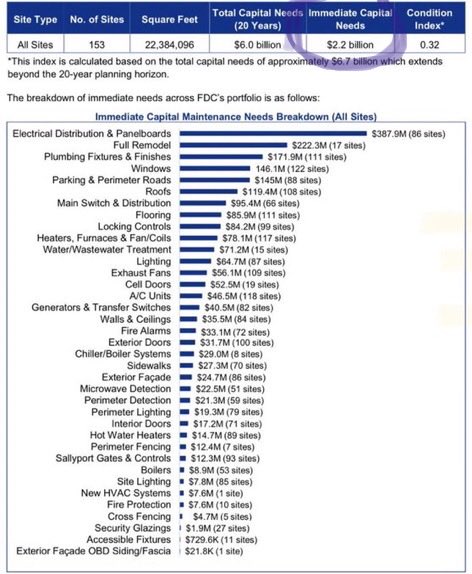
Florida incarcerates roughly 87,000 people in state prisons, making it the third-largest system in America. An independent KPMG assessment found the system requires $2.2 billion in immediate capital repairs to bring facilities up to minimum operational standards. Over the next 20 years, projected infrastructure needs approach $11.8 billion. Roughly one-third of facilities were rated poor or critical. Today roughly 75% of prison housing units still lack A/C.
Staffing isn’t better. At some @FL_Corrections facilities, correctional officer vacancy rates have ranged from 24% to more than 70%. That means skeleton crews, mandatory overtime, constant officer turnover, dorm closures, skyrocketing violence and routine lockdowns. This isn’t anecdotal. It’s structural.
Now here’s the thought experiment: Require every county jail in Florida to operate under the same constraints as the #Florida prison system.
Same per-inmate funding pressures.
Same double-digit staffing vacancies.
Same deferred maintenance.
Same aging facilities rated poor or critical.
Same heat conditions in summer.
Same multibillion-dollar backlog with little legislative support.
County jails often spend 2X per inmate per day what the prison system spends and answer directly to local voters. When A/C fails, phones ring. When staffing drops, commissioners demand answers. When conditions deteriorate, it becomes front-page news.
Now imagine a sheriff explaining that 75% of jail housing units will operate without full climate control because “that’s how the state does it.” Imagine explaining a 30%-70% deputy vacancy rate as normal. Imagine telling voters the repair backlog will be addressed sometime over the next TWO decades. Make them explain why violence is skyrocketing in their facilities. It’s up 50% in Florida prisons.
Would that last a week?
If it’s politically intolerable in a county jail for people awaiting trial and serving shorter sentences, why is it acceptable in a state prison for people serving time?
Here’s the difference: @FLSheriffs are one of the most powerful lobbying forces in Tallahassee. If their facilities were forced to operate under state-level constraints, there would be emergency press conferences, caucus meetings, and a call for a special session before the day was over. Relief would not be theoretical. It would be immediate.
So the real question isn’t whether Florida can afford modernization. The KPMG report makes clear what the bill is.
The real question is why urgency only appears when politically powerful actors feel the pressure.
We tolerate in state prisons what would be politically explosive in county jails. Not because it’s acceptable. Not because it’s efficient. But because the people inside are politically distant.
Real reform starts when incentives align. If you want modernization, remove the distance. Sometimes the fastest way to fix a system is to make everyone live under it.
Thoughts?
@JeffreyBrandes A third of Florida’s prisons are filled with people who’ve served decades and aged out of crime. If FL wants relief it should start by releasing the sick, elderly, and low-risk who have served long sentences. That’s the fastest, safest way to reduce pressure on a broken system.
Food was better before privatization. Now @aramark portions are so low families feel forced to buy iCare packages. This burden shifting takes advantages of families who are already suffering. #changethetray@FLSenate
“These meals are designed to keep people alive, not to nourish them. They don’t smell, taste or look good. There are lots of hotdogs, baloney sandwiches, soggy pasta with a mysterious sauce, something that might be called “salad”, but it’s really just a handful of wilted iceberg lettuce. We hear about cake that’s meant to be dessert, but is really designed to increase calories. There are fortified beverages that come in a powder like Kool-Aid. It’s supposed to provide critical nutrients, but many told us they don’t drink it, because the taste is chemical and they don’t know what’s in it.”
Thinking about that time an Arizona sheriff bragged about giving incarcerated people a 56¢ Thanksgiving meal 🤨
Cutting corners to give cheap, nutritionally inadequate slop is not a triumph – it's a public health concern.
“The state must create an Independent Corrections Commission, a permanent oversight body with the power to monitor staffing and safety conditions, consolidate decaying facilities, recommend evidence-based sentencing reform, expand supervised release for those who have aged out..”
Florida keeps putting more in prison without thinking of the money it takes to care for them. People become wards of the state @dannyalvarezsr@JonMartinEsq@RepMcClure parole will save money and let those safe pay for themselves Smart Justice pays for itself
🚨 🚨 Florida’s prison system is on the brink. DOC Secretary Ricky Dixon just asked lawmakers for $512M+ …NOT to improve conditions… just to keep the lights on. 🧵https://t.co/sZNYRgT3b7
573 men convicted of unarmed robbery have served over 20 years in prison. An FCOR pilot program to review their rehabilitation, support systems, and potential for safe release could save $17 million in the first year, with significant recurring savings thereafter. @JonMartinEsq
If 2,200 rehabilitated lifers, who committed crimes before age 30, are released as approved by FCOR, it could save $66M annually. Funds that could repair infrastructure like KPMG facilities.
Life in prison costs FL more than $1M per inmate (35 yrs at $30k/yr), plus legal & medical costs as they age. Why not invest in rehab for those ready to change? It’s cheaper and smarter. Send Kyle home. Parole. Grace.
We have 19 year old officers supervising 150 incarcerated individuals according to @FL_Corrections Secretary Dixon. Makes you wonder. We don’t care? We over incarcerate? We should listen to what the @KPMG report told us?