Here's a quick explainer on how stablecoins can fit into existing ERP workflows, including a couple of use cases to understand how it all comes together.
One concern that we hear often is that faster settlement means giving up control. With Coinbax, smart contracts can be set up with the same approval processes finance teams already use, while significantly reducing settlement times.
Shoutout to @sudiprokaya and @mk314k for building a great tool to use to help bring these topics to life using Simi from @laminalabs!
It's really awesome when people try your product and actually love it. Customers are the biggest validation we can get. We are still improving.
We built Simi at Lamina Labs because explaining technical stuff (like crypto!) shouldn't take hours of manual video editing. Love seeing it hit the mark for @CoinbaxHQ! 🙌
Real gap that becomes more obvious once the stablecoin sandwich goes away.
When transactions move wallet to wallet across banks, fintechs, and self-custody, the on-ramp and off-ramp edges disappear. Compliance can’t sit at edges that aren’t there. It has to live at the transaction itself: sanctions at send, reversibility, multi-party verification, rules tuned to specific regulators and counterparties.
@tempo and @arc help create purpose-built environments. @CoinbaxHQ ships chain-agnostic transaction-level controls.
Everyone is talking about stablecoins.
But nobody is talking about:
the speed of on ramp and off ramp
the liquidity between stablecoin and fiat
the global compliance layer
Feels like someone need to solve all the issues above
Makes me wonder… do we need a purpose-built Layer 1 for real-world payments?
Thinking back to an unforgettable week at Consensus Miami.
On May 7, live on @CoinDesk at @consensus2026, our founder Peter Glyman (@pglyman) shared how Coinbax is helping financial institutions get comfortable moving payments onchain through stablecoins, why it matters, and what comes next.
Watch the post-interview below, or the full version by clicking the link in the comments.
One theme that came up repeatedly this week at the @BankTechVC Annual Summit in Chicago: the best way for financial institutions to understand stablecoins is to actually start using and testing the technology.
That was a big focus during the panel “Beyond the Hype: How Stablecoins Earn a Seat at the Bank” featuring Coinbax CEO Peter Glyman, @alextreece1 of Stablecore, and Wade Peery, with Carey Ransom moderating the discussion.
A major takeaway: institutions do not need every answer before getting started. The key is experimenting in controlled environments with the right infrastructure, visibility, and safeguards in place while learning in real time.
Appreciate the great conversations all week in Chicago. Exciting things ahead.
Today, we share a breakthrough on the planar unit distance problem, a famous open question first posed by Paul Erdős in 1946.
For nearly 80 years, mathematicians believed the best possible solutions looked roughly like square grids.
An OpenAI model has now disproved that belief, discovering an entirely new family of constructions that performs better.
This marks the first time AI has autonomously solved a prominent open problem central to a field of mathematics.
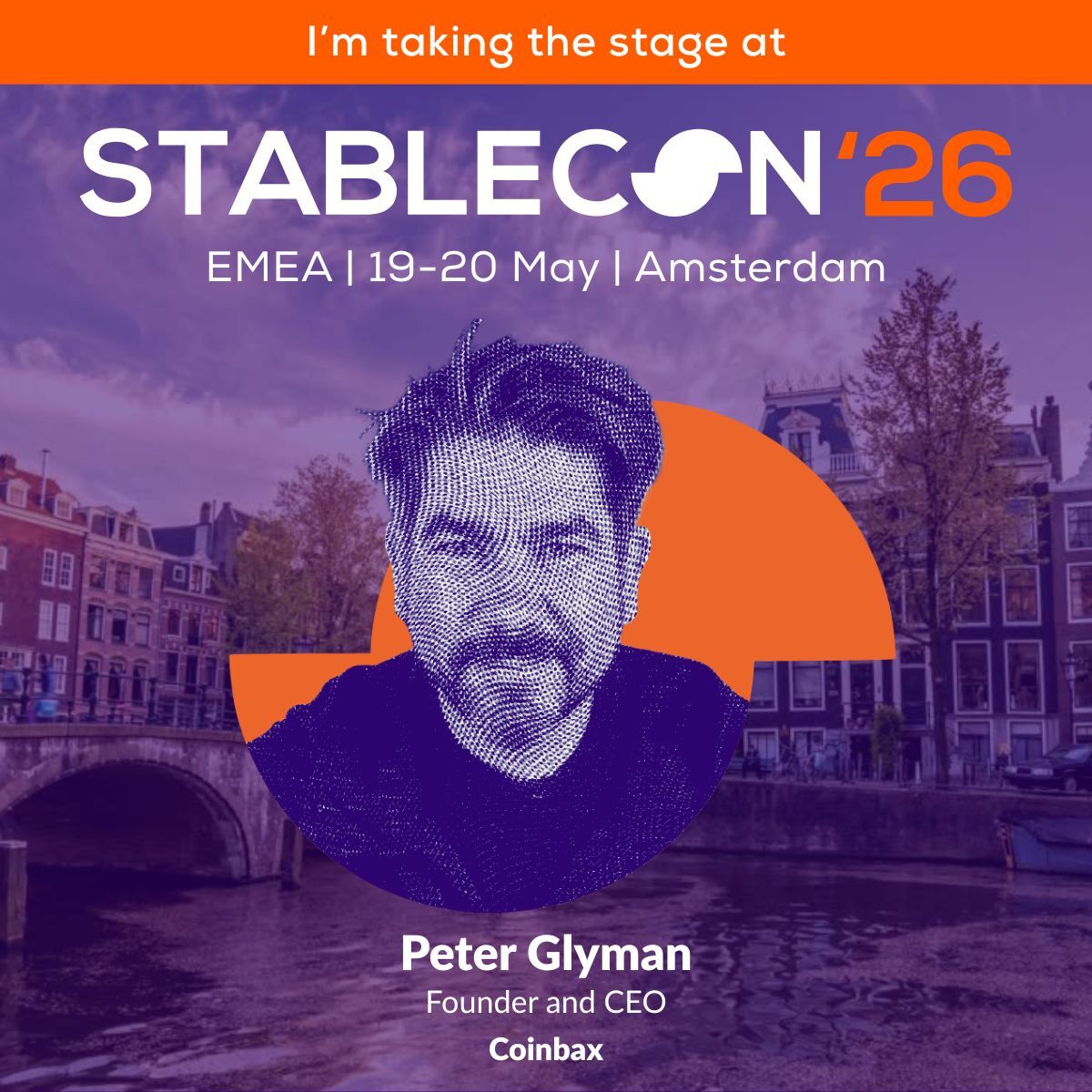
At @thestablecon EMEA, Coinbax Founder & CEO Peter Glyman joined Bryce Ferguson @sadbryce (CEO at @turnkeyhq) and Jess Houlgrave @Houlgrave (CEO at @WalletConnect ) for the panel:
“When Every Bank Has a Wallet: The Real Path to TradFi Stablecoin Adoption”
Moderated by Malak Alba, the conversation focused on what it will actually take for stablecoins to become part of everyday financial infrastructure.
Thank you to the Stablecon team for fostering a fun-filled event with engaging topics across payments, banking, and digital assets. It was great to connect with others across the ecosystem who are helping shape where digital payments go next.
@bettermoney_co@AdamZuck13 I like this “Stablecoins will change the world because they are the best technology for moving money: fast, cheap, global, programmable, and available around the clock.”
In three years, every bank account will have a wallet
Looking forward to my panel with @Houlgrave@WalletConnect and Bryce Ferguson @turnkeyhq at @stablecon EMEA in Amsterdam next week
Use code PG200 for €200 off → https://t.co/QQ7wfIMWO0
@CoinbaxHQ
Imagine losing $140,000 to a wrong wallet. No way back.
Institutions can't take such risks with millions and even billions moving daily.
With @CoinbaxHQ, institutions get the long-needed controls over stablecoin settlement.
- @pglyman at @CoinDesk's #Consensus2026
Had an engaging panel at the Merkle Science Meet Miami panel on Building Trust for Institutional Adoption of Stablecoins. Two things I would like to highlight:
Don't pick the asset. Pick the use case. The asset gets easier in production. Stablecoin vs. tokenized deposit is paralyzing institutions that should be picking a use case, picking a partner, and getting live. The asset question gets easier with real data.
The gap institutions keep pointing to is reversibility. Speed and finality are features until a risk team has to underwrite them. Build reversibility at the transaction level and stablecoin payments start to look a lot more like something a bank can actually deploy.
Thank you to my fellow panelists for keeping the conversation engaging and sharing your insights!
– Peter Glyman | @pglyman@okx@DuaneMorrisLLP@sumsub@zerohashx@utila_io@OlympixSecurity Chuk Okpalugo Max Howenstine Roshan Robert Patrick Murck Thibaut Gravelle-Vivien Justin Seidl @MoneyCodePod Surus