A lot of product ideas are iffy with answers for the most important questions - Why and How will your customers "Come, Play, Stay and Pay"? Repeatedly asking and answering these questions is what creates a virtuous value loop. #productmanagement
Take this as a rant.
Take this as something a long time coming
Take this from someone who's spent his life in factories growing up.
We need to develop a better ecosystem for ourselves to thrive!
A +ve critique on India's manufacturing scene. https://t.co/S2JcsubqDr
Satellite based infrastructure can be awesome economically and ecologically for India’s terrain and remote areas. While there is thinking on cost, it’s important to model worst case scenario of a fall out/disagreement with US on national security issues.
https://t.co/5vOrB6dFEf
It is truly unfathomable how this kid would come from a country with no chess culture and not only become World Champion, but inspire generations of Indian kids to push chess forward. The legend, @vishy64theking! Huge congratulations to India for winning the @ChessOlympiad!
The way forward is certainly “not go back to paper”. I feel India is ahead in the game. We should certainly stress test our systems, processes and continuously improve them. World’s largest democracy deserves no less.
Just a casual search and I realized the sheer number of “HDMI error” issues reported on @PrimeVideoIN for the last two years. That it’s not resolved even till today on @TataPlayBinge and other smart devices Is a bit surprising given the techies at @amazonIN sure are smart, then?
One week ago, the world lost a legend.
Charlie Munger was a treasure trove of wisdom—and most of it had nothing to do with investing.
10 of his most powerful insights for a life well lived:
(Note: Long post, bookmark for future)
1. The Most Valuable Riches Take Time
"The desire to get rich fast is pretty dangerous."
While this quote has traditionally been applied to investing (given it was his primary arena of public success), I believe its true meaning extends well beyond dollars and cents.
Whatever "rich" you're going after...
• Strong, durable relationships
• Physical strength or endurance
• Mental health and mindfulness
• Financial success
...know that it won't happen overnight.
It will take a long time—probably longer than you've ever imagined—but the most valuable "riches" of life are always worth waiting for.
Keep your compass pointed in the right direction, stay the course, and get "rich" slow.
2. Avoid the Second Arrow
"Generally speaking, envy, resentment, revenge, and self-pity are disastrous modes of thought...Life will have terrible blows, horrible blows, unfair blows, it doesn’t matter. Some people recover and others don’t. There I think the attitude of Epictetus is the best. He thought that every mischance in life was an opportunity to behave well. Every mischance in life was an opportunity to learn something and that your duty was not to be immersed in self-pity, but to utilize the terrible blow in a constructive fashion. That is a very good idea."
In 1953, a 29-year-old Charlie Munger faced a series of crushing blows, losing his 9-year-old son to leukemia, his wife to a divorce, and his money to the medical bills.
Very few people could have recovered from that series of events.
But recall the Parable of the Two Arrows:
The Buddha once asked his student, "If a person is struck by an arrow, is it painful?" The student nodded, yes.
The Buddha then asked, "If a person is struck by a second arrow, is that even more painful?" The student again nodded, yes.
The Buddha then explained, "In life, we cannot always control the first arrow. However, the second arrow is our reaction to the first. The second arrow is optional."
Charlie Munger was struck by the first arrow (harder than most of us can imagine), but he stared into the darkness and realized that the second arrow was optional.
When we encounter the inevitable challenges of life, we can all do the same.
3. Develop Real Knowledge
"The first rule is that you can’t really know anything if you just remember isolated facts and try and bang ’em back. If the facts don’t hang together on a latticework of theory, you don’t have them in a usable form...You may have noticed students who just try to remember and pound back what is remembered. Well, they fail in school and in life. You’ve got to hang experience on a latticework of models in your head."
There are two types of people:
• People who know how to talk about the thing.
• People who know the thing.
You encounter plenty of Type 1s: You hear them talking at every cocktail party and networking event. They wax poetic on a variety of topics, but when pressed for detail, they crumble. The knowledge is all on the surface. They know how to talk about the thing, but they don't know the thing.
You encounter few Type 2s: Those with real, deep knowledge are rarely the loudest in the room. They are generally too busy developing their depth or acting on it to be found talking about it.
The goal is to be Type 2 in a few domains—and to spend time with more Type 2s in the domains where you aren't one.
4. Live What You Want to Receive
"How to find a good spouse? The best single way is to deserve a good spouse...To get what you want, you have to deserve what you want."
The most important relationship advice I've ever received:
Make a list of the values you want to find in a partner, then go out and actually embody those values yourself.
You can't hope to attract a set of values that you yourself aren't embracing.
Similarly, as a parent, you can't hope to teach a child a set of values that you aren't walking with.
Live what you want to receive.
5. Invert, Always Invert
"All I want to know is where I’m going to die, so I’ll never go there."
Two thousand years ago, Stoic philosophers engaged in a seemingly peculiar daily exercise: they would sit quietly and imagine—in excruciating detail—all that could go horribly wrong in the days, weeks, and months ahead.
They referred to it as premeditatio malorum—the pre-meditation of evils.
The premise: Through the preparation of the mind for the potential worst-case scenarios, we can more aptly avoid such outcomes.
Complex problems are sometimes better solved backwards.
When you encounter a challenging life problem, rather than attempting to solve it forwards, invert and solve it backwards:
• What do you NOT want to happen?
• What actions, behaviors, or conditions would create that undesirable outcome?
• How can those traps be avoided?
Proceed accordingly.
6. Avoid the Ostrich Effect
"I think that one should recognize reality even when one doesn’t like it; indeed, especially when one doesn’t like it."
An ostrich will bury its head in the sand to avoid danger.
How many of us are metaphorically burying our heads in the sand in the face of new information that challenges our worldview?
If you want to be right more than you want to uncover the truth, you're in for a long, hard life. Avoiding knowledge because it doesn't confirm your existing beliefs is a dangerous game that will ultimately lead to your downfall.
Always question your strongly held beliefs. Learn the other side of the argument just as well as your own.
7. Never Mimic the Herd
"Mimicking the herd invites regression to the mean."
As Jeff Bezos said, "Being yourself is worth it, but don’t expect it to be easy or free. You’ll have to put energy into it continuously."
The fight against normalcy is the most important fight of your life.
No one can compete with you, at being you.
8. Create a "Too Hard" Pile
"I just try to avoid being stupid. I have a way of handling a lot of problems—I put them in what I call my ‘too hard pile,’ and just leave them there. I’m not trying to succeed in my too hard pile."
There are no style points in life.
The "too hard pile" is a useful tool for avoiding the stupidity that comes from attempting to tackle the big, complex, scary problem when there's a small, simple, obvious one right in front of you.
A few applications from my own life:
You don't need the fancy equipment and complicated workouts, you just need to show up and move your body in simple ways, every single day.
You don't need the latest, greatest new alternative investments and cutting edge tax strategies, you just need to invest in simple, low-cost index funds and hold them forever.
You don't need the 100 supplements and latest fad diets, you just need to eat 90%+ whole, unprocessed foods.
Avoid things that seem too hard and handle the easy, consistently, instead.
9. Success Follows Interest
"Another thing that I found is an intense interest of the subject is indispensable if you are really going to excel. I could force myself to be fairly good in a lot of things, but I couldn’t be really good in anything where I didn’t have an intense interest."
Most people focus too much on being interesting and not enough on being interested.
Being interested is how you become interesting.
When you pursue your genuine interests, you are prone to deep focus, which cultivates a depth that is impossible to fake.
Success always follows interest.
10. Wisdom Compounds
"Spend each day trying to be a little wiser than you were when you woke up. Day by day, and at the end of the day, if you live long enough, like most people, you will get out of life what you deserve."
Small things become big things.
In the wise words of Mahatma Gandhi, "Live as if you were to die tomorrow. Learn as if you were to live forever."
***
Goodbye to a Legend
In a beautiful piece reflecting on Charlie Munger's life, Wall Street Journal columnist Jason Zweig shared an interaction he had with Munger last month:
I asked what he might want for an epitaph of no more than 10 words. His reply was immediate and full of epistemic humility: "I tried to be useful." Not "I was useful." That would be for other people to judge. But "I tried." That much he knew.
It struck me as perhaps his most important wisdom of all.
To be useful—as a parent, spouse, child, sibling, colleague, friend, or leader—is our highest calling.
We will fall short in various ways along the journey, but we can all strive for this goal.
Here's hoping that at the end of our days, we may all be able to proudly proclaim: "I tried."
If you're still here, I hope you found some new inspiration in these words. If you did, share it with others and follow me @SahilBloom for more in the future.
A few days ago, I conducted a 100-piece British orchestra, The Royal Philharmonic Orchestra to perform India’s National Anthem at the legendary Abbey Road Studios, London. This is the largest orchestra ever to record India's National Anthem and it is spectacular! The "Jaya He" at the end gave me goosebumps. Felt great as an Indian composer :-)
I am sharing this historic recording with every one of you this Independence Day - use it, share it, watch it, but with respect :-) It is yours now. Jai Hind.
Happy #independenceday #Rickykej
@narendramodi
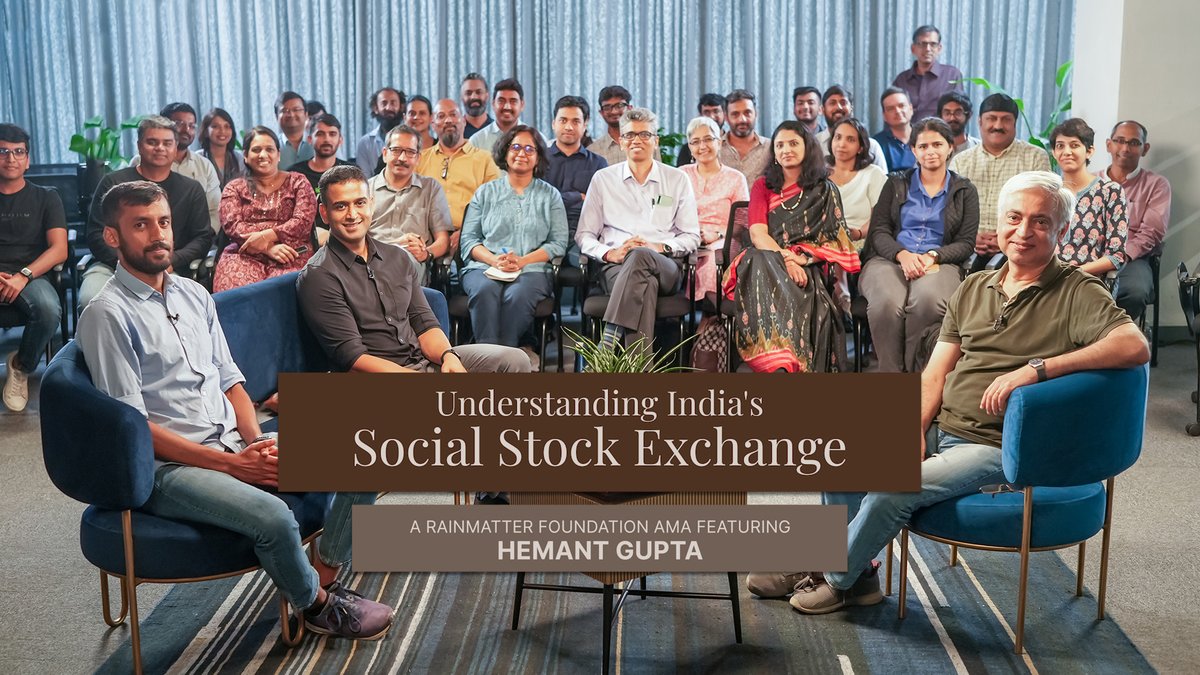
One of the big challenges for social organizations to raise funds from the mainstream population is overcoming the trust barrier— potential donors have a hard time trusting that their investment will be put to good use.
In the case of listed companies on stock exchanges, we have regulators & comprehensive disclosure norms that have built trust over time. If we had something similar for social organizations – a social stock exchange (SSE), could it help them raise funds easily and not just rely on Corporate social responsibility (CSR)?
We recently had an ask me anything session with Hemant Gupta, head of the BSE SSE, to discuss this.
BSE and NSE SSE's will be operational in the coming months. Soon, you will be able to donate to a cause that you identify with, just like investing in a stock from Kite.
Through @zerodha and @RainmatterOrg, we will:
1. Help the first 5 organizations with the minimum fundraising.
2. Evangelize the idea of SSE by nudging investors to have a small allocation in their portfolios toward social investments. Because that's what it is—not giving, but a social investment.
Here is the link to the conversation: https://t.co/uTRVRNIlkH
In case we have forgotten India’s per capita income is ranked 144th in the world. It’s a very poor country. Agriculture still employs half of the population and contributes just 18% to GDP. Unless this changes, you will see the same videos in 2030
Sam telling India they can’t compete with ClosedAI is peak hubris — or pure honesty! 🤷🏼♂️
Indian government & VC complex should launch a dozen Manhattan projects backing top engineers to prove him wrong — 🇮🇳 pride!