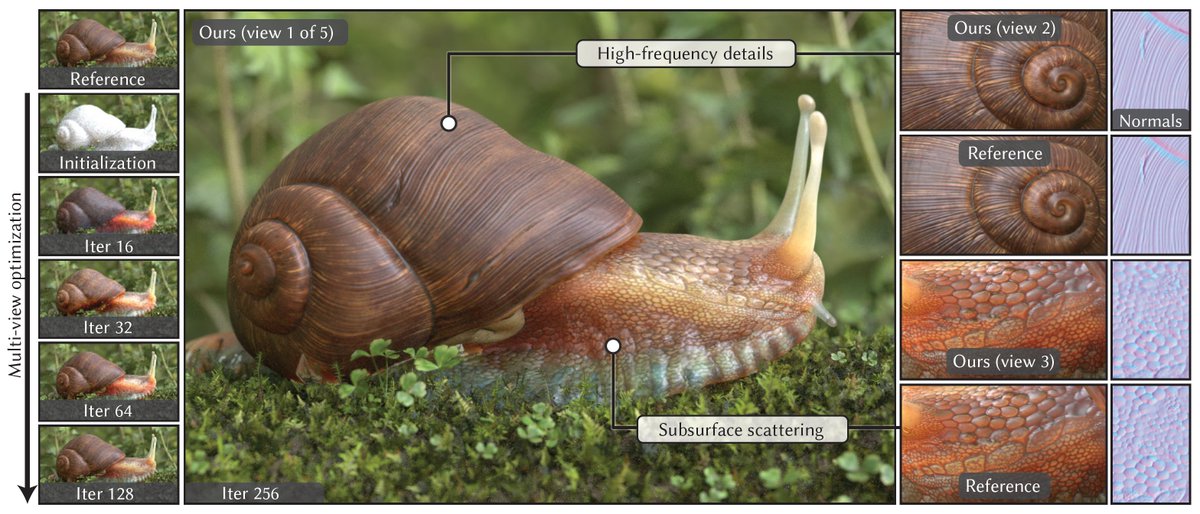
Inverse rendering has become a standard tool for 3D reconstruction problems. However, recovering high-frequency appearance textures is challenging. In our SIGGRAPH 2025 paper, we propose several techniques to robustly reconstruct complex appearances (e.g., human skin). 1/n
Are you at #SIGGRAPH, and like inverse rendering as much as I do? Come to our talk on "Practical Inverse Rendering of Textured and Translucent Appearance" at 14:40 during the Light & Relight session! Perfect opportunity to catch up if you come by our poster later as well 🚀
🚀 The source code for our #SIGGRAPH2025 paper "Practical Inverse Rendering of Textured and Translucent Appearance" is now available!
🔗 GitHub: https://t.co/GfhYNoooou
For PDF, supplemental and high-quality videos, check out the project webpage at https://t.co/gZuH8dEGyb! Joint work with Jérémy Riviere, Ruslan Guseinov, Stephan Garbin, Philipp Slusallek, @bernd_bickel, Thabo Beeler and @DelioVicini#SIGGRAPH2025 n/n
Inverse rendering has become a standard tool for 3D reconstruction problems. However, recovering high-frequency appearance textures is challenging. In our SIGGRAPH 2025 paper, we propose several techniques to robustly reconstruct complex appearances (e.g., human skin). 1/n
Finally, our methods enable high-quality facial appearance reconstruction from sparse captures. We fit parameters of standard production rendering models, producing realistic results without neural rendering. 5/n
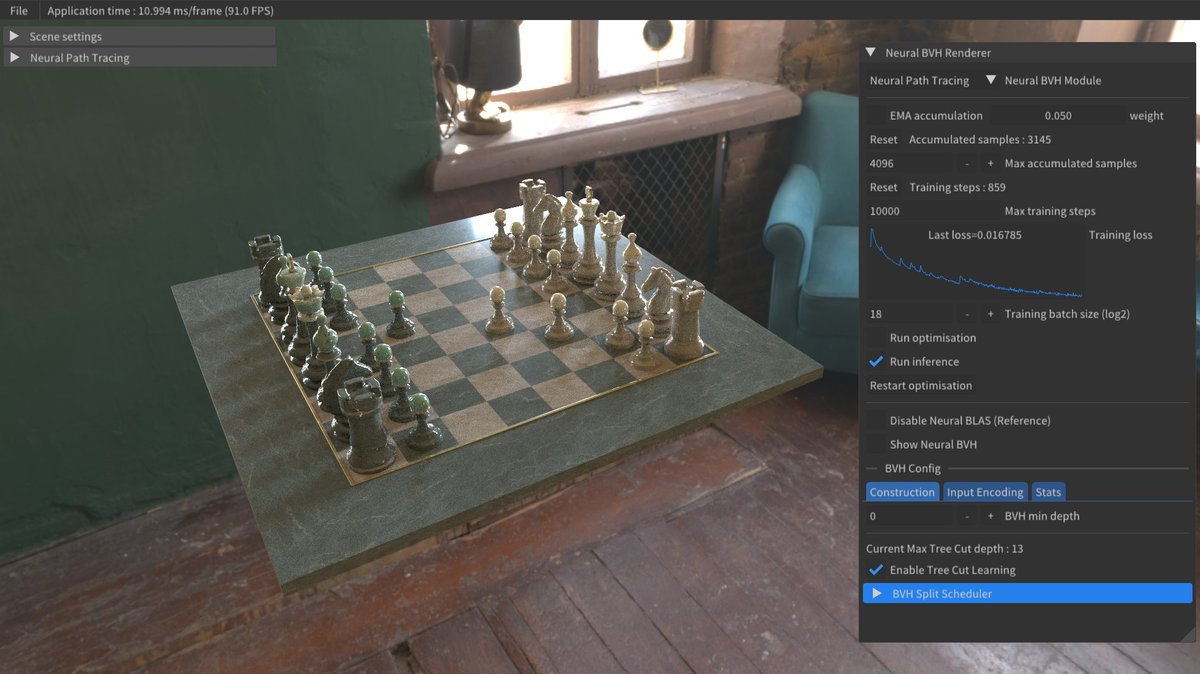
If you are at SIGGRAPH, come check out the live demo of our paper "N-BVH: Neural ray queries with bounding volume hierarchies" in the Emerging Technology session from 11:15-1:15 pm in Exhibit Hall F!
The Computer Graphics chair at @Saar_Uni just finished building our own whiteboard plotter. We used seven @STAEMars pens. Wonder what more colors could do?
#cg#saarland
Our work on #NBVH (Neural ray queries with Bounding Volume Hierarchies) will be presented this summer at #SIGGRAPH2024!
What's that? See🧵below ⤵️
📃Source Code: https://t.co/ZR6Ji7Hlz1
🌐Project Page/Paper: https://t.co/ooiiL2PHX0
(ft. @PhilippeWeier@iliyang@boubek et al.)
@anderslanglands Another way to control quality, while less impactful than the node count, is to increase the hashgrid's hashmap size in the "Input Encoding" tab. This was previously hidden behind the developper mode. Please redownload the latest binary for the latest update :)
We added binary releases for some GPUs to our N-BVH implementation🚀No more lengthy compilation just to try out rendering your own scene in our framework! Check it out here: https://t.co/DnRLsFlZ7L
@anderslanglands One way is to change the "Split scaling" factor in the "BVH Split Scheduler", the expected node count will show in the text above. 140k nodes is a good start for larger scenes.
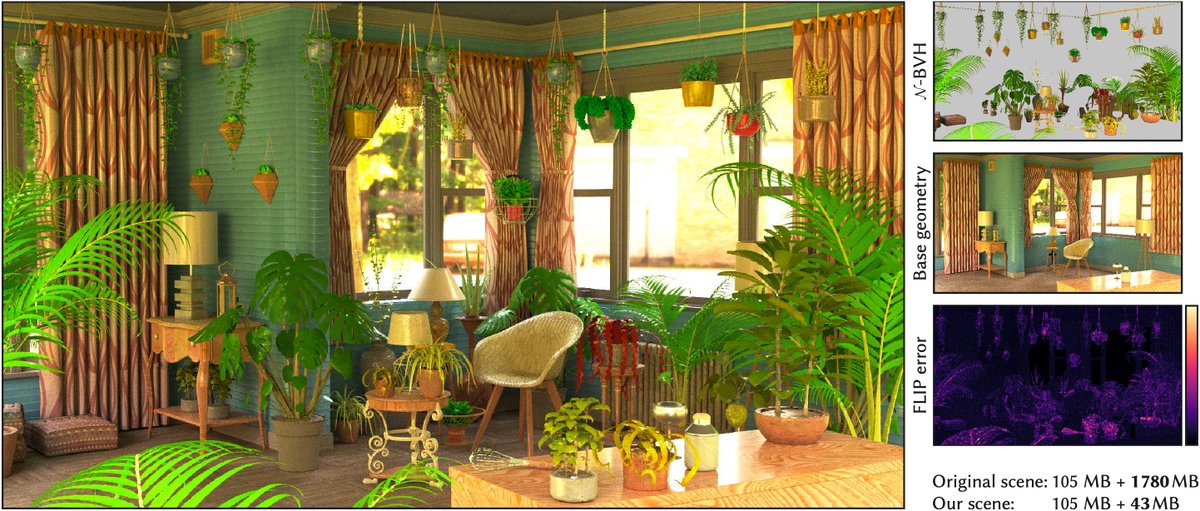
Ever wanted to load a large asset in your GPU path tracer, only to find it doesn't fit in memory? Then check out our #SIGGRAPH2024 paper “N-BVH: Neural ray queries with bounding volume hierarchies” (with Alexander Rath, @exppad, @iliyang, Philipp Slusallek and @boubek)
@NateMorrical@exppad@iliyang@boubek Thanks! Table 1 in our paper gives an overview of the performance for lower and higher visual quality. We are likely memory-bound, in particular, the ping-pong mechanism between every inference and BVH traversal step creates a lot of traffic that could probably be avoided.
Our N-BVH combines a traditional BVH with a hash-grid encoding to serve neural ray queries and integrate seamlessly into ray-tracing pipelines. Trained in a couple of minutes and running inference in real-time, our representation achieves up to 42x compression on complex assets.
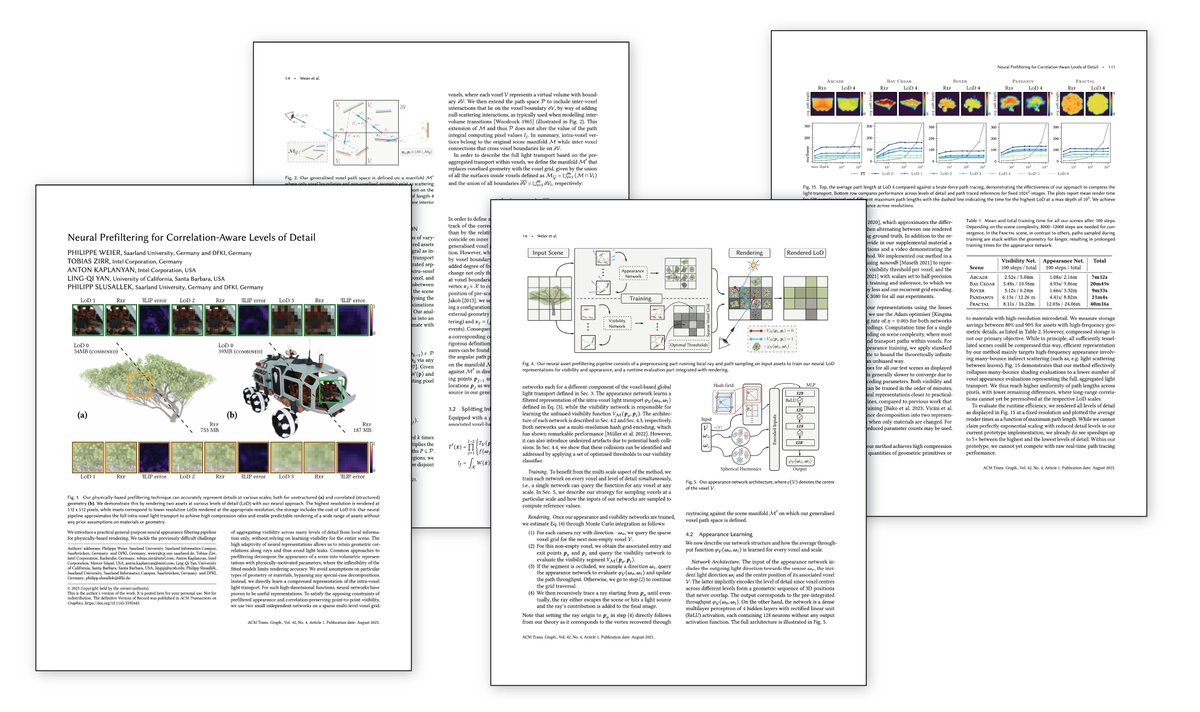
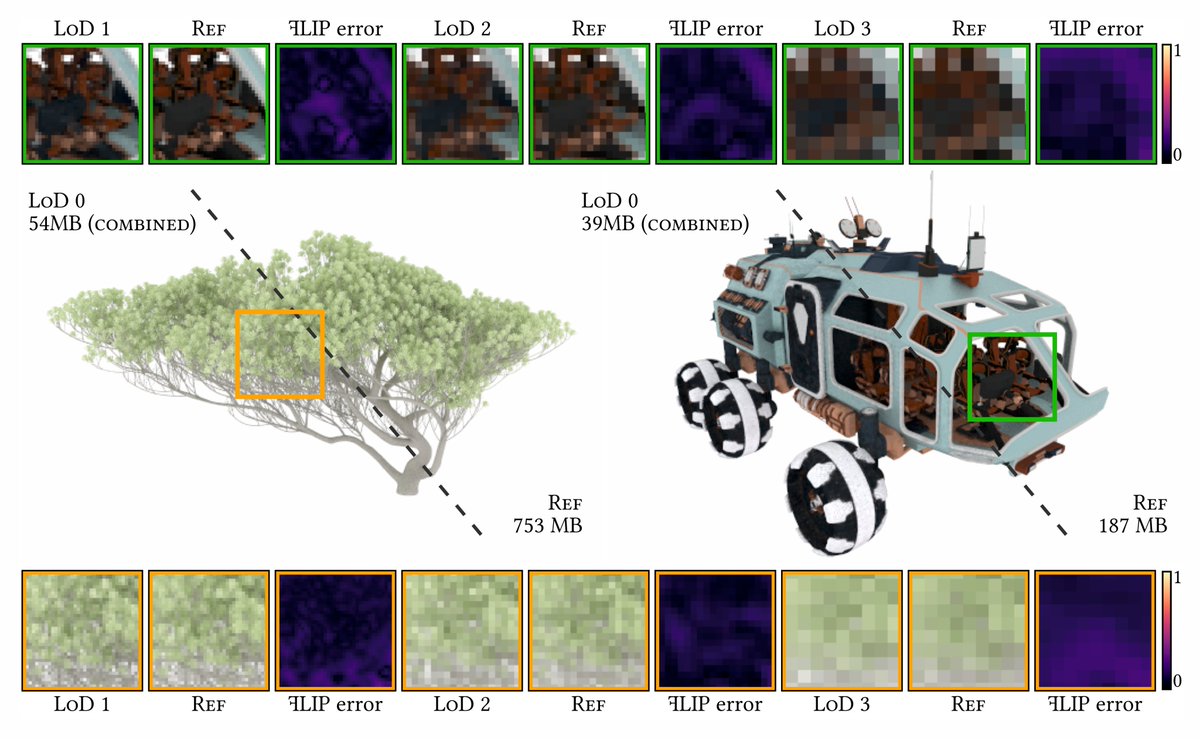
I'm thrilled to share our #SIGGRAPH2023 paper “Neural Prefiltering for Correlation-Aware Levels of Detail” in which we introduce a novel framework for compressed storage of high-detail geometry and appearance. (with @alphanew, @Kaplanyan, @lingqi_yan, and Philipp Slusallek)
With our neural LoD representation, we achieve compression rates of 70–95% compared to classic source representations, while also improving quality over previous work, at interactive to real-time framerates depending on the distance at which the LoD technique is first applied.