My superpower is learning and stubbornness. I want to be the guy who lives by the motto: ‘You’ve made it this far — sheer stubbornness kept you alive.’ 全憑固執
Philip Fisher wrote in Common Stocks and Uncommon Profits that the best companies sometimes deliberately spend heavily on future growth (research, expansion, new business lines) in ways that temporarily crush near-term earnings or cash flow.
He saw this as a feature, not a bug, provided the spending was genuine investment for the future and management had a long-range outlook.
Today’s market is doing the opposite. It is punishing Amazon, Google and Meta for turning free cash flow negative while they spend aggressively on AI infrastructure, even as these companies say this spend is a must and 2027 capex will be higher.
Fisher would have recognized this. The short-term cash burn is the cost of building capacity the companies believe will generate returns for years. The market is focused on the bill, best to focus on the opportunity.
A great chart: ASEAN+3’s role in the global AI supply chain
This chart shows the AI hardware value chain, from foundations to deployment.
🇯🇵 Japan: 52% of lithography chemicals
🇰🇷 Korea: 30% of DRAM & NAND memory chips
🇨🇳 China: 50% of laptop computers, 35% of power and data cable assemblies
🇲🇾 Malaysia: 46% of IC packaging and assembly parts, 36% of semiconductor test equipment
🇸🇬 Singapore: 32% of chip assembly & wafer-handling tools
🇹🇭 Thailand, 🇻🇳 Vietnam, and 🇵🇭 Philippines also hold strong positions in storage, networking, and components.
Data center capacity is expanding in 🇲🇾 Malaysia, 🇹🇭 Thailand, and 🇮🇩 Indonesia.
Source: @amro_asia
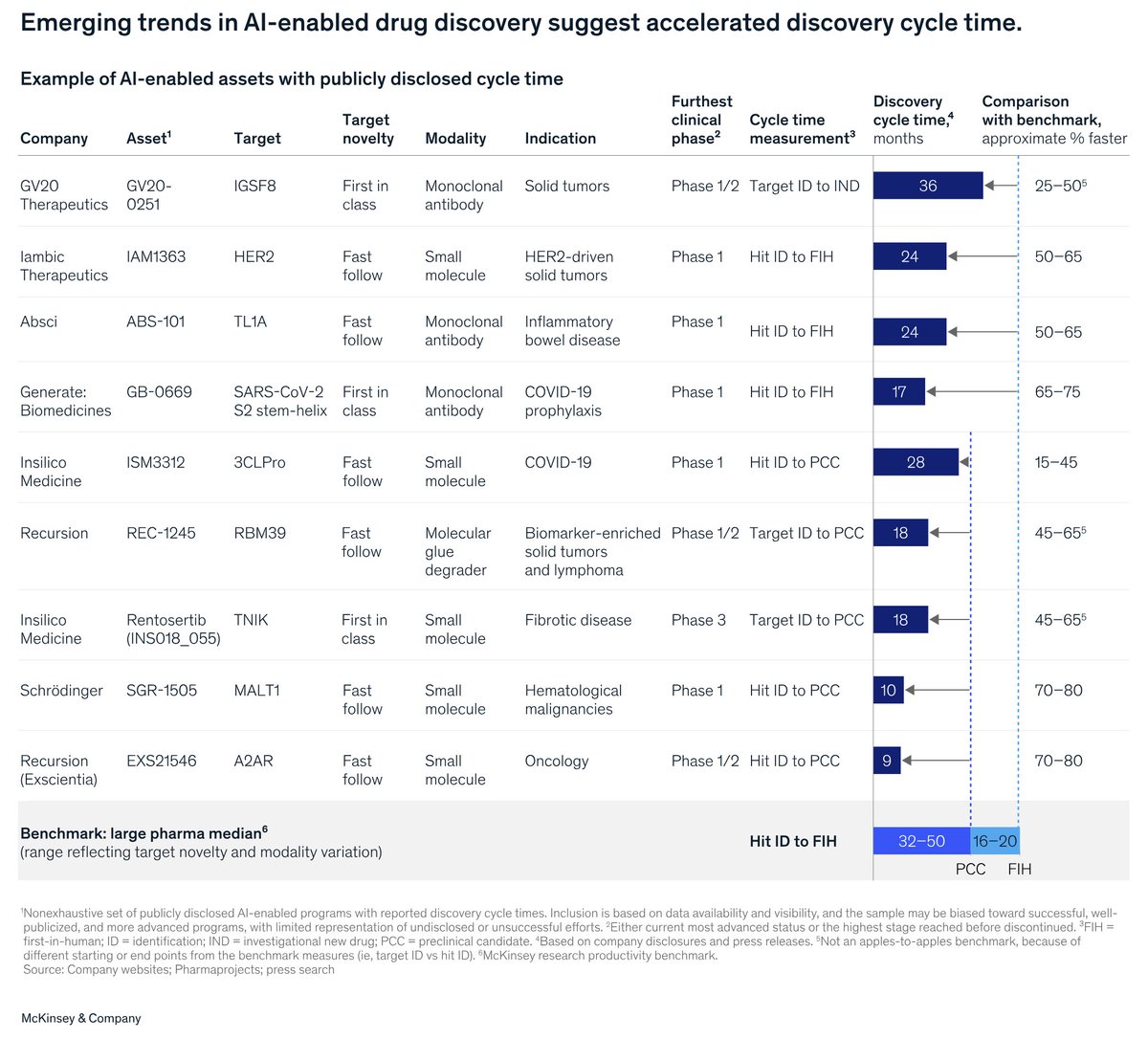
Is AI actually speeding up drug discovery?
According to new McKinsey research, there are early signs that it is: all of these candidates were AI-enabled, with discovery time cut by ~15-80%.
(Incredibly bullish)
Interesting disclosure from Ken Griffin via @CNBC that they have shed 80% of the SALP portfolio.
Super high confidence that this was $45b levered more than 4 to 1 so at least $180b gross. Unwinding that $180b would absolutely have had an impact.
Have felt it in the market.
Most golfers, when they string together a few great rounds, tell themselves they got lucky. They wait for it to end. Rotella's point is that the hot streak is your true ability. The bad rounds are the noise. What you're doing when everything clicks isn't an accident.
I've had stretches in investing where two or three positions ran at once and I caught myself thinking, that was lucky. I don’t think that way anymore. If I did the work. If I formed independent conviction and held through volatility and the thesis played out, that wasn't luck.
A hot streak is the best version of you. It’s God giving you a glimpse of who you actually are when you mentally get out of the way.
https://t.co/YqG9anW5Vy
Ed Thorp beat blackjack. Caught Madoff seventeen years before the SEC. Predicted Buffett would be the richest man in America. Compounded twenty years without a losing quarter. He is 93. Everything he did came from one paper written in 1956. The paper is still free. Almost nobody has read it.
Vegas, 1961.
Thorp is 28. He walks into Claude Shannon's MIT office asking for five minutes. Shannon, famously impossible to see, gives him the five minutes and stays for two years. Together they build the world's first wearable computer to beat roulette. It works. 9:58
The Buffett lunch, 1968.
Thorp reads John Kelly's 1956 sizing paper. Meets Warren Buffett once. Walks away and tells his wife Buffett will one day be the richest in America. Sixty years later, exactly that. Thorp did the math on a person applying compounding to time. Same math as Kelly. 31:20
The one thing Thorp added.
Kelly's paper gives you the mathematical maximum bet. Bet Kelly, optimal growth. Bet more, you die.
Thorp bet half.
Half Kelly gives up a fraction of growth for a huge cut in drawdown. Full Kelly routinely produces 40-60% drawdowns. Half Kelly usually keeps them under 20%. Same edge. A fraction of the pain.
Every serious quant who survives uses half Kelly or less. The ones who don't are the blowup stories.
Princeton Newport, 1969-1988.
Nineteen straight years. 19-20% a year. Not one losing quarter. Kelly's paper, Shannon's math, half Kelly's number, and discipline nobody else could imitate.
Madoff, 1991.
An investor asks Thorp to check Madoff's returns. Days later, he has proof of fraud. He hands the SEC a memo. They file it.
Seventeen years later Madoff collapses. Sixty-five billion in losses. The memo had been on someone's desk since 1991. 48:10
Enough.
Thorp shut down Princeton Newport at its peak in 1988. Still compounding 19% a year. He walked away.
"You can have enough. And it's better than not having enough."
This is the layer nobody sells. Every course, every AI swarm is built to make you want more. Thorp read Kelly, sized his bets, made his money, and stopped. Almost nobody in his field ever has.
Half Kelly on the size. Full self-awareness on when to walk. That is the formula.
2026. Thorp is 93.
He still writes. He still teaches. The math was the easy part, he'll tell you. The signal was never the edge. The sizing was. Half of it. The paper has been in the Bell Labs library since 1956. It's still there. It's still free.
Madoff was the loudest receipt. The stack takes new tuition every quarter.
Morgan Stanley’s message is nuanced. They are not turning bearish on AI. They are arguing that the memory trade is transitioning from its explosive first phase into a more normal phase of the cycle.
The key question investors are debating is whether hyperscalers, particularly the largest AI infrastructure buyers, are beginning to accumulate excess compute capacity. If some AI infrastructure is no longer fully utilized and starts being resold or leased to third parties, pricing power for GPUs and memory could moderate. Morgan Stanley refers to this as “chipflation,” where competition and excess capacity gradually reduce hardware pricing.
Memory remains one of the strongest beneficiaries of AI because HBM and DRAM demand continues to outstrip supply. However, Morgan Stanley notes that several leading indicators are approaching peak momentum. Memory pricing growth is slowing, inventory conditions have normalized considerably, and earnings revisions have already been overwhelmingly positive. Historically, this combination often marks the point where share prices consolidate even though fundamentals remain healthy.
Importantly, they distinguish between a peak in the rate of change and a peak in the cycle. Those are very different. Investors frequently confuse slowing growth with declining growth. Semiconductor stocks often begin correcting once earnings momentum becomes “less good,” even while profits continue reaching record highs.
Another concern is positioning. Memory has become one of the most crowded trades globally, with investors heavily concentrated in names such as Samsung, SK Hynix, and Micron. When positioning becomes this crowded, even minor disappointments during earnings season can trigger sharp pullbacks as investors take profits.
What Morgan Stanley will be watching most closely is not memory companies themselves, but the AI hyperscalers. If companies such as Microsoft, Amazon, Meta, Alphabet, or OpenAI begin signaling slower infrastructure spending, weaker token economics, or more disciplined capital allocation, investors may question how sustainable the current pace of memory demand will remain. The focus is shifting from hardware suppliers toward the spending intentions of the customers.
The long-term thesis, however, remains intact. Morgan Stanley still expects AI-related earnings growth of roughly 35% to 40% in 2027 and continues to view agentic AI as a structural investment theme. Their message is that the AI infrastructure build-out is unlikely to end, but the market may be entering a period where expectations become more realistic and valuation expansion gives way to earnings-driven returns.
In other words, this looks less like the end of the AI memory supercycle and more like the transition from Phase One, characterized by explosive hardware deployment, to Phase Two, where investors become increasingly focused on utilization, monetization, and return on capital.
We broadly share that view. Markets often correct when expectations become overly optimistic, even while fundamentals remain strong. AI infrastructure spending is unlikely to follow a straight line, but the long-term demand for high-performance memory continues to strengthen as model sizes grow and inference workloads expand. We view the current pullback as an opportunity to selectively add exposure to high-quality memory names rather than a reason to abandon the sector. In our view, this is a correction to buy, not the beginning of a structural downturn.
Sergey Brin rarely speaks publicly. He sat down for an unscripted Q&A on Frontier AI.
He admits even the people building these models do not fully understand what they have created:
1. All the specialized AI models are converging into one. Google used to need separate models for different scientific problems. Now the main Gemini models are becoming state-of-the-art for math and other scientific questions at the same time. Brin says he would not have predicted this convergence at the outset, and watching it happen has been incredible.
2. Training an AI on one skill mysteriously improves unrelated skills. This is the concept of transfer. Train a model on coding, and its math reasoning gets better, and vice versa. Teaching it to process images can improve its ability to think through geometric word problems. The capabilities bleed into each other in ways nobody fully engineered.
3. Even Sergey Brin does not know how to prompt these models. He says he is genuinely confused about what level to prompt at. Do you tell it to debug a specific chunk of code, or ask it to write a better neural net training algorithm, or just say, " What should I do today. He admits that even at Google, they do not know exactly where the edges of Gemini's capabilities are.
4. One of the biggest leaps in AI came from the dumbest sounding trick. Chain-of-thought prompting is just telling the model to think step by step before giving your problem. Brin says it seemed like the dumbest thing ever, and there was no obvious reason it should work. But it did, and it spurred a significant increase in AI capability. Some of the most straightforward requests turn out to unlock the most.
5. Brin would not modify his own biology for today's AI. Asked how humans can keep up with the accelerating bandwidth of models, he acknowledged neural links and direct brain connections are being pursued. But he said he would personally wait for the technology to mature a lot before doing anything to change his biology. Today's models do not justify it.
6. Super intelligence does not mean solving the impossible. An audience member argued that true super intelligence would mean solving NP complete problems like the travelling salesman. Brin pushed back. Most computer scientists believe P is not equal to NP, which means no algorithm can reliably solve those problems optimally, and it does not matter how smart the AI is. Impossible stays impossible. Super intelligence just means being smarter than humans.
7. Computers mastering a skill has never stopped humans from pursuing it. Deep Blue beat Kasparov at chess in the 1990s, and people kept playing chess. After AlphaGo, the human game of Go advanced dramatically, and the players who lost to it became vastly better. Brin's point: AI does not retire human ambition in an area; it often pushes the state of the art and pulls people up with it.
8. Brin thinks something close to transformers could get us to AGI. Asked directly if transformers are sufficient, he said his guess is yes, largely because they have proven weirdly flexible, working for image and video far beyond their original text purpose. But he was careful to note they have quietly changed a lot along the way and are not the same architecture as the original transformer paper.
9. AGI means two different things, and one requires understanding the physical world. Brin personally thinks of AGI as AI that can improve itself. But he concedes others define it as AI that can do anything a person can, and he thinks they are probably more correct. To do everything a person can, the AI must understand and interact with the physical world, which is why world models, and robotics, become essential.
10. Inside Google, they now use the AI to build the AI. Brin says the team has shifted a lot of energy toward having the AI do things like monitor training runs and generate its own training data. You start to use the tool to build the tool. That is most of what he spends his time on now, what he calls the self-improvement game.
11. Brin is unusually candid about where Google trails its competitors. He admits Google was a little late to focus deeply on coding. He says Gemini 3.0 and 3.1 were on top across the board six months ago, but other labs have since made strides, particularly in coding. He gives a competitor's model the edge now on deep coding and overnight tasks, while pitching Gemini's flash model as far faster for rapid interactive iteration. hindsight, he says, is that they should have focused on code earlier.
12. He sees his own role as a rabble-rouser, not a manager. Brin is honest that delivering Gemini is Corey and Demis's responsibility, not his. he describes his job as poking and prodding the team, asking, are you really doing that, reminding them of priorities they might be missing and ideas they are not paying enough attention to. He admits this is sometimes a little disruptive.
13. Confidence comes from ignoring the monthly temperature. Brin says if he judged Google's position every month by which competitor just shipped a model, he would lose his confidence very quickly. Instead, he watches the longer arc. Things shift around constantly; one lab leads on one thing, another pulls ahead somewhere else, and he feels good about where Gemini actually is despite the day-to-day noise.
Anthropic engineer James Brady:
"Every agent in production lies. We measured it. The good ones lie less, the great ones catch the lie before the user does."
In 29 minutes, he walks through the verification stack he built and the patterns the Claude Code team adopted to keep agents honest at scale.
Watch the full talk, then save the config below👇
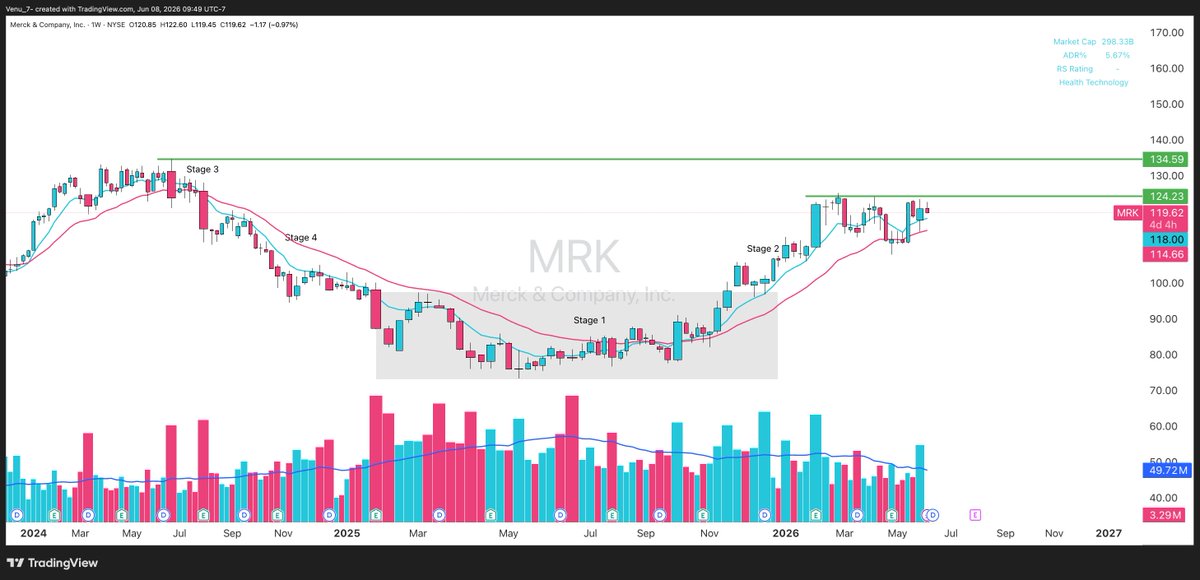
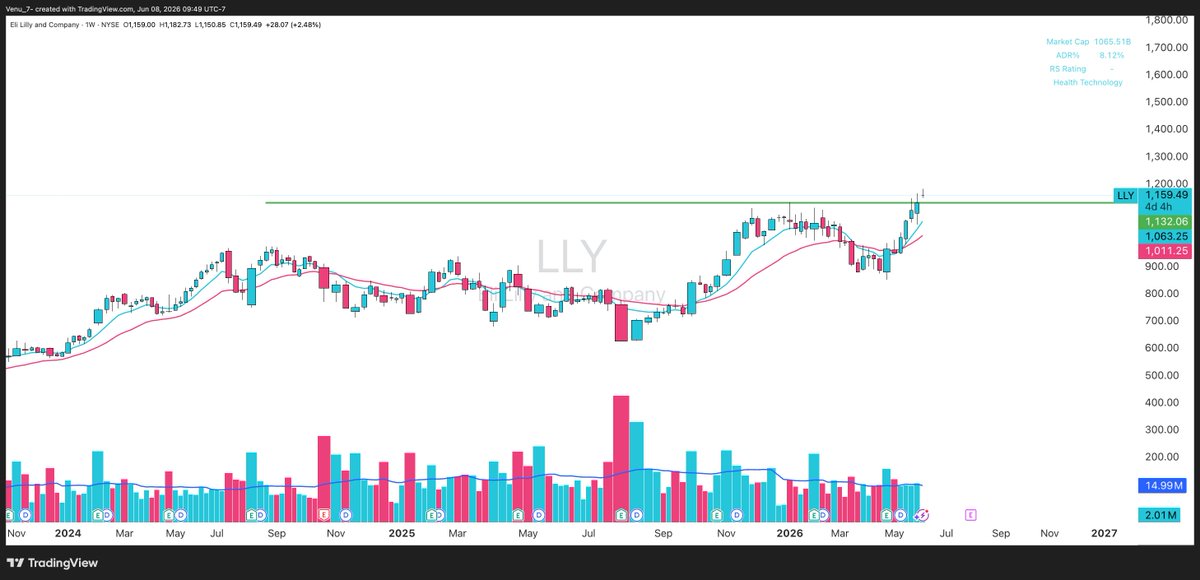
Once the AI theme gets too crowded, you might wonder where to park some cash.
Four legacy healthcare names worth watching:
$LLY - Obesity & diabetes powerhouse
$MRK - Cash-generating pharma giant
$UNH - Healthcare insurance leader
$JNJ - Diversified healthcare titan
Garry Tan (CEO of Y-Combinator): "when someone asks how I 'prompt' my AI, the answer is: I don't. the skills are the prompts."
[if I had this weekend to master skills and how to use them to automate workflows:]
→ read the Skillify 11-item checklist (SKILL.md in gbrain)
→ watch Murag + Barry Zhang: "Don't Build Agents. Build Skills Instead."
→ Read "Designing, Refining, and Maintaining Agent Skills at Perplexity"
→ do one workflow. type /skillify. watch it become permanent. that's the whole day.
here is how to set it up:
1. clone GBrain (his open-source second brain, Postgres-backed memory + 30 skills)
2. add GStack (23 battle-tested slash-command skills, drops right in)
3. do anything once → type /skillify → it's a skill forever
prompting is dead. skillifying is next.
THE LIFE CYCLE OF A BUBBLE
1. A genuine advancement creates real productivity gains. A real technological or economic improvement increases productivity and leads to genuine revenue and earnings growth.
2. Stock prices leak into reported profitability. Rising stock prices improve reported earnings, financing conditions, collateral values, and perceived business performance.
3. Reported profitability drives real investment. Companies increase hiring, capital spending, construction, expansion, and speculative investment because of their own or their customers’ reported profitability.
4. Bubble beliefs and abandonment of present-value discipline. Investors stop focusing on discounted cash flows and begin relying on continuing gains from the greater fool theory, believing they can sell later at a higher price.
5. Inflows from sideline investors. Previously cautious investors enter the market in large numbers. New money from existing and new investors participation drive prices higher.
6. Extreme overvaluation. Prices rise far above historical normal multiples of reported fundamentals, even ignoring the fact that reported fundamentals have been driven by rising stock prices.
7. Issuance. Companies take advantage of high valuations through IPOs, secondary offerings, stock-based acquisitions, SPACs, and insider selling.
8. Exhaustion of inflows. The flow of new investors starts shrinking while existing investors approach their risk and leverage limits. Volatility and dispersion grow and gains become less uniform across stocks.
9. Earnings disappointments from slowing price appreciation. As stock prices stop rising rapidly, the earlier boost from higher valuations into earnings weakens or reverses. Companies begin missing expectations.
10. Stock-price collapse with high volatility. Confidence in both the fundamental growth and in the greater fool theory break down and prices fall sharply. Volatility rises further as leverage unwinds.
11. Bear-market rallies and progressively greater exhaustion. Bargain hunters and frustrated latecomers repeatedly buy the dips, creating violent temporary rallies that fail. Markets make lower highs and lower lows.
12. Capitulation, abandonment, and normalization. Bubble participants eventually give up in disgust or exhaustion. Volatility falls, valuations normalize, and the market returns to more ordinary behavior.