I've been looking into public benchmarks and am astounded by the poor quality vs. how much we rely on them as an industry.
@xeophon pointed me to this excellent site https://t.co/xt5uUSyrcA which is an independent third party which scrutinizes benchmarks and "looks at the data" 💪
For example, here are some popular benchmarks we all rely on. Before trusting a benchmark its worth running them and inspecting examples the grader failed carefully, to get a sense of the quality.
I'm continuing to look more into this, and will write something up eventually once I've collected more data, but I think this is an important subject.
Every single organization on the planet, no matter its size, now needs low latency tokens to create a permanent layer of defense around their infrastructure
Today’s compute demand is minuscule compared to what will be needed
There is an (unpatchable?) supply-chain zero-day in PyTorch autograd that allows a regularization term to use the model's weights as RAM and SGD as its CPU clock to run any computation during training.
How much do you want to bet that closed labs are sponsoring bad actors to use these vulnerabilities to scare the gov into more regulation. Weird how they are all coming out at the same time
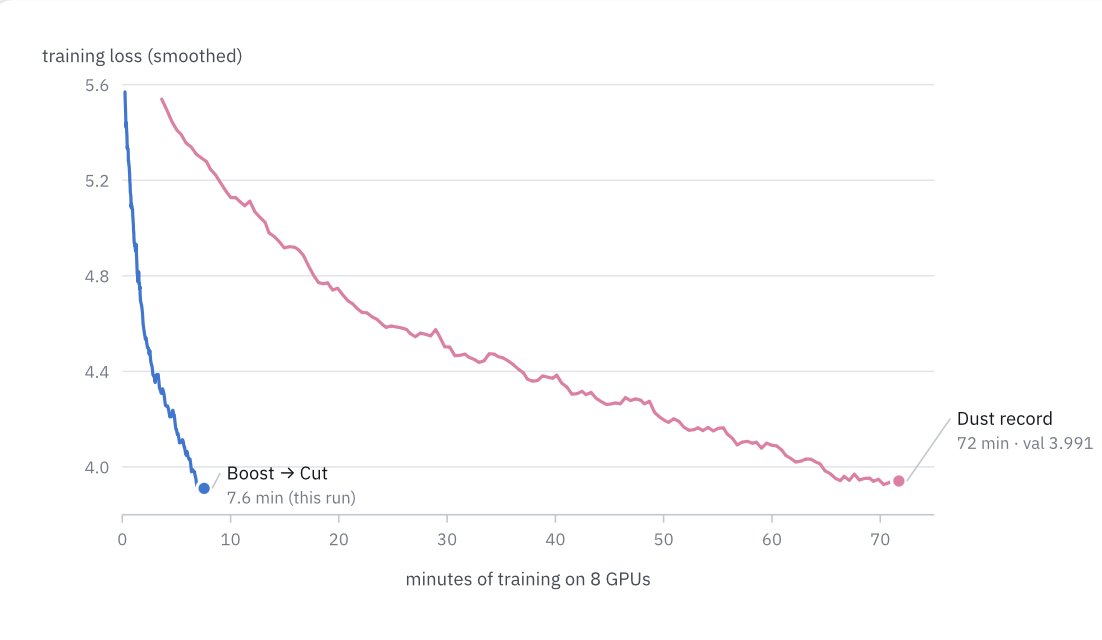
Inspired by Nick Cammarata’s interpretability essay “Neural Networks Are Already Clean”, I turned a couple of its ideas into speedups for pretraining without backpropagation. Still in the works. 2.3x speedup, cool https://t.co/VOEbLacbhq
@p_rabtsevich I made a newish discovery with Claude for Cuneiform tablets, was inspired by you. Hopefully more people see this!
https://t.co/PgpvpKuJGQ
I had Claude help me go through the biggest online catalogue of cuneiform tablets (CDLI). We found 17 clay tablets, about 4,000 years old, listed as "unlocated" that are actually sitting in museums at Yale, Osaka and Toledo👇
A lot of tablets got published more than once: from old hand copies, from dealers, then again after a museum bought them. so the catalogue has some objects twice, once with the location unknown. Claude compared the signs of 97,896 texts and found 4,415 near-identical pairs.
Scribes often wrote the same text on two tablets, so a matching text isn't proof on its own. "unlocated" records have a museum twin 2.8x as often as museum tablets have one elsewhere, so about 2 in 3 of those twins are the same tablet and 1 in 3 are ancient duplicates.
Yale: 8 texts hand-copied by T. G. Pinches match @Yale tablets. Tablets NBC 11569-11581 are a run of 13. One was already known to be a Pinches text. 8 of the other 12 match texts T. G. Pinches copied by hand (MVN 5). The odds of that by chance are about 1 in 500 trillion.
Osaka: 8 texts from the "unlocated" TCICA group match tablets in one run of numbers at the National Museum of Ethnology (NME H94599-H94665), where 5 others were already linked. The odds by chance are about 1 in 10 quadrillion.
Toledo: Amherst 57 and toledo museum of art 1930.197 have the same 58-sign text, the same seal, the same date (Amar-Suen year 1), and both are unopened envelopes. the museum's record doesn't mention Amherst.
There are 11 other candidates I’m having Claude look at but it hasn’t provided enough evidence to completely make a claim on those.