I choose: Aristotle over Plato/ Reason over Mysticism /. Rational Egoism over Altruism / Laissez Faire Capitalism ov Statism/ Individualism over Collectivism!
We can control the outcome of our lives. Positive thoughts yield positive life outcomes… and negative creates negative.
Our thoughts are Incredibly Powerful… We Need to Choose Ours Wisely!
Europe's central banks were not built to protect you, they were built to finance wars.
The Bank of England launched in 1694 with a single purpose: lend William III 1.2 million pounds to fight Louis XIV, and collect interest in perpetuity. Parliament handed a private cartel a monopoly on note issuance. In exchange, the Crown got its war. Depositors got paper promises. The model spread like an infection.
France watched and replicated. John Law established the Banque Générale in 1716, eventually converting it into the Banque Royale, which he used to flood France with paper livres backed by nothing but colonial fantasies about Louisiana. By 1720 the whole scheme collapsed, wiping out French savers across two generations and poisoning French confidence in paper money for over a century.
The lesson Europe drew was not "stop doing this." The lesson was "do it more carefully."
Germany formed the Reichsbank in 1876, Sweden had its Riksbank from 1668 (the world's oldest, and a blueprint every subsequent government copied). Each institution followed the same logic: centralize control, monopolize issuance, and give the state a captive lender when revenue from taxation proves politically inconvenient.
Ludwig von Mises explained that inflation functions as a tax. Every unit of currency created without corresponding production transfers purchasing power from your savings to whoever spends the new money first, which is always the government. That process accelerated dramatically after World War One, when the gold standard's constraints became inconvenient for states that had already promised their citizens more than they could honestly deliver.
The Weimar hyperinflation from 1921 to 1923 is the obvious horror story, but the quieter theft across the rest of Europe through the 1920s and 1930s cost savers just as much over time, simply spread across more years. Gradual expropriation carries less drama and less political resistance.
Every European central bank operating today, including the European Central Bank created in 1998, runs on this same foundational logic: the sovereign needs money, the bank provides it, and you absorb the cost through prices that never quite return to where they were.
Welfare states can't be stopped except by challenging their basic (im)moral principle, altruism (i.e., selflessness and sacrifice for others as the highest moral virtue, value, and achievement). The political "right" also claims to subscribe to the same basic principle, so they cannot effectively fight against welfare states. They don't know how to argue against their own (im)moral philosophy.
If Ayn Rand is right, a collectivist tyranny is inevitable. Which, she adds, inevitably ends in socioeconomic dysfunction and widespread human suffering. Selflessness, it turns out, is actually destructive and deadly.
The politician who could solve many of your problems probably won’t be elected anytime soon, because his campaign pitch would be political suicide: “You’re more capable of solving your own problems than I am. My job is to protect your freedom, get government out of your way, and stop pretending I’m your savior.”
There’s far more political currency in convincing people they’re helpless, identifying someone else to blame, and promising that one more politician with a little more money and power will finally fix everything.
Dependency sells. Self-reliance doesn’t need a campaign manager.
WHAT IS ANTI-CAPITALISM?
"Capitalism is a social system based on the recognition of individual rights, including property rights, in which government’s sole purpose is to preserve and protect those rights, and its only proper functions are national defense, policing, and adjudication (law courts). Functions are confined to those that serve the sole purpose; functions beyond these three necessarily violate rights by compelling some to serve others.
Capitalism is a relatively new and radical social system, originating in the 18th century Enlightenment when the power of reason was most respected, individual rights were first identified, and men began to conceive of (and fight for) constitutionally constrained, representative government, throwing off authoritarianism. Being new, radical, and reasonable, capitalism could not easily withstand or survive the counter-Enlightenment, as spread by the likes of Rousseau, Kant, Fichte, Hegel, and Marx.
Few anti-capitalists would contest my definition of capitalism: that it’s a social system – that it institutionalizes rights (especially private property rights) – that it uniquely depends upon and embodies egoism, individualism, the profit motive, and the pursuit of happiness. What critics detest is any portrayal or defense of capitalism as good – as either a productive or moral social system." — @richardsalsman3
The political ideological spectrum is not right vs. left, but statism/collectivism vs. individualism.
Socialism, Communism, and Fascism are all forms of statism/collectivism.
This is what the empty right vs. left spectrum is meant to hide.
Only individualism results in Capitalism: the social system of freedom, based on the recognition of individual rights.
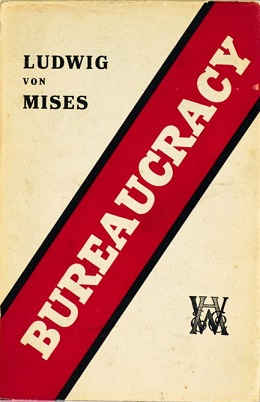
Ludwig von Mises wrote Bureaucracy in 1944, while living as a refugee in New York after fleeing Nazi Austria. He had watched the Austrian state expand relentlessly through the 1920s and 1930s, and he understood exactly where that expansion led. The book arrived during a period when Western governments were consolidating wartime control and showing little appetite to release it.
Mises draws a clean line between profit management and bureaucratic management. A private firm lives or dies by whether its revenue covers its costs. A government bureau has no such constraint. Nobody fires the Department of Motor Vehicles for making you wait two hours. Bureaus survive through political appropriation, not customer satisfaction, so they optimize for political survival instead of delivering value to you.
An insurmountable problem is built into the incentive structure of every bureau by design. Without profit-and-loss signals, managers cannot calculate whether they are creating or destroying value. Instead, they respond to procedural compliance, headcount growth, and budget preservation. Mises identified this as the logical outcome of removing the price system from resource allocation.
The book's central lesson is that you cannot transplant bureaucratic methods into commercial enterprise without destroying it. Every regulation imposed on private business forces it to operate partly by bureaucratic logic rather than market logic. Enough regulations, and the business sector becomes an extension of the state apparatus, answerable to officials rather than consumers.
The book's legacy is immense and largely unacknowledged. Public choice economists like James Buchanan built entire research programs on closely related insights, publishing formal models of bureaucratic self-interest starting in the 1960s. "Bureaucracy" gave that tradition its moral backbone. Mises indicted an entire intellectual class that kept demanding more of it.
The Masterpiece.
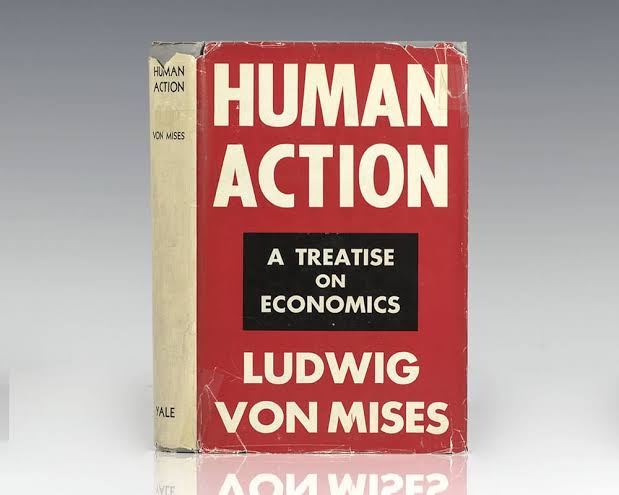
Ludwig von Mises published Human Action in 1949, twenty years after fleeing the socialist catastrophe consuming Europe. He wrote it first in German in 1940, finishing the manuscript while escaping Nazi-occupied Austria. By 1949, Keynesian economists controlled every major university and government treasury in the Western world. Mises had no institutional support, no tenured chair in America, and no government grants.
The book's core argument destroys the pretense of central planning at its foundation. All economic value is subjective, meaning prices emerge from individual human choices, not from labor inputs or government decrees. Central planners cannot replicate the price system because prices require private property and voluntary exchange to generate real information. Strip those away and planners fly blind, misallocating capital on a massive scale. Mises called this the socialist calculation problem, and no Keynesian has ever answered it satisfactorily.
The interventionist state corrupts economic coordination through every price control, subsidy, and money-printing scheme. These tools distort the signal system that coordinates millions of independent decisions. You pay for this directly: inflation confiscates your savings, price ceilings create shortages, and subsidies redirect capital away from your actual needs toward politically connected industries.
Mises built his method on praxeology, the formal study of human action under scarcity. Economics derives from the logic of choice, not from statistical regression. This gave free market thinkers a bedrock that empiricist critics cannot simply vote away.
Human Action still cuts deep because the Federal Reserve has printed over $9 trillion since 2008 and the consequences Mises predicted, asset bubbles, mal-investment, and monetary chaos, arrived exactly on schedule. The book does not age because human nature does not change.
@FreeTalkLive CALVIN COOLIDGE: GOAT?
"Under Coolidge, the top income tax rate of 65% was cut to 20%. The stock market began its unprecedented “Roaring 20s” climb as it became clear through 1924 that Coolidge’s tax reduction bill would pass." @CapitalismMag
https://t.co/ErZeWgz9hA
Ludwig von Mises published Socialism: An Economic and Sociological Analysis in German in 1922, one year before hyperinflation destroyed the German mark and reduced Weimar Republic savings to ash. He was not theorizing in a vacuum. Soviet central planning had just launched, socialist parties controlled legislatures across Europe, and most intellectuals treated collective ownership as inevitable progress.
Mises built the book around one lethal argument: socialism cannot calculate. Without private property in the means of production, there are no real prices for capital goods. Without real prices, planners have no rational way to allocate resources. They guess, they waste, they destroy. This is a mathematical problem, not a political preference. Billions of production decisions require price signals generated by genuine market exchange, and a planning committee in Moscow or Vienna cannot manufacture those signals by decree.
The problem is the planning apparatus itself: the bureaucrat has coercive power over resources he cannot possibly value correctly. Mises walked through labor, capital allocation, the family, and democratic politics, showing how socialist logic corrodes each institution.
Economists like Oskar Lange pushed back in the 1930s, claiming market socialism could simulate prices. That project failed in every country that tried it. The Soviet Union collapsed in 1991 after seven decades of misallocation. Venezuela, the wealthiest country in South America at the time, nationalized its oil sector in the 2000s, and they started eating zoo animals soon after.
The book's legacy is underappreciated: it handed free market thinkers a complete refutation of socialism before the Soviet experiment had even fully launched, decades before the evidence arrived in the form of mass starvation and gulags.
Most people who defend central planning have never read Mises. That ignorance costs you because the policy consequences hit your paycheck, your savings, and your options.
@Reazonuk@TLRationalist The basic issue in the world today is between two principles: Individualism and Collectivism.
-Ayn Rand
("Textbook of Americanism," pamphlet, 1946)
Context, always.
Cost/benefit analysis is important in making any decision. One can do this and still maintain one’s principles while keeping one’s conscience clear.
“There is, however, one moral aspect of the issue that needs clarification. Some young men seem to labor under the misapprehension that since the draft is a violation of their rights, compliance with the draft law would constitute a moral sanction of that violation. This is a serious error. A forced compliance is not a sanction. All of us are forced to comply with many laws that violate our rights, but so long as we advocate the repeal of such laws, our compliance does not constitute a sanction. Unjust laws have to be fought ideologically; they cannot be fought or corrected by means of mere disobedience and futile martyrdom. To quote from an editorial on this subject in the April 1967 issue of Persuasion: ‘One does not stop the juggernaut by throwing oneself in front of it….’”
Ayn Rand, “The Wreckage of the Consensus”
Sweden's socialist experiment nearly killed one of the most productive economies in the world. The Swedes fixed it by reversing course: something the left refuses to do.
By 1993, Sweden's GDP had contracted three years straight. Unemployment hit 12 percent. The welfare state built after World War II had pushed marginal income tax rates above 80 percent, crowded out private investment, and handed bureaucrats control over capital allocation. The state owned or regulated everything that mattered.
Then Sweden cut. Drastically.
Between 1991 and 1994, the center-right Bildt government privatized state enterprises, deregulated financial markets, opened Sweden to foreign competition, and slashed the top marginal tax rate from 87 percent down to 50 percent. The central bank gained independence from politicians in 1999. Corporate tax fell to 28 percent by 1994.
Capital responded immediately. Investment returned. Productivity climbed. By the late 1990s Sweden posted some of the strongest growth in the OECD.
The villain in this story is the Swedish Social Democrats, who spent four decades proving that governments cannot efficiently allocate capital, suppress price signals without distorting behavior, or tax production at confiscatory rates without destroying it. They tried anyway and ended with a collapsing economy by 1991.
The recovery came from property rights, competition, and price signals directing resources toward their most productive uses. Sweden stopped fighting the market, and the market rewarded every Swede who survived the wreckage.
The freest economy in American history produced the greatest explosion of living standards the world had ever witnessed, and the people who benefited most were the poor.
Between 1870 and 1900, real GDP per capita roughly doubled. Steel output went from 77,000 tons in 1870 to over 11 million tons by 1900. Kerosene dropped so cheap that even working-class families could light their homes at night. Carnegie drove down steel prices while paying wages that rose faster than inflation. The market did that. No regulator in Washington achieved this.
Federal spending in 1870 sat at roughly 3.7% of GDP. Congress had no income tax until 1913. The regulatory state was microscopic. Capital formation exploded precisely because entrepreneurs kept what they built.
But there is a villian here: the progressive revision of this history. Academics frame the Gilded Age as a catastrophe of exploitation, demanding the state as savior. The numbers destroy that story. Real wages for unskilled labor rose 50% between 1860 and 1890. Infant mortality fell. Life expectancy climbed.
What about technology? Could some important things have been invented during that time? Only AC power, the lightbulb, the telephone, the camera, the automobile, the airplane... nothing really important.
Property rights worked. Contract enforcement worked. Sound money, anchored to gold, kept capital allocation honest and prevented governments from inflating savings into dust.
The progressives arrived after 1900 and systematically dismantled each pillar: the income tax in 1913, the Federal Reserve in 1913, regulatory agencies multiplying through the 1920s. Growth slowed. Then the Fed contracted the money supply and Congress passed Smoot-Hawley, and you got 1929. The state caused that collapse and later blamed it on the free market.
"While there is a real threat of people accidentally misusing AI assistance to do a lot of damage, that threat is always going to be limited by the humans who ultimately direct AI computers and can literally unplug them."
"We already have laws against configuring and connecting computers in ways that lead to felonies. AI companies should develop technologies and practices so their AI agents follow those laws, not ask the government to dictatorially limit AI progress as such." - @AlexEpstein
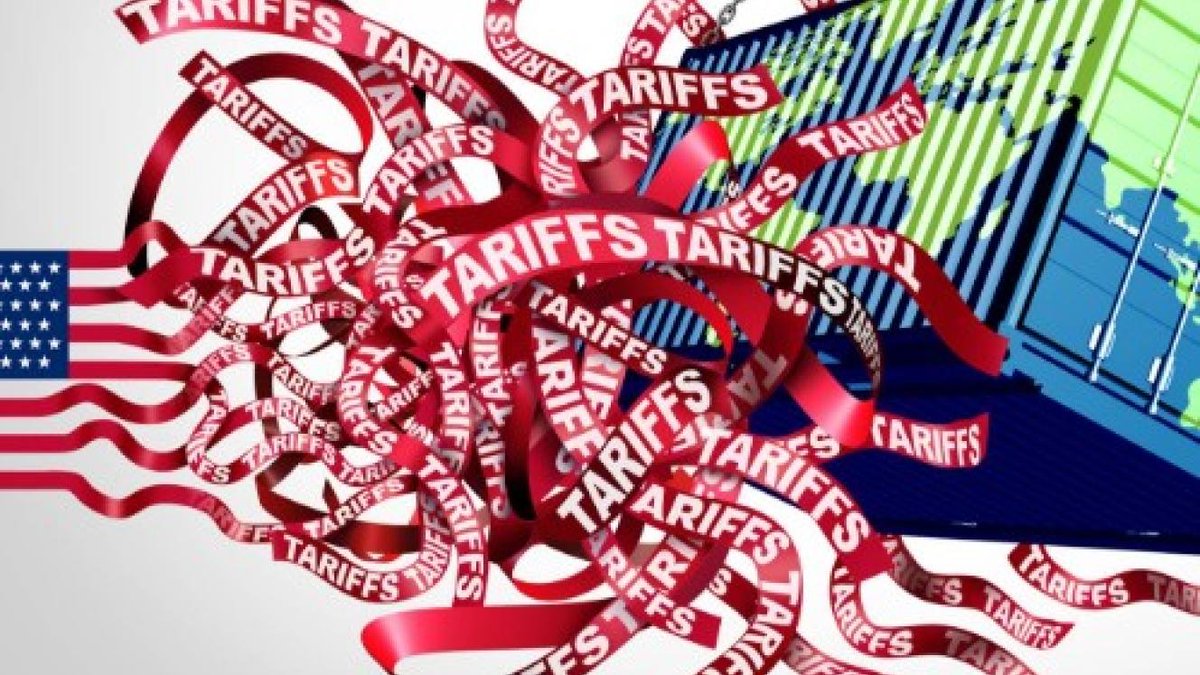
Every tariff puts a visible winner on TV and buries the losers where no camera follows.
When Trump slapped 25% tariffs on Canadian steel in 2025, American steel producers cheered. Politicians pointed to those mills. Journalists photographed those workers. Nobody photographed the automakers in Michigan paying higher input costs, or the consumers absorbing those costs in vehicle prices averaging $1,200 more per unit according to Anderson Economic Group.
Frédéric Bastiat laid this out in 1850. The seen is the protected industry. The unseen is every downstream producer who now operates with a cost disadvantage, every consumer who buys less, every dollar of capital that flows into a politically protected sector instead of somewhere it would have gone voluntarily.
A tariff redirects production, at gunpoint, away from efficient allocation toward politically favored allocation. The steel worker keeps his job. The appliance manufacturer cuts ten jobs you never hear about. The net result is destruction of real wealth.
Governments run this scam because the winners are concentrated and loud, and the losers are diffused and silent. You don't know which products you didn't buy because tariffs quietly raised their prices out of your range. That invisibility is the entire political mechanism.
Politicians manufacture a crisis, protect an industry, and collect the credit. You pay the bill through higher prices, and you never even see the invoice.
The time to decentralize is upon us!
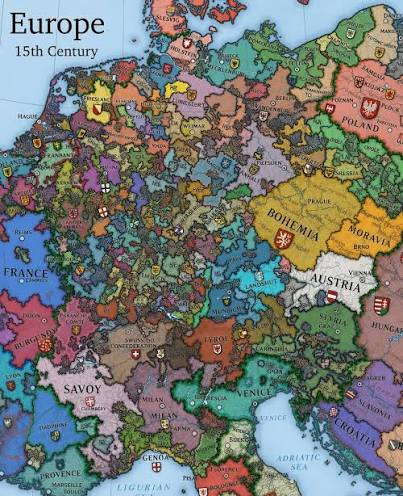
Decentralization is the only political structure that actually disciplines government, and Switzerland's canton system proves it with 700 years of evidence.
Twenty-six cantons compete for residents and businesses. Appenzell Innerrhoden runs differently from Zurich, which runs differently from Geneva. When Basel raises taxes past the tolerance of its engineers and entrepreneurs, those people move to Zug, which has kept its corporate tax rate under 12%. Basel loses the revenue. The lesson writes itself.
Centralization is the villain. Every time a federal authority absorbs a decision that cantons once made, you lose the price signal. You lose the experiment. You lose the exit option. Brussels crushes this mechanism across the EU, which is why French farmers and German industrialists both scream at the same unresponsive bureaucracy with nowhere to go.
Competition between governments constrains Leviathan the way competition between businesses constrains monopoly pricing. Strip away that competition and governments do exactly what monopolists always do: extract maximum value from captive subjects while delivering minimum service.
The canton system works because it keeps power close to the people funding it and gives those people somewhere else to go.
Take power and responsibility out of the hands of bureaucrats thousands of kilometers away. Localize it to within manageable sections, and watch your area flourish.