Unlock your reading and spelling potential, learn more about the Science of Reading.
https://t.co/CZ3AwFVYgn
Gain years of progress in just 10 hours with our free video lessons. Phonics to the 12th grade level.
https://t.co/AE87sIK69U
What fascinates me most about ancient Roman engineering is how something built centuries ago can still leave us amazed today. Looking at this underground water channel, I can’t help wondering about the people who designed and constructed it without modern machinery, computers, or advanced surveying tools.
The Romans understood something fundamental about engineering: water could be moved efficiently by using gravity, carefully planned gradients, and durable construction. Their aqueduct systems supplied cities, baths, fountains, and households, becoming an essential part of urban life.
What I find most impressive is the practical thinking behind such structures. This wasn’t architecture created merely to impress the eye; it served a real purpose and reflected a deep understanding of materials and water management.
Ancient engineering reminds us that progress isn’t always about having the newest technology. Sometimes, it’s about understanding the basics so well that your work continues to inspire people nearly two millennia later.
When I listen to Sold A Story (just finished episode 4), my blood boils. We’ve known how to effectively teach students (of all backgrounds) for a long time. Because certain people didn’t like the method or those who promoted they disparaged and dismissed it. Infuriating!
Why does the education establishment refuse to learn from schools that succeed?
Wesley Elementary produced high-performing students for 20 years. Not one exceptional teacher or one exceptional class. An entire school, year after year.
Imagine what education could have been if we had learned from what worked.
How many generations of children missed out?
Another must-listen episode of Sold a Story.
Giving novices problems they lack the knowledge to solve makes little sense. Ausubel said this in 1968 and it still holds true.
"If I have to reduce all educational psychology to just one principle, I would say this: the most important single factor influencing learning is what the learner already knows. Ascertain this and teach [the learner] accordingly."
-David Ausubel
@HannahWardEdu McGuffey includes some tales from Aesop, simplified or extended to meet the grade level of the reader they are in. (Which are higher than current norms after the First Reader, older norms are where they should be if reading is well taught.)
@TeddyRookBook Syllabic Phonics in different languages including Latin:
https://t.co/NXInYZqQNR
Quotes from the Slave Narratives about how reading was taught:
https://t.co/MnqYoM4K7g
I have a one page (2 page, but pick 1, original McGuffey or new organization) document with all the diacritical markings used in the McGuffey readers. I use them to build up reading skill and vocabulary with my remedial students.
I used them with my children to homeschool as well.
Feel free to use/include/copy, whatever you need with it:
https://t.co/CAMkRXserF
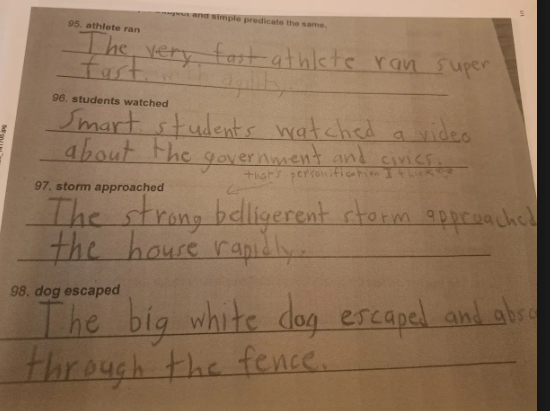
Writing involves a multitude of things. One area I like to focus on with my 5th graders is improving sentence composition. I like to use sentence expansion, sentence combining, and sentence imitation activities for practice. This helps students focus on just the sentence and it gives students opportunities to retrieve previously learned vocabulary words. Examples provided below. The use of fast is redundant in the first sentence. This student spelled government correctly in the second sentence. Many students forget the letter n as they aren't thinking of govern + ment. He retrieved the term personification and used it brilliantly in the third sentence adding in the word belligerent we learned earlier this year. He used the word absconded correctly as well in the fourth sentence. I believe this is 5-minutes of worthwhile practice.
The redoubtable Reid Lyon posted a long, thoughtful comment on my Substack praising Linda Diamond's essay and the work of @ehanford. Worth your time.
https://t.co/9M693brdHx
Hanford "has established what I consider a gold standard for education journalism....No other journalist I have spoken with has devoted as much time to understanding the science of reading development, reading difficulties, and reading instruction."
@larissaphillip@smarterparrot That is most of my students.
I have free lessons for those with that level of problem, focuses on multi syllable words and nonsense words to undo guessing habits. Video makes it easy for a tutor or parent to use them.
Ends at 8 syllable words.
https://t.co/0dRUoJWB67
They need to read their own report.
A French study found that as few as 10 sight words in initial phonics instruction made results worse,
because guessing and memorizing compete with sounding out, less than 5% of French schools teaching this way.
Deauvieau, Jérôme, and Paul Gioia, “L’efficacité des méthodes d’enseignement de la lecture : les apports de l’enquête Formalect” (The Effectiveness of Reading Teaching Methods: Findings from the Formalect Survey), Note du CSEN no. 11, Conseil scientifique de l’Éducation nationale (French Ministry of Education’s Scientific Council), June 2024. [Note: The study matched the teaching methods of 9,340 French first-grade teachers to national test scores for about 139,000 of their students. The authors’ full report, “L’efficacité des méthodes d’enseignement de la lecture. Une enquête sur le cas français,” Centre Maurice Halbwachs, Études et documents no. 45, April 2024, breaks the results out by textbook type. Even classes that used fully decodable books but added about 10 memorized words did worse than classes taught strictly with phonics.]
https://t.co/dRakEojymA
Somehow we've reached a point in education where:
- teaching kids explicitly is controversial
- academic rigour is treated as a threat to student wellbeing
- memorizing math facts is discouraged or considered unnecessary
- practice is dismissed as "drill and kill"
Low expectations are not kindness, and nothing hurts someone's confidence more than falling further behind every year.