Meet Planctoteuthis sp. 🦑
“Images have finally enabled the description of this tail, but no one knows what it is used for. It looks like a siphonophore from a distance, and one hypothesis is that it could be used for siphonophore mimicry.” — #SamplingGap Co-chief Sci Dr. Perez
I just released ReShiki v0.6.1, a free, open-source alternative to ChemDraw.
Chemical drawing, reinvented.
Built in Rust for macOS, Windows, and Linux. Draw molecules, build reaction schemes, and export figures.
Try it: https://t.co/CrYQ1alzHT
Biologists use specialized open-source models for tasks like modeling the structure of molecular systems, designing drug-like molecules, and predicting the effects of genetic mutations. But these models are often expensive to run, potentially limiting their impact.
In our latest Science Blog, we share how Claude was able to optimize inference for more than 30 open-source models, making them 4x faster on average, partly by writing custom software for GPUs. We’re open sourcing all of the optimization code.
Read more: https://t.co/qiuN1jpgpA
New in @CellCellPress from Biohub Investigator @BoHuangLab: AI-designed proteins built from scratch (dubbed "Rhobins") work in living cells and match or even surpass fluorescent tags refined over decades of natural protein engineering.
Read the paper: https://t.co/yUziVyORa5
Backward-swimming Bathyopsurus — a rare deep-sea isopod that lives between 4,000 and 11,000 m. They use two pairs of enlarged, paddle-like legs to swim; scientists have observed the animal moving backward and even upside down. #DeepWonders, Trinidad & Tobago, 3,923 m
Out at @nature just now!
https://t.co/6E9s9rCPz8
We present #RIED, a new paradigm for excitation-free super-resolution microscopy.
We establish chemical super-resolution microscopy using electrochemiluminescence (ECL), chemiluminescence (CL), and bioluminescence (BL).
(1/n)
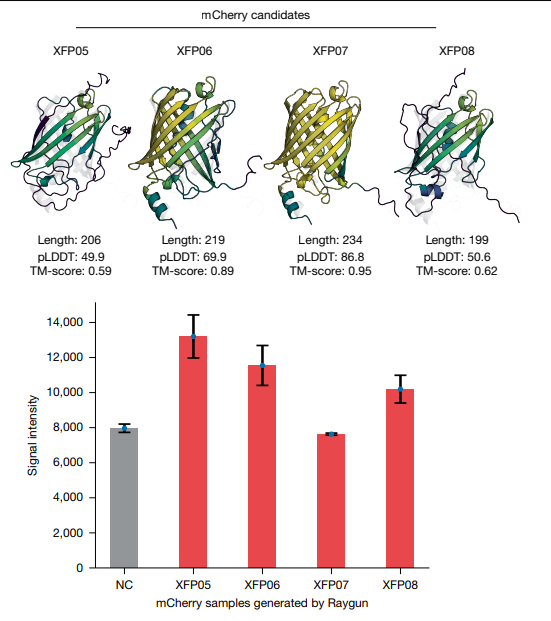
What you are looking at here are mini-mCherry proteins, all designed using Raygun (just published in Nature).
The whole concept in this new AI algorithm is to redesign proteins so that they are shorter.
Having smaller proteins is a fascinating thesis. From a functional standpoint, one can imagine how smaller proteins may penetrate solid or fixed tissues easier. From a production standpoint, smaller proteins may be more sturdy, easier to produce and purify.
In fact, we recently ran a miniaturization campaign for a client on a beauty enzyme for similar reasons. Definitely an exciting space to be in!
First molecular characterization of a luciferase from a deep-sea coral.
Our new paper reports AnmLuc, the light-producing enzyme of the sea pen Anthoptilum murrayi, collected ~1100 m down off Brazil. Add its substrate and the enzyme emits blue light. First-authored by my PhD student Gabriela Galeazzo.
Full paper in the replies.
Today in @Nature we report how AI-guided redesign enhances protein evolution. Integrating ProteinMPNN sequence design with autonomous laboratory evolution, we establish a workflow to engineer enzymes with improved properties over those evolved from natural proteins. Redesigned starting points consistently evolve an expanded fitness landscape, reaching new function with higher activity, specificity, and stability than their natural counterparts.
https://t.co/pNlw6z1zvU
1/14
For biologists who haven't tried it yet, I actually have found Claude Science to be very helpful for figure making. I provided some PDBs and chem strings, with direction on how I want things assembled and what view is helpful for paper I'm writing with @mu_anand , and it did a really good job of following instructions! Even pointed out a mistake I made folding a structure with ESMFold2. Some ways to go and I do wish Fable was OK for biologists, but this was surprisingly nice to use.
First molecular characterization of a luciferase from a deep-sea coral.
Our new paper reports AnmLuc, the light-producing enzyme of the sea pen Anthoptilum murrayi, collected ~1100 m down off Brazil. Add its substrate and the enzyme emits blue light. First-authored by my PhD student Gabriela Galeazzo.
Full paper in the replies.
Introducing Claude Science, a new app designed with every stage of research in mind.
Artifacts traced to their code, environments managed on demand, and 60+ optional scientific databases that you can connect.
Available now in beta.
There is a beautifully illustrated book, first published in 1887 (!), called "Living Lights."
It's a book about animals and plants that bioluminesce, or emit light, such as fireflies, jellyfish and even vegetables. It was published nearly 100 years before the luciferase gene was first cloned, and about 75 years before GFP was identified and isolated.
The chapter on vegetables is particularly interesting: "In nearly all countries these vegetable lamps are found; and even in the old legends of the Greeks, Hindus, and Persians, references to the 'burning bush,' and other luminous phenomena are met..."
Folklore then turns to more direct observations: "In South America and Asia occurs a plant known to science as Euphorbia phosphorea; which emits, when severed or cut, a milky juice somewhat resembling that of the dandelion. At night the juice of the former is, when heated, brilliant phosphorescent...if the stem be broken and used as a pen, this latex may be employed as a luminous ink..."
Fascinating throughout. The book also contains many ideas which have since been discredited, especially around luminous birds and cattle! It also doesn't mention Aequorea victoria, the jellyfish from which GFP was first isolated; the book mostly covers luminescent animals in the Atlantic ocean, Mediterranean, and Caribbean (Aequorea was found in the Pacific Northwest.)
The book also mentions many names that have fallen out of modern nomenclature. The author describes "Phosphorax noctilucus," a type of slug from Tenerife that I can't find anywhere online. The closest species name I can find is Pyrophorus noctilucus, or the "fire beetle," which is one of the brightest bioluminescent insects in the world (but is not a slug!) It emits light that is apparently bright enough to read a book with.