IMO Jelani is correct. Investors (correctly) care about the bottom line and not mathematical theorems.
I’d add another reason to release results is that by default transparency is good and “information wants to be free”. Sharing results both teaches us about what is true in mathematics (for example the matrix multiplication exponent) and what are the capabilities of AI systems (which we should care about for many reasons).
The IAS seal is “Truth and Beauty” influenced by Keats’ words:
“Beauty is truth, truth beauty,”—that is all Ye know on earth, and all ye need to know.
The idea that mathematicians or scientists would prefer to live in ignorance and not know truths is anathema to this maxim.
@evenscreech in fact:
I assume there is a P != NP proof discoverable with current internal frontier models, this is either proven by proving that prime factorization is NP-intermediate, or it uses the machinery from the P != NP proof to prove prime factorization is NP-intermediate
I still don’t quite buy the analogies with space exploration and biotech, but I agree with the “shut up and compute” part. I think we spend too much time debating what AI will mean for the field. We’ll find out as we go. In the meantime, it’s pretty fun to watch.
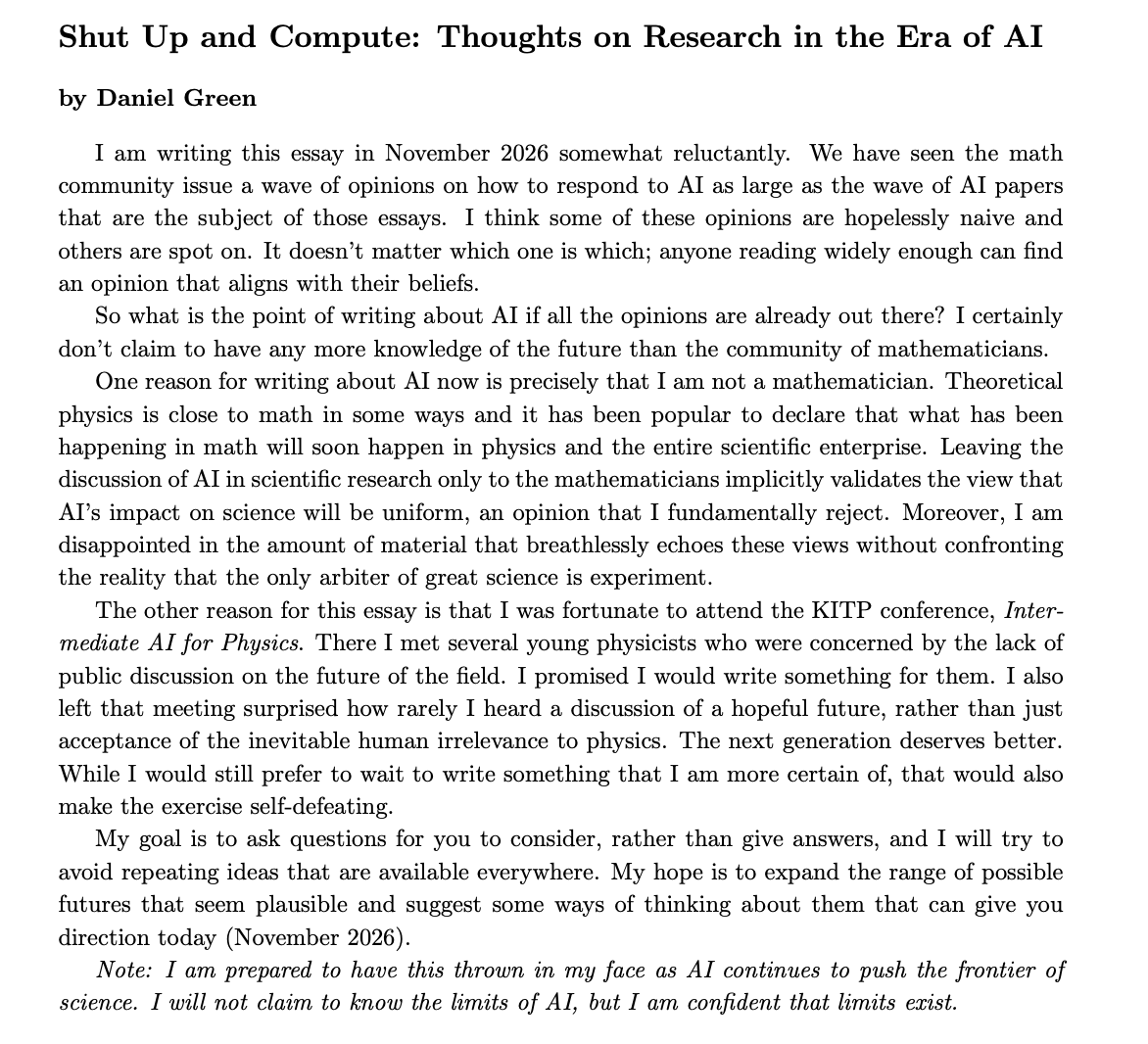
When I was at the KITP last month, some young physicists asked me to write some thoughts/advice on physics in the era of AI. Here is the result:
https://t.co/iC40w5Cwhj
I am prepared to have this thrown in my face, but I am willing to risk it if it helps the next generation now
This has me quite mad. Anthropic announces a proof of a big problem, OpenAI responds by releasing their proof dated Nov 6th.
Just openly admitting -- bragging -- "we have it too, we have a bunch of cool math we're not going to share unless we have to for our stock price".