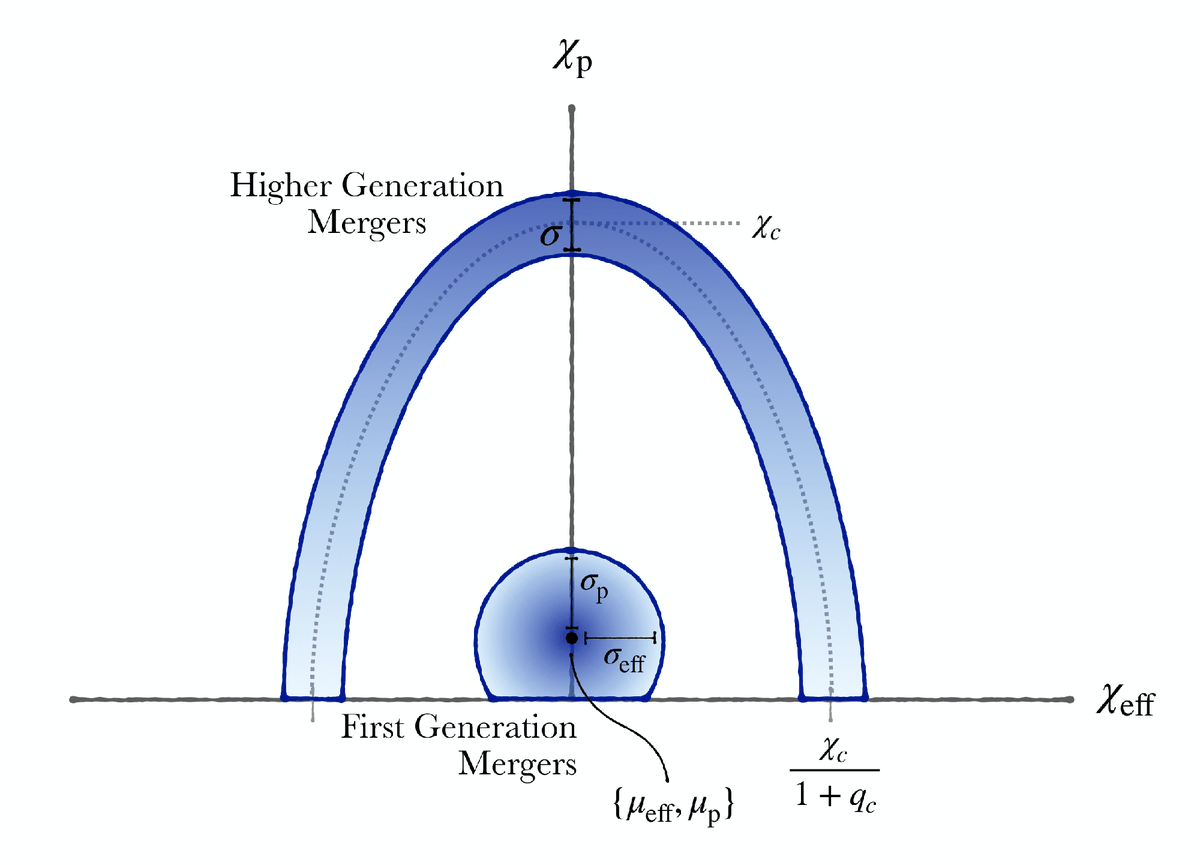
A new study in @PhysRevLett suggests many #BlackHoles above 45 solar masses grew through a series of collisions between other black holes in dense star clusters — helping explain why some black holes are larger than stellar evolution models predict.
🔗 https://t.co/Cbhc0VX9Gk
Apollo HD - Upscaled 16mm Apollo footage to music (Extended March 2026 Version)
As #ArtemisII goes behind the Moon, heres a look back to the glorious Apollo missions in newly upscaled HD quality.
This short film is a compilation of stunning Apollo film footage upscaled using modern techniques set to a beautiful music score.
The film is a compilation of several missions from the unmanned Apollo 4 test flight thru to the incredibly successful Apollo 17 which saw the last men on the moon
Made by Mike Constantine of Moonpans using footage from the NASA Johnson Space Center and The Apollo Flight Journal.
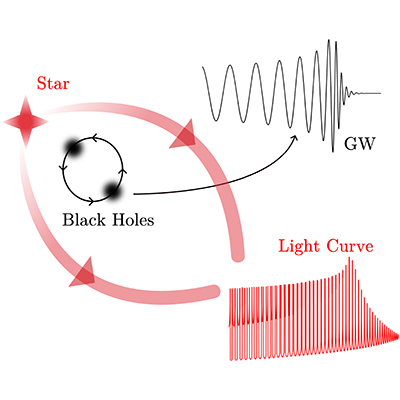
The quasiperiodic lensing of starlight by a supermassive black hole binary system can leave imprints on the light curve of the host galaxy, which can help discover and characterize such binaries. #astrophysics https://t.co/6VCB3u1BZ1 #OpenAccess
Every December since 2017, I've delivered a keynote at Q2B Silicon Valley, commenting on recent progress in quantum computing. Here is what I said this time. It's been a good year for quantum.
https://t.co/NcZqWV0dDV
On the cover of our latest issue: A new proposal shows how entangling neutral-atom quantum processors across distances could open the door to probing quantum dynamics on scales where spacetime’s curvature comes into play.
Read more: https://t.co/OfPcVvdcAt
NASA satellites and computers have provided us with these mesmerizing swirls that cover our planet—but this isn’t star stuff. Each color represents a different aerosol that was floating in the atmosphere above our heads from 1 August to 14 September 2024.
Depicting aerosols in this way helps us understand how far-flung corners of the globe are connected via our shared atmosphere.
Learn more in #ScienceAdviser—our free daily newsletter: https://t.co/puT6UHzhbQ
A black hole unlike any seen before has been spotted in the early universe. The discovery by the James Webb Space Telescope upends the textbook understanding of the cosmos's evolution. @walkingthedot reports: https://t.co/8wY7R3xeCI
** STEPHEN HAWKING WAS RIGHT **
Using a very strong black-hole merger signal, the @LIGO-@ego_virgo-@KAGRA_PR Collaboration has shown the 2nd law of black hole mechanics, Hawking's area law (A_final > A_initial), to hold with high credibility.
PRL: https://t.co/IMlx5kgNU7 #open
Using AI to advance our understanding of fundamental physics is the dream. Excited to see our latest AI model 'Deep Loop Shaping' help @LIGO and @Caltech detect the gravitational waves of intermediate-mass black holes better! Published in @ScienceMagazine
We’re helping to unlock the mysteries of the universe with AI. 🌌
Our novel Deep Loop Shaping method
published in @ScienceMagazine could help astronomers observe more events like collisions and mergers of black holes in greater detail, and gather more data about rare space phenomena. 🧵
Gravitational field equations describing binary black holes can be recast in a form resembling coupled Maxwell’s equations for electrodynamics https://t.co/UCJyb693c2