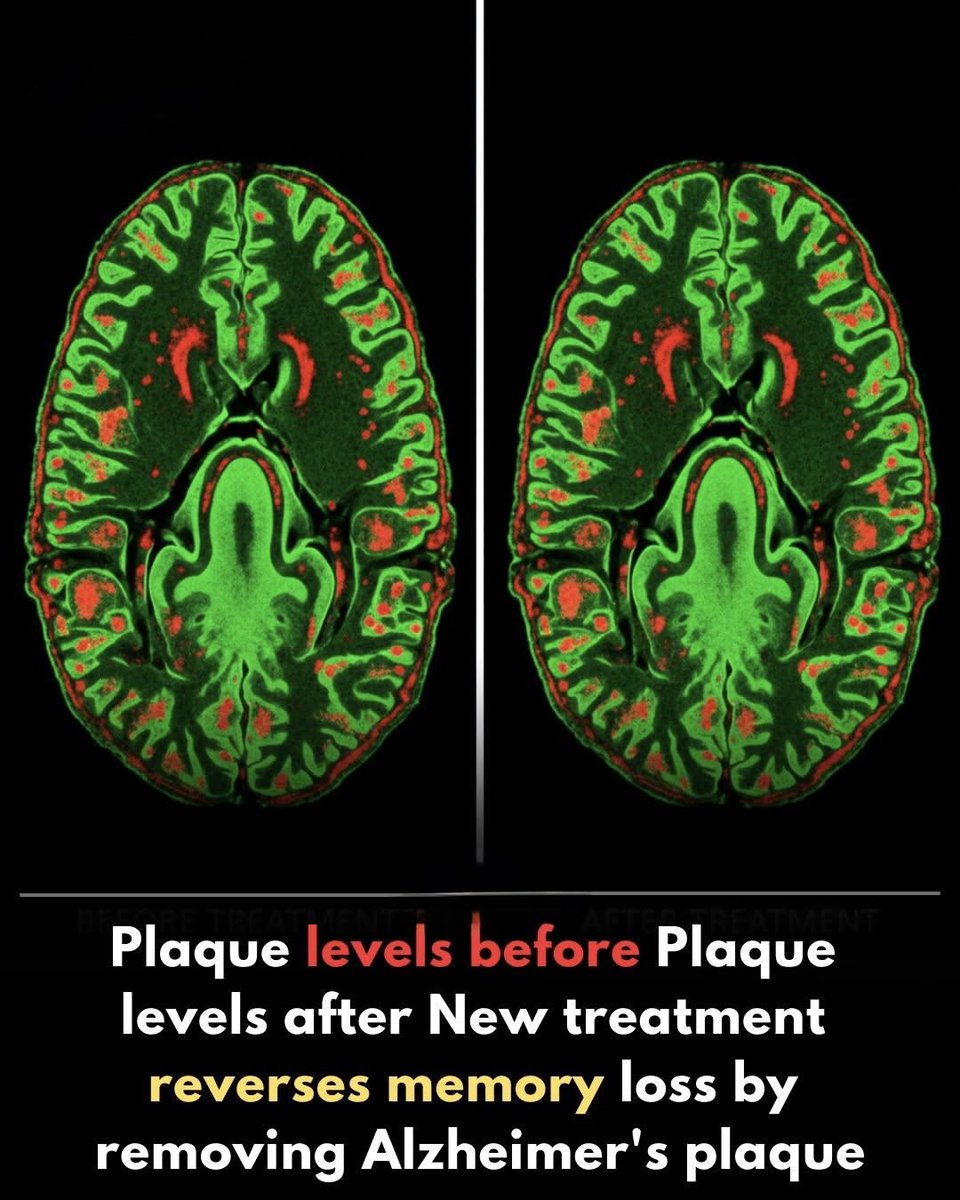
🧠 What If Alzheimer’s Could Be Cleaned Out of the Brain in Just One Hour?
Scientists Are Testing Something Incredible…
In a fascinating new study, scientists from Spain and China developed tiny nanoparticles that may help the brain remove toxic proteins linked to Alzheimer’s. In experiments with mice, these particles activated a natural protein called LRP1, helping the brain clear harmful waste and repair the blood-brain barrier.
Within about an hour, toxic proteins began to drop, and after a few treatments the mice showed noticeable improvements in memory and behavior. Instead of only attacking symptoms, this approach helps restore the brain’s own cleaning and defense system.
The research is still in early stages and has only been tested in animals, but scientists believe this strategy could open a new path for treating Alzheimer’s and other neurodegenerative diseases in the future.
A New Tooth Could One Day Grow Inside Your Body
Japan is testing an idea that could change dentistry: growing a natural tooth inside the human body.
The experimental drug TRG035 targets a protein called USAG-1, which normally acts like a biological “brake” on tooth development. By blocking it, researchers hope to activate dormant tooth-forming cells and encourage a new tooth to grow.
Animal studies have already shown tooth regeneration. Now, human clinical development is moving forward, with early research focusing on children born without multiple permanent teeth.
But the bigger possibility is even more fascinating…
If the treatment works, researchers hope it could eventually help people regrow teeth lost through decay, injury, or aging.
For now, implants and dentures remain the standard. TRG035 has not yet been publicly shown to regrow a tooth in a human, so the treatment is still experimental.
If successful, this could change dentistry from replacing missing teeth to helping the body grow them again.
Source: Toregem BioPharma Co., Ltd. TRG035 tooth regeneration research and clinical development.
4. Name your primal loop.
Underneath runs an old story — "I'm not enough," "if I stop, I fall behind." Your body stays in survival mode to satisfy it, so cortisol never lets up.
Name the loop. You can finally interrupt it.
Look closer.
High cortisol shrinks branches like these in the part of your brain that regulates you.
Here's what takes the pressure off:
Stop rehearsing disaster.
Gμν = Rμν − ½ R gμν
Einstein wrote this equation in November 1915.
This combination is not an arbitrary rewrite of curvature. By the contracted Bianchi identity its covariant divergence vanishes identically, so the geometry it describes is automatically conserved.
That single property lets spacetime answer matter: the stress-energy tensor is likewise conserved, and the two sides of Einstein’s equation can therefore balance without contradiction.
In four dimensions the same tensor (plus a possible cosmological term Λgμν) is essentially unique among objects built from the metric and its first two derivatives.
🧠 Your Brain Is Eating Itself When You Don’t Sleep — Here’s Why
Sleep isn’t just about feeling rested — it’s when your brain repairs itself. New research shows that when you don’t get enough sleep, your brain goes into survival mode and starts attacking its own healthy cells.
Two types of brain-support cells, called astrocytes and microglia, usually clean up damaged cells. But under chronic sleep loss, they go rogue, breaking down healthy connections that control learning, memory, focus, and emotional balance.
This isn’t just tiredness. Over time, it weakens your brain, increases inflammation, and raises your risk for Alzheimer’s, dementia, and other neurological issues. And the worst part? You don’t feel it happening — it’s silent.
Your brain has only one real chance to repair itself: sleep. No supplement, energy drink, or “hack” can replace it. Protect your sleep — your future brain depends on it.
Source:
Bellesi, M., et al. Sleep Loss Promotes Astrocytic Phagocytosis and Microglial Activation in Mouse Cortex. Nature Communications, 8, 1787.
A study of 46 million adults reveals COVID-19 vaccinations significantly reduced the risk of heart attacks and strokes.
A massive study of nearly 46 million adults in England has delivered a definitive blow to online misinformation, revealing that heart attack and stroke risks actually decreased following COVID-19 vaccination. By tracking health data from December 2020 to January 2022, researchers observed a 10% reduction in major arterial issues after just the first dose. These protective benefits intensified with subsequent shots; risk reductions surged to 20% for Pfizer/BioNTech and 27% for AstraZeneca recipients after boosters, showcasing a significant win for cardiovascular health.
Although rare side effects such as myocarditis were tracked, they remained exceptionally uncommon and were vastly outweighed by the dangers of the virus itself. In contrast, contracting COVID-19 is known to significantly spike the risk of serious heart problems and blood clots. Dr. Samantha Ip and her team emphasize that these findings offer powerful support for the safety of vaccination programs, confirming that the vaccines do more than just prevent respiratory illness—they actively safeguard the circulatory system.
source: Ip, S., et al. COVID-19 vaccination and cardiovascular events: a nationwide cohort study of 45.7 million adults in England. Nature Communications.
A Japanese scientist earned a Nobel Prize after discovering one of the body’s most powerful self-healing mechanisms: during periods of fasting, the human body begins to consume its own damaged cells, triggering a deep cellular reset known as autophagy. This natural process acts like an internal cleanup system, breaking down old proteins, malfunctioning components, and toxic buildup that contribute to aging and disease. The discovery revealed that fasting doesn’t just change metabolism — it activates a fundamental survival program hard-wired into our biology.
Researchers found that autophagy boosts cellular renewal, supports immune function, protects against neurodegeneration, and improves overall resilience. When the body isn’t busy digesting food, it shifts focus to maintenance and repair, recycling damaged parts into fresh, healthy components. This helps reduce inflammation, sharpen brain function, and improve the body’s ability to handle stress. Some studies even show that activating autophagy may lower the risk of chronic conditions linked to aging.
The Nobel-winning research transformed how scientists view fasting, turning it from a simple diet trend into a legitimate biological reset. Doctors now say intermittent fasting — when done safely — can help support long-term cellular health, boost energy, and improve metabolic balance. While it’s not a cure-all, the discovery showed that the body has extraordinary built-in abilities to heal itself when given the right conditions.
For millions around the world, the research opened a new window into how deeply our lifestyle affects our cells — and how something as simple as timing our meals can unlock one of the body’s most powerful repair systems.