Gonna figure out this damn X algo if it’s the last thing I do.
Planning on posting more so I figure it's worth actually introducing myself.
Here we go. 👇
I grew up in the Bay and watched this place evolve through every boom and bust it's had.
My tech obsession started embarrassingly early. I was six or seven, teaching myself to code on an old HP in the corner of our house on dial up. My lunch breaks were spent reading Dummy’s Guides on C++ and PHP.
I was really cool in middle school.
In high school, I started my first company around sports data analytics.
Then Stanford. I studied AI and fell in love with NLP. Vector embeddings and parameterized models felt like such a step change over the manual rules that were used before.
Then transformers dropped.
For the first time you could take raw human language that was messy, unstructured and nothing like a database and actually reason about it.
I remember thinking that this changes everything.
I graduated, joined an early-stage startup, built out their entire ML team from scratch.
Training architectures, architecting our data platform, serving models in production and growing that team to about 30 people.
Then I left in 2021. It was pre-ChatGPT, and I had this gut feeling that the consumer moment for AI was closer than anyone was publicly talking about.
I spent a year traveling with my girlfriend. We worked remote in Lisbon, Copenhagen, Chile, Patagonia, Paris, etc.
She had a clear agenda each day. I had Wi-Fi and a feeling that I needed to build something.
Planning on sharing some new projects soon. This is by far the biggest boom in San Francisco yet - need to buckle in because I suspect it’s just going to get crazier.
Right now the tax code actively incentivizes replacing humans with machines.
-Equipment depreciation benefits.
-Healthcare costs stacked on top of wages for human hires.
It's not a level playing field.
Before we talk UBI, there’s some low hanging fruit we can fix first.
Right now the tax code actively incentivizes replacing humans with machines.
-Equipment depreciation benefits.
-Healthcare costs stacked on top of wages for human hires.
It's not a level playing field.
Before we talk UBI, there’s some low hanging fruit we can fix first.
governments have not been working on this for the last 20 years.
or if they’ve given us the best they’ve got we’re cooked.
the only ideas that have bubbled up are shutting down data centers or UBI. there’s not nearly enough thinking going into this (including at think tanks).
where are the policy proposals? where are the trigger clauses?
You are not bullish enough on AI and Robotics. Atlas we meet again 😌
For 20 years society has been researching how to solve unemployment rate issue caused by AI and Automation. This is why
a lot of big discoveries come from someone stubborn enough to keep pushing a thesis past the point where everyone else drops it.
modern agents have the tenacity.
the problem is when you give them a mandate that cuts against the consensus, they often revert to the mean.
what's missing is a persistent through line, some research theme the model can hold onto across a long arc.
that’s what people mean when we talk about research taste.
@simonw one perk of being a smaller company, while it lasts, is using the $200 membership instead of paying raw API costs. the enterprises are effectively subsidizing the next generation of their challengers.
absolutist forecasts survive because the terms are never pinned down. a recession is coming works until you specify which indicators, what threshold, what timeframe. AGI estimates share that structure. the claim always includes a timeline and leaves arrival undefined. you can't be wrong about the foothills if nobody agreed what the mountain looks
another one bites the dust i guess.
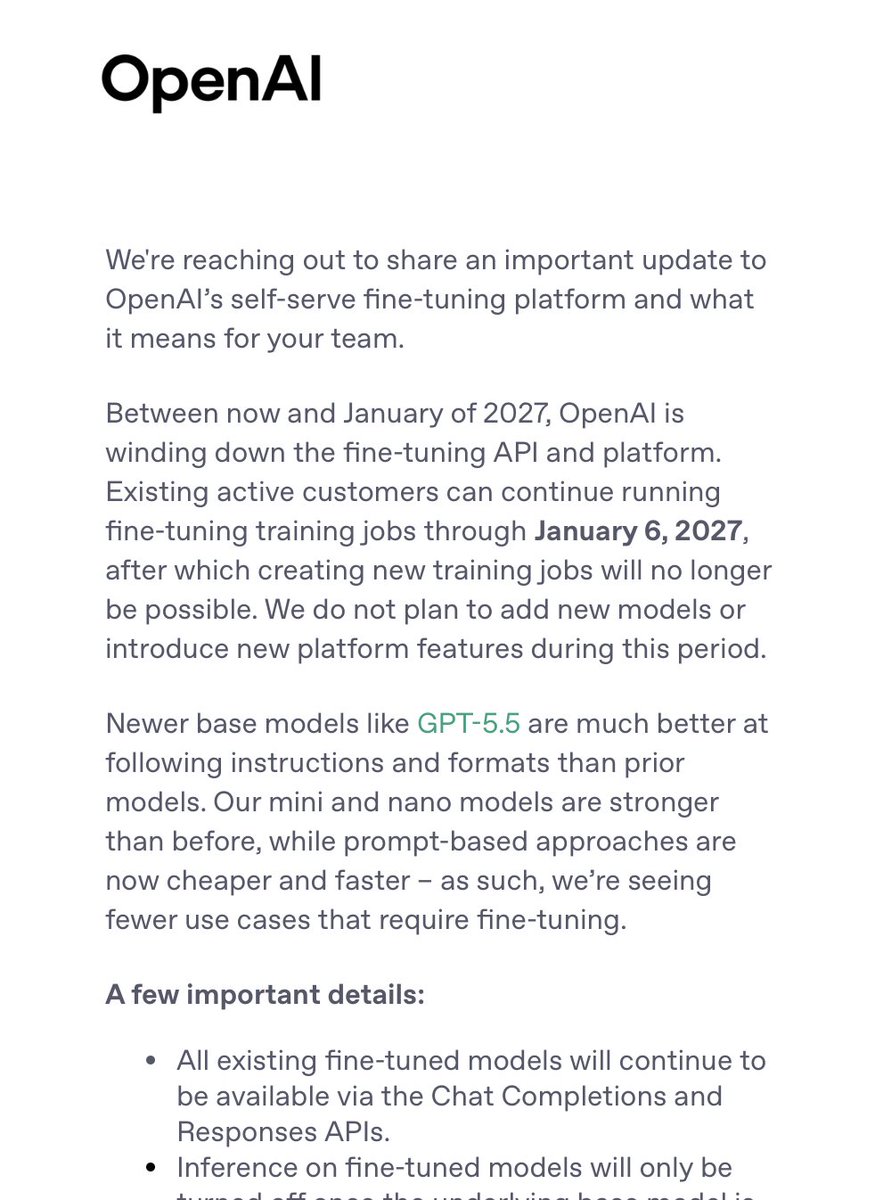
OpenAI is killing its fine-tuning platform by January 2027.
the industry is headed towards more powerful base models, fewer LoRA adapters.
the frontier labs are trying to do everything at the common base level so they're not managing different weights for every customer.
Thinking Machines now has some room to double down on their fine-tuning stack tinker, but I'm watching how KV cache training shakes out before betting too hard on any approach that requires custom weights.
Gonna figure out this damn X algo if it’s the last thing I do.
Planning on posting more so I figure it's worth actually introducing myself.
Here we go. 👇
I grew up in the Bay and watched this place evolve through every boom and bust it's had.
My tech obsession started embarrassingly early. I was six or seven, teaching myself to code on an old HP in the corner of our house on dial up. My lunch breaks were spent reading Dummy’s Guides on C++ and PHP.
I was really cool in middle school.
In high school, I started my first company around sports data analytics.
Then Stanford. I studied AI and fell in love with NLP. Vector embeddings and parameterized models felt like such a step change over the manual rules that were used before.
Then transformers dropped.
For the first time you could take raw human language that was messy, unstructured and nothing like a database and actually reason about it.
I remember thinking that this changes everything.
I graduated, joined an early-stage startup, built out their entire ML team from scratch.
Training architectures, architecting our data platform, serving models in production and growing that team to about 30 people.
Then I left in 2021. It was pre-ChatGPT, and I had this gut feeling that the consumer moment for AI was closer than anyone was publicly talking about.
I spent a year traveling with my girlfriend. We worked remote in Lisbon, Copenhagen, Chile, Patagonia, Paris, etc.
She had a clear agenda each day. I had Wi-Fi and a feeling that I needed to build something.
Planning on sharing some new projects soon. This is by far the biggest boom in San Francisco yet - need to buckle in because I suspect it’s just going to get crazier.
there’s a lot of cosplaying at productivity right now.
it feels good to have your agents working, it feels good to be churning tokens. we’ve all so internalized productivity culture we think something has to be happening at all times. tokens feel productive even when they’re not useful
@antirez@Redisinc there’s something liberating about burst work. iceaxe sat untouched for weeks then got most of its core in one stretch where i barely left the desk. no calendar app is designed for that and good on redis for not fighting it
impostor syndrome in AI founder circles has never been higher.
for basically the entire history of software, you could see what you were using.
if it was magic on first use, that's all that mattered. a bad demo was obvious and a product that didn't live up to the hype fell apart the second you touched it.
AI agents broke that as the "product" is hidden behind an opaque API. you watch a cherry-picked demo and it looks incredible, but you genuinely can't tell how much fire is behind the smoke. even when they let you use it yourself, you still can't tell. Is this a bespoke model? Finetuned? A prompt wrapper around Claude?
does it actually /work/?
with conventional SaaS you knew within 10 minutes. with agents, you need dozens of use cases, edge cases, metrics tracking, and lived experiences before you can even form an opinion.
evaluation went from "did it work?" to a statistical question across a whole lot of measured data points.
@sauravstwt for a stretch, software was one of the cleaner paths to a 150k salary without a traditional degree. that attracted a lot of people who wanted the outcome more than the craft. it sucks to say but that era is over
a lot of big discoveries come from someone stubborn enough to keep pushing a thesis past the point where everyone else drops it. modern agents have the tenacity. the problem is when you give them a mandate that cuts against the consensus, they revert to the mean. what's missing is a persistent through line, some research theme the model can hold onto across a long arc
the accessibility tree is the useful layer. agents read it, screen readers read it, anyone who can't use a mouse reads it. when macOS or the browser forces you to expose it, you get that for free. the DS is a good example of a platform that never baked it into the SDK, and developers aren't going to add it themselves
@simonw the naming here is getting out of control… my read is antigravity is Google consolidating their agent runtime and pushing it out across the board. similar maybe to how they’re trying to co-brand all their AI experiences Gemini. smart agents run in an antigravity loop?
@tiangolo@FastAPI typed, opinionated frameworks are the best of all worlds for agent-written code. less surface area to get wrong, easier for humans to grep what was actually generated. FastAPI hits both. glad I built Mountaineer on top of it