How does the brain group a scene into objects?
Exciting new preprint by Sami Mollard! GammaNet’s recurrent dynamics predict human grouping times without training on reaction-time data.
https://t.co/KeIyNtHNHy
#Neuroscience#PerceptualGrouping
Why do some regions in an image look like “objects” and even appear stronger?
We show that Gestalt cues (convexity, closure) not only define figures, but boost perceived contrast and neural responses in areas V1/V4 of the visual cortex.
Link: https://t.co/CwcbSsdc1Y
#Neuroscience
What makes a brain implant last? Less gliosis, more surviving neurons. In a systematic 100+ probe mouse study, Corin Orlemann et al. show that flexible polyimide improves over hard silicon across the board.
#Neurotech#NeuralInterfaces https://t.co/HIVPunUWSI
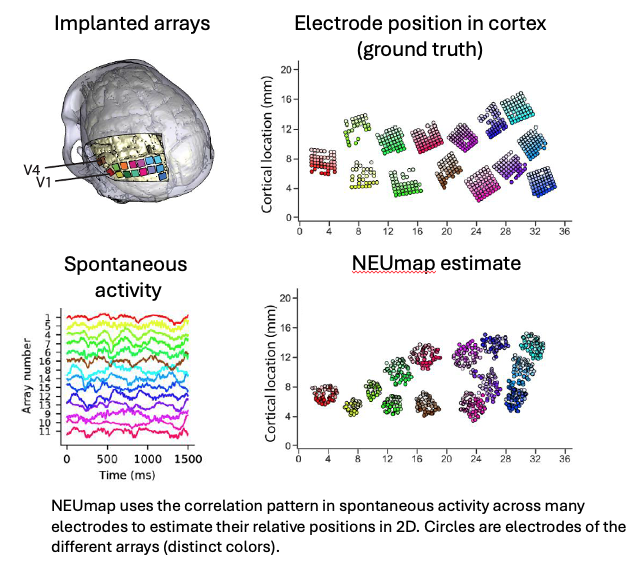
Our new paper in Brain Stimulation by Antonio Lozano et al: NEUmap rapidly maps visual percepts for cortical visual prostheses using spontaneous neural activity. Validated in macaques and blind humans, with <1s of data.
https://t.co/qyOKCUkMnF
Glimpse from the human LGN: We recorded from single neurons and measured the receptive fields, color opponency, monocular tuning, and found that closing one eye changes spontaneous activity. Toward understanding human vision at the level of single neurons! https://t.co/ZBRpztwEvA
Predictive coding has guided neuroscience for years but it does not account for the neuronal data. We review how patterns of feedback during spatial and temporal predictions are better captured by a family of opposing theories, collectively termed BELIEF.
https://t.co/QU22KK7h7y
In this short letter we explain why binding problems occur in the brain and why deep neural networks need to cope with them. We respond to Scholte and de Haan (TICS 2025), who previously claimed the opposite. https://t.co/j0ngmVhpdj
We have a postdoc-position at the institute de la Vision to develop high density recordings throughout the monkey brain. For information about the position and the application procedure, see https://t.co/iPn20MnYrA..
We have a PhD-position at the institute de la Vision in to develop optogenetic stimulation in macaques to induce and refine artificial vision for blind people. For information about the position and the application procedure, see https://t.co/5av9bqMWvD
Paolo Papale's THINGS ventral stream spiking dataset (TVSD) came out. It is open and contains neuronal responses in V1, V4 and IT to ~25,000 THINGS images. We expect that the dataset will be useful to compare the visual brain to deep neural networks.
https://t.co/CF8lJBrfBl
Here is Matt Self's preprint on the responses of LGN neurons in a human patient, together with Osvaldo Vilela, Sergio Neuenschwander and others. The cells had center-surround receptive fields, and showed surprising activity changes when an eye was closed.
https://t.co/ovzputmdS0
Paolo Papale et al. find that the representation of borders of objects in natural scenes are special in the visual brain. Borders elicit extra activity in area V1. There is an early effect reflecting receptive field tuning and a later, contextual effect.
https://t.co/heBm5xZR3H
This new paper spearheaded by Matt Self shows the link between border-ownership tuning in area V4 of the visual cortex and figure-ground signals in area V1, by an analysis of the pattern of noise correlations between neurons in these two cortical areas.
https://t.co/n5CwnKeYHn
@DorisDijk@MatthewWSelf I am very happy that the paper about hippocampal responses elicited by pronouns that refer to concepts came out this week!
https://t.co/b7cyrRj13j
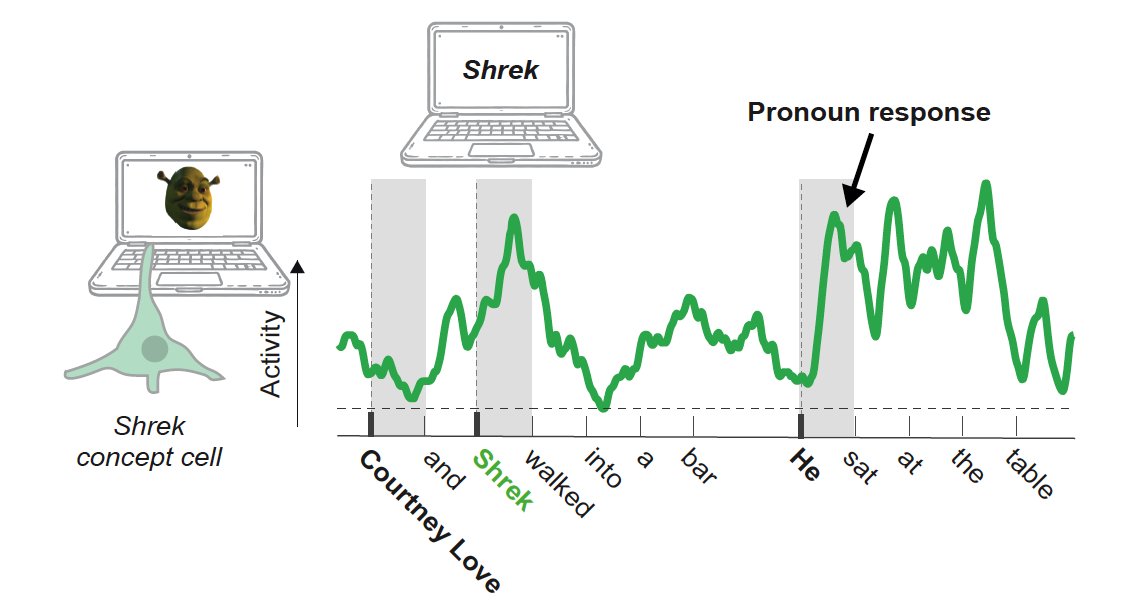
I am very proud of the pre-print that just came out. Doris Dijksterhuis (@DorisDijk), Matt Self (@MatthewWSelf) and their team recorded from single neurons in the human hippocampus. Neurons that encode the person referred to by a noun also become active for pronouns.
@DorisDijk@MatthewWSelf E.g. if the name “Lionel Messi” activated the neurons they also become active in response to a pronoun referring to him. E.g. the “he” in “he scored a goal’.
https://t.co/JCg2nyqscD
Our lab at the Institut de la Vision (IDV) in Paris is seeking a PhD student or postdoc. The project explores the function and organisation of the macaque visual brain using high channel count neural interfaces for neuroscience and prosthetics. https://t.co/1smUVOndMK
Pleased to announce our Generative Adversarial Collaboration at @CogCompNeuro#CCN2024
“Is V1 a Cognitive Map?”
And we need YOUR help!
Please Download + Comment on the Proposal by Clicking the Following Link:
https://t.co/svs8U4NPkz
Outline of GAC in 🧵 below!
Fantastic work, Koen! Great that you can finally share this last paper of your PhD work. This was a super inspiring HBP-funded @HumanBrainProj project with the labs of @LarsMuckli , @mattlark@Pieters_Tweet with so much help from all coauthors!
Neuroprostheses to electrically stimulate the brain of e.g. blind individuals benefit from monitoring of neurons, to test if the activation suffices. Feng Wang et al. compared methods to remove electrical artefacts that would otherwise obscure the signal.
https://t.co/vhOOEJDaha