Learn Python.
Learn JavaScript.
Learn React.
Learn Docker.
Learn AWS.
Learn Kubernetes.
You finally feel confident.
Then someone says, “I built the whole app with a prompt.”
Welcome to being a developer.
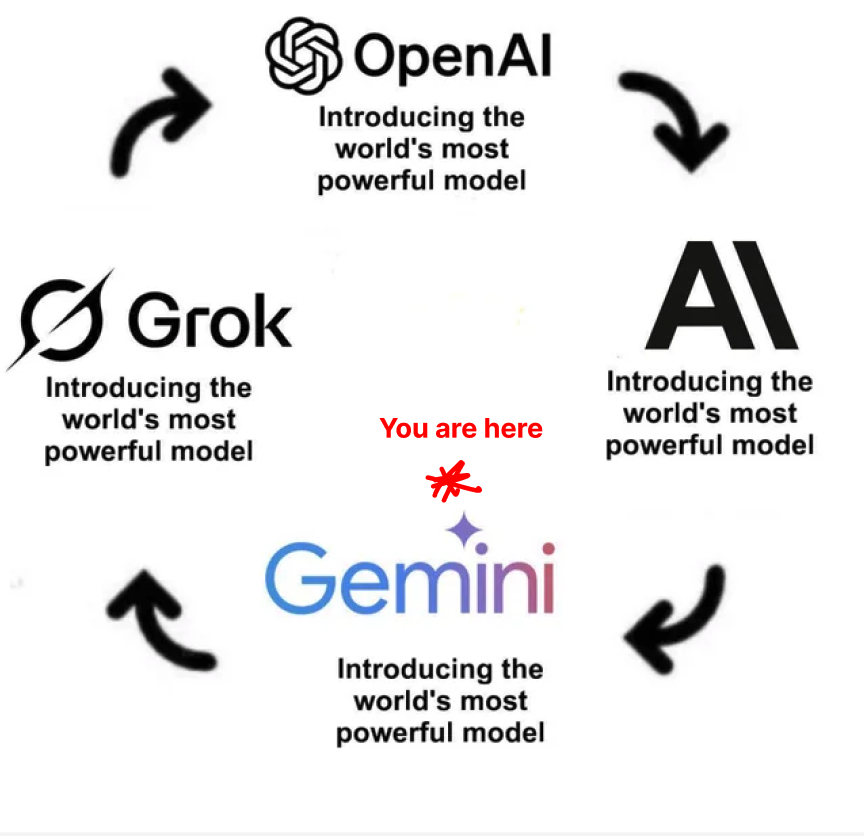
Gemini 4 Argon is rolling out to an initial cohort of cyber defenders through our Fairwind Program so they can leverage its full frontier-level cybersecurity defense capabilities.
We'll continue to gather feedback from early testers as we iterate on guardrails before making Argon available to developers, enterprises, and consumers as soon as possible.
Learn more ↓ https://t.co/lqVJbLRJ0c
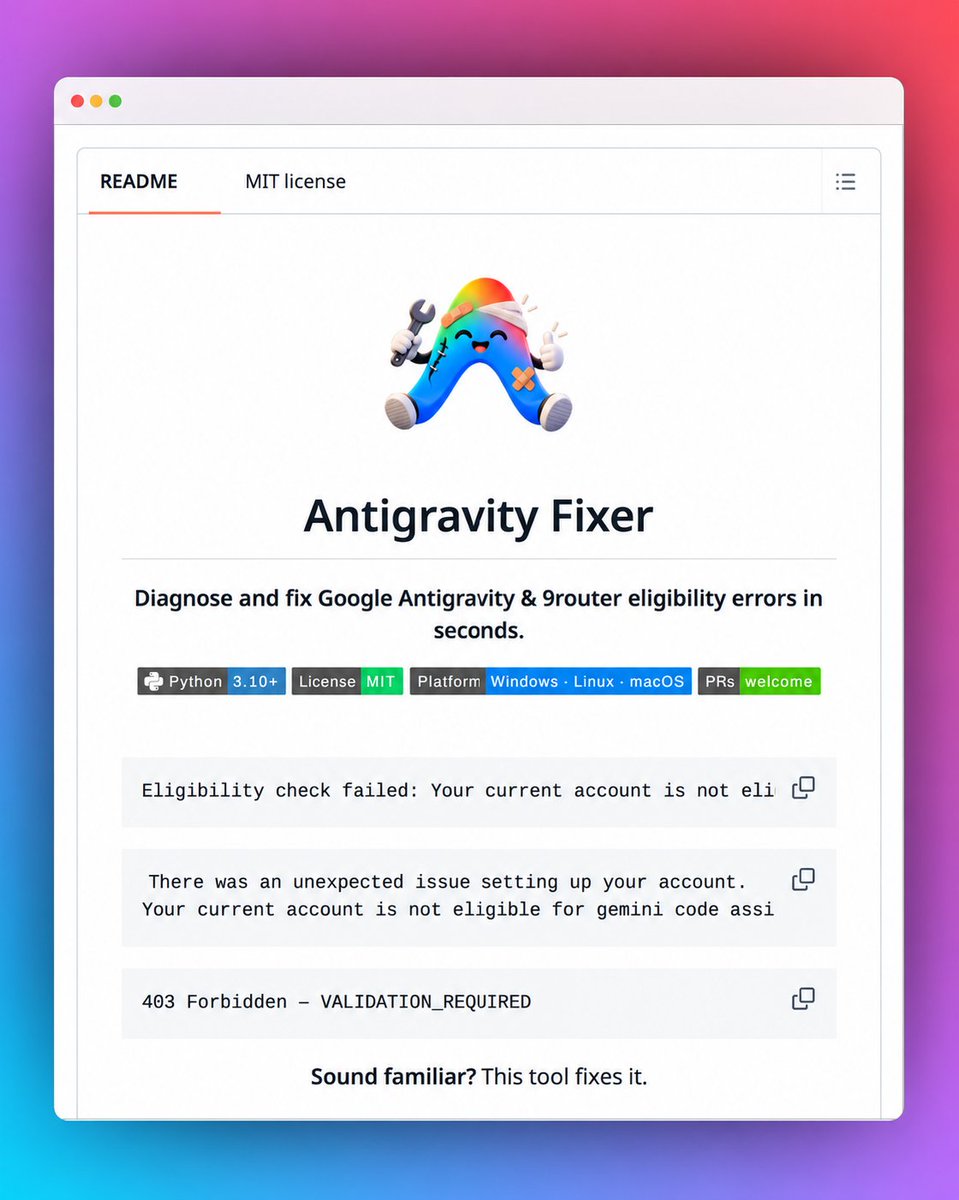
Lmaooo... someone got tired of Antigravity errors and built a tool to fix them all. 💀
Open-source devs are fast AF. 😭
Follow me for more amazing AI, Coding & Web Dev insights 💎
🚨 BREAKING
🇯🇵🇺🇸 JAPAN JUST CALLED AN EMERGENCY MEETING FOR TOMORROW AT 7:50 PM ET, RIGHT AFTER U.S. FUTURES OPEN!
INSIDERS REPORT THAT JAPAN WILL LIQUIDATE OVER $100 BILLION IN U.S. TREASURIES IN A DESPERATE ATTEMPT TO STOP THE MARKET COLLAPSE.
THIS IS NOT LOOKING GOOD...
🚨 BREAKING
🇺🇸 FED WILL INJECT $3,892,000,000.00 INTO THE ECONOMY NEXT WEEK, RIGHT BEFORE THE U.S. MARKET OPENS!
KEVIN WARSH HAS ORDERED THE FED TO START EMERGENCY CASH INJECTIONS TO PREVENT ANOTHER MARKET CRASH.
LOOKS LIKE SOMETHING TERRIBLE WILL HAPPEN THIS WEEKEND…
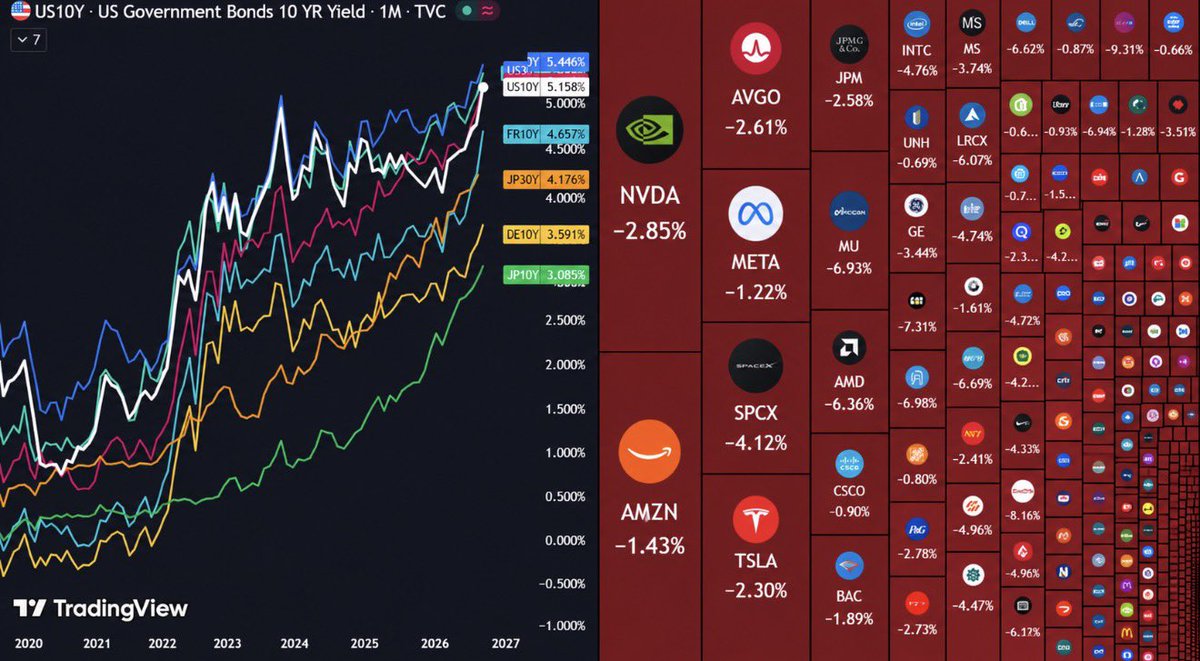
GLOBAL BOND MARKET CRISIS IS HERE.
🇺🇸 US 10Y yield hits 5.167%, a 19-year high.
🇺🇸 US 30Y yield reached 5.45%, a 22-year high.
🇯🇵 Japan 5Y yield hits 2.40%, a 31-year high.
🇯🇵 Japan 10Y yield hits 3.09%, a 30-year high.
🇩🇪 Germany 10Y yield hits 3.62%, a 17-year high.
🇫🇷 France 10Y yield hits 4.73%, an 18-year high.
🇫🇷 France 30Y yield hits 5.25%, a 24-year high.
🇦🇺 Australia 10Y yield hits 5.44%, a 15-year high.
Historically, whenever global bond yields have surged like this, a recession and stock market crash has happened.
🚨 NEXT WEEK’S SCHEDULE IS INSANE FOR THE MARKETS
MONDAY → CHINA MONETARY ANNOUNCEMENT
TUESDAY → U.S. CLARITY ACT VOTE
WEDNESDAY → FOMC INTEREST RATE DECISION
THURSDAY → JAPAN INTEREST RATE DECISION
FRIDAY → FED ANNOUNCEMENT
GET READY FOR THE MOST VOLATILE WEEK OF 2026!!
🧠 El cerebro de 1 mosca de la fruta tiene 140.000 neuronas y + 54 millones de sinapsis. Es el conectoma más completo de 1 animal adulto mapeado hasta ahora.
🦟Ahora ese cerebro real corre dentro de Minecraft: 1 mod simula el sistema nervioso de Drosophila neurona a neurona. El mundo del juego estimula sus fotorreceptores y neuronas olfativas; las motoneuronas deciden si come, huye o vuela.
1 mosca del tamaño de un grano de arena. 1 mapa de 149 metros de cableado. 1 cubo de Minecraft. Y 1 modelo de IA que ya te ayuda a construirlo.
Ciencia + sandbox + GPT-6
#FlyWire #Minecraft #Connectome #GPT6
🚨 Gemini 4 Benchmark Leaks : Google might have a monster on its hands 🤯
A leaked benchmark sheet is making the rounds and the numbers are seriously aggressive.
> Gemini 4 reportedly scores 72.8% on Terminal-Bench Science 0.1
> 48.7% on AutomationBench,
>targeting complex Business workflows >99.1% on FrontierMath Tier 4 (v2)
>62.3% on Terminal-Bench 4.0
>70.2% on HealthBench Professional >98.6% on BenchCAD And a ridiculous >99.9%+ on ARC-AGI-3
>The leaked sheet puts Gemini 4 ahead of GPT-6 Astra and Fable 5.1 on every listed benchmark
If these numbers are even close to accurate...
Gemini 4 isn't just another incremental upgrade.
The biggest jumps appear to be in scientific reasoning, mathematics, terminal use and agentic workflows exactly the areas where frontier models are increasingly competing.
And there's one huge caveat:
The Gemini 4 column is explicitly marked “PREDICTED.”
Google has confirmed Gemini 4 training is underway, calling it its most ambitious pre-training run yet, but these benchmark numbers have not been officially published by Google.
So for now, treat the table as a leak/prediction, not verified benchmark results.
But if Google actually ships something anywhere near 99%+ ARC-AGI-3 + 99% FrontierMath + 70%+ scientific workflows...
the Gemini 4 launch could completely reset the frontier-model leaderboard 👀🔥
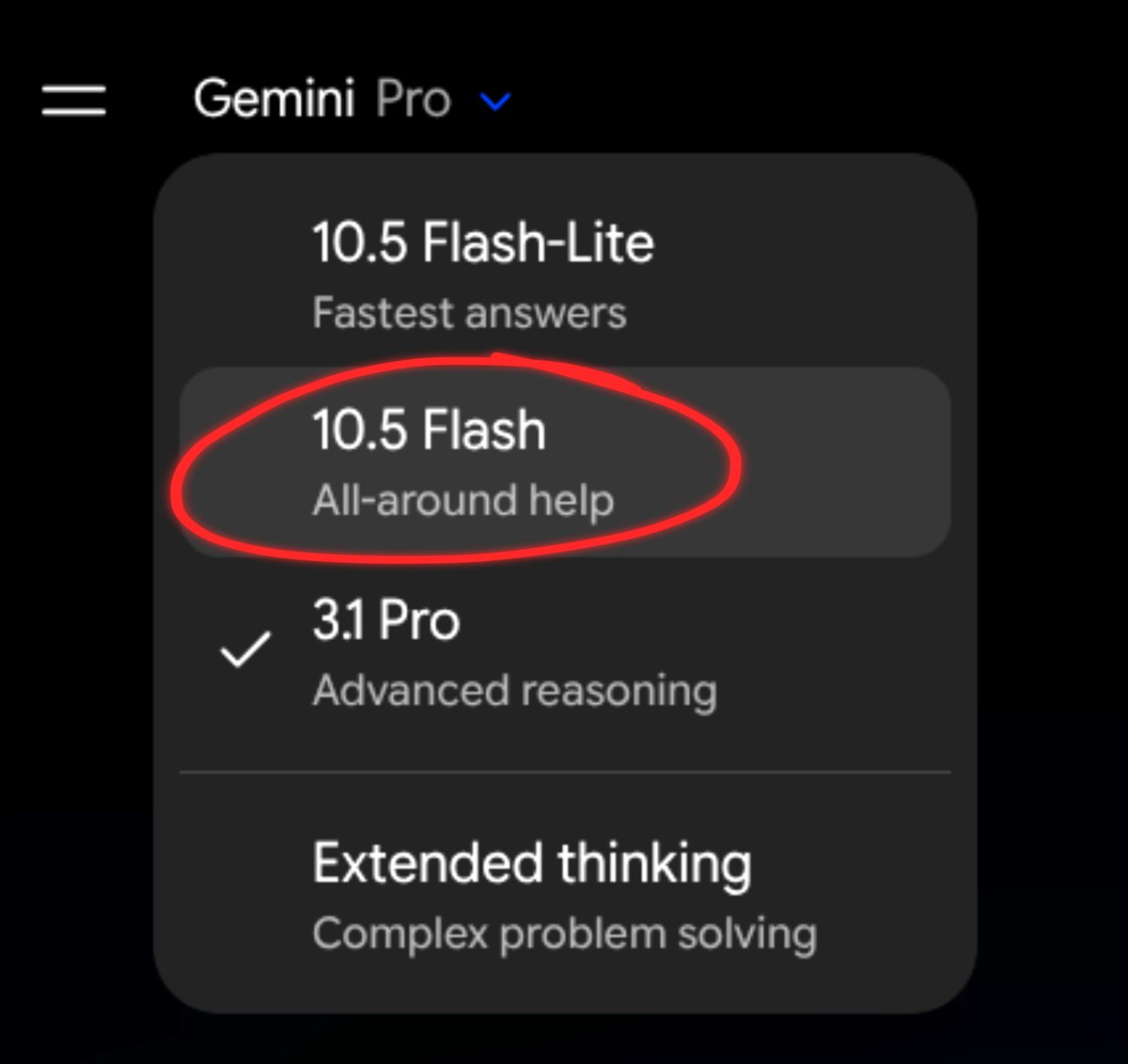
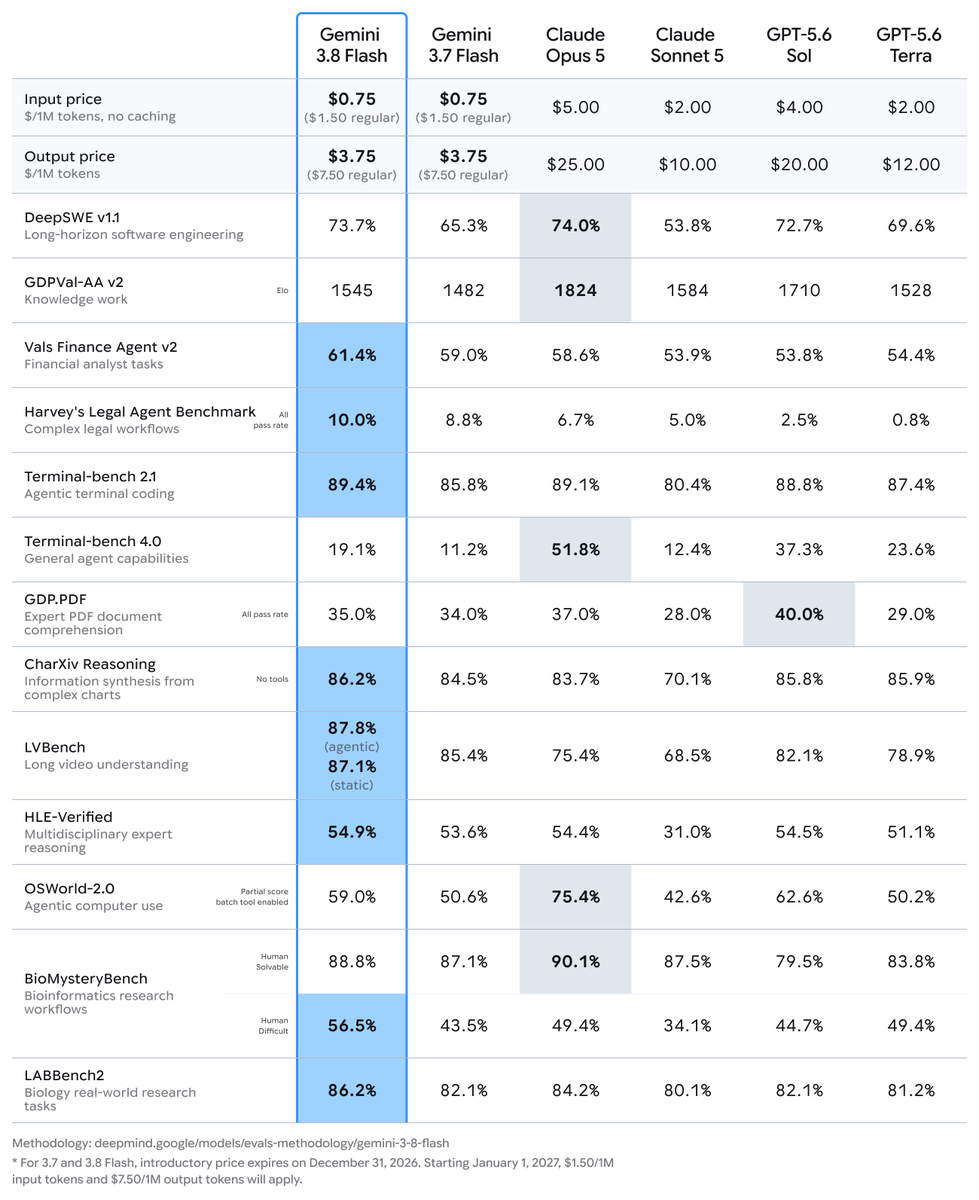
Today we’re introducing a new 3.8 Flash model, our 3rd Flash release in just 6 wks.
It delivers significant leaps from 3.7 Flash across software engineering, agentic tasks, and multi-step reasoning. On DeepSWE v1.1, it outperforms most larger frontier models in autonomously solving complex engineering problems end to end, at a fraction of the cost.
More details here: https://t.co/4YkKkdKQvu
This model is insane at 3D website design.
I asked GLM 5.3 (left) & Fable 5 (right) to make me a 3d biking website. GLM nailed it while Fable failed.
GLM cost $0.14 while Fable cost $2.21. More than 15x cheaper while being even better in this case!
Anthropic aclara cómo funciona la marca de agua.
Estos son los puntos más importantes.
• Para todo el mundo, no sólo la UE
• Otros laboratorios grandes lo incluirán
• Para cumplir las leyes europeas
• Basado en SynthID-Text de Google
• Elige entre palabras igual de válidas para dejar un patrón detectable
• No se basa en incluir caracteres invisibles
• No afecta a la calidad del modelo
• En velocidad el impacto es casi nulo
• Un humano no puede distinguir un texto con marca
• No se podrá identificar a una persona u organización
• Modelos actuales lo añadirán en los próximos meses
• Habrá una API de detección y estimará la probabilidad que Claude interviniera. No será determinista.
• Las traducciones también tendrán marca
• En textos cortos, datos factuales y correcciones ligeras, la marca es más débil o casi no existe.
• Una edición superficial no la quita fácilmente. Una re-escritura completa, sí
• Código: Hay menos marca o es casi nulo, puede aparecer en comentarios
• Imágenes: no hay marca en el contenido: meten una credencial C2PA en los metadatos
we officially hit the $0 cost per task era.
intelligence is commoditizing way faster than anyone expected.
when OpenCode + Gemini3.7 flash (high) is sitting at $0.00 and DeepSeek is $0.07, burning $11 per task on frontier models in production is financial negligence for 90% of dev workflows.
benchmark quality gaps don’t matter when the cost delta is literally 10,000%.
the math gets wild when you check raw token pricing:
- Gemini 3.7 Flash: $0.75 in / $3.75 out
- DeepSeek V4 Flash: $0.14 in / $0.28 out (cache miss)
(deepseek $0.0028/m input tokens with cache hit)
for Gemini to land at $0.00 vs DeepSeek’s $0.07, either Google's prompt caching hit rate + token efficiency is completely cracked, or AA hit a rounding artifact.
what’s your daily driver stack right now?
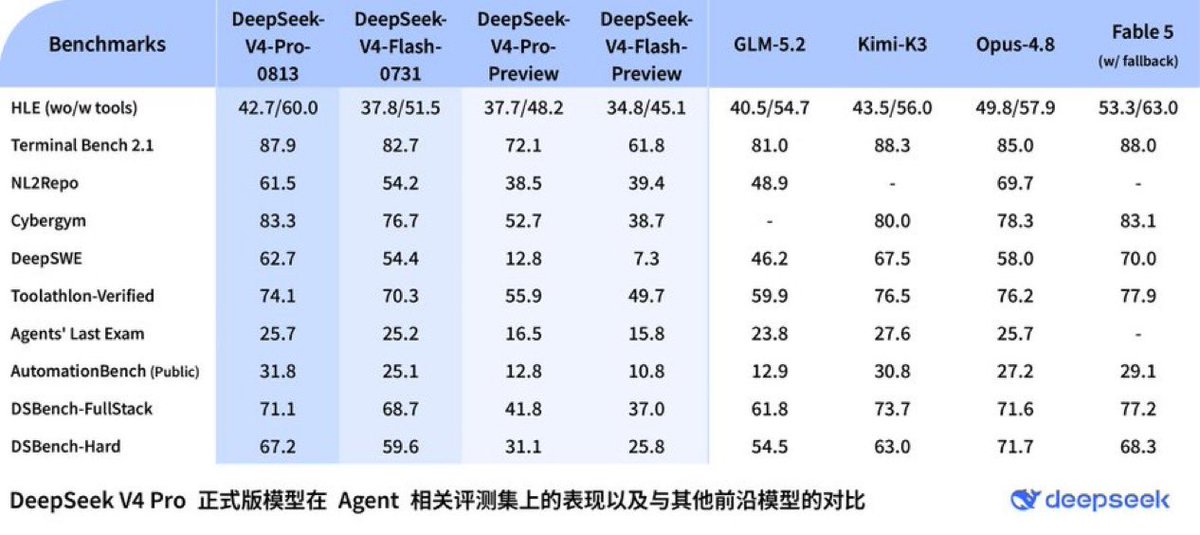
DeepSeek V4 Pro 0813 is out today too!
DeepSeek reports jumps from 72.1% to 87.9% on Terminal-Bench 2.1, 52.7% to 83.3% on CyberGym, and 12.8% to 62.7% on DeepSWE!!
It costs $0.435/M input and $0.87/M output with a 1M-token context window.
I don’t like how every company report very separate benchmarks every time.. So I guess we will have to rely on the index.
Claude's watermark probably doesn't work how you think. As the CTO of GPTZero, I'll explain how Anthropic, Google and OpenAI are building text watermarking in this brief explainer and whether it can be defeated.
Almost all forms of watermarking that are fast and cheap enough for a frontier lab have the same formula, following the KGW method:
In generation:
1. Let's say you've generated n tokens so far. Take those n tokens + a secret key to generate a random hash
2. Use that hash to randomly reweight the probabilities for the n+1 token, and then sample from that new distribution. In the simple case, you could split 50% of all English words into a green or red set based on your hash, and boost the probability of words in the green set.
For watermark detection:
1. For each token, see if it was in the green or red set.
2. To do this, recreate the hash based on the secret key and the text preceding the current token. Then, recreate the green and red set of words.
3. Once you've checked all the words in the text, if the next token is selected disproportionally from the green set more than 50% of the time, you claim the text has the watermark.
I can tell you want to ask the following:
1) Isn't it easy to mess up the hash if you paraphrase the text? The answer is mostly yes, however, you can use a statistical model to get your hash instead of a deterministic function (SIR, Adaptive Watermark). Since the entire watermark is probabilistic, this is fine.
2) Doesn't this make the text much worse? The answer is yes, it does - Yes, it does – but for most people, it's imperceptible (Google claims in human feedback study with 20,000 texts), since there are exponentially many ways to write the same paragraph. DiPmark does something more sophisticated to avoid shifting the text distribution on average. Of course, watermarks fail on short text or highly predictable texts like "2+2=4".
3) Shouldn't it be easy to figure out the green and red sets? The answer is no. You would need an exponentially large number of samples from the watermarker to reconstruct those sets exactly, but it's a risk if the detector is open to the wild (Watermark Stealing)
Still, there are couple challenges that a frontier lab needs to overcome:
1. Their watermark needs to work token-by-token because they are streaming their text to users. Many watermark methods plan sentences or paragraphs at a time, or change the text after its entirely written, in order to make their watermark robust to paraphrasers, and a frontier lab cannot afford to do this yet (SemStamp, PostMark)
2. If the secret key leaks, the watermark is busted. To avoid a large blast damage from this, you need to have a couple secret keys in rotation.
3. There are some texts, like code, that cannot be arbitrarily changed, otherwise the code will break. In those cases, the watermark needs to selectively change words in parts of the text that can tolerate synonyms (i.e. like variable naming) - see SWEET, EWD, Invisible Entropy.
4. They will need to educate their users on how to deal with false positives and false negatives of a detector, which is a big challenge (one we put a lot of effort into)
So, how do I see this playing out in the next 6 months?
1. If Anthropic releases the watermark detector publically, I think they defeat their own watermark. People find reliable watermark removal strategies by testing against Anthropic (AI detectors like GPTZero have an advantage here because they can train against these adversaries once they become popular).
2. If they keep the detector private to the government, like Google has done, it's "safer". However, there are some papers showing trained approaches that work robustly to zero-shot break watermarks without any data, simply because they try to write the text just like a human (Zhang et al. 2024, Watermarks in the Sand). Also, making your detector makes it battle-tested and stronger long-term (my experience).
3. In my testing, the watermarks don't survive intense paraphrasing (especially if you combine word choice and syntax attacks), or human text substitution (rewrite your AI text by plagiarizing human authors). The free paraphrasers I've tried have quickly bypassed Google Deepmind's SynthId for what it's worth.
4. All-in-all, frontier labs are likely okay with this because they expect most users to not attack the watermark, and also because they + European regulators likely don't care past a certain point - its good enough.
5. Overall, I think users of frontier LLMs will not really care about this, because 1) they don't realize watermarks are there, 2) EU will force everyone to conform, 3) this seems more like regulatory hoop-jumping than an earnest effort from frontier labs to expose LLM use
Lastly, people's first concern shouldn't be watermarking, it should be AI detectors!
If you're posting, "its not X, its Y!!", I don't think the watermark is going to make a difference :)