@paulnovosad Economics is different in this respect and we may never know if the work is true.
One thing that would help would simply be a stronger culture of replication (e.g., a working paper should link to data and code instead of waiting for publication)
@paulnovosad The issue is mainly the absence of a proper feedback loop for the usefulness and truthfulness of economic knowledge. In computer science, if you publish an algorithm and claim it's great, people will know very quickly if you're full of shit...
@JohnHolbein1 Honestly, it does not matter whether you use it or not, you are ultimately responsible for the output you produce -- whether it's a referee report, a paper, a blog post.
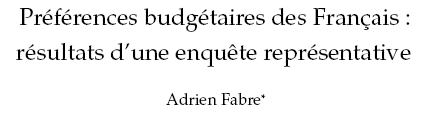
🚨 Quelles mesures les Français sont-ils prêts à accepter pour réduire le déficit public ? J'analyse les résultats d'une enquête inédite menée en 2026 sur un échantillon représentatif de 1 000 Français.
🧵Voici les 5 résultats qui m'ont le plus surpris :
Out today in @ScienceMagazine: with the amazing Haochuan Cui, Yiling Lin, & @LingfeiWu, we analyzed 3.6 million scientists publishing 1960–2020. The findings reshape a century-old debate about age and scientific creativity.
@jt_kerwin Nonetheless, what is true is that some fields and subfields tend to have looser econometric standards. PNAS publishes across all sciences (in this case, sociology). Not a PNAS problem per se, but certainly a "we need to converge on standards across the social sciences" problem!
@jt_kerwin Did you read the paper? They also provide estimates using alternative identification strategies and directly discuss the issue of pleiotropy. They are not naive about this. I don't think less of this paper than most dodgy IVs I have seen in the econ literature tbh
@ahall_research As usual, the path to a safe technology will be via institutional guardrails, not by building a bunker in the garden, and this is totally achievable in the years to come!
@ahall_research I think AI existential risk is non-negligible, just like Trump and Putin having access to the atomic bomb is a real risk. Doesn't mean I don't go about my daily routine, simply because it's a risk I cannot protect myself against in the short to mid run.
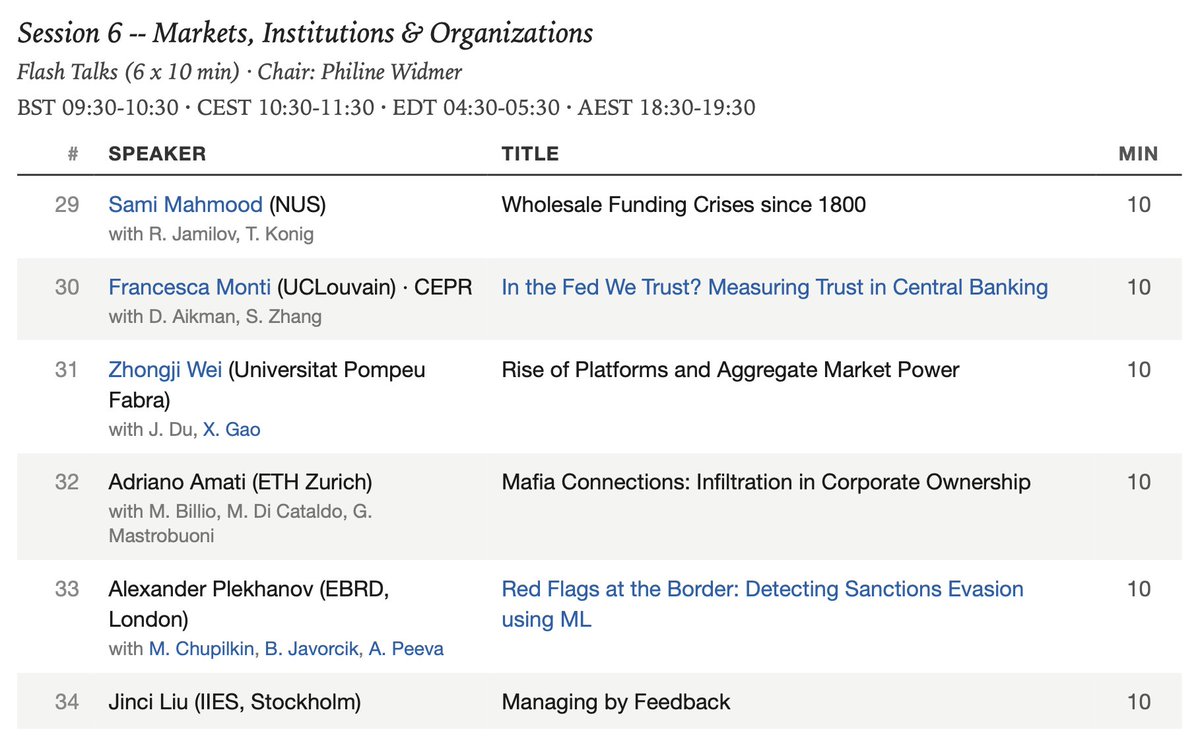
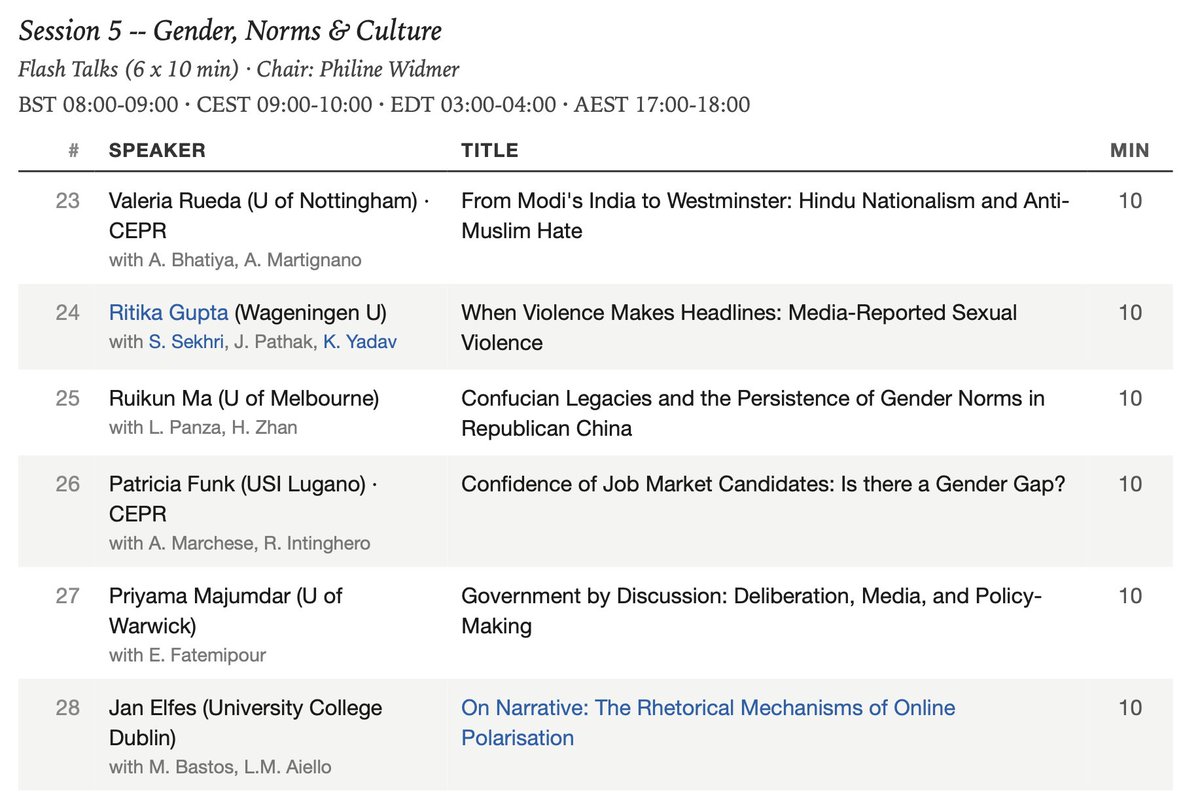
We have started the second day of the MPWZ-CEPR Text-as-Data Workshop (already the 11th edition).
Join us here: https://t.co/tzxcFIF6oE
Text-as-data is being used across economics now -- from projects on gender norms to central bank trust, mafia networks, and sanctions evasion, to superstar scientists and AI patents 📈📊
@cepr_org@ellliottt
We have just kicked off the 11th edition of the MPWZ-CEPR Text-as-Data Workshop! We will "time-travel" with LLMs, measure trust in institutions, track political narratives, and much more! 40 papers, one link: https://t.co/I9eubBqvDs.
See the program: https://t.co/jpHWiuCkoM
@rduartegonzalez@florianederer@phinifa@ezhuravskaya Our paper is an RCT conducted in summer 2023 to understand the effects of the algorithmic feed (relative to the chronological feed).
We found that it pushed users to the right.
This paper is perhaps closer to what you're after: https://t.co/ZCvwP9XYVm
@emollick@leia_ruseva I think you would need to adjust for the time spent on the task to compare Opus 4.6 and GPT 5.4. It seems the difference between these two models is mostly the amount of compute thrown at the problem.
@jfullerucla @ahall_research@karpathy I deem it very unlikely that models won't beat experts in the future, which doesn't mean there won't be human experts of course (we still have chess and Go players after all).
@ahall_research Moving from a "publish and then the results are true forever" culture to a "run code and replicate findings" culture would certainly help