$AFRM Thread....
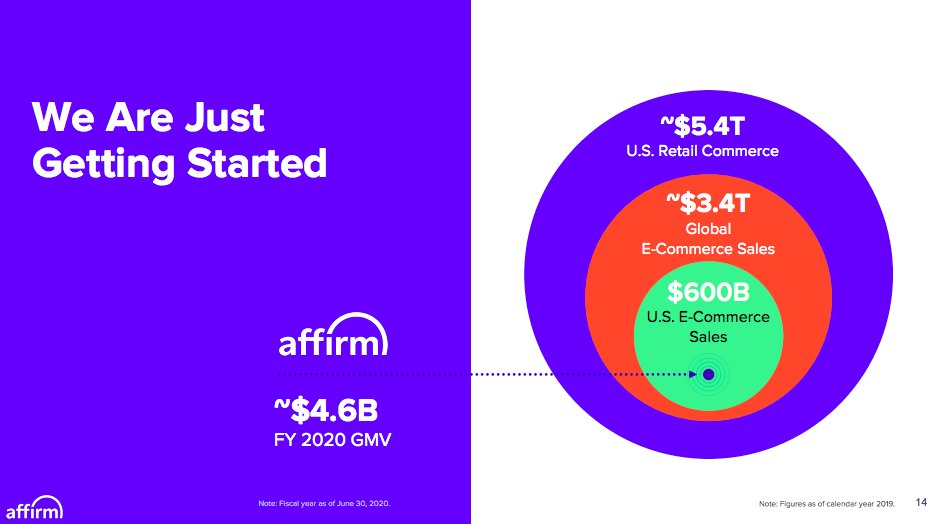
According to $AFRM S-1, in North America, “buy now pay later” market share is expected to triple to 3% of the e-commerce payments market by 2023.
Let's dive into $AFRM....
A tribute To Warren Buffett
About 20 years ago when I first got into investing, I thought the stock market was a fool’s game. It looked like a casino to me, prices flashing all day, people guessing what would happen next and everyone pretending they knew something. Real estate made much more sense to me because I could actually understand what I was buying.
If I bought a $1m rental property and put down $200,000, the math felt pretty simple. I could add up the mortgage, taxes, insurance, maintenance and every other expense, then compare that against the rent I collected. If it cost me $6,000 a month to own and I collected $8,000, I was making roughly $24,000 a year on my $200,000 investment plus appreciation, principal paydown and tax benefits.
That made sense to me because I could see the asset, touch the asset and understand what produced the cash. Stocks felt completely different until I started reading Buffett and Munger. That was probably one of the biggest turning points of my life as an investor.
I read practically everything I could find about both of them. Shareholder letters, books, interviews, speeches, old transcripts, anything I could get my hands on. I also made the trip to Omaha many times and sat there listening to two of the greatest investing minds in history answer questions for hours.
What they eventually taught me was so simple that I almost felt stupid for not seeing it earlier. A stock is not a ticker, not a chart and not some little piece of paper that moves up and down every second. It is ownership in a productive asset.
Once I understood that, the wall I had built between real estate and stocks completely disappeared. A rental building produces rent and a business produces cash. One has tenants and the other has customers, but economically you are still trying to understand what the asset can produce relative to what you are paying for it.
A building needs maintenance and a business needs reinvestment. A property can be overleveraged and so can a company. A great location can give a building pricing power just like a great brand, network, technology or distribution advantage can give a business pricing power.
At the end of the day the question is remarkably similar. How much economic value am I getting for the amount of capital I am giving up today, and what could this productive asset look like many years from now? Buffett often used Aesop’s old saying that a bird in the hand is worth two in the bush to explain the basic principle. Once I started thinking that way, investing became a completely different game.
I stopped thinking like somebody buying stocks and started thinking like somebody buying businesses. I started asking what I would pay for the entire company if the stock market disappeared tomorrow. I started caring about free cash flow, reinvestment, returns on incremental capital, balance sheets, competitive advantages and where the business could be 10 years from now.
The funny thing is the stock market itself was never really the casino. The casino was the behavior. You can gamble with a stock, a rental property, a restaurant, a farm or practically anything if you pay too much, borrow too much or buy something you do not understand.
That is one of the greatest gifts Buffett and Munger gave investors. They made investing feel less like speculation and more like ownership. They taught generations of people to stop staring at prices and start thinking about businesses.
Warren Buffett also taught me something far more important than valuation. He taught me that money can be rebuilt, businesses can be rebuilt and even a fortune can sometimes be rebuilt. Reputation is different because it can take decades to earn and only a few seconds to destroy.
1/👇
A billionaire went on stage and explained in 42 minutes how the entire economy works. for free. Wall Street spent the next decade pretending nobody saw it.
he didn't sell a course. he didn't plug a fund. he stood at a whiteboard and drew three lines that explain every crash, every recovery, and every rate decision since 1929.
MBA programs charge $200,000 to teach frameworks he covered in the first 15 minutes. six of the models he drew on that board are still classified as proprietary at three major banks. he gave them away on YouTube.
the part nobody talks about: he predicted exactly what happened in 2020, two years before it played out. interest rates hitting zero, the central bank running out of tools, the money printer. he drew it on a whiteboard in 2018 like he was reading tomorrow's newspaper.
a portfolio manager at a top-five firm told me every new analyst on his desk watches this before they're allowed to open a terminal. not the CFA prep. not the internal training. this one lecture.
40 million people have seen it. almost none of them can name the three forces he draws in the first ten minutes.
it is still free.
Charlie Munger literally explained how "Inversion Thinking" helped him become a billionaire:
1. He solves every problem backwards. Munger calls it inversion, and he uses it constantly. Most people ask how do I succeed at this. He asks the opposite: what would guarantee failure here, and then he simply avoids that. He says it works like algebra. Some problems you cannot solve forwards, but invert them and the answer falls out easily.
2. As a young weather forecaster, he asked how he could kill pilots. Stationed in the Air Corps ferry command, drawing weather maps alone in a hangar at night, he didn't ask how to forecast well. He asked: how would I most easily kill these pilots? He worked it through in reverse and found only two answers. Send them into icing their plane couldn't handle, or send them somewhere they'd run out of fuel before any airport was clear. He became fanatical about avoiding exactly those two things.
3. He points out that inversion could have saved Kobe Bryant. The two ways he found to kill a pilot, icing and getting caught out with nowhere to land, are flight risks a disciplined person simply refuses to take. If someone around Kobe had thought that way, Munger says, he'd still be here. It was so stupid, in his words, to die that way. The whole point of inversion is that the fatal error is usually obvious once you go looking for it on purpose.
4. His grandfather taught him the same trick as a boy. When Munger went swimming, his grandfather told him to swim as long as he wanted, but stay near the shore. It sounds simple enough to laugh at, but it's inversion in one sentence: don't optimize for the best swim, eliminate the way you drown. Munger insists the man was genuinely wise.
5. The military gave him a second trick: bracketing. In ROTC he was taught to fire mortar shells one long, one short, then correct to land the next one on target. He says he never fired a real shell in his life, but he has used that bracketing method to size decisions ever since. When he needs to know how big or small to make something, he brackets it high and low and closes in. Kapow.
6. His best inversion turned $125,000 into $600,000. As a young lawyer he had a client whose ranch land the Edison Company wanted an easement through. The client's famous, pompous appraiser valued it at $125,000, using the standard two-dimensional method: comparable sales, price per acre, acreage. Munger, who wasn't even an appraiser, saw the flaw. The land was hilly.
7. He forced the problem into three dimensions and the answer changed completely. Hilly land gets developed by lopping off the tops of hills and filling the valleys. The transmission towers would freeze the grade and make that impossible, doing enormous damage the flat, two-dimensional appraisal never captured. The old appraiser refused to change a thing, so Munger told his client to fire the twit, hired one who could think in three dimensions, and got $600,000 out of honest engineers who also thought that way.
8. The more due diligence someone does, the weaker a thinker they usually are. This is his sharpest line. Munger says endless analysis is often just a way of soothing an inner insecurity, and it doesn't actually work. The genuinely capable thinkers understand a situation fast and act. The armies of young lawyers billing by the hour to comb through every purchase order are, more often than not, papering over the fact that they can't see the answer.
9. You don't need certainty. You need to be about 96% sure. Munger is blunt that waiting for 100% is a mistake, because in most cases 96% is all you're ever entitled to, and the rest is wasted motion. The skill is knowing when you already have enough to act, and having the nerve to move on it.
10. He and Buffett closed a multibillion-dollar oil deal in about two days. When Occidental needed money fast to buy Anadarko, Munger didn't fly anywhere or run endless analytics. He and Buffett talked by phone, and after decades together, he says, one grunt speaks a volume. It was obvious: the Permian Basin is America's best oil, layer after layer with nothing comparable, and they'd get an 8% preferred dividend from a reputable operator plus upside. A no-brainer, he says, as long as you don't insist on making it hard.
The price of optimism
Last night over dinner, a friend and I were talking about stocks and investing. At one point he asked me what I thought about today’s market. My answer surprised him. I told him I’m becoming increasingly neutral / bearish because truly attractive opportunities have become remarkably difficult to find.
The interesting part is that I don’t think businesses have become worse. In many cases they’re better than they’ve ever been. Revenue is growing, margins are expanding, and management teams continue to execute well. The problem isn’t the businesses. The problem is the expectations.
I think one of the biggest misconceptions in investing is that the stock market prices businesses. It doesn’t. It prices expectations about businesses. The stronger the story becomes, the less attention investors pay to the mathematics.
Every bubble in history began with a story that was at least partially true. Railroads changed America. The Internet changed the world. Artificial intelligence will almost certainly transform countless industries. The story is often correct but the investment often isn’t.
Investors frequently confuse a wonderful business with a wonderful investment. Those are not the same thing. A wonderful business purchased at an irrational price can produce years of disappointing returns, while an ordinary looking business purchased with enough pessimism already reflected in the valuation can become an extraordinary investment.
Perhaps one of the simplest investing principles ever spoken remains one of the most valuable: be fearful when others are greedy, and greedy when others are fearful. Most people remember the quote. Far fewer stop to ask what greed actually looks like in practice.
Greed doesn’t always look like euphoria or reckless speculation. Sometimes it looks like complete certainty. It looks like believing a company can do no wrong, that every quarter will exceed expectations, and that valuation no longer matters because “this time is different.”
Just look around this platform. How many people are posting their portfolio gains? How many conversations revolve around risk instead of upside? How many investors are asking what assumptions are already embedded in today’s price instead of simply projecting higher revenues, higher margins, and higher stock prices?
One of the most dangerous habits in investing is asking only what a business could become. That’s an interesting question, but it isn’t the most important one. The more important question is what today’s price already assumes the business will become.
Every stock is simply a claim on tomorrow. The question isn’t whether tomorrow will be wonderful. The question is how much of tomorrow has already been sold to today’s investors.
I think optimism itself has become an asset class. Investors aren’t simply buying businesses anymore. They’re paying increasingly higher prices for increasingly optimistic assumptions about those businesses.
Eventually reality catches up. It always does. Not because reality necessarily became worse, but because expectations drifted beyond what reality could reasonably deliver.
One lesson that took me years to appreciate is that every dollar you invest has two jobs. The first is to own a great business. The second is to avoid paying so much for it that even exceptional execution produces mediocre returns. Most investors obsess over the first job while almost completely ignoring the second.
The irony is that great businesses are not particularly rare. Underpriced great businesses are. That’s why investing is often less about discovering exceptional companies than having the patience to wait until exceptional companies become temporarily unpopular.
1/2👇
The Mathematics of Losing
One of the biggest misconceptions in investing is that gains and losses are symmetrical. They aren’t because if you loose 20%, and you don’t need to make 20% to recover. You need 25%. The deeper the hole becomes, the steeper the climb back out.
Most people understand this when they see the math. Very few change the way they invest because of it. That is surprising because this simple chart explains why so many investors spend years working hard without actually moving forward. They aren’t just trying to grow wealth. They’re constantly trying to recover wealth that never should have been lost in the first place.
Imagine you have $1 million and your portfolio falls by 50%. You now have $500,000. Many investors instinctively think they simply need another 50% return to get back to even, but a 50% gain on $500,000 is only $250,000. You would still be sitting at $750,000 and would need your portfolio to double just to break even.
This is where investing becomes less about mathematics and more about psychology. Human beings naturally focus on upside because upside is exciting. We dream about doubling our money, finding the next great company, or discovering an investment nobody else has noticed. Very few people spend equal time thinking about what happens if they’re wrong.
That may be the biggest mistake of all. The stock market has an invisible tax that almost nobody talks about. It isn’t inflation, management fees, or capital gains taxes. It is large drawdowns. You lose money immediately, then you lose something even more valuable while trying to recover it.
You lose time. Time is the one resource that can never be replaced. Warren Buffett cannot buy more of it, and neither can you. A large drawdown doesn’t simply reduce your portfolio. It steals years of future compounding that quietly disappear forever.
Imagine two mountain climbers trying to reach the summit. The first climbs incredibly fast but slips every few hundred feet and falls halfway back down. The second climbs more slowly, but never loses ground. Most people assume the faster climber wins, yet over time it is often the steady climber who reaches the top first.
Investing works exactly the same way. The goal is not to climb the fastest. The goal is to avoid falling off the mountain.
Think about someone who breaks their pelvis (ie me, lol). The accident itself happens in seconds, but recovery can take months. They need surgery, physical therapy, and time before they can even begin making progress again.
Large investment losses work the same way. The decline may happen in weeks, but recovering from it can consume years of your financial life. A single bad decision can erase half a decade of disciplined investing (something I recently experienced with $TTD). That should completely change how you think about taking risks.
Compounding is often described as an engine. I think a snowball is a better analogy. Every year it grows a little larger, and because it is larger, it gathers even more snow the following year. Eventually the process becomes almost magical.
Now imagine picking up that snowball and throwing it off a cliff. You haven’t just made it smaller. You’ve forced yourself to begin building another one from scratch. That is exactly what catastrophic losses do to a portfolio.
There is another trap hidden inside large losses that is even more dangerous than the mathematics. Once people lose enough money, they stop thinking clearly. They begin anchoring to the price they paid instead of the value of the business they own.
The market doesn’t know what price you paid. The market doesn’t care what price you paid. Only you do.
1/👇
Andrej Karpathy joined Anthropic five weeks ago.
Yesterday my friend on his team sent me the Claude.md file he actually uses.
It completely changed how I work with Claude.
From the very first message, the difference was obvious.
With this file, Claude finally stops fighting me and starts working exactly the way I need it to.
Bookmark it before it gets taken down.
Read it now, then check the article below.
This 50-minute lecture by Jeff Bezos will teach you more about business than a 2-year MBA program.
Bookmark it and give it 50 minutes today, no matter what.
I stole this idea and now use it with every single employee.
It’s the best illustration I’ve seen of teaching someone to be high agency.
It says there are 5 levels of work:
Level 1: “There is a problem.”
Level 2: “There is a problem, and I’ve found some causes.”
Level 3: “Here’s the problem, here are some possible causes, and here are some possible solutions.”
Level 4: “Here’s the problem, here’s what I think caused it, here are some possible solutions, and here’s the one I think we should pick.”
Level 5: “I identified a problem, figured out what caused it, researched how to fix it, and I fixed it. Just wanted to keep you in the loop.”
Using this framework, here’s what I say to every new employee…
You will live at Level 4 from Day 1 and as we build trust you will rise to Level 5.
Being high agency doesn’t just mean tackling problems in this way. It means your entire way of working should be oriented to being a Level 4+ employee.
Plz feel free to steal it as well.
And ty @stephsmithio for the framework!
this is f*cking dangerous
build hedge fund using "loop engineering" that prints alpha 24/7 (Full Guide)
if I had this a year ago, I would've built my hedge fund in a week instead of a year
bookmark before someone takes it down
🚨 The creator of Claude Code just shared a full walkthrough on how to actually use it the right way.
30 minutes. Free. Straight from the person who built it.
Watch the workshop and save it for later.
You’ll likely get more practical value from this than from most expensive coding courses online.
Most people are only scratching the surface of what Claude Code can do.
Then check out the guide below.