Founder life:
Monday: we're dead
Tuesday: we're so back
Wednesday: dead again
Thursday: one customer said yes
Friday: we are going to be a trillion dollar company
1/4
Meet Qwenputer: Qwen3.5-4B with a full RISC-V CPU inside its weights, using the model's own Gated DeltaNet layers as RAM.
It runs C and MicroPython in its forward passes, no external runtime.
On DeepMind math: base 55–90%, base + Python tool 95–100%, Qwenputer 97.5–100%.
I wish @robulabs would make their lables more verbose, kinda like how Digikey does theirs.
It's an annoyance to sit down and manually mark till I am ready to sort and assemble.
The most robotics-friendly deformable sim solver, FBA, is dropping soon. Kudos to my amazing collaborators @PranaLabs_
In our old work https://t.co/8QHIGvk6YL, we used its "baby" version to sim2real cloth folding within minutes/hours.
I have said for years that software engineering is far too undisciplined, looks like we finally have to pay down all the security debt incurred by lazy practices
If you ever deployed a robot in production, you know how important speed and minimizing damage is. You can have the perfect solution but no one will pay for it if it's slower than humans or breaks things more often.
"we make it work, then make it fast" yes but going from quasi-static to dynamic manipulation changes your whole problem.
You need to design your entire stack, including hardware, to be fast and force-aware from day one, and @EkaRobotics seems to be the only one doing this?
future robot deployment workflow:
> someone buys a bunch of robots for their factory/farm/warehouse
> robots arrive
> onboard the robots with the site context thru agent
> robots start doing their job perfectly
if you are not building for this u are ngmi
Openrouter started routing my glm5.3 flash requests to open inference today. THATS AN FP4 QUANTIZED ENDPOINT 😡😡😡
TOP 10 ANIME BETRAYALS OF ALL TIME. SCREWED MY WHOLE PROJECT BY THE TIME I FIGURED OUT WHAT WAS GOING WRONG.
As usual GLM5.3 flash FP8 was a good boi. FP4 bad boi
Absolutely. Fast forward to 2036/46: New medicines, cheaper energy, homegrown chips, satellites protecting crops and cities, rockets launching them and factories building things we once imported. Quite the grift.
Unfortunately, none of the above fits in a delivery bag or arrives in <2 minutes, so its contribution to the economy remains questionable. Ignoring the many drones that’ll enable quicker delivery of medicines et al and transport critical materials etc much quicker since being in the air and not on ground we can’t count its contribution to the economy.
Because obviously a country that can’t manufacture its own chips, aircraft engines, or advanced machinery but can deliver imported avocados in a few minutes is clearly winning the economic race.
Strongly disagree - bad take.
Recommend watching this (https://t.co/6p6ef7BfKZ) and reading some articles on how using low-income and middle income section of the society for unskilled labour is detrimental for long term economic growth (and yes, you’ll see see short term economic wins).
Also adding a summary on this^ from a couple of readings, thanks to gemini:
• Destroys Aggregate Demand via the Marginal Propensity to Consume (MPC): Lower-income brackets have a high MPC, meaning they immediately spend almost every dollar they earn back into the local economy. Keeping their wages low directly shrinks the consumer spending base, stifling corporate revenue and overall GDP growth [The American Middle Class, Income Inequality, and the Strength of Our Economy, Growth’s Secret Weapon: The Poor and the Middle Class].
• Triggers the Middle-Income Trap: Cheap, abundant labor creates a massive disincentive for capital investment. Why would a firm spend capital on automation, high-tech tools, or R&D when it can just hire cheap labor? This reliance stalls innovation, preventing the nation from transitioning from a low-cost producer to a high-value, knowledge-based economy [Under Pressure: The Squeezed Middle Class].
• Creates a Negative Human Capital Externality: Non-skilled, low-wage jobs prevent families from investing in higher education or technical certifications for their children. This lack of financial mobility starves the future economy of specialized talent, dragging down national labor productivity over generations [The American Middle Class, Income Inequality, and the Strength of Our Economy, Growth’s Secret Weapon: The Poor and the Middle Class].
• Stifles Grassroots Innovation: Entrepreneurship requires risk, and risk requires financial insulation. When the lower-middle class is trapped in paycheck-to-paycheck survival, they cannot accumulate seed capital, blocking a primary driver of market competition and creative destruction [The American Middle Class, Income Inequality, and the Strength of Our Economy, Under Pressure: The Squeezed Middle Class].
• Worsens Fiscal Deficits: A low-skilled workforce generates negligible personal income tax revenue for the government. Simultaneously, because market wages fail to meet basic living costs, the state faces intense pressure to increase transfer payments (welfare, healthcare, housing subsidies), creating severe structural budget deficits [Under Pressure: The Squeezed Middle Class].
• Guarantees Future Structural Unemployment: Non-skilled, routine labor is highly exposed to technological displacement. Building an economy on these roles leaves a nation heavily vulnerable to massive automation shocks, which forces the state to inherit astronomical economic adjustment and retraining costs later on [Under Pressure: The Squeezed Middle Class].
Chinese bride gifts her partner a flagship GPU at wedding — he breaks down in tears
She handed him an ASUS ROG Astral RTX 5090 that costs around $12,000
Can you sample a robot policy the way you sample an image? 🎲
No RL run. No reward. No fine-tuning.
We train a diffusion model on the 𝘄𝗲𝗶𝗴𝗵𝘁𝘀 of thousands of RL policy networks, then sample brand-new ones that walk 🚶, dance 🕺, and spin-kick 🦵 on a real Unitree G1 🤖
The best part? The 𝘄𝗲𝗶𝗴𝗵𝘁𝘀 have a secret 👀 Every network, no matter the motion, pays the most attention to the hips and waist — embodiment comes first; motion comes second. 🦾
📄 arXiv: https://t.co/iC8g2eAzYB
🌐 Website: https://t.co/xH5bdm9TZs
#Robotics #HumanoidRobots #DiffusionModels #RobotLearning #EmbodiedAI
I'm an engineering generalist (well, I'm in robotics.) and I've always been uneasy with neural nets because I never fundamentally understood them in the way I understand kinematics or electromagnetism. This essay has had the largest effect in dissolving that discomfort in years.
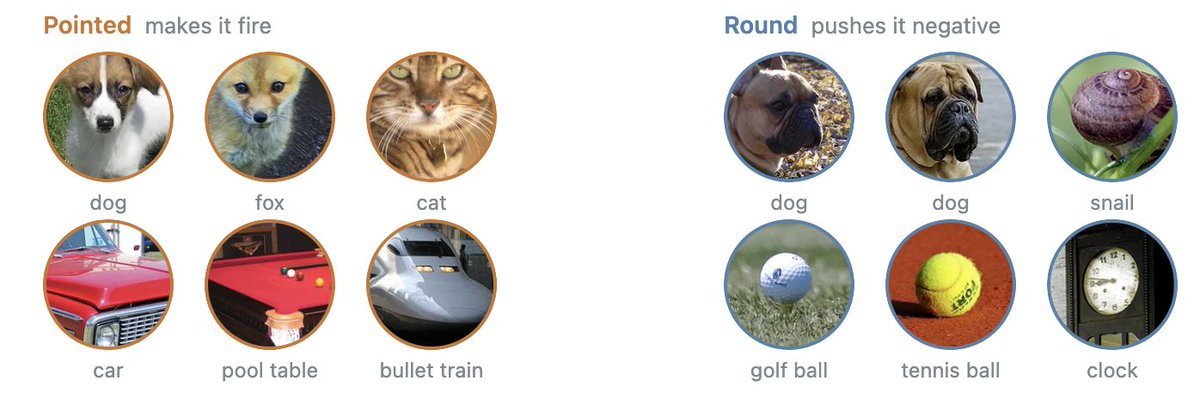
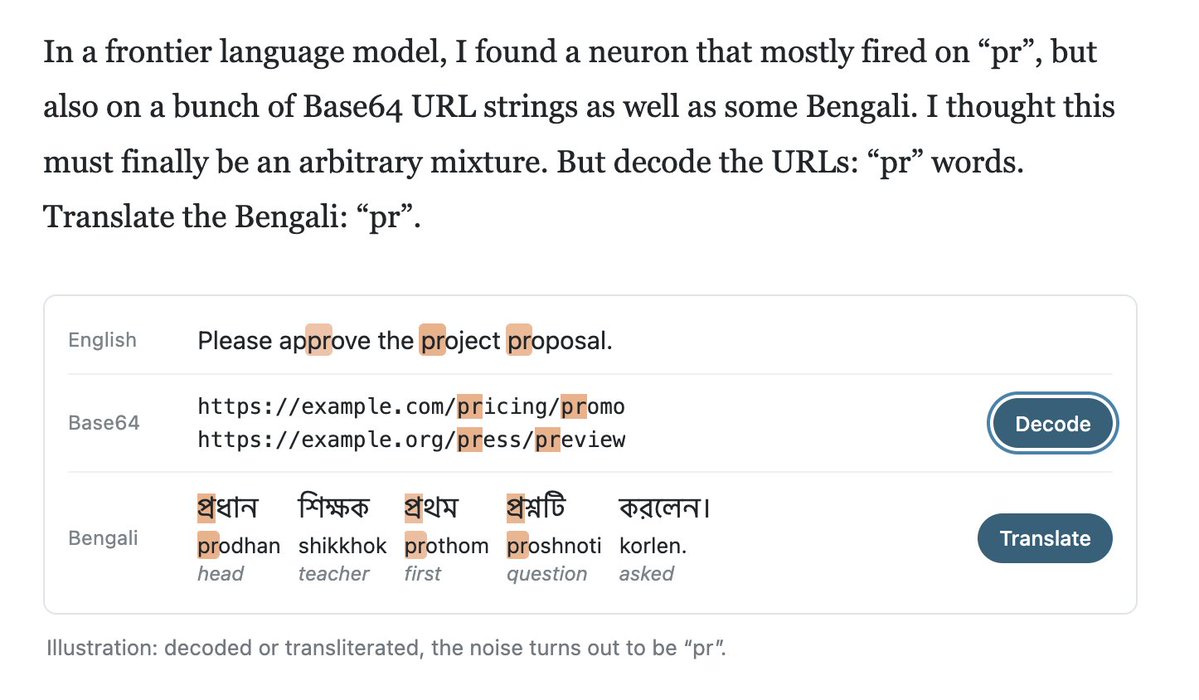
interpretability might be the most important scientific problem in the world right now, as I don't think we can solve alignment if we don't know what we're building. I think I have good news about it. I co-authored early work in mechanistic interpretability at OpenAI and came away pessimistic, because neural networks appeared to fold into arbitrary tangled knots. years later, I started openai's first large-scale automated interpretability project, finding about 2% of neurons legible with the primitive tools we had
with modern agentic tools and a much closer look, the picture looks totally different. the vast majority in models up to trillions of parameters are legible, and their circuits beautiful. many famous examples of tangled neurons turned out to be misunderstood. The roadblocks I expected mostly aren't there. I now think ambitious interpretability will be solved by the time we need it most, and possibly quite soon, as automated scientists keep improving. it may be a bitter lesson for interpretability: the simple thing, at absurd scale, works
https://t.co/zHij5zwKGT
this is so so somatic wow wow wow
the models have space to discretize more concepts than our languages developed words for, it’s like the ultimate agglutinative language