Close, but not quite.
Processing time per block is generally constant at roughly 400ms per block, per account. Accounts are processed in parallel, which is an important distinction.
The biggest discrepancy between Keeta’s actual performance and what Chainspect reports is that our block times depend on when the client completes the voting process. Keeta does not use a mempool. If a client generates a block, receives temporary votes, and then waits several minutes before converting those votes into permanent votes (while still within the 5-minute expiration window), Chainspect may record that as a slower transaction. In reality, the delay was client-side timing rather than network processing time, so it is not an accurate reflection of transaction performance.
It’s also important to understand that a significant portion of the ~400ms processing time is attributable to network latency rather than computation. The client must transmit the block to representatives, receive votes, and complete the voting process. As a result, physical distance between the client and representative nodes can impact observed processing times. A client located farther from the participating nodes will naturally experience higher round-trip network latency than a client located nearby. This is a characteristic of distributed systems and is not indicative of slower node execution.
It’s also worth noting that the current ~400ms processing time is not a hard technical limit. Internal testing indicates we could likely reduce processing time by roughly 30% by rewriting node vote validation from TypeScript to Rust. However, we have intentionally chosen not to pursue that optimization. We believe the marginal performance gain is outweighed by the benefits of maintaining the reference node implementation in a language that is widely understood and accessible to most engineers. Our priority is making the network easier to understand, audit, and contribute to, rather than optimizing for a relatively small reduction in already low processing latency.
There’s a sleeping L1 gem everyone is overlooking right now and in the next 5 minutes, I’ll tell you exactly why;
Currently there is only around $27 Billion Dollars of RWAs on-chain across all blockchains.
The Al Nahyan family - the second wealthiest family on Earth with a net worth of around $335 Billion USD - controls approximately 6% of the world's oil reserves through the Abu Dhabi National Oil Company, representing roughly $8.46 Trillion USD in oil wealth alone.
They also produce approximately 4.5 million barrels per day, generating something in the range of $120–130 billion USD in annual gross revenue.
It is this family that Keeta $KTA has entered a joint venture with through ASK Group @askgroupae, founded by H.H. Sheikh Ahmed Bin Sultan Bin Khalifa Bin Zayed Al Nahyan.
In a bear case where Keeta only manages to tokenize just ONE % of Abu Dhabi's reserve value and it eventually finds representation as tokenized assets on Keeta's Network that would roughly $84.6 BILLION Dollars in on chain RWAs.
That's around 3.3x times more than the total market cap of all RWA's today across all chains, and remember that's just in the case that they tokenize JUST 1%.
And this goes far beyond oil. The joint venture includes gold, silver, copper, and a wider basket of Gulf industrial metals. The UAE is already one of the world’s largest commodity trading hubs, with hundreds of billions flowing annually through the Dubai Gold and Commodities Exchange.
It also includes cross-border payments across some of the largest remittance corridors on earth, with the UAE–India corridor alone moving over $20 Billion USD annually. And @askgroupae - linked to the wider royal Al Nahyan family - holds rights to Keeta’s presence across the UAE, the Middle East, India, and Africa.
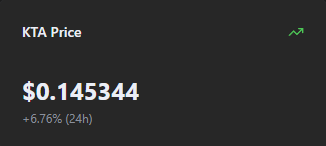
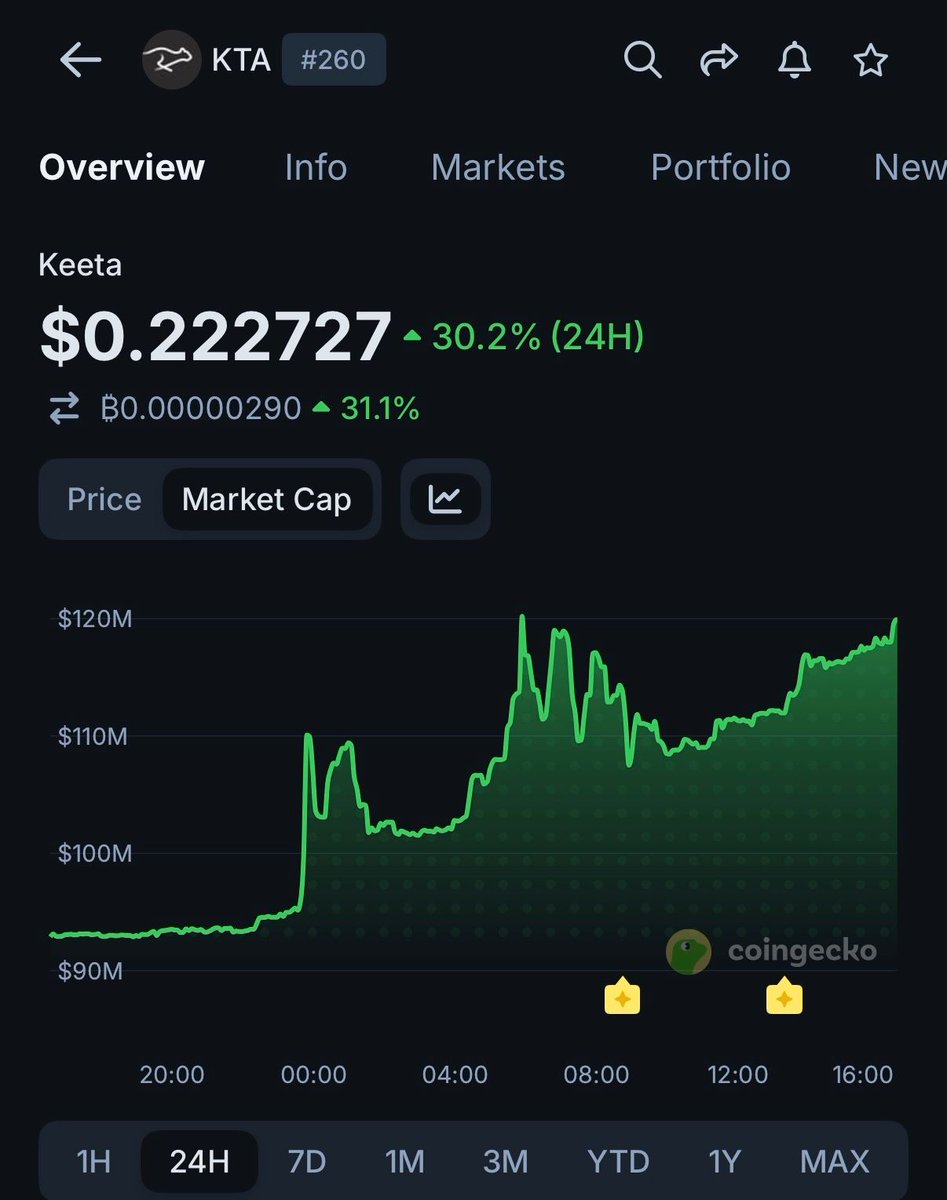
As of writing this, $KTA sits at just a $100 Million marketcap today - lower than the market caps of some memecoins and dino chains.
Yet the upside scenario people are overlooking is exposure to markets measured in the hundreds of billions and even trillions of dollars.
The deal isn't hypothetical - it's signed, and integration is already underway. Keeta is probably one of, if not the ONLY chain that is able to represent and facilitate this through its tech; Keeta settles transactions faster and at a much larger scale than anyone else, with compliance built into the protocol.
Chains like $XRP have been trying to achieve something similar for the past 14 years, reaching a $200 Billion market cap largely on speculation that they could eventually make it work in some form, somewhere, at some point, somehow. Well, they can’t and their chains will be driven by this same speculation that they could eventually make it work in some form, somewhere, somehow for the next 14 years as well.
Keeta is aiming to accomplish what Ripple couldn’t within a year of its public existence. Now imagine what they will achieve in the next one, two, or five years.
This could end up being one of the biggest opportunities in the market.
Let’s revisit Keeta’s adoption strategy and record progress.
Phase One (Anchors):
· Keeta originally integrated key payment rails, including SEPA for Europe and ACH/Wire for the United States
· On-chain identity was enabled to uphold KYC and banking compliance requirements
Phase Two (Expansion):
· Expanded international transfers to 160+ countries
· Unlocked multi-currency accounts across nine currencies (USD, CAD, AED, GBP, EUR, HKD, JPY, MXN, CNY)
· Significantly broadened domestic payment system support
· Launched Keeta Personal as an application for individuals and businesses to utilize the infrastructure
Phase Three (Strategic Partnerships & Adoption):
· Keeta announced a joint venture with @askgroupae to tokenize tens of billions of dollars in Gulf commodities and modernize cross-border payments in the GCC region and beyond
This is only the beginning.
We are still expanding our payment capabilities.
We continue progressing on additional Phase Three initiatives.
We remain determined to prove Keeta is the missing piece to revolutionize finance.
Stay tuned.
One of my pet peeves in the blockchain industry are specialist chains — and the logical fallacy surrounding them.
We need $HYPE and $ASTER for trading, because there are simply too many orders for a generic chain to handle the volume
We need @arc and @tempo, because predictable fees and fast finality are simply impossible elsewhere — definitely not just to make our shareholders happy
We need $PLUME for RWAs, because… why do we need it again?
What you need is one good chain that can do its job at scale: Move value.
I remember being at a VIP side event where supposed “experts” were asked rapidfire questions:
“One chain to rule them all? Yes/No”
The stage was filled with the quickest drawn “No” signs that session has seen. Only the lady representing Visa hadn’t answered and instead declined the question.
I found myself standing up and my emotions must have been showing because this guy next to me was giving me a weird look.. idiots
I just found this statement so incredibly stupid. These supposed experts, and really not just them but everyone, is ignoring the most fundamental law of the internet:
The network effect.
It’s what made the giants like Facebook, Apple, Amazon, and… Google into the who they are today and this is precisely what will make @KeetaNetwork the largest financial innovation of the web3 era.
$KTA
(1/9) Keeta and ASK Group @askgroupae, a UAE-based investment group led by His Highness Sheikh Ahmed bin Sultan bin Khalifa bin Zayed Al Nahyan @asknahyan, have created a joint venture aiming to tokenize tens of billions of dollars of commodities and modernize cross-border payments in the Gulf Cooperation Council (GCC) region and beyond, contributing to the UAE's vision and commitment to growth as a global leader in digital finance and real-world asset infrastructure.
Innovation thrives when visionary leadership and transformative technology come together. We are pleased to embark on this journey with Keeta, led by CEO Ty Schenk and supported by the confidence of former Google CEO Eric Schmidt. Together, we aim to contribute to UAE’s vision for digital finance, cross border connectivity, and the tokenization of real world assets.